India's 300 MT Steel Production Capacity Vision is Driving Large-Scale Greenfield Investments
June 02, 2026
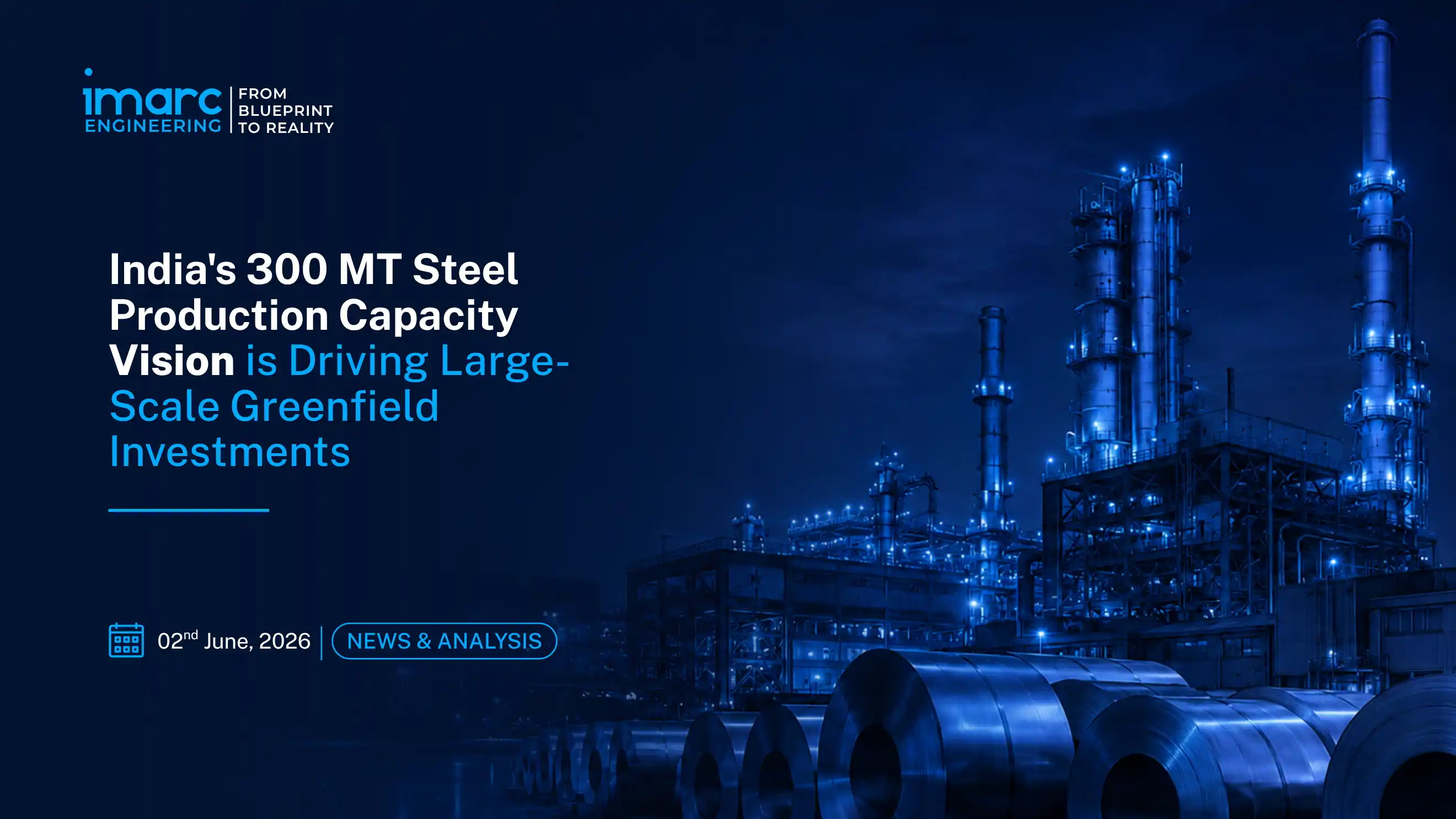
In May 2026, JSW Steel commenced construction of a 13.2 MTPA greenfield integrated steel plant at Paradeep in Odisha, with an estimated investment of INR 65,000 crore (USD 6.8 billion) spread across 2,950 acres. The ceremony was attended by Odisha Chief Minister Mohan Charan Majhi and JSW Group Chairman Sajjan Jindal. JSW's Paradeep plant is the largest industrial investment in Odisha's manufacturing history, and it is one of the most consequential greenfield steel plant announcements in a decade.
It is also a marker of precisely where India's steel industry stands in 2026: entering the final and most capital-intensive phase of its journey toward 300 MT of annual production capacity, a target set by the National Steel Policy of 2017 with a 2030 deadline, now supported by the largest simultaneous wave of greenfield and brownfield steel investment India has ever seen.
The 300 MT Milestone: Where India Stands and What Remains
India's steel industry is entering a major investment cycle. Steel production capacity India 300 MT is the central target of the National Steel Policy India, which aims to increase capacity from approximately 220 MTPA in FY2026 to 300 MTPA by 2030. India produced 168.4 million tonnes of crude steel in FY2026, reinforcing its position as the world's second-largest steel producer.
This growth is being driven by strong demand from infrastructure, construction, railways, automotive, defence, and manufacturing sectors. With per-capita steel consumption still well below the global average, long-term demand remains strong. As a result, steel manufacturing investment India and steel capacity expansion in India in 2026 projects are accelerating across the country.
To bridge the gap to 300 MTPA, India must add roughly 80 MTPA of new capacity through a combination of greenfield steel plant projects in India and brownfield expansion India investments. This creates significant opportunities for developers, investors, and providers of EPCM services steel plant India, feasibility studies, DPR preparation, project management, and integrated steel plant development services.
JSW Steel's Paradeep Greenfield: The Flagship of the Current Investment Wave
The JSW Steel project at Paradip is one of the most significant greenfield steel plant in India investments currently underway. The coastal location was selected to improve access to Odisha's iron ore reserves, facilitate coking coal imports through Paradip Port, and enhance logistics efficiency and export competitiveness.
The project will be developed as an integrated steel plant in India with a planned capacity of 13.2 MTPA and an investment of INR 65,000 crore. It forms a key part of India's broader steel capacity expansion India 2026 strategy and the push toward steel production capacity India 300 MT under the National Steel Policy India.
JSW aims to increase its total steelmaking capacity from 31.9 MTPA to 48.8 MTPA by 2030, with the Paradip project contributing a major share of this growth. The scale of the investment highlights the growing momentum behind large-scale steel manufacturing investment India projects.
Tata Steel, SAIL, and the Broader Expansion Wave
Tata Steel completed the 5 MTPA Phase II expansion of its Kalinganagar facility in 2025, increasing plant capacity to 8 MTPA and taking its total India capacity to 26.1 MTPA. The company has also approved further expansion projects at NINL, Meramandali, and Maharashtra, reinforcing its long-term commitment to India's steel sector. These investments are a key part of the country's ongoing steel capacity expansion India 2026 cycle.
Public-sector producers are also investing heavily. SAIL is undertaking a major modernisation programme, including an INR 20,000 crore expansion at Bokaro Steel Plant and capacity upgrades at Rourkela. The company aims to increase crude steel capacity from 20 MTPA to 35 MTPA by 2031. Meanwhile, NMDC Steel's 3 MTPA greenfield steel plant in India project at Nagarnar has begun ramping up production.
At the same time, Jindal Steel & Power is expanding its Angul operations in Odisha, using syngas-based DRI technology to reduce emissions. Together, these projects highlight the scale of steel manufacturing investment in India and the industry's push toward higher capacity, improved efficiency, and more sustainable steel production.
The PLI Specialty Steel Scheme: Driving the Value-Added Investment Layer
Alongside mainstream capacity additions, the specialty steel PLI scheme in India is driving investment in high-value steel grades used in defence, renewable energy, power transmission, automotive, and aerospace sectors. Through multiple phases of the scheme, companies have committed nearly INR 44,000 crore in investments, supporting new specialty steel capacity and job creation.
The programme is expected to add approximately 8.7 MTPA of specialty steel capacity by FY2031, reducing India's dependence on imports of advanced steel products. Strong investor confidence is also evident, with several steel and allied companies planning IPOs to fund ongoing steel manufacturing investment in India and capacity expansion projects.
Green Steel: The Compliance and Competitiveness Imperative
India's steel capacity expansion in India in 2026 programme is focused not only on increasing output but also on reducing carbon emissions. The introduction of Europe's Carbon Border Adjustment Mechanism (CBAM) is increasing pressure on Indian steel producers to adopt cleaner production technologies. In response, the Ministry of Steel's Green Steel Initiative had certified 90 producers across 15 states by March 2026, covering products such as TMT bars, coils, wire rods, and pipes.
Major steelmakers are already investing in low-carbon technologies. JSW Steel is expanding renewable-energy use and piloting carbon-capture solutions, while Tata Steel and Jindal Stainless are testing hydrogen-based steelmaking technologies. Although green steel India investment remains at an early stage, decarbonisation is becoming a key consideration for every new greenfield steel plant project. Future competitiveness, particularly in export markets, will increasingly depend on integrating low-carbon pathways into plant design from the outset.
The Project Infrastructure India Needs to Deliver 300 MT
Achieving steel production capacity India 300 MT by 2030 will require more than investment announcements, it will require successful execution of major capacity expansion projects. With an estimated investment requirement of up to USD156 billion, India needs sustained annual spending on new steelmaking, rolling, and downstream facilities to support its long-term growth objectives under the National Steel Policy India.
The challenge extends beyond financing. New greenfield steel plants and brownfield expansion projects across India must address land acquisition, raw-material security, logistics, utilities, environmental approvals, equipment procurement, and workforce development.
As a result, robust steel plant DPR preparation and feasibility study for steel plant India investment processes have become critical for project bankability, cost control, and timely execution. Accurate technology selection, supply-chain planning, and project management are now essential to successful steel manufacturing investment projects in India.
India has 220 MT today. It needs 300 MT by 2030. JSW's Paradeep plant is the opening move of the final phase, and every tonne between here and the target requires a bankable project, a capable engineering partner, and a commissioning deadline that doesn't slip.
Talk to IMARC Engineering about Greenfield Project Management Services for steel plants, manufacturing facilities, and large-scale industrial infrastructure projects.
About IMARC Engineering
IMARC Engineering is an end-to-end provider of steel plant EPCM consulting service for greenfield steel plant and brownfield expansion projects across India. Our expertise includes steel plant feasibility studies, DPR preparation, integrated steel plant master planning, raw material logistics assessment, pellet plant and beneficiation plant engineering, process engineering, project management, procurement support, construction supervision, and commissioning. We support integrated steel plants, EAF mills, DRI units, specialty steel facilities, and downstream steel-processing projects, helping clients move from investment planning to operational production with greater speed, efficiency, and execution certainty.
Latest News
-
Tamil Nadu Allocates INR 98 Lakh for DPR Preparation of Five Infrastructure Projects in Chennai
October 16, 2026
-
SunBridge BioEnergy Starts Commercial Production at INR 350 Crore, 300 KLD Ethanol Plant in Madhya Pradesh
October 15, 2026
-
PM Modi Launches INR 753.68 Crore VOC Port Infrastructure Projects in Tamil Nadu
October 14, 2026
-
India's Manufacturing Sector Shows Recovery in Q2 FY27 as 95% of Firms Report Stable or Higher Output
October 12, 2026
-
Puri Greenfield Airport Gets Environmental Clearance, Advancing INR 5,631 Crore Project in Odisha
October 09, 2026
Trusted by Industry Leaders
We partner with global enterprises and ambitious businesses across sectors to deliver operational excellence, strategic insights, and sustainable growth through integrated solutions.









Success in Their Words
Real feedback from clients across industries. Discover how our solutions delivered measurable impact and operational excellence.

I wanted to express my sincere appreciation for your efforts in handling this matter. Your dedication and commitment have been truly commendable, and it is evident that you have put in tremendous hard work and expertise into resolving the issues at hand. We are greatly interested in continuing our collaboration with you in the future, as your professionalism and reliability have made you a trusted partner. Thank you once again for your invaluable contribution. We look forward to strengthening our partnership ahead.

It has been a pleasure working with the IMARC team. The insights provided were structured, clear, and highly valuable, helping us strengthen both our technical and financial planning with confidence. We deeply appreciate the team’s professionalism, responsiveness, and attention to detail throughout the engagement. Every requirement was well understood and effectively incorporated, resulting in a comprehensive and actionable output. Overall, our experience has been excellent, and I would gladly recommend IMARC to organizations seeking a reliable research partner.

Your service is truly exceptional. Working with the IMARC team has been a seamless and professional experience. The clarity of communication, responsiveness to queries, and consistent support at every stage made the entire engagement highly efficient. The insights shared were well-structured, practical, and perfectly aligned with our requirements, helping us make informed decisions with confidence. Overall, the dedication and professionalism demonstrated by your team stand out, and I would be glad to recommend IMARC as a reliable and trustworthy research partner.

IMARC did an outstanding job in preparing our study. They were punctual, precise, and consistently responsive throughout the entire process. The team delivered all the data we required in a clear, well-organized, and highly professional format. Their strong attention to detail, combined with their ability to meet every deadline without compromising quality, truly set them apart. Overall, their reliability and commitment made them an exceptional partner for our project, and we would gladly work with them again in the future.

IMARC made the whole process incredibly easy from start to finish. Everyone I interacted with via email was polite, professional, and straightforward to deal with, always keeping their promises regarding delivery timelines and remaining consistently solutions-focused. From my very first contact, I appreciated the professionalism and support shown by the entire IMARC team. I highly recommend IMARC to anyone seeking timely, affordable, and reliable information or advice. My experience with IMARC was excellent, and I truly cannot fault any aspect of it.

I’d like to express my sincere gratitude for the excellent work you accomplished with the study. Your ability to quickly understand our requirements and deliver high-quality results under tight timelines truly reflects your expertise, exceptional work ethic, and unwavering commitment to your customer’s success. The professionalism and responsiveness you demonstrated throughout the process made a significant difference. Our entire team and company are incredibly thankful for your dedication, reliability, and support. Once again, thank you for your outstanding contribution.
Ready to Experience the IMARC Advantage?
Whether you're planning a new facility, expanding operations, optimizing performance, or facing complex challenges—IMARC Engineering brings the expertise, experience, and commitment needed for success.