Climate Risk Integration Gains Importance for Battery Storage Project Development in India
July 15, 2026
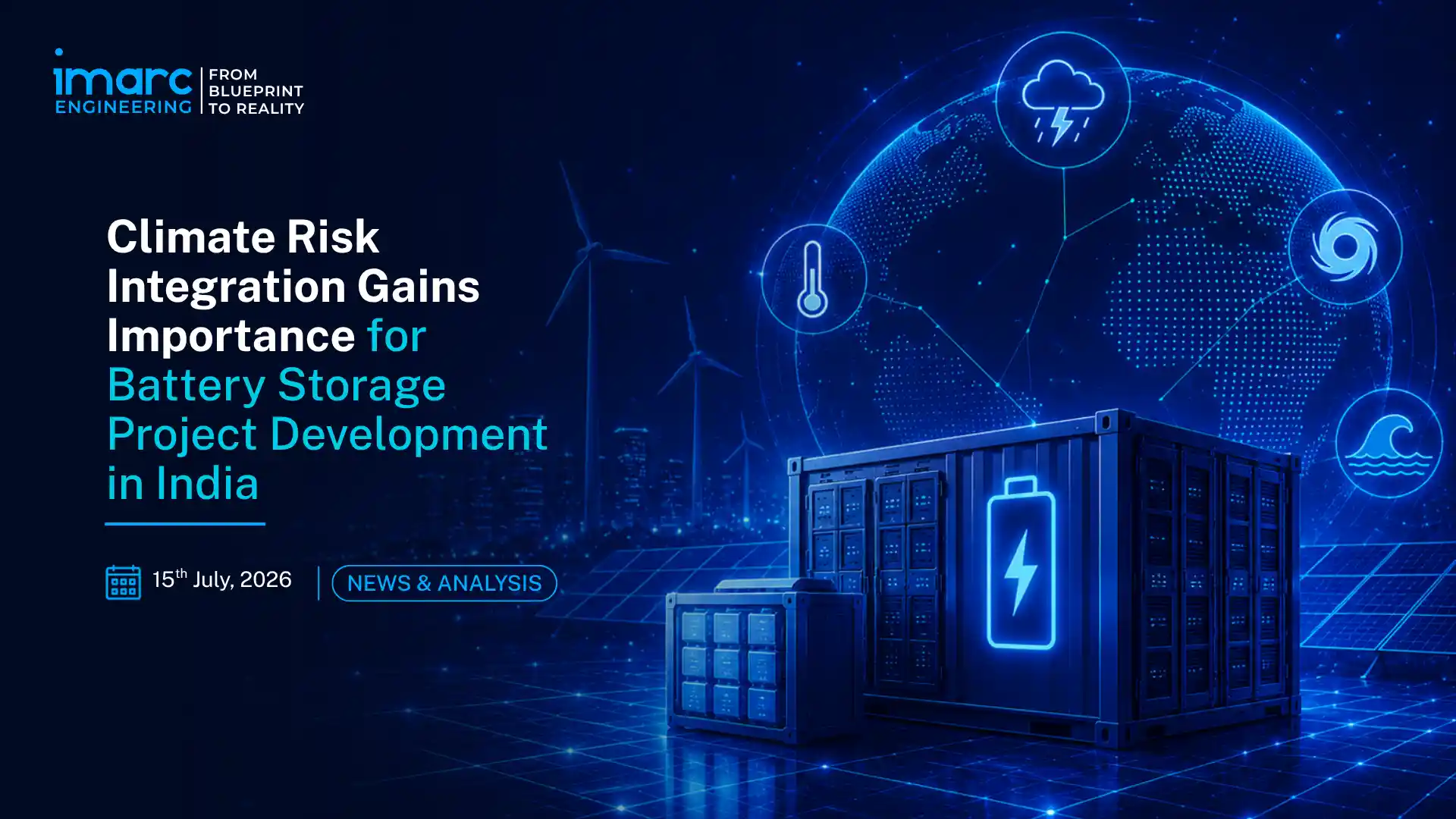
India's rapid expansion of battery energy storage systems (BESS) is increasing the focus on climate risk integration during project planning. As developers scale battery storage projects in India, extreme weather events, rising temperatures, flooding risks, and changing environmental conditions are becoming critical factors influencing site selection, system reliability, and long-term asset performance.
In July 2026, at India Energy Storage Week 2026, the India Energy Storage Alliance and Customised Energy Solutions released a landmark market report projecting that India will need 888 gigawatt-hours of energy storage capacity by 2035-36, up from barely 1 GWh today. Annual battery energy storage system additions are projected to accelerate from 50.2 GWh in 2026 to 138 GWh by 2036.
India's installed BESS capacity expanded more than elevenfold in just six months, rising from 0.78 GWh in December 2025 to 8.7 GWh by June 2026. This is not incremental growth. It is a deployment acceleration that places battery storage projects in India on a trajectory comparable to what India's solar programme looked like in its early scaling phase.
And just as early solar investors learned that site-specific environmental conditions, dust, humidity, cyclone exposure, dramatically affected real-world performance against project models, the BESS industry in India is now beginning to understand that climate risk integration is not a compliance checkbox. It is a determinant of project viability.
Why Climate Risk Assessment is Becoming Essential for Battery Storage Projects in India
As per IMARC, India's BESS market is expected to grow at a CAGR of 25% during 2026-2034. The government has deployed INR 91,000 crore (USD 10.9 billion) in Viability Gap Funding to support 43.2 GWh of early BESS capacity, bringing bid tariffs to commercially attractive levels.
The Central Electricity Authority's target is 411.4 GWh of total energy storage by 2031-32, with 236.2 GWh from BESS and 175.2 GWh from pumped hydro. As of March 2026, 9,653 MW / 26,729 MWh of BESS was under construction, and 19,797 MW / 61,013 MWh was at the tendering stage.
This is infrastructure being built to last 20 to 25 years. Over that lifespan, a BESS project will operate through monsoon floods, summer heat extremes, cyclone seasons, and the broader trajectory of climate change that India's own climate projections document. A project sited, designed, or operated without factoring in climate risk is not just exposed to performance degradation.
It is exposed to stranded asset risk, where physical damage, regulatory intervention after a safety incident, or systematic underperformance against contracted capacity means the project cannot service its debt or meet its generation obligations.
The Climate Risks Specific to Indian BESS Deployments
India's geography creates a diverse and demanding set of climate exposures for battery storage project development. Understanding these is the starting point for effective climate risk assessment.
Heat stress is the most pervasive risk. India's coastal and interior plains regularly record ambient temperatures of 40-50 degrees Celsius in summer. Battery cells operating in high ambient temperatures experience accelerated degradation, a process called calendar ageing, that reduces available capacity and shortens operational life.
For Lithium Iron Phosphate chemistry, which is the preferred choice for Indian BESS deployments because of its superior thermal stability and lower fire risk compared to NMC chemistries, ambient temperature management still matters significantly. LFP delivers its rated 5,000-8,000 cycle life under controlled temperature conditions. Sustained operation in unmanaged high-ambient environments shortens that life materially.
Flooding and inundation represent a second critical risk. India recorded more than 240 distinct flood events nationally in 2025. Utility-scale BESS containers are ground-mounted or installed at grade level in most current deployments. Sites that appear dry during the pre-monsoon survey can experience significant inundation during extreme rainfall events, particularly in coastal districts, river floodplains, and areas with historically inadequate drainage infrastructure. A flooded battery enclosure is not just an operational outage. It is a safety emergency and a potential total loss event.
Cyclone exposure affects the eastern and western coastlines. Odisha, Andhra Pradesh, Tamil Nadu, Gujarat, and Maharashtra, all states with significant BESS pipeline, face cyclonic conditions periodically. Wind loads on BESS container structures, inverter buildings, and switchgear enclosures must be specified against the design wind speeds applicable to the site's cyclone risk zone.
Structures designed to standard industrial specifications may not meet the wind load requirements that a cyclone-exposed coastal site demand. And thermal runaway risk, the propagation of heat from one battery cell to adjacent cells, potentially triggering fire, is exacerbated in high-temperature environments if enclosure cooling systems are undersized or fail during a heat event.
How Climate Risk Integration Improves Project Outcomes
Effective climate risk integration does not make BESS projects more expensive. It makes them more bankable and more durable. The project planning sequence begins with climate risk assessment at the site selection stage, before land acquisition, before grid connectivity negotiations, before technology selection.
A site in a coastal district that faces both cyclone exposure and flood risk carries materially different design requirements than a semi-arid interior site that faces primarily heat stress. Treating these sites identically in technology specification or financial modelling produces projects that underperform against plan.
Chemistry selection is directly influenced by climate conditions. LFP is the pragmatic default for Indian utility-scale BESS because it delivers strong lifecycle resilience in tropical conditions. With expected cycle life of 5,000 to 8,000 cycles and calendar life of roughly 12 to 15 years, LFP combines thermal stability, safety, and predictable degradation profiles.
Installed costs in 2025 sat in the range of INR 22,000 to INR 28,000 per kWh. Round-trip efficiency typically falls between 88 and 92 percent. In hot, humid environments, LFP degrades significantly less than cobalt-rich chemistries, reducing repowering risk and O&M cost volatility over the project life.
Enclosure design must account for the specific climate envelope of the deployment site. This means specifying thermal management systems, active cooling, passive ventilation, or liquid cooling depending on ambient conditions, for the design temperature extremes, not the average. It means designing drainage and waterproofing for the 1-in-50-year flood event, not the expected annual rainfall. And it means structural specifications that reflect the applicable cyclone wind zone for the site's geographic location.
These are engineering decisions that must be locked in at the DPR stage, because they determine civil and structural costs, equipment specifications, and grid connection design, none of which are easily or cheaply changed after construction begins.
For lenders and equity investors in BESS projects, climate risk assessment is increasingly a due diligence requirement rather than a nice-to-have. International lenders, ESG-focused infrastructure funds, and multilateral financing institutions require TCFD-aligned climate risk analysis as a condition of project financing.
As India's renewable energy infrastructure continues to attract institutional capital, the projects that can demonstrate structured climate risk management will access capital at lower cost and on better terms than those that cannot.
India needs 888 GWh of storage by 2035. Every gigawatt-hour of BESS deployed in a flood plain without flood engineering, or in a heat corridor without thermal management, is a liability waiting to crystallise. Climate risk integration is not extra cost, it is the cost of building storage that actually works.
IMARC Engineering's Perspective
At IMARC Engineering, climate risk integration is a standard component of how we approach battery storage project development, not an optional add-on. When we conduct site selection for utility-scale BESS, we assess flood zone mapping, ambient temperature profiles, cyclone risk corridors, and drainage infrastructure alongside the grid connectivity and land cost factors that developers typically prioritise first.
When we specify enclosure designs and thermal management systems, we specify for the temperature extremes the site will experience over a 25-year project life, not for the average conditions that equipment datasheets assume. When we prepare DPRs and feasibility studies for BESS projects seeking Viability Gap Funding or project finance, we include climate risk scenario analysis as a financial modelling input, because lenders with ESG mandates are increasingly requiring it.
India's energy storage infrastructure is being built for 20-30-year operational lives. The climate India's BESS projects will operate in over that horizon is not the climate of 2026. Getting climate risk assessment right at the project planning stage is the most cost-effective investment a developer can make in long-term asset resilience.
Latest News
-
PM Modi Launches INR 753.68 Crore VOC Port Infrastructure Projects in Tamil Nadu
October 14, 2026
-
India's Manufacturing Sector Shows Recovery in Q2 FY27 as 95% of Firms Report Stable or Higher Output
October 12, 2026
-
Puri Greenfield Airport Gets Environmental Clearance, Advancing INR 5,631 Crore Project in Odisha
October 09, 2026
-
IEX Subsidiary Applies for Coal Exchange Registration Under India’s New Coal Exchange Rules 2026
September 30, 2026
-
India Pushes Domestic Shipping Container Manufacturing with INR 10,000 Crore Assistance Scheme
September 25, 2026
Trusted by Industry Leaders
We partner with global enterprises and ambitious businesses across sectors to deliver operational excellence, strategic insights, and sustainable growth through integrated solutions.












Success in Their Words
Real feedback from clients across industries. Discover how our solutions delivered measurable impact and operational excellence.

I wanted to express my sincere appreciation for your efforts in handling this matter. Your dedication and commitment have been truly commendable, and it is evident that you have put in tremendous hard work and expertise into resolving the issues at hand. We are greatly interested in continuing our collaboration with you in the future, as your professionalism and reliability have made you a trusted partner. Thank you once again for your invaluable contribution. We look forward to strengthening our partnership ahead.

It has been a pleasure working with the IMARC team. The insights provided were structured, clear, and highly valuable, helping us strengthen both our technical and financial planning with confidence. We deeply appreciate the team’s professionalism, responsiveness, and attention to detail throughout the engagement. Every requirement was well understood and effectively incorporated, resulting in a comprehensive and actionable output. Overall, our experience has been excellent, and I would gladly recommend IMARC to organizations seeking a reliable research partner.

Your service is truly exceptional. Working with the IMARC team has been a seamless and professional experience. The clarity of communication, responsiveness to queries, and consistent support at every stage made the entire engagement highly efficient. The insights shared were well-structured, practical, and perfectly aligned with our requirements, helping us make informed decisions with confidence. Overall, the dedication and professionalism demonstrated by your team stand out, and I would be glad to recommend IMARC as a reliable and trustworthy research partner.

IMARC did an outstanding job in preparing our study. They were punctual, precise, and consistently responsive throughout the entire process. The team delivered all the data we required in a clear, well-organized, and highly professional format. Their strong attention to detail, combined with their ability to meet every deadline without compromising quality, truly set them apart. Overall, their reliability and commitment made them an exceptional partner for our project, and we would gladly work with them again in the future.

IMARC made the whole process incredibly easy from start to finish. Everyone I interacted with via email was polite, professional, and straightforward to deal with, always keeping their promises regarding delivery timelines and remaining consistently solutions-focused. From my very first contact, I appreciated the professionalism and support shown by the entire IMARC team. I highly recommend IMARC to anyone seeking timely, affordable, and reliable information or advice. My experience with IMARC was excellent, and I truly cannot fault any aspect of it.

I’d like to express my sincere gratitude for the excellent work you accomplished with the study. Your ability to quickly understand our requirements and deliver high-quality results under tight timelines truly reflects your expertise, exceptional work ethic, and unwavering commitment to your customer’s success. The professionalism and responsiveness you demonstrated throughout the process made a significant difference. Our entire team and company are incredibly thankful for your dedication, reliability, and support. Once again, thank you for your outstanding contribution.
Ready to Experience the IMARC Advantage?
Whether you're planning a new facility, expanding operations, optimizing performance, or facing complex challenges—IMARC Engineering brings the expertise, experience, and commitment needed for success.