Why Gujarat's New Renewable Energy and Battery Storage Push Matters for Industrial Projects in India
May 15, 2026
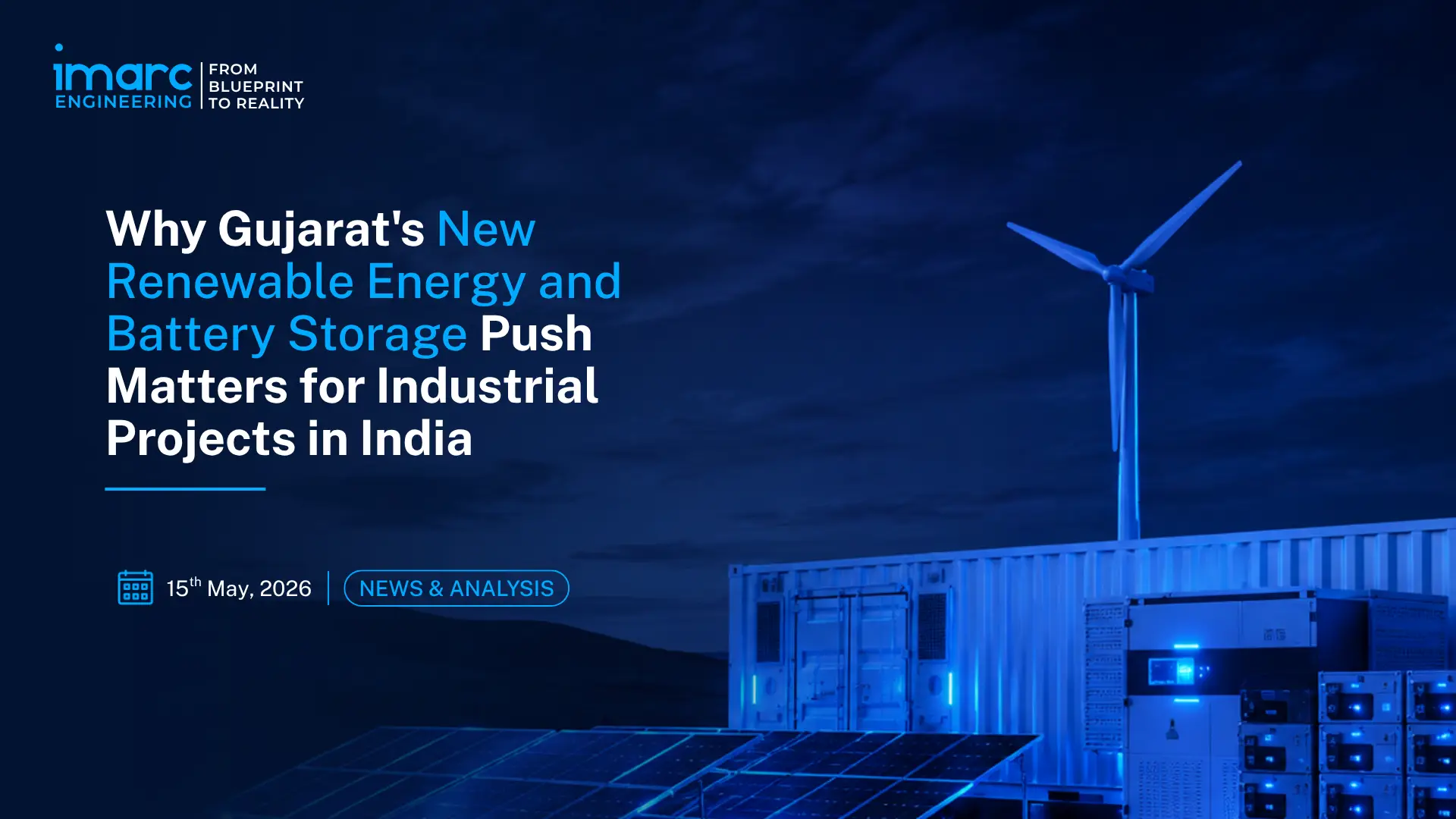
In May 2026, the Gujarat state government approved the Standard Operating Procedure for the Gujarat Integrated Renewable Energy Policy-2025 (GIREP-2025), creating a fully operationalised, time-bound framework for setting up renewable energy projects across every technology category. Government announced that Battery Energy Storage Systems are now operational at five locations across the state, with 870 MW of combined capacity initiated and 13 new BESS projects registered across Ahmedabad, Gandhinagar, Banaskantha, Patan, and Kutch.
For manufacturers, industrial investors, and project developers evaluating Gujarat as a base, these are not routine policy updates, they are structural enablers that directly change the risk and return profile of industrial power infrastructure.
GIREP-2025: What the Policy Actually Enables for Industrial Users
The Gujarat Integrated Renewable Energy Policy-2025, notified in December 2025 and now operationalised through a formal SOP approved in May, supersedes the earlier 2023 policy and will govern all renewable energy projects commissioned through December 31, 2030. Projects commissioned during this window receive incentives and benefits for 25 years from commissioning, a bankable horizon that fundamentally changes the investment case for long-term industrial energy planning.
For industrial users, the most commercially significant provisions are those governing captive and open access consumption. GIREP-2025 removes all capacity restrictions on renewable energy projects established for captive use or third-party sale, meaning a manufacturing unit can size its captive solar or wind installation entirely on the basis of its own load requirements, without regulatory ceiling constraints.
Wheeling of power for captive or third-party sale is explicitly permitted on payment of applicable GERC-notified charges, with energy banking and settlement governed by GERC regulations. Developers and captive users retain carbon credit ownership from their projects, creating a tradable sustainability asset alongside the energy cost benefit.
The policy covers ground-mounted and rooftop solar, wind and wind-solar hybrid projects, floating solar, canal-based solar, agri-photovoltaics, rooftop wind, standalone Battery Energy Storage Systems, BESS co-located with new or existing renewable plants, pumped hydro storage, green hydrogen supply projects, and emerging technologies including tidal, ocean, and geothermal.
For industrial parks and large manufacturing campuses, the Renewable Energy Park provision, minimum 50 MW capacity, available to both public and private developers, allows dedicated clean energy infrastructure to be co-located with or proximate to production facilities. The state also introduced the Akshay-Urja-Setu portal for on-demand renewable energy connectivity, allowing industrial investors to check grid connectivity availability and initiate project registration digitally rather than through sequential manual approvals.
870 MW of Battery Storage Now Live: What It Means for Industrial Power Reliability
Gujarat's Battery Energy Storage System deployment is the most practically consequential development for industrial power consumers. As of May 2026, 870 MW of BESS capacity is initiated across five operational sites, Modhera and Lakhpat (the earliest deployments, including India's first solar-integrated BESS at Modhera Solar Village), and a recently commissioned facility at Charal in Sanand taluka of Ahmedabad district. Thirteen additional projects are registered across multiple districts. The state targets 75 GWh of storage capacity by 2035 as part of its broader ambition of over 100 GW of renewable energy by 2030.
For industrial consumers, the operational significance of grid-connected BESS is direct and immediate. Solar generation peaks during the day and declines sharply in the evening, precisely when industrial shift operations often reach peak load. BESS absorbs surplus daytime solar generation and dispatches it during evening peak hours, reducing grid stress, eliminating the need for expensive diesel backup generation, and providing industrial consumers with a more stable, predictable power supply.
Gujarat's strategy of locating BESS near renewable energy generation sites, reducing transmission losses, means that industrial units in the Ahmedabad-Sanand-Gandhinagar corridor now have access to stored renewable power with improved reliability characteristics.
Critically, once the GIREP-2025 SOP receives full regulatory clearance, which the state government signalled is imminent, registrations for BESS systems will open to commercial and industrial consumers directly. This means a manufacturing unit in Gujarat will be able to integrate its own captive solar plant with a co-located or grid-connected battery storage system under a single policy framework, with competitive bidding for BESS components managed through a state-facilitated process. For energy-intensive industries, chemicals, pharmaceuticals, glass, ceramics, textiles, data centres, this is a fundamentally better energy cost and reliability proposition than was available two years ago.
The New Regulatory Obligations: RPPO, ESO, and What Industrial Plants Must Plan For
GIREP-2025 does not only create opportunity for industrial consumers, it also creates obligations. The Gujarat Electricity Regulatory Commission notified its updated Renewable Power Purchase Obligation regulations on August 12, 2025, extending RPPO compliance requirements to all obligated entities, including open access consumers and captive power plant operators with installed capacity exceeding 100 kW. Any manufacturing plant in Gujarat consuming electricity through open access or operating a conventional captive generating plant above this threshold is now subject to annual renewable energy purchase targets.
The GERC regulations also introduce a new Energy Storage Obligation: obligated entities must fulfil a defined percentage of annual electricity consumption through energy storage, with at least 85% of stored energy sourced from renewable generation. This is not a future requirement; it is in effect.
For industrial plants conducting feasibility studies or detailed project reports for new facilities in Gujarat, the RPPO and ESO obligations must be modelled as operational costs from Year 1 of commissioning. Failure to plan for renewable procurement volumes and energy storage integration at the DPR stage creates both compliance risk and unexpected cost exposure in the operating phase.
The practical implication is that a techno-economic feasibility study for a new manufacturing plant in Gujarat must now treat the renewable energy and storage infrastructure layer as a core project component, not an optional sustainability add-on.
For large facilities, the most economically efficient compliance route is captive renewable generation combined with co-located or wheeled BESS, which the GIREP-2025 framework now explicitly supports. The capital cost of this infrastructure must be benchmarked against the avoided cost of grid power, potential carbon credit revenue, and the long-term RPPO compliance cost of alternative procurement.
Why Gujarat's Energy Ecosystem is Now a Manufacturing Location Advantage
The convergence of GIREP-2025's captive and open access framework, the operationalised BESS grid infrastructure, the incoming industrial BESS registration window, and the mandatory RPPO and ESO regime creates a complete energy ecosystem that is actively advantageous for industrial investment, not just compliant.
Gujarat already hosts India's largest renewable energy manufacturing cluster: Reliance's Jamnagar clean energy complex, the Tata-PSMC semiconductor fab at Dholera, Tata Agratas' battery gigafactory at Sanand, the CG Power OSAT facility, and Adani's Mundra and Khavda renewable energy hubs. Each of these facilities is being designed or expanded with a captive renewable energy and storage layer built in from the outset, both because GIREP-2025 makes it economically rational and because the RPPO and ESO regulations make it legally necessary.
For industrial investors conducting location selection for new manufacturing plants, pharmaceuticals, specialty chemicals, EV components, electronics, food processing, data centres, Gujarat's energy policy environment now offers three distinct advantages over most other Indian states: a clearly defined, time-bound industrial captive project approval process through a single-window digital portal; access to a grid with 870 MW (and growing) of integrated battery storage that directly improves the reliability of renewable power supply; and a policy framework that allows unlimited captive capacity, carbon credit ownership, and 25-year benefit certainty.
Energy is typically the second-largest operating cost for process manufacturing plants after raw materials. A feasibility study that does not model the Gujarat renewable energy advantage against comparative states is leaving a material cost and compliance variable unanalysed.
The window to benefit from GIREP-2025's full incentive package is time-limited to projects commissioned through December 31, 2030. For manufacturing plants with 24-to-48-month development timelines, the effective registration deadline for captive projects under the current policy window is 2027-28 at the latest.
Project developers, EPC contractors, and industrial plant setup consultants advising clients on Gujarat manufacturing investments should treat GIREP-2025 captive and BESS project registration as a first-phase deliverable alongside site selection, not a utility matter to be resolved post-construction. The policy is live, the infrastructure is operational, and the regulatory obligations are already in effect. The industrial energy case for Gujarat has never been stronger, and it is compounding with every BESS site commissioned.
Gujarat's energy infrastructure is no longer a supporting condition for industrial investment, it is an active competitive advantage. The manufacturers who integrate it from Day 1 will define the cost structure of India's next industrial decade.
Planning a manufacturing or industrial project in Gujarat? Get in touch with our experts.
Latest News
-
India Pushes Domestic Shipping Container Manufacturing with INR 10,000 Crore Assistance Scheme
September 25, 2026
-
India’s Growing GCC Sector Brings Greenfield Setup and Regulatory Compliance into Focus
September 24, 2026
-
Uttar Pradesh Approves INR 200+ Crore Ethanol Plant at Chhata Sugar Mill in Mathura
September 23, 2026
-
Escorts Kubota Breaks Ground on INR 2,000 Crore Greenfield Manufacturing Plant in Uttar Pradesh
September 22, 2026
-
SEMICON India 2026 Highlights Expansion of India’s Semiconductor Manufacturing Ecosystem
September 21, 2026
Trusted by Industry Leaders
We partner with global enterprises and ambitious businesses across sectors to deliver operational excellence, strategic insights, and sustainable growth through integrated solutions.











Success in Their Words
Real feedback from clients across industries. Discover how our solutions delivered measurable impact and operational excellence.

I wanted to express my sincere appreciation for your efforts in handling this matter. Your dedication and commitment have been truly commendable, and it is evident that you have put in tremendous hard work and expertise into resolving the issues at hand. We are greatly interested in continuing our collaboration with you in the future, as your professionalism and reliability have made you a trusted partner. Thank you once again for your invaluable contribution. We look forward to strengthening our partnership ahead.

It has been a pleasure working with the IMARC team. The insights provided were structured, clear, and highly valuable, helping us strengthen both our technical and financial planning with confidence. We deeply appreciate the team’s professionalism, responsiveness, and attention to detail throughout the engagement. Every requirement was well understood and effectively incorporated, resulting in a comprehensive and actionable output. Overall, our experience has been excellent, and I would gladly recommend IMARC to organizations seeking a reliable research partner.

Your service is truly exceptional. Working with the IMARC team has been a seamless and professional experience. The clarity of communication, responsiveness to queries, and consistent support at every stage made the entire engagement highly efficient. The insights shared were well-structured, practical, and perfectly aligned with our requirements, helping us make informed decisions with confidence. Overall, the dedication and professionalism demonstrated by your team stand out, and I would be glad to recommend IMARC as a reliable and trustworthy research partner.

IMARC did an outstanding job in preparing our study. They were punctual, precise, and consistently responsive throughout the entire process. The team delivered all the data we required in a clear, well-organized, and highly professional format. Their strong attention to detail, combined with their ability to meet every deadline without compromising quality, truly set them apart. Overall, their reliability and commitment made them an exceptional partner for our project, and we would gladly work with them again in the future.

IMARC made the whole process incredibly easy from start to finish. Everyone I interacted with via email was polite, professional, and straightforward to deal with, always keeping their promises regarding delivery timelines and remaining consistently solutions-focused. From my very first contact, I appreciated the professionalism and support shown by the entire IMARC team. I highly recommend IMARC to anyone seeking timely, affordable, and reliable information or advice. My experience with IMARC was excellent, and I truly cannot fault any aspect of it.

I’d like to express my sincere gratitude for the excellent work you accomplished with the study. Your ability to quickly understand our requirements and deliver high-quality results under tight timelines truly reflects your expertise, exceptional work ethic, and unwavering commitment to your customer’s success. The professionalism and responsiveness you demonstrated throughout the process made a significant difference. Our entire team and company are incredibly thankful for your dedication, reliability, and support. Once again, thank you for your outstanding contribution.
Ready to Experience the IMARC Advantage?
Whether you're planning a new facility, expanding operations, optimizing performance, or facing complex challenges—IMARC Engineering brings the expertise, experience, and commitment needed for success.