India’s Food Processing Boom Reignites Mega Food Park Investment Debate in 2026
May 12, 2026
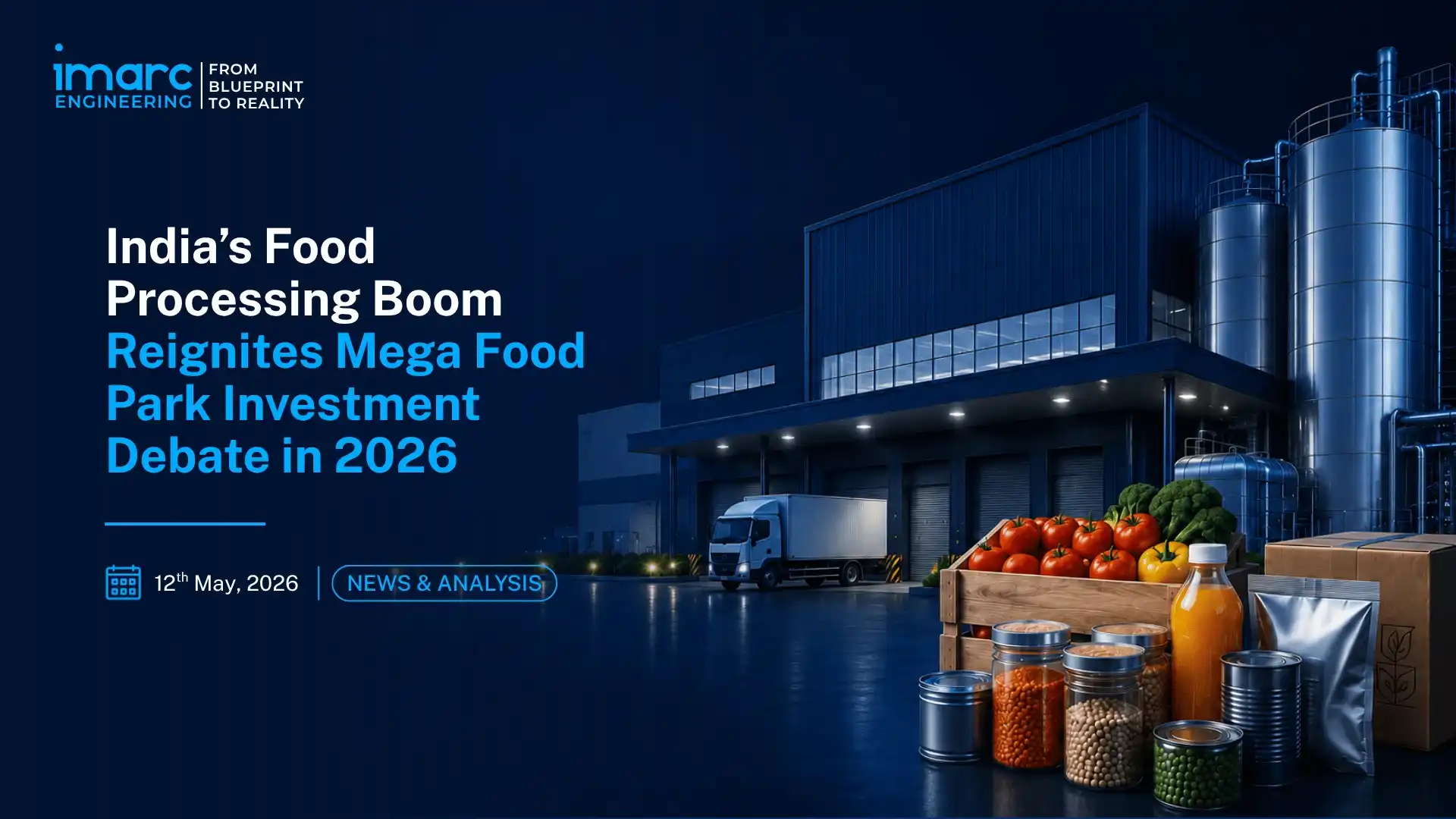
India’s food processing industry is entering a pivotal growth phase, with the sector projected to reach USD 535 billion in output by 2025–26, accounting for nearly 32% of the total food market and ranking among the top five globally. This trajectory significantly strengthens food processing feasibility in India, making it a compelling space for investors targeting scalable, demand-driven opportunities.
For stakeholders assessing food processing project feasibility in India, the current cycle offers strong fundamentals, rising consumption, supply chain formalization, and supportive policy frameworks. Cumulative FDI inflows of USD 15.86 billion (April 2000–December 2025) further underscore long-term investor confidence in food processing projects in India and the broader food processing infrastructure India is building.
At the core of this infrastructure push are Mega Food Parks, positioned as integrated hubs to enable efficient, large-scale processing. They have played a key role in shaping early mega food park investment opportunities and attracting interest in investing in mega food parks. However, more than a decade on, the model requires a critical reassessment to determine whether it still aligns with evolving market needs and supports robust food processing plant feasibility study in India outcomes.
As investors evaluate mega food park investment in India, the focus is shifting toward more nuanced, location-specific strategies, balancing policy incentives with operational viability. This makes a fresh, objective review of the Mega Food Park model essential for the next phase of growth.
The Macro Backdrop: Why the Moment is Real
Several forces are converging to make India's food processing boom structurally durable rather than policy driven. India is the world's largest producer of milk and millets, the second-largest producer of fruits, vegetables, and fisheries. Processed food now accounts for 20% of India's total agri-food exports, USD10.09 billion of the USD49.4 billion exported in 2024-25, and the government has set an ambitious target of USD100 billion in combined food, beverage, agriculture, and marine exports by 2030. In early 2025, Commerce Minister Piyush Goyal announced 100% FDI in the food and beverage industry, a sweeping liberalisation that has widened the investment access pathway for global players.
World Food India 2025, the fourth edition of the government's flagship food sector investment showcase, drew over INR 1 trillion in investment interest, with Reliance Retail, Coca-Cola, Amul, and Olam Foods alone signing MoUs worth INR 75,000 crore on the opening day. Reliance Retail's plans to invest INR 40,000 crore in food parks represent the largest single private commitment to food processing infrastructure in India's history. AB InBev has committed USD 250 million to India's beverage market. These are not exploratory positions; they are scale commitments that reflect the underlying consumption growth story.
The PLI Scheme for Food Processing Industries (PLISFPI), with INR 10,900 crore outlay running from FY2021-22 to FY2026-27, has approved 170 applications and generated cumulative investment of INR 9,000 crore, added 35 lakh MT of processing capacity, and created approximately 3.39 lakh direct and indirect jobs, already exceeding the scheme's original 2.5 lakh job creation target. PLI-supported food processing product sales grew 10.58% and export sales rose 7.41%, per the latest MoFPI data from April 2026. Agricultural and processed food exports from PLI-approved applicants have grown at a 13.23% CAGR from 2019-20 to 2024-25.
The Mega Food Park Scheme: What the Numbers Actually Show
The Mega Food Park Scheme was launched with transformative ambitions: 42 parks sanctioned across six phases, each expected to generate INR 250 crore in investment, and linkages to 25,000 farmers. Government grants of up to 50% of project costs, capped at INR 50 crore per park, were provided through public-private partnership structures via special purpose vehicles.
As of August 31, 2025, 25 Mega Food Parks are operational, covering states like Andhra Pradesh, Maharashtra, Punjab, Rajasthan, Uttarakhand, and Chhattisgarh. The parks collectively cover 50-100 hectares each, with investments exceeding INR 250 crore per park from combined public and private sources. Andhra Pradesh, Maharashtra, and Punjab lead in approved projects with three each.
The scheme's delivery against its own targets, however, tells a more nuanced story. While 22 operational parks have been linked to approximately 6.66 lakh direct and indirect jobs, a significant aggregate, actual direct employment has averaged under 3,000 per operational park, significantly below the 30,000-job target per park. The variance is primarily explained by phased unit commissioning and the reality that job projections bundled farmer and retailer network linkages with direct plant employment. The scheme's design targets at least 30,000 jobs per park encompassing these broader supply chain linkages, but the direct factory employment baseline is substantively different from the headline projection.
Occupancy has also been uneven. Parks that benefit from proximity to a dense agricultural catchment, reliable cold chain infrastructure, and a well-developed road network have performed strongly. Parks in geographies where raw material aggregation is logistically expensive or where the local food processing entrepreneur base is thin have faced slower plot take-up. The MoFPI's own recommendation, moving toward plug-and-play models with shared utilities and pre-built processing facilities to lower entry barriers, reflects an honest acknowledgement that the original infrastructure-only model does not automatically generate occupancy.
The Policy Reset: PMKSY, Irradiation, and the New Infrastructure Push
Recognising both the opportunity and the infrastructure gaps, the government has substantially reset its food processing infrastructure agenda through 2025-26. In July 2025, the Union Cabinet approved an additional INR 1,920 crore outlay, taking total PMKSY allocation to INR 6,520 crore for the Fifteenth Finance Commission cycle through March 2026. The enhanced allocation includes INR 1,000 crore specifically for 50 multi-product food irradiation units, a targeted intervention that addresses one of India's most persistent export vulnerabilities.
Between 2020 and 2024, India recorded 527 rejection incidents at EU ports, many attributed to phytosanitary and food safety compliance failures that irradiation technology is designed to solve. MoFPI issued an Expression of Interest for irradiation unit proposals in May 2025, with a deadline extended to February 2026, and has also called for proposals to set up 100 NABL-accredited food testing laboratories.
Under PMKSY during 2025, 36 new projects were sanctioned and 94 operationalised, adding 28.48 lakh MT of processing and preservation capacity and projected to benefit 1.4 lakh farmers. Cumulatively, 1,185 of 1,618 approved PMKSY projects are operational, driving over Rs 21,900 crore in investment and impacting 51 lakh farmers with 7.22 lakh direct and indirect jobs. The Union Budget 2025-26 allocated INR 4,364 crore to MoFPI, covering PMKSY, PLI, and PMFME, with INR 1,444 crore specifically for PLISFPI.
The government has also launched Cluster Development Programmes (CDP) under new guidelines published in February 2026, signalling a shift toward sector-specific processing clusters rather than the generic multi-commodity park model. This is a meaningful structural evolution: a turmeric cluster in Nizamabad, a seafood cluster in coastal Andhra Pradesh, can achieve the density of raw material supply and processing specialisation that a generic food park cannot. Andhra Pradesh Chief Minister Naidu has separately set a target of INR 30,000 crore in food processing investment in the state, pitching it specifically as a hub for seafood, fruits, spices, and agro-clusters.
Revisiting Mega Food Park Feasibility in 2026
The Mega Food Park model was designed for an era when the primary constraint to food processing investment was the absence of physical infrastructure, cold storage, power supply, water, roads, and quality testing facilities. In regions where that constraint still dominates, the model remains relevant and necessary. For states like Jharkhand, Chhattisgarh, and parts of the Northeast, shared infrastructure parks continue to lower the investment threshold for first-generation food processors who cannot viably build standalone utilities.
In more developed agri-industrial geographies, however, the feasibility question has changed. The primary constraint is no longer physical infrastructure, it is market linkage, quality compliance for export, and cold chain continuity from farm gate to retail outlet. A INR 50 crore government grant and a developed industrial plot do not solve an EU rejection at the port of Hamburg. This is the gap the irradiation units, food testing labs, and export-linked PLI scheme are designed to address, and it is a more sophisticated policy response than the original parks provided.
The most commercially viable food processing investments in India today, large quick service restaurant supply chains, dairy processing facilities, seafood export units, and millet-based branded food manufacturers, are selecting locations based on raw material proximity, cold chain logistics, and PLI eligibility, not Mega Food Park designation. That does not make the parks irrelevant; it means their feasibility is increasingly dependent on sector-specific configuration, geographic selection, and active tenant development rather than passive infrastructure provision. Parks that integrate PLI scheme eligibility, export-oriented processing mandates, and traceability infrastructure are generating stronger commercial traction than generic developments.
The Investment Imperative Going Forward
India's food processing boom in 2026 is real and broad-based. The sector grows at a CAGR of 8.38%, is projected to reach INR 65,244 billion by 2033, and is attracting institutional capital, from Reliance's INR 40,000 crore commitment to AB InBev's USD 250 million pledge, at a scale that makes it one of the most active investment destinations in Indian manufacturing. Seafood exports hit a record USD 7.68 billion in FY26, the highest in Indian maritime history. AAHAR 2026, the food industry's flagship trade exhibition, showcased a generation of innovation-led food entrepreneurs taking processed food into new categories, functional foods, fortified millets, sustainable packaging, and health-linked nutrition products.
For investors evaluating food processing in India, the Mega Food Park designation is one entry point among many, and not necessarily the most efficient one. The PLI scheme's direct incentive structure, the new irradiation and food testing laboratory infrastructure, and the emerging cluster development framework offer investment access pathways that are more closely aligned with commercial food processing requirements than the original park model.
A bankable feasibility study for a food processing investment in India in 2026 must assess all three layers: the physical infrastructure available through parks and clusters, the PLI incentive eligibility for incremental sales, and the export compliance infrastructure, cold chain, testing, traceability, and irradiation, that determines whether an Indian-manufactured food product can access the markets where the real value lies.
India's food processing boom is no longer a projection. The question for 2026 is not whether to invest, it is which infrastructure model delivers the returns.
Latest News
-
India Pushes Domestic Shipping Container Manufacturing with INR 10,000 Crore Assistance Scheme
September 25, 2026
-
India’s Growing GCC Sector Brings Greenfield Setup and Regulatory Compliance into Focus
September 24, 2026
-
Uttar Pradesh Approves INR 200+ Crore Ethanol Plant at Chhata Sugar Mill in Mathura
September 23, 2026
-
Escorts Kubota Breaks Ground on INR 2,000 Crore Greenfield Manufacturing Plant in Uttar Pradesh
September 22, 2026
-
SEMICON India 2026 Highlights Expansion of India’s Semiconductor Manufacturing Ecosystem
September 21, 2026
Trusted by Industry Leaders
We partner with global enterprises and ambitious businesses across sectors to deliver operational excellence, strategic insights, and sustainable growth through integrated solutions.









Success in Their Words
Real feedback from clients across industries. Discover how our solutions delivered measurable impact and operational excellence.

I wanted to express my sincere appreciation for your efforts in handling this matter. Your dedication and commitment have been truly commendable, and it is evident that you have put in tremendous hard work and expertise into resolving the issues at hand. We are greatly interested in continuing our collaboration with you in the future, as your professionalism and reliability have made you a trusted partner. Thank you once again for your invaluable contribution. We look forward to strengthening our partnership ahead.

It has been a pleasure working with the IMARC team. The insights provided were structured, clear, and highly valuable, helping us strengthen both our technical and financial planning with confidence. We deeply appreciate the team’s professionalism, responsiveness, and attention to detail throughout the engagement. Every requirement was well understood and effectively incorporated, resulting in a comprehensive and actionable output. Overall, our experience has been excellent, and I would gladly recommend IMARC to organizations seeking a reliable research partner.

Your service is truly exceptional. Working with the IMARC team has been a seamless and professional experience. The clarity of communication, responsiveness to queries, and consistent support at every stage made the entire engagement highly efficient. The insights shared were well-structured, practical, and perfectly aligned with our requirements, helping us make informed decisions with confidence. Overall, the dedication and professionalism demonstrated by your team stand out, and I would be glad to recommend IMARC as a reliable and trustworthy research partner.

IMARC did an outstanding job in preparing our study. They were punctual, precise, and consistently responsive throughout the entire process. The team delivered all the data we required in a clear, well-organized, and highly professional format. Their strong attention to detail, combined with their ability to meet every deadline without compromising quality, truly set them apart. Overall, their reliability and commitment made them an exceptional partner for our project, and we would gladly work with them again in the future.

IMARC made the whole process incredibly easy from start to finish. Everyone I interacted with via email was polite, professional, and straightforward to deal with, always keeping their promises regarding delivery timelines and remaining consistently solutions-focused. From my very first contact, I appreciated the professionalism and support shown by the entire IMARC team. I highly recommend IMARC to anyone seeking timely, affordable, and reliable information or advice. My experience with IMARC was excellent, and I truly cannot fault any aspect of it.

I’d like to express my sincere gratitude for the excellent work you accomplished with the study. Your ability to quickly understand our requirements and deliver high-quality results under tight timelines truly reflects your expertise, exceptional work ethic, and unwavering commitment to your customer’s success. The professionalism and responsiveness you demonstrated throughout the process made a significant difference. Our entire team and company are incredibly thankful for your dedication, reliability, and support. Once again, thank you for your outstanding contribution.
Ready to Experience the IMARC Advantage?
Whether you're planning a new facility, expanding operations, optimizing performance, or facing complex challenges—IMARC Engineering brings the expertise, experience, and commitment needed for success.