EV Components Distribution in India: How Manufacturers Are Building Regional Supply Chains
May 05, 2026
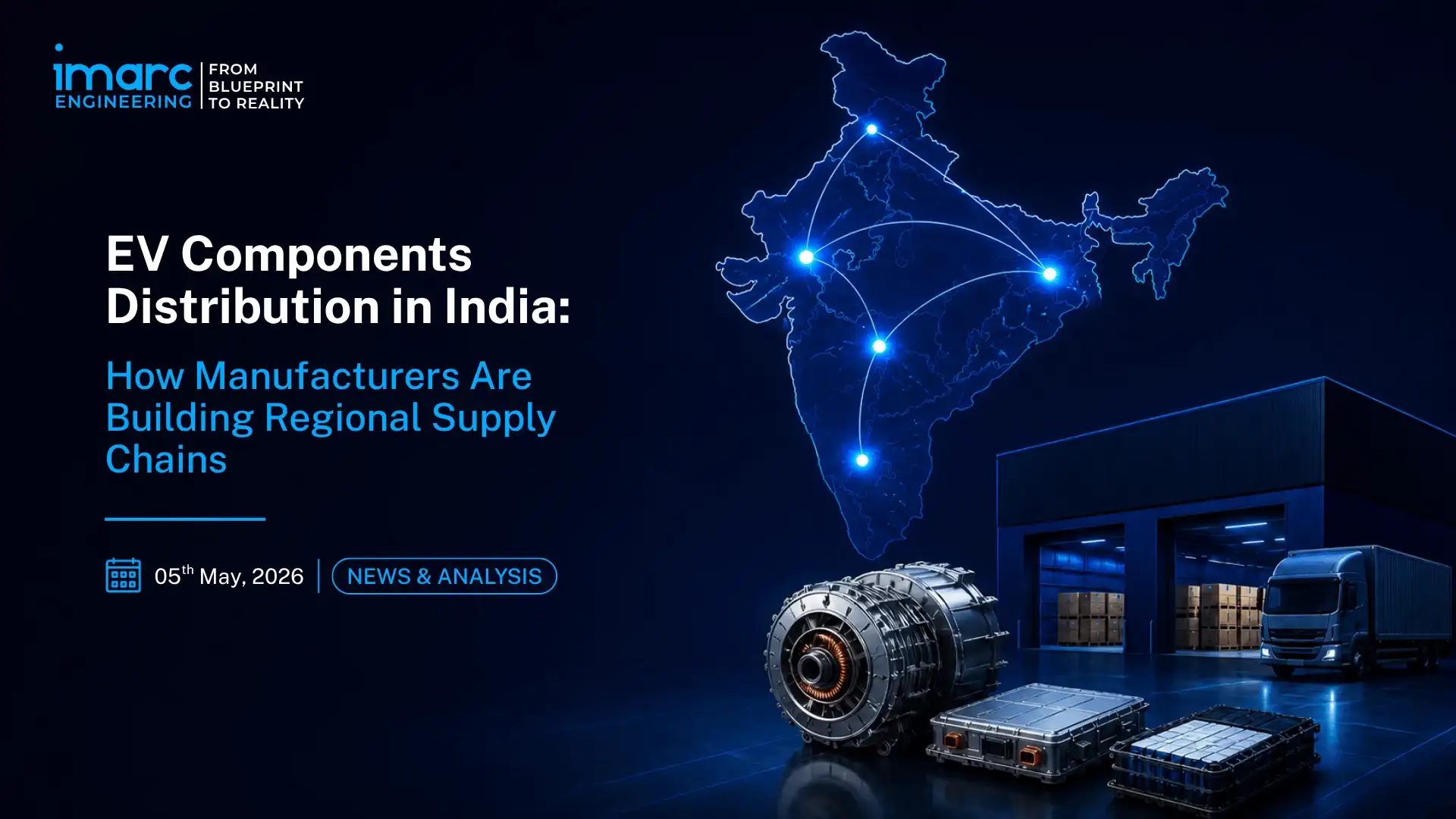
India's electric vehicle revolution is no longer a metropolitan story. From Assam's electric auto-rickshaws to Karnataka's expanding charging corridors, the momentum is spreading rapidly across geographies, outpacing the ability of traditional logistics networks to adapt. At the heart of this transformation lies a straightforward but critical principle: the development of a robust EV ecosystem depends heavily on strengthening EV components distribution in India and optimizing the broader EV supply chain in India. Without a well-established regional distributor network to support parts availability, maintenance services, and timely component delivery, the ambition of reaching 80 million electric vehicles on Indian roads by 2030 risks remaining aspirational rather than achievable.
The Scale of the Opportunity and the Pressure it Creates
The EV market of India is expanding at such a rate that it would not have been predicted even a couple of years ago. The volume of EV sales increased by 16.9% to 2 million units in FY25, while the number of electric two-wheelers was up by 21.2% to 1.15 million units, whereas passenger EVs crossed the milestone of 100,000 units in growth of 18.2%.
This explosive growth has shifted the strategic weight from vehicle manufacturers to component suppliers. Batteries, traction motors, controllers, BMS systems, DC-DC converters, chargers, and wire harnesses, the building blocks of every EV, need to be produced domestically and distributed efficiently across a country where the fastest-growing markets are no longer Delhi or Bengaluru, but Lucknow, Nagpur, Coimbatore, and smaller cities beyond.
Tier 2 and Tier 3 cities are now the genuine engines of EV adoption growth. In Assam itself, more than 85% of new three-wheeler registrations were made through the use of electric vehicles in 2023, with an expectation of this to reach 100% by 2025. This is due to several government policies in states such as providing waiver of registration fees for new registrations. In Bihar, for instance, EV registrations have increased by two-fold from 10,850 in FY24 to 23,096 in FY25.
The Localization Imperative: Policy is Pushing the Chain Inward
The structural shift toward regional distribution networks does not exist in isolation, it is being actively engineered by policy. The PMP through FAME-II is pressurizing automobile manufacturers to localize their procurement operations by directly incentivizing the local production of components. The Union Budget for FY 2025-26 has also provided for exemption from custom duties on 35 capital goods used in manufacturing batteries for EVs in addition to zero custom duties on cobalt, lithium, and other 25 critical minerals that were exempted in the previous budget of July 2024.
The PM E-DRIVE program, which will now continue till March 2028 with an allocation of INR 10,900 crore, is continuing its effort to promote fleet electrification along with the development of charging facilities across states. As per data available up to June 2025, the government had promoted 16.29 lakh EVs through the FAME-II program.
A landmark April 2026 report from the International Institute for Sustainable Development found that at least 14 state governments now provide financial support for localizing EV and battery manufacturing. The report noted that supply-side EV and battery policies are beginning to translate into investments spanning the entire EV value chain, but are leading to geographically dispersed manufacturing outcomes. The finding is significant: it confirms that India's EV supply chain is not consolidating in one hub but spreading across states, making regional distributor networks not just useful, but structurally necessary.
Component Manufacturers Redefining Distribution Architecture
Uno Minda is perhaps the clearest example of a legacy component manufacturer proactively restructuring for the EV era. The company has already built one of India's deepest aftermarket distribution networks, covering 600 districts, over 7,000 pin codes, and more than 1 lakh channel partners, and a dedicated network of mechanics and auto electricians who have sold Minda products for over six decades.
In February 2025, Uno Minda signed a joint venture with Suzhou Inovance Automotive Co. Ltd., a Chinese EV powertrain specialist, to manufacture high-voltage EV components including combined charging units, e-axles, inverters, and motors in India.
Crucially, the venture designates India as its exclusive manufacturing and distribution territory. This is a deliberate strategy to plug EV-specific components into an already-functioning regional distribution spine rather than building from scratch.
Varroc Engineering is pursuing a parallel path. At the Bharat Mobility Global Expo 2025, the company showcased a full suite of homegrown EV solutions, traction motors, controllers, chargers, and DC-DC converters, with an explicit focus on improving EV economics through weight optimization and local production. With revenue of INR 20.8 billion in the first half of FY2025 and a record peak order book, Varroc is scaling its manufacturing footprint to match distribution ambitions. The company operates with 37 manufacturing facilities and seven R&D centres across eight countries, serving OEMs like Hero MotoCorp, TVS, Honda, and Tata Motors in India, relationships that double as ready-made distribution channels for EV-specific components.
Napino Auto & Electronics, headquartered in Gurugram, is expanding its production footprint specifically for EV components including BLDC motors, controllers, BMS systems, and wire harnesses targeting the two- and three-wheeler market. Napino has established a dedicated production line in Halol, Gujarat, and counts Ather Energy among its key clients. The company demonstrated connected solutions and electrification innovations at the Auto Component Show 2025.
From FY27, Uno Minda, Varroc, and Napino are all expected to begin receiving incentives under the automotive PLI scheme, joining major OEMs like Mahindra, Tata Motors, Bajaj Auto, TVS Motor, and Ola Electric. This financial push will help these component makers scale output and expand their regional reach.
Charging Infrastructure as a Distribution Network in Itself
An often-underappreciated dimension of EV component distribution is the charging infrastructure network, which functions as both demand infrastructure and a physical distribution and service grid. Bolt.Earth, India's largest EV charging network with over 100,000 chargers across 2,000+ cities, has built strategic alliances with Mahindra, Bajaj, TVS Motor, and several other manufacturers. Its 2025 launch of Blaze DC, India's first universally compatible DC fast charger for two- and four-wheelers, signals how charging hardware itself is becoming a localized manufacturing play.
Statiq, another major operator, expanded to 100 cities with over 10,000 charging stations and added 3,000 new stations in 2025 alone, focusing on urban centers and growing semi-urban corridors. The company has set a target of 20,000 advanced chargers by 2026, incorporating AI-optimized fast charging and real-time availability features. EVERTA, meanwhile, launched Made-in-India high-performance DC fast chargers and opened a manufacturing facility in Bengaluru with a target of 3,000 units annually by 2027.
The Indian EV charging station market, valued at $ 589.1 Million in 2025 and projected to reach $ 1,078.8 Million by 2034, is itself becoming a distribution vector, with companies like REIL and EESL deploying public chargers across cities in a pattern that mirrors how regional dealership and service networks once expanded for ICE vehicles.
Battery Makers Anchoring Regional Supply Chains
The battery subsector, which is still the most capital-intensive and geographically constrained portion of the EV value chain, is witnessing the largest investments into manufacturing anchors.
For instance, Exide Industries, through its Exide Energy Solutions subsidiary, will construct a new 12 GWh greenfield lithium-ion cell plant in Bengaluru, with an initial 6 GWh phase scheduled to commence production by FY2025-26. It also plans to collaborate with Hyundai Motor and Kia to manufacture lithium-iron-phosphate cells locally.
Another battery manufacturing giant Amara Raja has allocated an investment of Rs. 10,000 crores until 2032 in order to expand its manufacturing facility for lithium-ion cells and packs. With plans of production up to 16 GWh, Amara Raja expects growth in its production owing to high demands.
Lastly, Tata Motors' Agratas subsidiary will build a new $1.5 billion battery gigafactory that will go into operation in 2026. In addition, JSW has signed a MOU worth INR 40,000 crores with the government of Odisha for establishing a massive eco-system of EVs and green energy in Naraj (Cuttack) and Paradip (Jagatsinghpur). Such anchors create a gravitational force for various feeder suppliers and distributors in their geographical vicinity.
The Road Ahead: Depth Beyond the Metros
India's EV supply chain is at an inflection point where the infrastructure of the next decade is being laid today. The countries that have won the EV transition globally, China most prominently, did so not just through centralized gigafactories but through dense, layered distributor ecosystems that brought components to repair centers, fleet operators, and small assemblers in every district.
India's component makers are reading this lesson clearly. The combination of PLI incentives, FAME-II mandates, state-level policy support, and surging Tier 2 and Tier 3 demand is creating a structural imperative for regional distribution depth. Companies like Uno Minda, Varroc, Napino, Exide, and Amara Raja are not just scaling manufacturing, they are redesigning their go-to-market architectures to reach the mechanic in Patna, the fleet operator in Coimbatore, and the three-wheeler assembler in Guwahati.
The EV supply chain India needs is not a hub-and-spoke model radiating from four metros. It is a distributed network, regional warehouses, authorized service points, district-level distributors, and digital inventory systems, that mirrors the geographic spread of EV adoption itself. Building that network is the defining supply chain challenge of India's electric decade, and the manufacturers who solve it first will define the competitive map of a market measured in the hundreds of billions.
India's EV components distribution story is ultimately a story about reach, and reach, in a country of 1.4 billion people spread across 28 states, has always been built not at the top, but from the ground up.
Latest News
-
Wood Wins USD 200 Million ExxonMobil Construction Services Contract for PNG LNG Brownfield Projects
September 18, 2026
-
IHCL Signs 125-Key Greenfield Gateway Hotel in Sambalpur, Expanding Odisha Portfolio
September 18, 2026
-
Thoothukudi Mega Shipyard Moves Forward with INR 6.78 Crore Geotechnical and Seabed Investigation Tender
September 17, 2026
-
Nagpur–Warangal Greenfield Highway Targets December 2027 Completion as Land Acquisition Bottlenecks Ease
September 16, 2026
-
BRICS New Delhi Declaration 2026 Focuses on Resilient Supply Chains, Critical Minerals and Energy Cooperation
September 15, 2026
Trusted by Industry Leaders
We partner with global enterprises and ambitious businesses across sectors to deliver operational excellence, strategic insights, and sustainable growth through integrated solutions.










Success in Their Words
Real feedback from clients across industries. Discover how our solutions delivered measurable impact and operational excellence.

I wanted to express my sincere appreciation for your efforts in handling this matter. Your dedication and commitment have been truly commendable, and it is evident that you have put in tremendous hard work and expertise into resolving the issues at hand. We are greatly interested in continuing our collaboration with you in the future, as your professionalism and reliability have made you a trusted partner. Thank you once again for your invaluable contribution. We look forward to strengthening our partnership ahead.

It has been a pleasure working with the IMARC team. The insights provided were structured, clear, and highly valuable, helping us strengthen both our technical and financial planning with confidence. We deeply appreciate the team’s professionalism, responsiveness, and attention to detail throughout the engagement. Every requirement was well understood and effectively incorporated, resulting in a comprehensive and actionable output. Overall, our experience has been excellent, and I would gladly recommend IMARC to organizations seeking a reliable research partner.

Your service is truly exceptional. Working with the IMARC team has been a seamless and professional experience. The clarity of communication, responsiveness to queries, and consistent support at every stage made the entire engagement highly efficient. The insights shared were well-structured, practical, and perfectly aligned with our requirements, helping us make informed decisions with confidence. Overall, the dedication and professionalism demonstrated by your team stand out, and I would be glad to recommend IMARC as a reliable and trustworthy research partner.

IMARC did an outstanding job in preparing our study. They were punctual, precise, and consistently responsive throughout the entire process. The team delivered all the data we required in a clear, well-organized, and highly professional format. Their strong attention to detail, combined with their ability to meet every deadline without compromising quality, truly set them apart. Overall, their reliability and commitment made them an exceptional partner for our project, and we would gladly work with them again in the future.

IMARC made the whole process incredibly easy from start to finish. Everyone I interacted with via email was polite, professional, and straightforward to deal with, always keeping their promises regarding delivery timelines and remaining consistently solutions-focused. From my very first contact, I appreciated the professionalism and support shown by the entire IMARC team. I highly recommend IMARC to anyone seeking timely, affordable, and reliable information or advice. My experience with IMARC was excellent, and I truly cannot fault any aspect of it.

I’d like to express my sincere gratitude for the excellent work you accomplished with the study. Your ability to quickly understand our requirements and deliver high-quality results under tight timelines truly reflects your expertise, exceptional work ethic, and unwavering commitment to your customer’s success. The professionalism and responsiveness you demonstrated throughout the process made a significant difference. Our entire team and company are incredibly thankful for your dedication, reliability, and support. Once again, thank you for your outstanding contribution.
Ready to Experience the IMARC Advantage?
Whether you're planning a new facility, expanding operations, optimizing performance, or facing complex challenges—IMARC Engineering brings the expertise, experience, and commitment needed for success.