Coats Digital Launches AI-Powered GSD RealMotion for Time and Motion Studies in Apparel Manufacturing
September 02, 2026
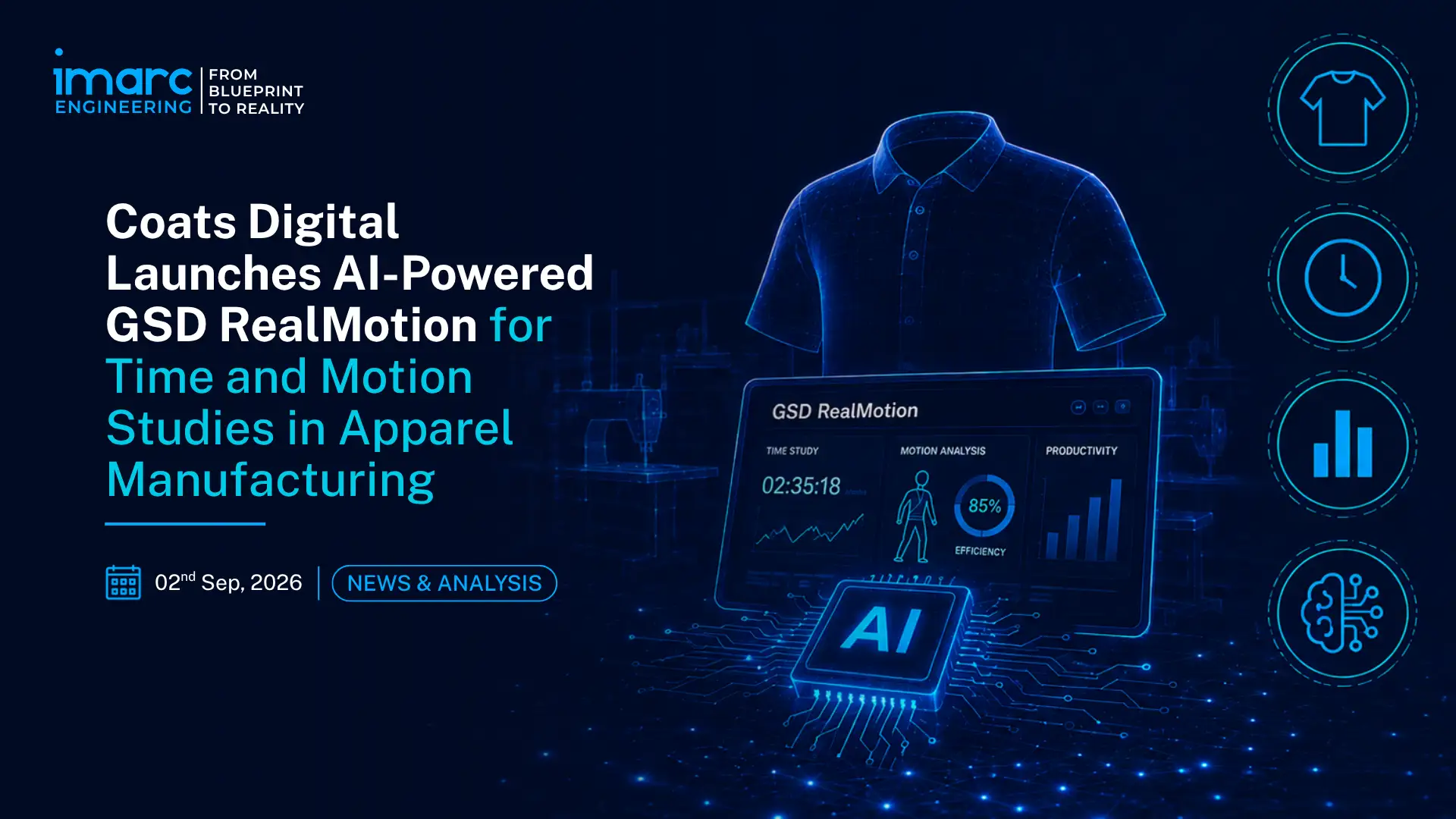
Coats Digital announced the launch of GSD RealMotion on August 19, 2026, introducing an AI-powered solution designed to give apparel manufacturers greater visibility into factory-floor operations. The system analyses shop-floor video using Coats Digital's established GSD methodology. It is positioned as a digital alternative to conventional stopwatch-based measurement, using AI-assisted motion analysis to accelerate method studies while retaining engineer validation.
According to Coats Digital, a 45-minute manual timing exercise can be reduced to around 15 minutes using video-assisted analysis. This could allow industrial engineering teams to study a larger share of production activities without the time burden of traditional measurement methods. For apparel manufacturers, the launch provides a commercial example of AI and computer vision being applied to established industrial-engineering workflows on the factory floor.
What is Coats Digital GSD RealMotion?
Coats Digital describes GSD RealMotion as an AI-powered motion analysis solution that converts shop-floor video into structured, GSD-coded method studies. It builds on GSDCost, the company's established system for setting method-time-cost benchmarks in garment manufacturing.
GSDCost uses standard motion codes and predetermined times to establish and optimise method-time-cost benchmarks, supporting garment costing and manufacturing efficiency across the apparel supply chain. GSD RealMotion is designed to work alongside this existing system rather than operate as a standalone measurement tool.
It compares observed shop-floor methods directly with the engineered GSD standards stored in GSDCost. Once verified and approved, observed standards can be published back into GSDCost. This is intended to keep future costing quotes aligned with actual shop-floor performance rather than theoretical method assumptions.
How Does GSD RealMotion Use AI and Computer Vision for Time Studies?
According to Coats Digital, the system uses AI and computer vision to convert ordinary phone video of a shop-floor operation into a structured, motion-by-motion method study, which industrial engineers then validate and refine. The AI component handles detection and initial classification of individual GSD motion codes from the video footage, while engineers retain the role of validating and refining that AI-generated output before it is treated as an approved study.
Coats Digital's stated capabilities for the tool include AI-assisted detection and validation of GSD motion codes from video, automated creation of motion-by-motion method studies with observed times, visual operation sequencing through method Gantt analysis, and side-by-side study comparisons designed to pinpoint actionable method variances between operators or lines performing the same operation.
How Are AI-Powered Time Studies Different From Traditional Stopwatch Studies?
Traditional stopwatch-based time studies primarily measure elapsed time for operations or work elements and rely on the industrial engineer's observation and method analysis to interpret how the work is performed. By contrast, video-based motion analysis preserves a visual record that can support more detailed review of individual movements, operation sequences, and method variations.
Some manufacturers already use frame-by-frame video analysis to study motion-level detail, but Coats Digital estimates that manually analysing a single operation this way can take around eight hours. At that level of effort, applying detailed video analysis across a large number of factory operations can become difficult to scale.
GSD RealMotion is positioned as a faster alternative. According to Coats Digital, it can reduce the manual timing exercise to a video-assisted study completed in significantly less time. The goal is to move from analysing a small sample of operations to evaluating motion-level performance across much larger sections of the factory in a fraction of the time.
How Can Computer Vision Identify Non-Value-Added Motions and Support Productivity and Capacity Gains?
A key feature of GSD RealMotion, according to Coats Digital, is its ability to classify each captured motion as value-added, necessary, or non-value added. This helps manufacturers identify which motions contribute to production and which indicate waste, rework, or inefficient methods.
This motion-level analysis can help industrial engineers investigate the causes of time or capacity gaps and identify opportunities to improve the underlying method. Coats Digital projects that addressing these inefficiencies could generate USD 2–3 million in annual cost savings per manufacturing site, recover capacity for an additional 60,000 garments annually, and save 12,000 engineering hours. These figures are Coats Digital's internal projections, not independently audited or third-party verified results.
What Role Do Industrial Engineers Play When AI Is Used for Time and Motion Studies?
Coats Digital says GSD RealMotion is designed to shift, rather than eliminate, the role of industrial engineers on the shop floor. The tool combines AI-based motion detection with GSD benchmarks to compare actual operator methods with established standards. According to Coats Digital, this helps engineers identify method variation, understand root causes, improve methods, and recover production capacity. It also allows engineers to spend more time on method improvement rather than manual measurement.
Validated improvements can potentially be transferred across comparable production lines, while completed studies can contribute to a searchable, central library of reusable engineering knowledge. The approach illustrates how AI can automate or accelerate time-intensive measurement and analysis tasks while allowing industrial engineers to focus on validation, interpretation, root-cause analysis, and method redesign.
What Does GSD RealMotion Indicate About the Future of Industrial Engineering in Manufacturing?
Himanshu Mehrotra, Managing Director of Coats Digital, described the launch as part of the company's focus on “next-generation AI technologies” for the fashion industry. He said GSD RealMotion shows how practical AI can turn deep domain expertise into actionable insight.
The product combines AI-driven detection with engineer validation. Verified results can then feed back into the existing costing and standards system. This positions AI as an acceleration and scale layer for industrial engineering, rather than a replacement for engineered standards.
If this approach proves effective at scale, it could change how apparel manufacturers conduct time and motion studies. Instead of relying on detailed manual analysis for a limited sample of operations, industrial engineering teams could use video-based, AI-assisted analysis to examine a much larger share of shop-floor activities while retaining human validation of the resulting method studies.
Coats Digital says GSD RealMotion can turn a 45-minute manual timing exercise into a 15-minute video-assisted study. The company also projects potential annual benefits of USD 2–3 million in cost savings, capacity for an additional 60,000 garments, and 12,000 engineering hours saved per manufacturing site; these impact figures are based on Coats Digital's internal modelling rather than independently verified factory results. Whether faster analysis translates into sustained productivity and capacity gains will ultimately depend on how manufacturers validate and act on the motion-level insights the system provides.
IMARC Engineering’s Perspective
GSD RealMotion demonstrates how AI and computer vision are being incorporated into commercially available tools for core industrial engineering activities such as time and motion studies. Coats Digital's approach combining AI-assisted motion detection with engineer validation rather than removing engineers from the process also highlights the importance of maintaining engineering oversight where method accuracy can influence costing, capacity planning, and production-line decisions.
At IMARC Engineering, we see tools of this kind as complementary to, rather than a substitute for, broader plant and process engineering. Motion-level analysis of an individual operation can provide valuable input when manufacturers plan new capacity or reconfigure existing lines, but decisions around line balancing, equipment layout, material flow, workforce deployment, and overall plant capacity still require engineering judgement across the complete production system.
As AI-powered time and motion study tools mature in apparel manufacturing, similar combinations of computer vision, digital work measurement, and engineer-led method analysis could become increasingly relevant to industrial engineering in other manufacturing environments. Manufacturers that combine faster measurement with disciplined, system-level process engineering may be better positioned to translate motion-level insights into measurable productivity and capacity improvements.
Latest News
-
Tamil Nadu Allocates INR 98 Lakh for DPR Preparation of Five Infrastructure Projects in Chennai
October 16, 2026
-
SunBridge BioEnergy Starts Commercial Production at INR 350 Crore, 300 KLD Ethanol Plant in Madhya Pradesh
October 15, 2026
-
PM Modi Launches INR 753.68 Crore VOC Port Infrastructure Projects in Tamil Nadu
October 14, 2026
-
India's Manufacturing Sector Shows Recovery in Q2 FY27 as 95% of Firms Report Stable or Higher Output
October 12, 2026
-
Puri Greenfield Airport Gets Environmental Clearance, Advancing INR 5,631 Crore Project in Odisha
October 09, 2026
Trusted by Industry Leaders
We partner with global enterprises and ambitious businesses across sectors to deliver operational excellence, strategic insights, and sustainable growth through integrated solutions.









Success in Their Words
Real feedback from clients across industries. Discover how our solutions delivered measurable impact and operational excellence.

I wanted to express my sincere appreciation for your efforts in handling this matter. Your dedication and commitment have been truly commendable, and it is evident that you have put in tremendous hard work and expertise into resolving the issues at hand. We are greatly interested in continuing our collaboration with you in the future, as your professionalism and reliability have made you a trusted partner. Thank you once again for your invaluable contribution. We look forward to strengthening our partnership ahead.

It has been a pleasure working with the IMARC team. The insights provided were structured, clear, and highly valuable, helping us strengthen both our technical and financial planning with confidence. We deeply appreciate the team’s professionalism, responsiveness, and attention to detail throughout the engagement. Every requirement was well understood and effectively incorporated, resulting in a comprehensive and actionable output. Overall, our experience has been excellent, and I would gladly recommend IMARC to organizations seeking a reliable research partner.
Your service is truly exceptional. Working with the IMARC team has been a seamless and professional experience. The clarity of communication, responsiveness to queries, and consistent support at every stage made the entire engagement highly efficient. The insights shared were well-structured, practical, and perfectly aligned with our requirements, helping us make informed decisions with confidence. Overall, the dedication and professionalism demonstrated by your team stand out, and I would be glad to recommend IMARC as a reliable and trustworthy research partner.

IMARC did an outstanding job in preparing our study. They were punctual, precise, and consistently responsive throughout the entire process. The team delivered all the data we required in a clear, well-organized, and highly professional format. Their strong attention to detail, combined with their ability to meet every deadline without compromising quality, truly set them apart. Overall, their reliability and commitment made them an exceptional partner for our project, and we would gladly work with them again in the future.

IMARC made the whole process incredibly easy from start to finish. Everyone I interacted with via email was polite, professional, and straightforward to deal with, always keeping their promises regarding delivery timelines and remaining consistently solutions-focused. From my very first contact, I appreciated the professionalism and support shown by the entire IMARC team. I highly recommend IMARC to anyone seeking timely, affordable, and reliable information or advice. My experience with IMARC was excellent, and I truly cannot fault any aspect of it.

I’d like to express my sincere gratitude for the excellent work you accomplished with the study. Your ability to quickly understand our requirements and deliver high-quality results under tight timelines truly reflects your expertise, exceptional work ethic, and unwavering commitment to your customer’s success. The professionalism and responsiveness you demonstrated throughout the process made a significant difference. Our entire team and company are incredibly thankful for your dedication, reliability, and support. Once again, thank you for your outstanding contribution.
Ready to Experience the IMARC Advantage?
Whether you're planning a new facility, expanding operations, optimizing performance, or facing complex challenges—IMARC Engineering brings the expertise, experience, and commitment needed for success.