India's Cement Industry Accelerates Solar and Green Energy Adoption Amid Rising ESG and Cost Pressures
June 15, 2026
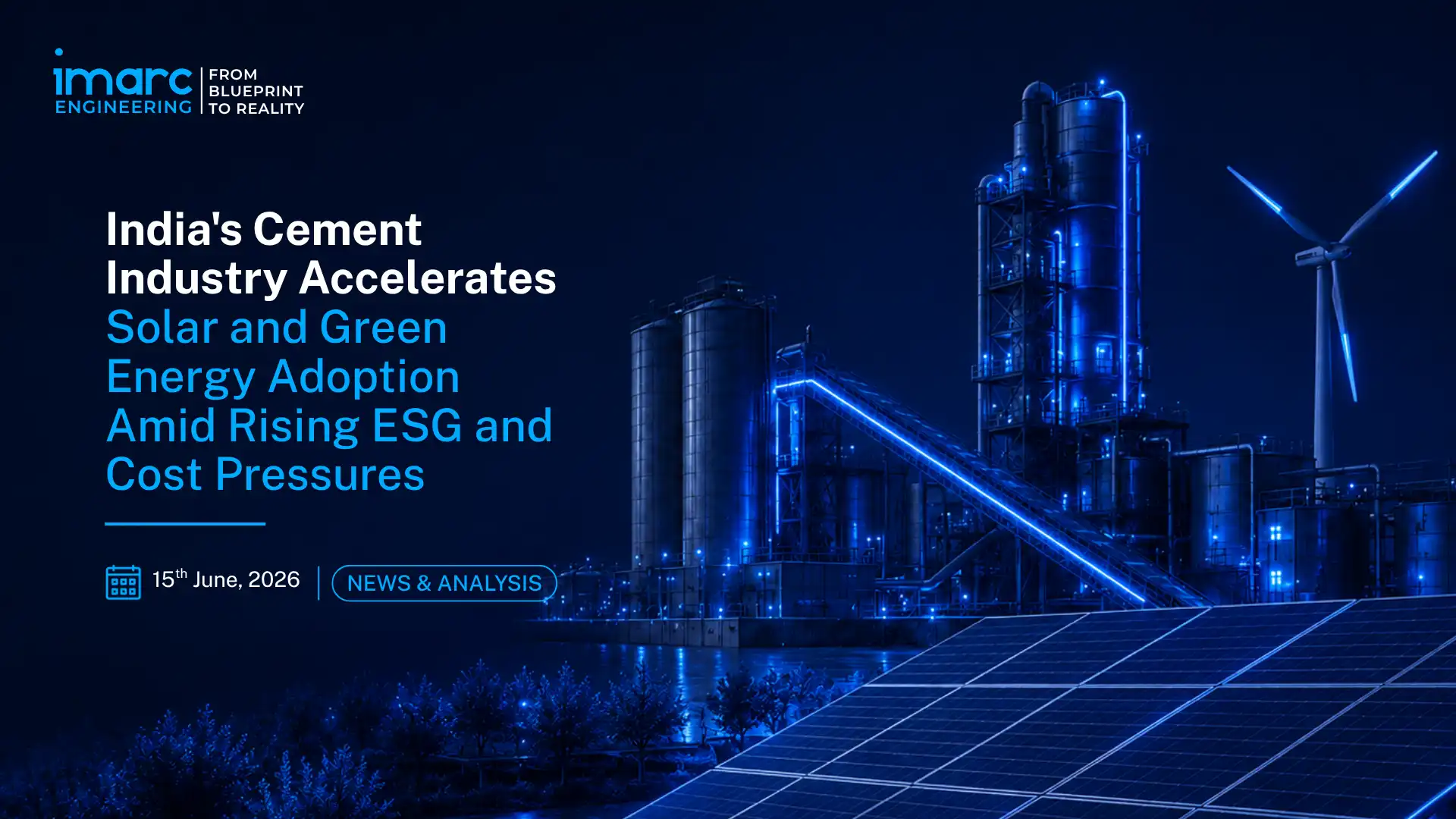
India's cement industry is increasingly treating renewable energy not only as a sustainability initiative but also as a strategic driver of ESG compliance in India, sustainable manufacturing in India, and long-term operational competitiveness. Leading producers are expanding their use of renewable power and waste heat recovery systems to reduce energy costs, strengthen margins, improve energy security, and meet the growing ESG expectations of investors, lenders, customers, and regulators.
Recent disclosures illustrate the scale of this shift. Shree Cement reported that green electricity accounted for 61% of its power consumption in Q4 FY26, supported by 666.5 MW of renewable capacity. Ambuja Cements commissioned 225 MW of solar capacity during Q3 FY26, taking its renewable portfolio to 898 MW and moving closer to its FY27 target of 1,122 MW. UltraTech Cement reported 1.4 GW of renewable energy capacity and 1.02 GW of waste heat recovery capacity, while Dalmia Bharat increased renewable power consumption to 48% following the expansion of its renewable portfolio to 410 MW.
What is notable is that these figures are not drawn from long-term sustainability roadmaps but from earnings-call disclosures to investors and analysts. Renewable energy deployment has become a measurable operational and financial metric, reflecting a broader industry trend in which decarbonisation, energy security, and profitability are increasingly aligned.
Why Rising Energy Costs Are Driving Green Energy Adoption in India's Cement Industry
The cement industry remains one of the most energy-intensive segments of Indian manufacturing, with power and fuel typically accounting for 30–40% of production costs. As energy prices rose following global supply-chain disruptions and sustained volatility in coal and grid electricity markets, cement producers accelerated green energy adoption as both a cost-reduction and competitiveness strategy.
This shift is increasingly shaping ESG compliance in India and broader corporate sustainability in India. Captive solar power can deliver electricity at costs well below industrial grid tariffs, while waste heat recovery systems (WHRS) convert kiln exhaust heat into power, reducing dependence on purchased electricity. Together, these technologies support industrial decarbonization while improving operating margins and energy security.
For many producers, the business case is now clear. In its Q4 FY26 investor call, Sagar Cements highlighted WHRS, solar power, and operational efficiency initiatives as key drivers of future margin improvement. The example reflects a broader trend across the renewable energy in cement industry landscape, where sustainability investments are increasingly being evaluated through the lens of profitability, resilience, and long-term value creation.
The company recently commissioned 2.8 MW of waste heat recovery capacity, with the balance 1.55 MW of its 4.35 MW WHRS project expected to be operational by end of June 2026. This pattern, a mid-size cement producer prioritising WHRS and captive solar as the primary margin improvement mechanism, is being replicated across dozens of Indian cement plants simultaneously. The sector-wide target of adding 5 GW of renewable energy capacity by 2030, from the 1,800 MW base established by 2024, reflects the scale of this transformation.
The ESG Compliance Dimension: Carbon Credit Trading and Regulatory Pressure
The financial logic is reinforced by a regulatory pressure that is tightening. India's carbon credit trading scheme, initiated in 2025-26, is creating a compliance cost architecture for energy-intensive industries that will increase over time. Although India's cement sector primarily serves the domestic market and does not export to the EU, making the Carbon Border Adjustment Mechanism's direct impact limited, the Indian CCTS creates domestic price discovery for carbon emissions that directly penalises high-emission production profiles and rewards green investment. Industry observers note that carbon is becoming a significant cost driver — and the World Cement Association has warned that global cement companies that delay decarbonisation will face three to four times higher prices as carbon costs accumulate.
ESG compliance in India is also increasingly lender-driven and investor-driven, not just regulatory. India's largest cement producers, UltraTech, Shree Cement, and Dalmia Bharat, are all members of RE100, the global corporate renewable energy initiative committing to 100% renewable electricity. This membership creates direct accountability to institutional investors, ESG rating agencies, and global lending institutions whose ESG frameworks determine access to capital at preferred rates.
CareEdge-ESG's analysis of India's cement sector found that 95% of leading companies now utilise renewable energy in their operations. Four of the six companies with formal renewable electricity targets have made RE100 pledges, but 14 of the sector's tracked companies in FY24 still lacked clear renewable electricity targets, highlighting that the gap between the frontrunners and the rest of the industry remains significant.
Renewable Energy and Decarbonization Technologies Transforming India's Cement Industry
The renewable energy in cement industry transition in India is using three primary technology pathways. Waste heat recovery systems, capturing exhaust heat from preheater and cooler stages, are the highest-priority investment for integrated plants, WHRS can supply 20-30% of a plant's electricity requirement at near-zero marginal cost once the capital is deployed.
Solar power, both rooftop and ground-mounted captive plants, is being commissioned by virtually every major producer, with capacities ranging from a few MW at grinding units to hundreds of MW at integrated manufacturing clusters. Wind energy is a third pathway, particularly relevant for plants in Rajasthan, Gujarat, Tamil Nadu, and Maharashtra where resource quality is strong, though integration costs are higher.
Alternative fuels are a fourth and increasingly important dimension. The average use of alternative fuels in India's cement sector stands at approximately 6%, with some plants achieving over 20%. Heidelburg has achieved 29.9% alternative fuel share, with biomass at 13%. JSW Cement targets 10.4% waste-driven energy in clinker production. ACC collaborated with Wastech to establish a modern waste-processing facility for refuse-derived fuel production in Raipur.
Carbon capture utilisation is emerging at the technology frontier: in December 2025, Ambuja Cements was selected for the first Indo-Swedish carbon capture and utilisation pilot in the global cement sector, a landmark that signals India's entry into the most technically advanced layer of industrial decarbonization. The complete industrial decarbonization pathway for cement, from renewable electricity through WHRS to alternative fuels and eventually to CCUS, is being assembled systematically by India's leading producers.
The Capacity Growth Context: Outlook for the Sector
The complexity of India's cement sector sustainability story is that it is not a declining or stable industry trying to decarbonise, it is a rapidly growing one. India's cement capacity is expected to reach 850 MTPA by 2030, from approximately 650 MTPA today. UltraTech alone commissioned 17.4 MTPA of new capacity in recent quarters.
Ramco Cements is scaling to 30 MTPA by 2026. Dalmia, Shree, and JSW are all expanding. The National Infrastructure Pipeline, the PM Awas Yojana housing programme, smart city development, and the road construction programme, collectively, these demand drivers require more cement, not less, for the next decade.
Achieving absolute emission reductions in a sector adding hundreds of MTPA of new capacity requires that every new plant is designed from the outset with maximum renewable energy integration, highest clinker factor reduction, and WHRS as a standard engineering component rather than an optional upgrade. That is the challenge, and the opportunity, that corporate sustainability in India's cement sector now presents to engineers, developers, and equipment suppliers simultaneously.
India's cement industry has discovered that the greenest plant is also the most profitable one. Every sector that burns fossil fuel for heat or power is about to learn the same lesson.
IMARC Engineering's Perspective
The cement sector's green energy push is instructive for the broader industrial manufacturing landscape. What UltraTech, Ambuja, Shree, and Dalmia have discovered, that renewable energy is simultaneously the right ESG move and the most effective cost-reduction lever available to energy-intensive manufacturers, applies equally to steel, chemicals, food processing, pharmaceuticals, and every other sector where power and fuel costs constitute 25-40% of manufacturing expenses.
Our company see this intersection of ESG compliance in India, cost management, and industrial decarbonization playing out in every greenfield and brownfield plant design engagement we undertake. The manufacturers who integrate captive solar, WHRS, and waste-to-energy systems at the DPR stage, rather than retrofitting them later, achieve both better economics and stronger ESG credentials from Day 1.
For cement plants, for steel mills, for chemical plants, and for every energy-intensive industrial facility being designed or expanded in India today, the question is no longer whether to pursue green energy adoption. It is how quickly it can be engineered into the plant design and how cost-effectively it can be commissioned. That is the engineering challenge IMARC Engineering is built to solve.
Latest News
-
NTPC Invites EOI for Grid-Connected Sodium-Ion Battery Storage Pilot in India
September 14, 2026
-
Tamil Nadu Shortlists Cheyyur and Manellore for Chennai’s Second Airport, AAI to Assess Feasibility
September 10, 2026
-
East Central Railway Invites INR 4,040 Crore EPC Bids for Koderma Detour Double-Line Project
September 09, 2026
-
NHAI Receives 17 Bids for INR 8,300 Crore Rameshwar-Paradeep Coastal Highway Project
September 08, 2026
-
Octillion Opens 3 GWh EV Battery Manufacturing Plant in Gujarat, Expands India Capacity to 9 GWh
September 07, 2026
Trusted by Industry Leaders
We partner with global enterprises and ambitious businesses across sectors to deliver operational excellence, strategic insights, and sustainable growth through integrated solutions.










Success in Their Words
Real feedback from clients across industries. Discover how our solutions delivered measurable impact and operational excellence.
I wanted to express my sincere appreciation for your efforts in handling this matter. Your dedication and commitment have been truly commendable, and it is evident that you have put in tremendous hard work and expertise into resolving the issues at hand. We are greatly interested in continuing our collaboration with you in the future, as your professionalism and reliability have made you a trusted partner. Thank you once again for your invaluable contribution. We look forward to strengthening our partnership ahead.

It has been a pleasure working with the IMARC team. The insights provided were structured, clear, and highly valuable, helping us strengthen both our technical and financial planning with confidence. We deeply appreciate the team’s professionalism, responsiveness, and attention to detail throughout the engagement. Every requirement was well understood and effectively incorporated, resulting in a comprehensive and actionable output. Overall, our experience has been excellent, and I would gladly recommend IMARC to organizations seeking a reliable research partner.

Your service is truly exceptional. Working with the IMARC team has been a seamless and professional experience. The clarity of communication, responsiveness to queries, and consistent support at every stage made the entire engagement highly efficient. The insights shared were well-structured, practical, and perfectly aligned with our requirements, helping us make informed decisions with confidence. Overall, the dedication and professionalism demonstrated by your team stand out, and I would be glad to recommend IMARC as a reliable and trustworthy research partner.

IMARC did an outstanding job in preparing our study. They were punctual, precise, and consistently responsive throughout the entire process. The team delivered all the data we required in a clear, well-organized, and highly professional format. Their strong attention to detail, combined with their ability to meet every deadline without compromising quality, truly set them apart. Overall, their reliability and commitment made them an exceptional partner for our project, and we would gladly work with them again in the future.

IMARC made the whole process incredibly easy from start to finish. Everyone I interacted with via email was polite, professional, and straightforward to deal with, always keeping their promises regarding delivery timelines and remaining consistently solutions-focused. From my very first contact, I appreciated the professionalism and support shown by the entire IMARC team. I highly recommend IMARC to anyone seeking timely, affordable, and reliable information or advice. My experience with IMARC was excellent, and I truly cannot fault any aspect of it.

I’d like to express my sincere gratitude for the excellent work you accomplished with the study. Your ability to quickly understand our requirements and deliver high-quality results under tight timelines truly reflects your expertise, exceptional work ethic, and unwavering commitment to your customer’s success. The professionalism and responsiveness you demonstrated throughout the process made a significant difference. Our entire team and company are incredibly thankful for your dedication, reliability, and support. Once again, thank you for your outstanding contribution.
Ready to Experience the IMARC Advantage?
Whether you're planning a new facility, expanding operations, optimizing performance, or facing complex challenges—IMARC Engineering brings the expertise, experience, and commitment needed for success.