India's New FDI Policy Opens Global Sourcing Opportunities for Manufacturers and Exporters
July 28, 2026
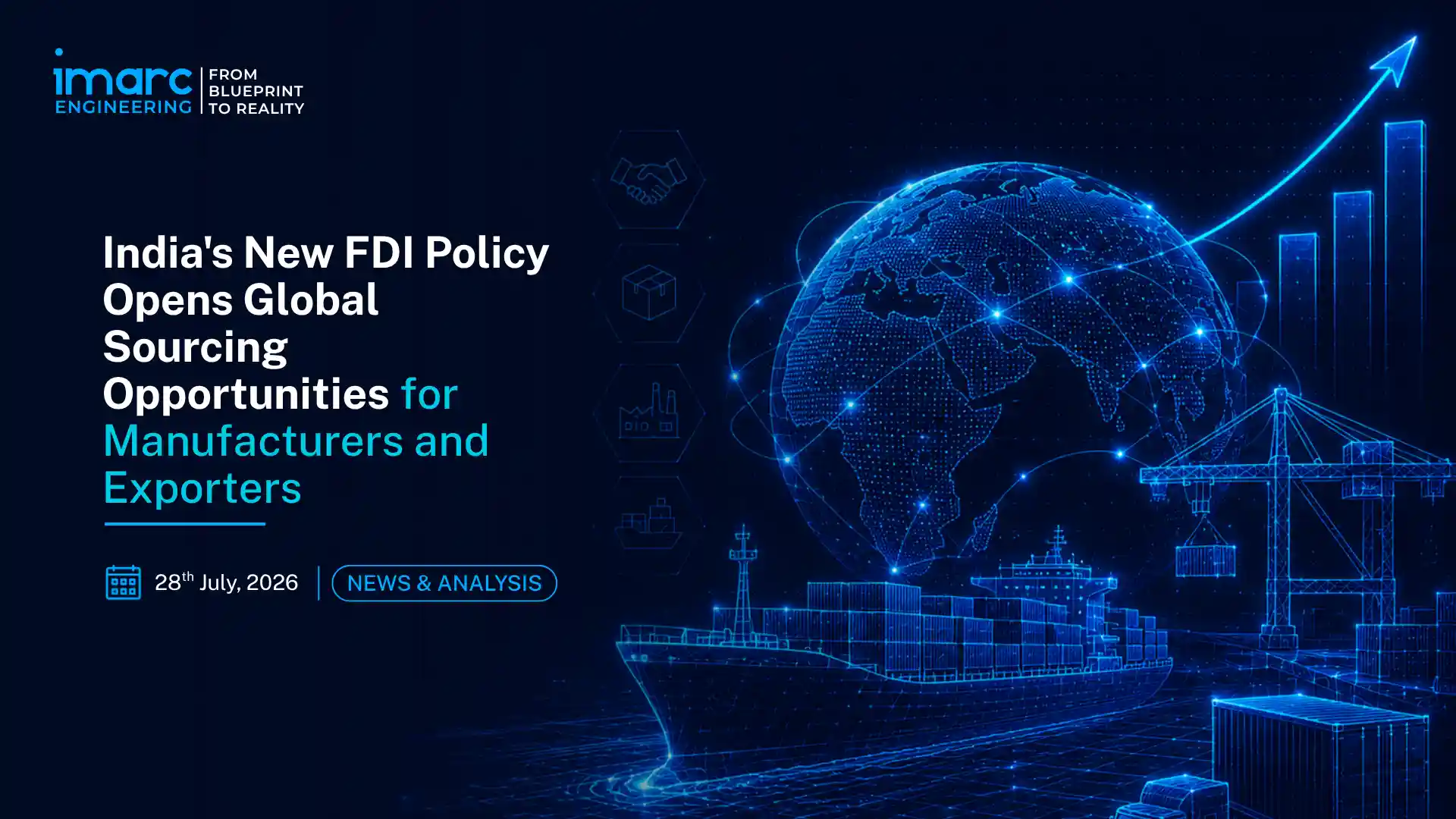
In July 2026, the Department for Promotion of Industry and Internal Trade (DPIIT) issued Press Note 3 of the 2026 Series, amending India's Consolidated FDI Policy to permit foreign direct investment in the inventory-based model of e-commerce, exclusively for the export of goods manufactured or produced in India. Until this amendment, 100% FDI under the automatic route was available only for the marketplace model of e-commerce, where platforms act as intermediaries between buyers and sellers.
The inventory-based model, where the platform owns the goods it sells, has remained closed to foreign investment for nearly a decade, a restriction originally designed to protect India's domestic retail sector. The new provision carves out a narrow but consequential exception: foreign-funded e-commerce entities can now own inventory in India, provided every unit sold is exported under the Foreign Trade Policy 2023 and the Foreign Exchange Management (Export of Goods & Services) Regulations, 2015. Domestic B2C retail remains untouched.
For manufacturers, exporters, and international procurement teams, this is a structural change to how global sourcing opportunities in India can be built and scaled, and it arrives alongside a broader wave of trade and export policy momentum that is reshaping India's position in global supply chains.
What Press Note 3 (2026 Series) Actually Changes
The amendment is precise rather than sweeping. It does not open India's retail sector to foreign ownership. It opens a single, export-only channel: an e-commerce entity may now hold and manage inventory of India-made goods inside the country for the specific purpose of shipping that inventory abroad.
Global platforms, most visibly Amazon and Walmart-owned Flipkart, both of which have lobbied for this change for years, can now warehouse India-manufactured products domestically and fulfil international orders directly, rather than routing every export transaction through a marketplace structure of independent third-party sellers.
This matters commercially because inventory ownership changes what a platform can do for a supplier. Under the marketplace model, a platform is a matchmaker; it cannot forecast demand against owned stock, consolidate shipments efficiently, or guarantee fulfilment timelines the way an owned-inventory model allows.
Under the new provision, foreign-funded platforms can build the warehousing, quality control, and export logistics infrastructure that turns manufacturing sourcing in India into a predictable, scalable channel for international buyers, precisely the kind of infrastructure that global retail and procurement teams look for before committing sourcing volumes to a new country.
Why This Strengthens Global Sourcing in India
India's new FDI policy lands at a moment when the underlying export numbers are already moving in the right direction. Cumulative merchandise and services exports for April–June 2026-27 are estimated at approximately USD 232.73 billion, up close to 11.4% over the same period last year, and merchandise exports alone grew by more than 15% year-on-year in the same quarter.
Commerce and Industry Minister Piyush Goyal have projected merchandise export growth of around 17% and services export growth of around 11% for the year, with a stated ambition of reaching USD 1 trillion in combined exports. The India–UK Comprehensive Economic and Trade Agreement, which came into force on July 15, 2026, gives 99% of Indian exports duty-free access to the UK market, a tariff advantage that stacks directly on top of the new e-commerce FDI channel for manufacturers targeting that corridor.
Amazon has already stated a target of USD 80 billion in cumulative India-origin exports by 2030, and the government's own ambition for e-commerce exports specifically sits between USD 200-300 billion by the same year, a figure India is currently well short of.
The FDI policy for exporters announced through Press Note 3 is, in effect, the regulatory unlock that both of these targets depend on: without permission to hold export-bound inventory domestically, foreign platforms could not build the fulfilment infrastructure that volumes of this scale require.
What It Means for Manufacturers, Exporters, and Global Buyers
For Indian manufacturers and MSMEs, which already account for close to 48.6% of India's total exports, the practical effect of export sourcing in India becoming easier is access to a platform's logistics network, quality benchmarking, and demand forecasting without each individual manufacturer having to build export capability from scratch.
Categories already visible in India's MSME export mix, textiles and garments, handicrafts, gems and jewellery, personal care and packaging, automotive components, and food-grade materials, are the categories best positioned to benefit first, since global platforms will prioritise product lines where India already demonstrates cost competitiveness and consistent quality.
For international buyers and procurement teams, the amendment lowers a specific kind of friction: the uncertainty of sourcing from a market where inventory control, return handling, and fulfilment reliability sat with a patchwork of independent sellers rather than an accountable owned-inventory operator. As global brands continue to diversify away from single-country sourcing under the broader “China Plus One” trend, supplier sourcing in India becomes commercially simpler when a foreign-funded platform can guarantee inventory availability and export compliance directly.
But the policy change does not, by itself, solve the operational work of finding the right supplier. Identifying manufacturers with the right capacity, certifications, and quality systems; evaluating vendors against production capability and compliance history; and structuring the contracts, inspection regimes, and logistics arrangements that make a sourcing relationship reliable, this remains a distinct body of work. It is exactly the reason sourcing consultants in India and dedicated sourcing services in India exist: to convert a policy opening into an operating supply chain.
The Execution Gap Behind the Policy Announcement
A liberalised FDI policy is a necessary condition for scaled global sourcing in India, not a sufficient one. Global platforms entering the inventory-export model will still need to build warehousing capacity, quality inspection protocols, and supplier onboarding pipelines from a standing start in most product categories. Manufacturers seeking to plug into this channel will need to demonstrate export-grade production consistency, documentation, and capacity headroom that many domestically focused factories have not yet built.
And procurement teams evaluating India manufacturing exports as a new sourcing geography will still need on-the-ground supplier identification, factory audits, and vendor evaluation before committing volume, the same due diligence any new sourcing market requires, policy tailwind or not.
This is where the gap between policy announcement and functioning supply chain typically opens up. The government has removed a regulatory barrier; it has not built the supplier discovery, vendor qualification, and quality assurance infrastructure that determines whether a specific manufacturer is actually ready to fulfil international orders at the volume and consistency a global platform requires.
Press Note 3 (2026 Series) removed a decade-old restriction in five sentences of regulatory text. Turning that opening into reliable export volume, supplier by supplier, factory by factory, is the work that determines who actually captures India's global sourcing opportunity.
IMARC Engineering’s Perspective
India's new FDI policy is a genuine structural opening, but the manufacturers and global buyers who benefit fastest will be the ones who pair the policy change with disciplined sourcing execution. At IMARC Engineering, we see Press Note 3 (2026 Series) as validating exactly the kind of manufacturing sourcing in India work we support: identifying manufacturers with export-ready capacity, running vendor evaluation and factory audits against international quality and compliance benchmarks, and helping suppliers build the production discipline, documentation, and capacity planning that export-oriented buyers and platforms require before they commit volume.
A policy amendment can open a channel; it cannot, on its own, verify that a specific factory can hold a tolerance, meet a delivery schedule, or pass an international quality audit. That verification work, supplier identification, technical and quality evaluation, and capacity planning support, is what turns global sourcing opportunities in India from a policy headline into a functioning, reliable supply chain.
As international buyers and platforms move to capitalise on this opening, the manufacturers who have already done the work of becoming export-ready, and the procurement teams that have proper sourcing support in place, will be the ones who capture the volume first.
Latest News
-
China's Tunnel Boring Machine Export Controls Put Focus on India's Proposed USD 1.2 Billion Manufacturing Incentive Scheme
October 22, 2026
-
NTPC Plans Nuclear Power Project Feasibility Studies in More Indian States, Including Uttar Pradesh
October 21, 2026
-
NITI Aayog Releases Data Centre Evaluation Framework, Highlights Power and Water Planning Risks
October 20, 2026
-
Tamil Nadu Allocates INR 98 Lakh for DPR Preparation of Five Infrastructure Projects in Chennai
October 16, 2026
-
SunBridge BioEnergy Starts Commercial Production at INR 350 Crore, 300 KLD Ethanol Plant in Madhya Pradesh
October 15, 2026
Trusted by Industry Leaders
We partner with global enterprises and ambitious businesses across sectors to deliver operational excellence, strategic insights, and sustainable growth through integrated solutions.










Success in Their Words
Real feedback from clients across industries. Discover how our solutions delivered measurable impact and operational excellence.

I wanted to express my sincere appreciation for your efforts in handling this matter. Your dedication and commitment have been truly commendable, and it is evident that you have put in tremendous hard work and expertise into resolving the issues at hand. We are greatly interested in continuing our collaboration with you in the future, as your professionalism and reliability have made you a trusted partner. Thank you once again for your invaluable contribution. We look forward to strengthening our partnership ahead.

It has been a pleasure working with the IMARC team. The insights provided were structured, clear, and highly valuable, helping us strengthen both our technical and financial planning with confidence. We deeply appreciate the team’s professionalism, responsiveness, and attention to detail throughout the engagement. Every requirement was well understood and effectively incorporated, resulting in a comprehensive and actionable output. Overall, our experience has been excellent, and I would gladly recommend IMARC to organizations seeking a reliable research partner.

Your service is truly exceptional. Working with the IMARC team has been a seamless and professional experience. The clarity of communication, responsiveness to queries, and consistent support at every stage made the entire engagement highly efficient. The insights shared were well-structured, practical, and perfectly aligned with our requirements, helping us make informed decisions with confidence. Overall, the dedication and professionalism demonstrated by your team stand out, and I would be glad to recommend IMARC as a reliable and trustworthy research partner.

IMARC did an outstanding job in preparing our study. They were punctual, precise, and consistently responsive throughout the entire process. The team delivered all the data we required in a clear, well-organized, and highly professional format. Their strong attention to detail, combined with their ability to meet every deadline without compromising quality, truly set them apart. Overall, their reliability and commitment made them an exceptional partner for our project, and we would gladly work with them again in the future.

IMARC made the whole process incredibly easy from start to finish. Everyone I interacted with via email was polite, professional, and straightforward to deal with, always keeping their promises regarding delivery timelines and remaining consistently solutions-focused. From my very first contact, I appreciated the professionalism and support shown by the entire IMARC team. I highly recommend IMARC to anyone seeking timely, affordable, and reliable information or advice. My experience with IMARC was excellent, and I truly cannot fault any aspect of it.

I’d like to express my sincere gratitude for the excellent work you accomplished with the study. Your ability to quickly understand our requirements and deliver high-quality results under tight timelines truly reflects your expertise, exceptional work ethic, and unwavering commitment to your customer’s success. The professionalism and responsiveness you demonstrated throughout the process made a significant difference. Our entire team and company are incredibly thankful for your dedication, reliability, and support. Once again, thank you for your outstanding contribution.
Ready to Experience the IMARC Advantage?
Whether you're planning a new facility, expanding operations, optimizing performance, or facing complex challenges—IMARC Engineering brings the expertise, experience, and commitment needed for success.