Haryana's Industrial Expansion Package Strengthens Manufacturing Investment and Greenfield Project Opportunities
July 29, 2026
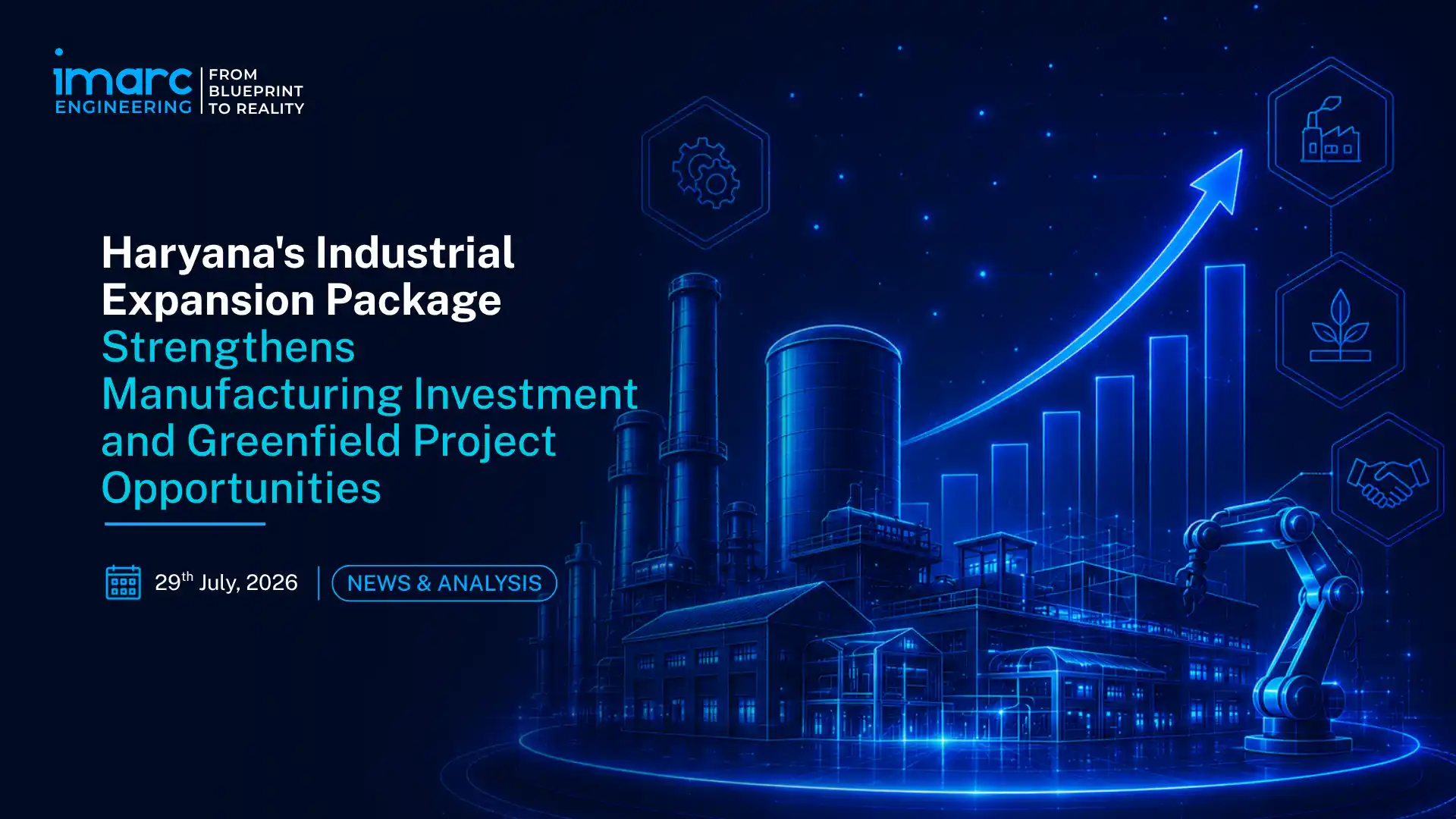
In June 2026, Chief Minister Nayab Singh Saini formally launched the Make in Haryana Industrial Policy 2026, alongside nine sector-specific policies the state cabinet approved. Together, this package of ten policies replaces the Haryana Enterprises and Employment Policy 2020 and became effective from May 26, 2026, running for five years.
The state is targeting INR 5 lakh crore in fresh investment and 10 lakh new jobs over that period. The scale of early response has been notable: Haryana signed MoUs worth INR 1.10 lakh crore on the launch day alone. For manufacturers evaluating new production capacity in North India, the Haryana industrial expansion package is not a single incentive scheme, it is a structural rewrite of how the state allocates land, disburses incentives, and courts greenfield investment.
What the Industrial Expansion Package Includes
The most consequential structural change in the Haryana industrial policy is the removal of the old A, B, C, and D block classification system, which for years concentrated incentives in a handful of designated regions and left large parts of the state industrially underdeveloped. In its place, the new framework introduces a revised categorisation, Core, Intermediate, Sub-Prime, and Prime/Focus Areas, that extends industrial incentives across every block in Haryana. This is a deliberate move toward balanced regional Haryana industrial development, ensuring that manufacturing investment in Haryana is no longer concentrated only around Gurugram and Faridabad.
The package also addresses a long-standing investor complaint about incentive delivery speed. Approvals, land allocation, incentives, and regulatory clearances are now being routed through an AI-enabled Intelligent Investment Facilitation Portal, described by officials as an “AI Single Window 2.0”, intended to compress the time between application and ground-breaking for new industrial project development in Haryana.
Why Manufacturing Investment in Haryana is Accelerating
The policy's ten-document structure covers sector-specific frameworks for electronics and ESDM, data centres, IT and emerging technology, Global Capability Centres, EVs, renewable energy, pharmaceuticals, animation and gaming, and agri-processing, reflecting a state government betting simultaneously on traditional manufacturing expansion in India and on next-generation, technology-intensive industry.
Haryana's new Data Centre Policy 2026 grants “Essential Service” status to data infrastructure and offers dedicated incentives for hyperscale installations above 10 MW. That framework has already converted into a concrete commitment: Anant Raj signed an MoU worth INR 20,000 crore for data centre infrastructure expected to create around 6,000 jobs and add 307 MW of IT capacity by FY2032.
On the ground, land allotment activity has kept pace with the policy announcement. Following the Gurugram Investment Summit, the state's Empowered Executive Committee approved allotment of more than 36 acres of industrial land across Sohna, Bawal, Barhi, and Dhatheda within a single week in June 2026, to seven companies. HSIIDC officials estimate those approved projects alone represent investments worth INR 1,315.70 crore and more than 5,000 direct jobs.
In parallel, HSIIDC opened a major e-auction of industrial plots across ten industrial estates, including IMT Kharkhoda, IMT Manesar Phase-V, IMT Faridabad, IGC Saha, Kundli, Rai, Narwana, Sirsa, and Panchkula Extension-II, giving manufacturers, logistics operators, and warehousing firms a formal, transparent route to acquire industrial land inside Haryana's established industrial corridor network.
Which Industries Are Likely to Benefit
The policy explicitly prioritises future-oriented sectors, semiconductors, electric vehicles, renewable energy, green hydrogen, and advanced manufacturing, alongside dedicated incentives for R&D infrastructure, patent commercialisation, and export promotion. A separate announcement details a planned 250-350-acre toy industry cluster under the policy, with ESDM companies receiving capital subsidies, tax benefits, and skill development support specifically designed to build export capacity in electronics manufacturing.
Green manufacturing is also structurally incentivised, with support for renewable energy adoption, zero liquid discharge systems, and carbon credit generation for new industrial units, signalling that greenfield manufacturing projects in Haryana with strong environmental compliance will draw stronger policy backing than conventional facilities. Export-oriented units affected by recent geopolitical trade disruptions are separately eligible for one-time diversification support, a provision aimed directly at manufacturers restructuring supply chains away from single-market dependence.
Why Haryana is Becoming Attractive for Greenfield Manufacturing Projects
The state sits inside the Delhi-NCR industrial belt, with over 40 HSIIDC-managed industrial estates already established, ranging from the mature IMT Manesar manufacturing hub to newer zones such as IMT Kharkhoda in Sonipat.
The Haryana Orbital Rail Corridor, a dedicated freight and connectivity line under construction by HSIIDC and the Ministry of Railways, is designed to link these industrial estates directly to national logistics networks, infrastructure of exactly the kind that determines whether a greenfield manufacturing project can move raw materials and finished goods efficiently once commissioned.
What Manufacturers Should Consider Before Establishing a New Facility
A favourable policy environment changes the economics of entering Haryana, but it does not remove the technical work of actually establishing a plant. Manufacturers evaluating manufacturing plant setup in Haryana still need a structured feasibility study that tests site-specific factors, land classification under the new Core/Intermediate/Sub-Prime/Prime framework, utility availability, proximity to raw material and labour markets, and connectivity to the Orbital Rail Corridor and national highway network, against the specific production process the facility will run.
Site selection itself has become more consequential now that incentives are no longer concentrated in a fixed set of blocks; a manufacturer must weigh land cost, industrial estate maturity, and utility infrastructure readiness across a wider set of options than the old policy offered.
Regulatory approvals, environmental clearance, factory licensing, fire safety, and pollution control board consent, still follow their own statutory timelines regardless of how fast the AI Single Window processes incentive applications, and must be sequenced correctly against civil construction and equipment procurement to avoid delaying commissioning.
Detailed engineering, utility sizing, plant layout, material handling systems, and building services should be planned early enough to inform land selection and plot sizing rather than being developed after land allocation. And construction supervision and phased commissioning discipline determine whether a facility built under this accelerated policy window actually starts production on the schedule the investment case assumed.
Haryana signed INR 1.10 lakh crore in MoUs on the day it launched its new industrial policy. The distance between a signed MoU and an operating manufacturing plant is engineering and project execution, and that is where the real opportunity in Haryana's industrial expansion now lies.
IMARC Engineering’s Perspective
Haryana's industrial expansion package is one of the most substantive state-level manufacturing investment reforms India has seen in 2026, and the early numbers, INR 1.10 lakh crore in day-one MoUs, active HSIIDC land allotments, and a functioning e-auction pipeline across ten industrial estates, suggest the state intends to convert policy into ground-broken projects quickly. At IMARC Engineering, we see this as exactly the kind of environment where engineering discipline determines who captures the opportunity fastest.
A revised incentive structure and a faster approval portal do not, by themselves, produce a commissioned facility. That requires the same fundamentals every greenfield project depends on: rigorous feasibility studies and site selection that account for Haryana's new land categorisation, DPR preparation aligned with the sector-specific policy the project falls under, detailed engineering for utilities and process infrastructure, and coordinated regulatory approval and construction management that keeps a project on the accelerated timeline the policy is designed to support.
At IMARC Engineering, we support manufacturers evaluating industrial investment in Haryana, from ESDM and EV component makers to pharmaceutical, renewable energy, and advanced manufacturing units, with the full spectrum of engineering and project development services needed to move from policy announcement to operating plant. As Haryana's manufacturing sector absorbs this new wave of investment, the manufacturers who pair the state's incentive architecture with sound engineering planning will be the ones who commission their facilities on schedule.
Latest News
-
Tamil Nadu Shortlists Cheyyur and Manellore for Chennai’s Second Airport, AAI to Assess Feasibility
September 10, 2026
-
East Central Railway Invites INR 4,040 Crore EPC Bids for Koderma Detour Double-Line Project
September 09, 2026
-
NHAI Receives 17 Bids for INR 8,300 Crore Rameshwar-Paradeep Coastal Highway Project
September 08, 2026
-
Octillion Opens 3 GWh EV Battery Manufacturing Plant in Gujarat, Expands India Capacity to 9 GWh
September 07, 2026
-
Bihar Approves 336-Km Buxar-Bhagalpur Greenfield Expressway Under PPP Model
September 04, 2026
Trusted by Industry Leaders
We partner with global enterprises and ambitious businesses across sectors to deliver operational excellence, strategic insights, and sustainable growth through integrated solutions.









Success in Their Words
Real feedback from clients across industries. Discover how our solutions delivered measurable impact and operational excellence.

I wanted to express my sincere appreciation for your efforts in handling this matter. Your dedication and commitment have been truly commendable, and it is evident that you have put in tremendous hard work and expertise into resolving the issues at hand. We are greatly interested in continuing our collaboration with you in the future, as your professionalism and reliability have made you a trusted partner. Thank you once again for your invaluable contribution. We look forward to strengthening our partnership ahead.

It has been a pleasure working with the IMARC team. The insights provided were structured, clear, and highly valuable, helping us strengthen both our technical and financial planning with confidence. We deeply appreciate the team’s professionalism, responsiveness, and attention to detail throughout the engagement. Every requirement was well understood and effectively incorporated, resulting in a comprehensive and actionable output. Overall, our experience has been excellent, and I would gladly recommend IMARC to organizations seeking a reliable research partner.

Your service is truly exceptional. Working with the IMARC team has been a seamless and professional experience. The clarity of communication, responsiveness to queries, and consistent support at every stage made the entire engagement highly efficient. The insights shared were well-structured, practical, and perfectly aligned with our requirements, helping us make informed decisions with confidence. Overall, the dedication and professionalism demonstrated by your team stand out, and I would be glad to recommend IMARC as a reliable and trustworthy research partner.

IMARC did an outstanding job in preparing our study. They were punctual, precise, and consistently responsive throughout the entire process. The team delivered all the data we required in a clear, well-organized, and highly professional format. Their strong attention to detail, combined with their ability to meet every deadline without compromising quality, truly set them apart. Overall, their reliability and commitment made them an exceptional partner for our project, and we would gladly work with them again in the future.

IMARC made the whole process incredibly easy from start to finish. Everyone I interacted with via email was polite, professional, and straightforward to deal with, always keeping their promises regarding delivery timelines and remaining consistently solutions-focused. From my very first contact, I appreciated the professionalism and support shown by the entire IMARC team. I highly recommend IMARC to anyone seeking timely, affordable, and reliable information or advice. My experience with IMARC was excellent, and I truly cannot fault any aspect of it.

I’d like to express my sincere gratitude for the excellent work you accomplished with the study. Your ability to quickly understand our requirements and deliver high-quality results under tight timelines truly reflects your expertise, exceptional work ethic, and unwavering commitment to your customer’s success. The professionalism and responsiveness you demonstrated throughout the process made a significant difference. Our entire team and company are incredibly thankful for your dedication, reliability, and support. Once again, thank you for your outstanding contribution.
Ready to Experience the IMARC Advantage?
Whether you're planning a new facility, expanding operations, optimizing performance, or facing complex challenges—IMARC Engineering brings the expertise, experience, and commitment needed for success.