Automotive
February 06 2026
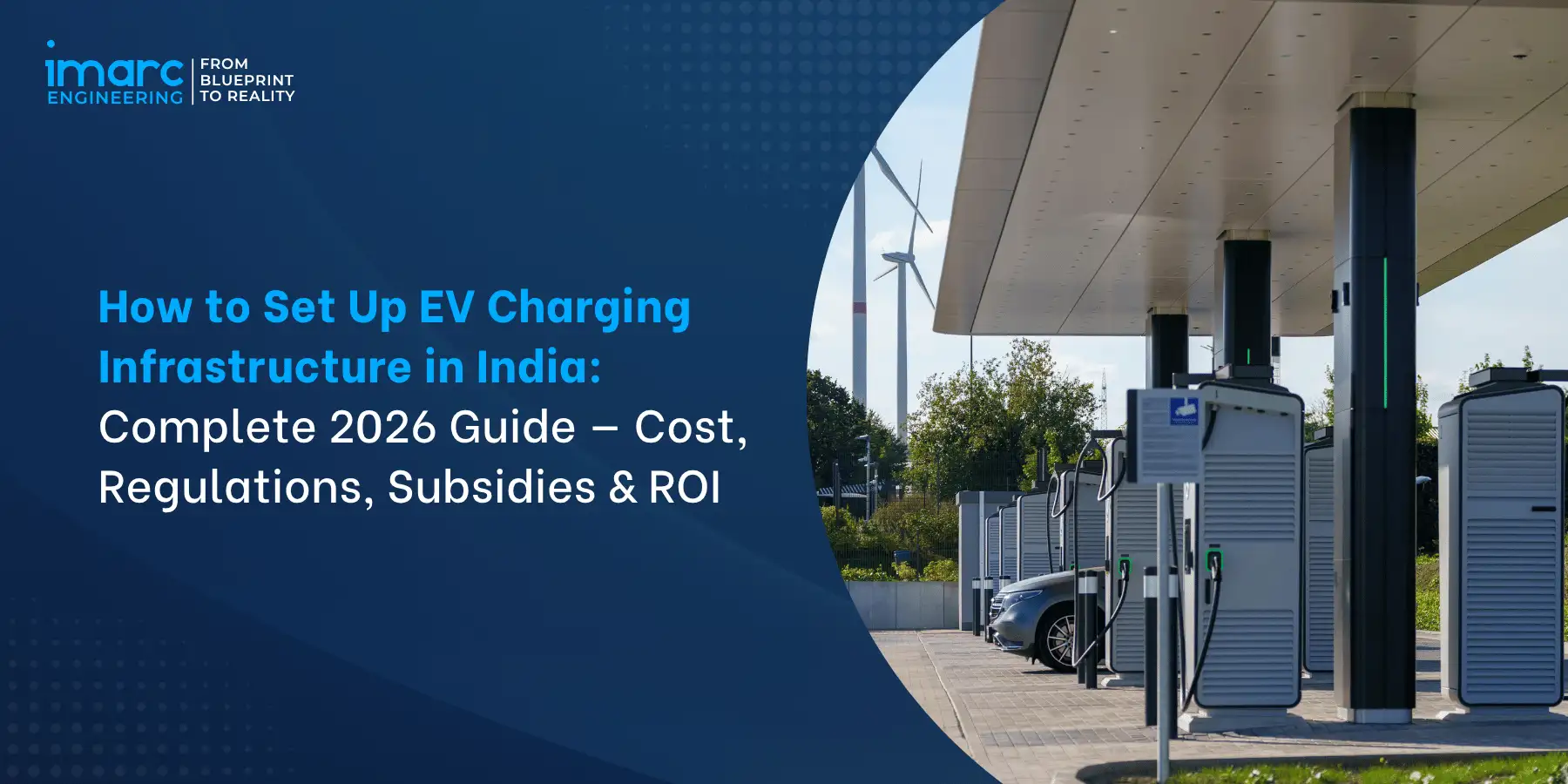
How to Set Up EV Charging Infrastructure in India: Complete 2026 Guide — Cost, Regulations, Subsidies & ROI
Introduction
The number of public EV charging stations in India expanded from around 5,000 in FY21 to over 26,000 in FY25, a fivefold rise in three years. However, despite this progress, the country remains at a ratio of 1 EV charging station per 235 electric vehicles. With the government allocating INR 10,900 crore under the PM E-DRIVE initiative and the country's requirement exceeding 13,00,000 public charging stations by 2030, the difference between the current scenario in India and what is required is one of the most attractive opportunities in infrastructure investment for the country.
For infrastructure developers, fleet owners, real estate companies, and investors looking at where to allocate their investments in the energy transition story in India, EV charging is no longer a high-risk, high-reward investment opportunity. It is a mature, policy-supported asset class with continually improving economics, an ever-expanding customer base, and a well-defined policy framework.
Based on the practical knowledge and experience of IMARC Engineering in EV infrastructure consulting, from conducting feasibility studies and site identification to grid integration and startup, this resource guide takes the reader through all the steps involved in developing EV charging infrastructure in India.
Table of Contents
- Section 1: India's EV Charging Market — Why Now?
- Section 2: EV Charging Station Setup Cost in India (2026 Breakdown)
- Section 3: Business Models & ROI for EV Charging Stations
- Section 4: Regulatory Framework & Government Subsidies
- Section 5: Site Selection & Feasibility Assessment
- Section 6: Choosing the Right EV Charger Technology
- Section 7: Grid Integration & Power Strategy
- Section 8: Engineering, Installation & Commissioning
- Section 9: Operations, Maintenance & Revenue Optimization
- Section 10: Scaling Your EV Charging Network
- Section 11: Latest Developments (2025–2026)
- Conclusion
- Frequently Asked Questions
Section 1: India's EV Charging Market — Why Now?
1.1 Market Size & Growth Trajectory
The adoption of electric vehicles in India is gaining momentum in all categories. In FY25, two-wheelers accounted for 6.4% of overall sales, followed by 31.8% for passenger three-wheelers and 21.6% for cargo three-wheelers. Four-wheelers are at 4.3%, which is in the early stages but is set to move quickly as more models become available and the total cost of ownership comes closer to that of gasoline-powered cars.
The challenge in the infrastructure deficit is where the truth lies. As of now, India has over 29,000 public charging stations, but the demand by 2030 is expected to be more than 1.3 million. This deficit will need constant investment of thousands of crores every year for the next five years to fill. The government's INR 10,900 crore PM E-DRIVE plan (FY2024-26) and the NITI Aayog's India Electric Mobility Index, launched in August 2025, show that the intent is now matched with serious outlays of capital.
1.2 The Business Case for EV Charging Infrastructure
The Indian market for electric vehicle charging services is expected to register a substantial CAGR through 2030. For investors, the investment opportunity provides several sources of revenue, including charging tariffs (per unit of electricity), membership models, fleet business, co-located amenities, and new sources of revenue such as grid services and carbon credits.
For real estate companies, electric vehicle charging infrastructure has become a necessary amenity in high-end commercial, retail, and residential real estate, with commercial real estate in Tier-1 cities now commanding a tangible rental premium if electric vehicle charging infrastructure is provided. For fueling companies and logistics companies, it provides a defensive investment to protect against demand destruction in their core businesses.
1.3 Who Should Invest in EV Charging Infrastructure?
- Infrastructure developers and Charge Point Operators (CPOs) building public charging networks.
- Real estate developers integrating EV charging into residential societies, commercial complexes, hotels, and malls.
- Fleet operators and logistics companies deploying depot and corridor charging for electric fleets.
- Fuel retail networks (petroleum companies transitioning to multi-fuel, multi-energy stations).
- PE/VC and infrastructure funds seeking exposure to India's energy transition.
- Government bodies and public sector undertakings implementing mandated public charging programs.
➤ Feasibility Study & Business Planning
Before committing capital, IMARC Engineering's feasibility study service evaluates technical viability, market potential, and financial returns specific to your EV charging project context.
Section 2: EV Charging Station Setup Cost in India (2026 Breakdown)
The most searched commercial intent question in this topic group is: “How much does it cost to set up an EV charging station in India?” And the answer to that question is: it depends, just like in any other infrastructure development. Below is the most detailed cost breakdown that is currently available for the Indian market.
2.1 Complete Capital Cost Breakdown by Station Size
| Cost Component | Small Station (2–4 chargers) | Medium Station (4–8 chargers) | Large Charging Hub (8–16+ chargers) |
|---|---|---|---|
| Land / Lease (annual) | 10–18% | 8–14% | 6–12% |
| Civil Works (foundation, canopy, drainage) | 10–15% | 10–13% | 8–12% |
| Transformer & Panel Upgrades | 15–28% | 18–25% | 20–28% |
| Cabling & Electrical Infrastructure | 5–10% | 6–10% | 6–10% |
| Charger Hardware | 30–40% | 35–45% | 40–55% |
| CMS Software & Networking | 3–6% | 3–5% | 2–4% |
| Safety, Fire NOC & Electrical Inspection | 2–4% | 2–3% | 1–3% |
| TOTAL | 100% | 100% | 100% |
IMARC Engineering Insight: In our experience advising EV charging projects, the most common budgeting mistake is underestimating upstream power infrastructure costs. Grid connectivity and transformer upgrades alone can add INR 5–15 lakh to a project that initially appeared to cost INR 25 lakh. Our CapEx planning service helps clients develop realistic, comprehensive project budgets before land agreements are signed.
2.2 Charger Hardware Cost Comparison
| Charger Type | Power Output | Charge Time (40 kWh) | Best Use Case |
|---|---|---|---|
| AC Slow | 3.3–7.4 kW | 6–12 hrs | Residential, offices |
| AC Fast | 11–22 kW | 2–4 hrs | Malls, hotels, depots |
| DC Fast | 30–60 kW | 40–80 min | Public corridors, hubs |
| DC Rapid | 120–160 kW | 15–25 min | Highways, city hubs |
| DC Ultra-Fast / MW-class | 240 kW–1 MW | 5–15 min | Heavy-duty, HDV corridors |
➤ Greenfield Project Management Services in India
Section 3: Business Models & ROI for EV Charging Stations
3.1 Business Model Comparison
| Model | Investment Level | Revenue Potential | Risk Profile | Best Suited For |
|---|---|---|---|---|
| CPO-Owned (Asset-Heavy) | High (₹50L–3Cr+) | High | High | Infrastructure developers, investors seeking direct control |
| Franchise / FOCO Model | Low–Medium | Medium | Low | Property owners wanting passive income from assets |
| Real Estate Integrated | Medium (embedded in project cost) | Medium (indirect value) | Low | Commercial/residential developers enhancing property value |
| Fleet / Depot Charging | Medium | Moderate (cost savings focus) | Low | Logistics firms, bus operators, ride-hailing fleets |
| PPP / Government-backed | Low–Medium (subsidized) | Regulated | Very Low | PSUs, DISCOMs, municipal bodies, state agencies |
3.2 Revenue Streams and Monetization
A well-structured EV charging business is not dependent on a single revenue line. The most commercially resilient operators stack multiple streams:
- Primary: Per-kWh charging fees. Current market range: INR 15–18/kWh for public DC fast charging.
- Subscription / fleet contracts: Fixed monthly fee for guaranteed charging access. Improves revenue predictability and reduces per-session sales cost.
- Advertising and digital display: High-traffic urban stations attract FMCG, automotive, and mobility brands. Revenue potential of INR 10,000–INR 50,000/month per high-visibility site.
- Co-located amenities: Cafes, convenience stores, restrooms. Stations with dwell-time-aligned amenities achieve 30–40% higher utilization than standalone chargers.
- Grid services / V2G: Demand response and virtual power plant participation, emerging in India, but already contractable with some progressive DISCOMs.
- Carbon credits: Under India's Carbon Credit Trading Scheme (CCTS) and related frameworks, green charging infrastructure generates tradeable credits, an additional IRR lever for large-scale operators.
3.3 ROI Projections & Break-Even Analysis
The following scenario models a medium-scale public DC fast charging station in a Tier 1 Indian city:
| Metric | Conservative (25% utilisation) | Realistic (40% utilisation) |
|---|---|---|
| Station Configuration | 4 × 60 kW DC Fast Chargers | 4 × 60 kW DC Fast Chargers |
| Break-Even Timeline | 7–10 years | 4–5 years |
Note: PM E-DRIVE subsidies can reduce effective CapEx by 40–80% on qualifying infrastructure, significantly improving the IRR and break-even timeline for eligible projects.
Section 4: Regulatory Framework & Government Subsidies
4.1 Do You Need a License to Set Up an EV Charging Station in India?
The quick answer is no – EV charging is a de-licensed activity under the Electricity Act, 2003 (as amended) in India. You do not need an electricity distribution license to set up a public charging station. This was a strategic choice to make it easier to enter the market and promote private sector investment.
However, de-licensed does not mean unregulated. What you do need:
- DISCOM connection approval: Load sanction, metering agreement, and grid connection from your local distribution company.
- Electrical Inspector certification: Mandatory inspection and sign-off before station goes live.
- Fire Safety NOC: From the local fire department, especially for stations above a certain load threshold.
- Building/municipal permissions: For civil structures (canopies, buildings) on the site.
- BIS-certified equipment: All chargers must use Bureau of Indian Standards certified hardware.
- OCPP/OCPI compliant CMS: Mandatory for networked chargers under MoP 2024 guidelines.
4.2 PM E-DRIVE Scheme: Complete Subsidy Guide (2026)
The PM Electric Drive Revolution in Innovative Vehicle Enhancement (PM E-DRIVE) scheme is India's most significant EV charging subsidy program. Key parameters:
- Total scheme outlay: INR 10,900 crore for FY2024–26.
- Charging infrastructure allocation: INR 2,000 crore for 72,300 charging stations, 22,100 DC fast chargers for four-wheelers, 1,800 for buses, and 48,400 for two/three-wheelers.
- Geographic focus: High-EV-penetration cities and national highway corridors.
- Subsidy rates: Up to 80% on upstream power infrastructure costs (transformer, panels, cabling); up to 100% in exceptional cases for remote or low-income areas.
- Eligible applicants: Central/state government agencies, DISCOMs, metro rail corporations, PSUs, and private entities via state government proposals.
- Application route: Through state nodal agencies (typically the state transport or energy department). Official portal: pmedrive.heavyindustries.gov.in
4.3 Ministry of Power Guidelines (September 2024) — Key Compliance Points
- Charger standards: CCS2 is the dominant DC fast charging standard. CHAdeMO is accepted for legacy vehicle compatibility. Bharat AC-001 and Bharat DC-001 standards apply for lower-power segments.
- Interoperability mandate: OCPP 2.0.1 compliance is mandatory for all networked chargers; OCPI for roaming across CPO networks.
- DISCOM connection timelines: 7 business days in metros, 15 days in municipal areas, 30 days in rural areas (from load application to sanction).
- GST structure: 18% GST on EV charging services (hardware); 5% on EVs themselves. Energy supplied through charging is not classified as 'electricity' for tax purposes — it is a service.
➤ Brownfield Project Management Services in India
Section 5: Site Selection & Feasibility Assessment
5.1 Critical Site Selection Criteria
Site selection is the variable that most determines long-term commercial performance. A well-executed site assessment conducted before land agreements are signed can be the difference between a 4-year payback and a 9-year one. Evaluate every potential location against these criteria:
- EV fleet density in the catchment: Number of registered EVs within 3–5 km. Cross-reference with local RTO data and EV registration growth trends.
- Traffic density and route type: Arterial roads, highway corridors, and transit interchange points consistently outperform residential streets on throughput.
- Dwell time alignment: The amount of time a typical user spends at the location must match the charging time of your charger type. A 5-minute errand does not suit a 45-minute DC fast charge.
- Grid proximity and capacity: Distance to the nearest transformer and available load headroom. Every 100m of additional cabling adds cost and complexity.
- Safety and accessibility: Clear entry/exit for vehicles including heavy-duty EVs, adequate lighting, and CCTV, mandatory for public acceptance and insurance.
- Competitive density: Are other CPOs already saturating the location? Utilization thins quickly in over-served micro-markets.
- Expansion potential: Land or parking capacity for additional bays as fleet penetration grows.
Government norms specify a minimum of 1 charging point for every 3 km in urban areas and 1 point for every 25 km on national highways, which forms a good benchmark for gap analysis. The most utilized categories of sites in the existing Indian market are highway rest stops, metro parking spots, bus stations, logistics hubs, fuel retail outlets, and business centers.
IMARC Engineering Field Observation: In our experience advising infrastructure developers, site selection determines 60–70% of a charging station's long-term utilization rate. Stations co-located with retail or food service establishments achieve 30–40% higher utilization than standalone stations, because dwell time aligns naturally with charging duration.
5.2 Feasibility Study Framework
A rigorous feasibility study conducted before land is committed should cover:
- Demand forecasting: Projecting charging sessions/day at 1, 3, and 5 years based on local EV fleet growth, competitor mapping, and price sensitivity.
- Grid assessment: Load flow study, transformer capacity analysis, DISCOM engagement, and upgrade cost estimation.
- Financial modelling: Full CapEx and OpEx model, revenue projection at multiple utilization scenarios, NPV, IRR, and sensitivity analysis.
- Regulatory mapping: Local permissions, DISCOM requirements, fire NOC process, and timeline to commissioning.
- Risk identification: Grid delay risk, competitor entry, technology obsolescence, and policy change scenarios.
➤ Location Analysis and Site Selection
➤ Feasibility Study & Business Planning
Section 6: Choosing the Right EV Charger Technology
6.1 AC vs DC Chargers — Decision Framework
The choice between AC and DC charging — and the power level within each category — is determined by your user profile, dwell time, and business model. There is no universally correct answer.
| Charger Type | Power Output | Charge Time | Best Use Case |
|---|---|---|---|
| AC Slow | 3.3–7.4 kW | 6–12 hrs | Home, office, residential society |
| AC Fast | 11–22 kW | 2–4 hrs | Hotels, destination retail, fleet depot |
| DC Fast | 30–60 kW | 40–80 min | Public stations, city hubs |
| DC Rapid | 120–160 kW | 15–25 min | Highway corridors, city fast-hubs |
| DC Ultra-Fast | 240 kW–1 MW | 5–15 min | Heavy-duty vehicles, HDV corridors |
In October 2025, VNT introduced India's first 1 MW EV charging solution developed entirely in-house designed for heavy-duty commercial vehicles with dynamic load balancing and smart energy management. This signals the rapid maturation of India's high-power charging technology ecosystem.
6.2 Charger Standards & Interoperability in India
- CCS2 (Combined Charging System 2): The dominant standard for DC fast charging. Mandated for all new four-wheeler DC chargers under MoP guidelines. Most Indian EV OEMs (Tata, MG, BYD, Hyundai) are CCS2-compatible.
- CHAdeMO: Used by a small number of Japanese OEMs. Declining globally but still relevant for legacy fleet compatibility.
- Bharat AC-001 / Bharat DC-001: India-specific standards for lower-power charging, predominantly for two and three-wheelers.
- OCPP 2.0.1: The Open Charge Point Protocol standard for communication between chargers and management systems. Mandatory for networked chargers under 2024 MoP guidelines.
- OCPI: Open Charge Point Interface enables roaming and interoperability between different CPO networks.
6.3 Charging Management System (CMS) Requirements
- Real-time remote monitoring: Fault detection, uptime tracking, energy metering, and alert escalation.
- Payment integration: UPI, credit/debit cards, RFID cards, and mobile app payment, all must be supported for maximum user accessibility.
- Dynamic pricing capability: Time-of-day pricing and demand-based rate adjustment to optimize revenue and manage peak load.
- Predictive maintenance alerts: Machine-learning-based fault prediction to reduce unplanned downtime.
- Fleet management integration: API connectivity with fleet management software for B2B customers.
➤ Equipment Selection and Technical Specifications Drafting
Section 7: Grid Integration & Power Strategy
7.1 Power Requirement Planning
Grid connection is always the most technically challenging and economically significant aspect of an EV charging scheme. The high density of charging loads causes a sudden and high concentration of demand, which, if not managed, results in grid instability, transformer saturation, and exorbitant demand charges.
The calculation of the station load is simple: add up the power ratings of all the chargers operating simultaneously (taking into account smart load diversity factors) and the other loads.
Critical steps for DISCOM engagement:
- Submit the load application with a detailed list of the loads and a single-line diagram as early in the project as possible, and the DISCOM approval timescales of 15 days can become the critical path.
- Ask for a feasibility study from the DISCOM if your load is above 100 kVA, and this will determine if any upgrades to the local infrastructure are required and who pays for it.
- Negotiate the parameters of the metering: Net metering eligibility (if solar is connected), time-of-day metering, and maximum demand.
7.2 Smart Charging & Load Management
- Time-of-Day (ToD) tariff optimization: Schedule fleet charging during off-peak hours (typically 11 PM–6 AM) to exploit lower tariff bands and reduce monthly bills by 20–35%.
- Dynamic load balancing: Distribute available power across chargers based on real-time demand, preventing any single charger from drawing beyond the sanctioned load and eliminating demand charge spikes.
- Demand response participation: Large-load EV charging stations can register with DISCOMs for demand response programs, curtailing load during grid stress events in exchange for incentive payments.
7.3 Renewable Energy Integration
Integrating on-site solar PV with EV charging is no longer a purely ESG decision — it is increasingly a commercial one. In states with high solar irradiance and expensive grid tariffs (Gujarat, Rajasthan, Tamil Nadu, Maharashtra), rooftop solar generating at INR 2.5–3.5/kWh can meaningfully cut the electricity cost component that represents 40–60% of operating expenses.
- Battery Energy Storage Systems (BESS): Pair solar generation with lithium-ion or LFP battery storage to enable peak shaving, backup power during outages, and time-shifting of cheap solar generation to high-tariff peak hours.
- Renewable Energy Certificates (RECs): Green energy procurement for EV charging generates RECs tradeable on the Indian Energy Exchange, an additional revenue stream and an ESG reporting asset.
IMARC Engineering Insight: Our engineering teams have managed grid integration for multiple charging installations across India. The most common challenge we encounter is underestimation of transformer and cabling requirements, which can delay project timelines by 2–3 months and inflate budgets by 20–30% if not planned from project inception.
➤ Utilities Planning — Water, Power, HVAC & Steam Services
Section 8: Engineering, Installation & Commissioning
8.1 Project Execution Phases
The long-term performance of a charging asset is determined in large part by the quality of its commissioning. Shortcuts during engineering or installation create reliability problems that are expensive and disruptive to fix post-launch.
- Phase 1 — Civil works: Site preparation, foundation work for charger mounting posts, drainage, parking bay marking, canopy or weather protection structure, perimeter lighting, and CCTV infrastructure.
- Phase 2 — Electrical infrastructure: Transformer installation or upgrade, LT panel and distribution board, feeder cabling from the utility connection point, earthing and lightning protection systems.
- Phase 3 — Charger installation: Mounting and securing charger hardware, inter-wiring, communication cabling (Ethernet/4G/fiber), CMS integration and configuration, payment system setup.
- Phase 4 — Testing and commissioning: End-to-end load testing, safety interlock verification, billing system validation, communication link testing, emergency shutdown testing, and regulatory inspection preparation.
8.2 Typical Project Timelines
| Phase | Activity | Small Station (2–4 chargers) | Medium (4–8 chargers) | Large Hub (8–16+ chargers) |
|---|---|---|---|---|
| Permitting & DISCOM | Load sanction, NOCs | 4–8 weeks | 6–12 weeks | 8–16 weeks |
| Civil Works | Foundation, civil, canopy | 2–4 weeks | 3–6 weeks | 5–10 weeks |
| Electrical Works | Transformer, panels, cabling | 2–3 weeks | 3–5 weeks | 5–8 weeks |
| Charger Install & CMS | Hardware + software + commissioning | 1–2 weeks | 2–3 weeks | 3–5 weeks |
| TOTAL PROJECT TIMELINE | Permitting to commissioning | 8–12 weeks | 12–20 weeks | 20–36 weeks |
8.3 Quality Assurance & Safety Standards
- IS 17017 compliances: The Indian Standard for EV charger safety, covering electrical insulation, earthing, environmental protection, and user interface safety.
- Electrical Inspector certification: Mandatory in most states before a charging station can be energized for public use.
- Fire Safety NOC: Required from the local fire department, typically triggered above a certain installed load or when a battery storage system is present.
- BIS product certification: All charger hardware sold or installed in India must carry BIS certification, verify before procurement.
Section 9: Operations, Maintenance & Revenue Optimization
9.1 Preventive Maintenance Framework
Operational excellence is the key commercial differentiation among the EV charging service providers in India. Uptime, and not the number of chargers, is the measure of customer satisfaction, Google reviews, and ultimately, revenue. The standard to be achieved is 95%+ uptime for DC fast chargers. This can be done through:
- Daily: Remote system health check via CMS dashboard; review of session data for anomalies; automated fault alerts.
- Weekly: Physical inspection of cable condition, connector cleanliness, signage, parking bay markings, and CCTV functionality.
- Monthly: Electrical connections torque check, earthing resistance test, software/firmware update review, revenue reconciliation audit.
- Quarterly: Full thermal imaging of electrical panels, charger hardware deep-clean, load testing, and battery storage health check (if applicable).
- Annual: Comprehensive third-party inspection, calibration verification for metering equipment, insurance renewal, and regulatory compliance review.
9.2 Pricing Strategy & Revenue Optimization
- Per-kWh pricing: INR 10–17/kWh is the current public market range in India. Set pricing to balance competitiveness with margin, avoid racing to the bottom on tariff, as utilization is driven more by reliability and convenience than by price for most EV users.
- Subscription models: Offer corporate fleet subscribers and frequent individual users a fixed monthly fee plus discounted per-kWh rate. This improves revenue predictability and ARPU while reducing churn.
- Dynamic / time-of-day pricing: Charge higher tariffs during peak demand hours (8–10 AM, 5–9 PM) and lower tariffs off-peak. This both optimizes revenue and manages load.
- Idle fees: A small penalty (INR 2–5/min) for vehicles occupying bays after charging completion, improves bay turnover and effective capacity.
9.3 Digital Platform & Customer Experience
India's EV charging market is maturing fast in terms of software infrastructure. In December 2025, Maruti Suzuki launched a common digital charging platform integrating 13 CPOs — giving users access to 2,000+ charging stations in 1,100 cities through a single mobile interface, with a target of more than 1,00,000 public stations by 2030. This inter-operable aggregator model is the direction the market is heading.
- List your stations on all major aggregator platforms: Tata Power EZ Charge, Bolt.Earth, Zeon Charging, PlugShare, and Google Maps. Discovery through aggregators can account for 40–60% of first-time sessions.
- Invest in user experience: In-app reservation, real-time charger availability, session start/stop control, digital receipts, and customer support chat. Session completion ratings are now a visible differentiator.
- Treat operational data as a business asset: Utilization patterns, peak demand windows, fault frequency by charger model, and revenue per bay per day, all are inputs to pricing optimization and network expansion decisions.
➤ Preventive Maintenance Planning
➤ Automation and Digital Monitoring Setup
Section 10: Scaling Your EV Charging Network
10.1 Network Expansion Strategy
Only after initial geos are stabilized and are producing good utilization data can the focus shift from installation to intelligent scaling. The players that will come to define the Indian EV charging market in the coming decade are those who are building scalable, data-driven growth engines, not just charging stations.
- Performance-based expansion: Use charger-level utilization data, revenue per bay, and peak demand timing to identify the profile of your highest-performing sites. Use that profile to score and prioritize candidate locations for expansion.
- Corridor development: Build charging density along inter-city highway routes to unlock range-anxiety-free long-distance EV travel, an untapped market segment that will grow rapidly as four-wheeler EV penetration increases.
- Standardization: Common site designs, equipment SKUs, procurement contracts, and operating procedures reduce per-site CapEx and OpEx as the network grows. Every deviation from standard increases cost.
10.2 Strategic Partnerships for Accelerated Growth
- OEM partnerships: Co-branded charging stations integrated with automaker apps and vehicle navigation systems provide guaranteed early utilization and marketing support. Tata Power's partnership with Tata Motors is the benchmark.
- Fleet and logistics partnerships: Long-term charging contracts with ride-hailing aggregators, e-commerce delivery fleets, and bus operators provide anchor utilization that de-risks new sites, the equivalent of an anchor tenant in retail real estate.
- Real estate partnerships: Embed charging in new commercial and residential developments during construction, far cheaper than retrofitting. Structure as a managed service agreement where the developer provides space and the CPO funds and operates the infrastructure.
- Fuel retail networks: HPCL's agreement with V-GREEN (December 2025) to deploy EV charging across 24,400+ fuel retail outlets is the most consequential distribution partnership in India's EV charging market to date. HPCL already operated 5,300 charging stations and 150 battery swapping stations before this agreement, the combined footprint creates a national charging network overnight.
Section 11: Latest Developments in India's EV Charging Sector (2025–2026)
- January 2026: MobiLane announced that it plans to break the 1,000 mark for EV charging stations in India by the end of 2026, up from 250+ units already installed, marking increasing confidence in the business case for public charging.
- January 2026: Incharz & NPCL, inaugurated a new EV charging plaza with 60 kW and 120 kW DC fast chargers and an AC charger for two-wheelers was announced in Greater Noida West for passenger as well as heavy vehicles.
- December 2025: V-Green & RoadGrid India entered into a strategic partnership for expanding EV infrastructure in India. RoadGrid announced handling installation and site activation, while V-Green will manage network ownership, software, and operations in order to implement fast EV charging at high-demand Smart City locations.
- December 2025: Maruti Suzuki introduced a unified digital charging infrastructure that will span more than 2,000 charging stations across with 13 CPOs integrated, 1,100 cities and aim to reach 1,00,000 public stations by 2030.
Conclusion: From Opportunity to Execution
The opportunity in India’s EV charging sector is now well-articulated, government-supported, and proven in the market. India must expand its public charging infrastructure by over 50 times in the next five years. Support from the government is genuine, with INR 10,900 crore of committed government capital, de-licensing, favorable tariffs, and state support schemes having significantly enhanced the investment climate. Technology is ready. And economics are viable for well-designed and well-located projects.
The difference between successful EV charging businesses and sub-par ones lies in the quality of execution – namely, the capacity to synthesize regulatory work, technical engineering, business planning, and operational management into a unified and sound program. The pitfalls of cost modeling, DISCOM delays, and grid integration issues that can sink projects are not unpredictable, they are predictable and avoidable with the right knowledge and planning rigor.
Whether it is your first foray into an EV charging project, an expansion of an existing charging network, or setting up an investment vehicle focused on EV infrastructure, IMARC Engineering offers comprehensive support and assistance with all the phases outlined in this guide. Our multi-disciplinary teams combine international best practices with deep India market knowledge to help clients establish, optimise, and scale world-class EV charging operations.
Frequently Asked Questions
Cost & Investment FAQs
Q: How much does it cost to set up an EV charging station in India?
Setup costs range from INR 15–30 lakh for a small 2–4 charger station to INR 1–3 crore or more for a large charging hub with 8–16+ DC fast chargers. The primary cost drivers are: charger hardware type and count, grid connection and transformer requirements, civil infrastructure, and location. Projects in urban locations with existing grid capacity at the lower end of that range; highway sites requiring new transformer connections sit at the top.
Q: Is setting up an EV charging station profitable in India?
Yes — for well-planned projects in high-EV-penetration locations, EV charging stations are commercially viable. The key variables are site utilization rate, tariff structure, CapEx including grid costs, and operating model.
Q: What is the ROI on an EV charging station investment?
ROI depends heavily on utilization, which is itself driven by site quality, charger reliability, and local EV fleet density. Numbers vary in cases of conservative modelling (25% utilization) and realistic utilization (40%+).
Regulatory & Licensing FAQs
Q: Do I need a license to set up an EV charging station in India?
No electricity distribution license is required, EV charging is a de-licensed activity under the Electricity Act, 2003. However, you do need: a DISCOM connection approval, Electrical Inspector sign-off before energizing, a Fire Safety NOC, relevant building permissions for civil structures, and BIS-certified charger hardware. Networked chargers must also be OCPP 2.0.1 compliant.
Q: What government subsidies are available for EV charging infrastructure in 2026?
The PM E-DRIVE scheme is the primary central government subsidy program — allocating INR 2,000 crore for 72,300 charging stations with subsidies of up to 80% on upstream power infrastructure. State governments offer additional incentives including capital subsidies on charger hardware, preferential EV electricity tariffs, and land concessions through industrial estates.
Q: How do I apply for the PM E-DRIVE subsidy?
Private entities apply through the relevant state government's nodal agency (typically the state transport or energy department), which then submits consolidated proposals to the central government. Government bodies, DISCOMs, metro rail corporations, and PSUs can apply more directly. The official scheme portal is pmedrive.heavyindustries.gov.in. IMARC Engineering's regulatory advisory team assists clients in navigating the application process.
Q: What safety standards must EV charging stations meet in India?
Key standards include: IS 17017 (EV charger safety), BIS product certification for all hardware, electrical earthing and insulation standards per IS 3043, and fire safety compliance per NBC (National Building Code) requirements. OCPP 2.0.1 is mandated for networked chargers under the September 2024 MoP Guidelines.
Technical & Operational FAQs
Q: What is the difference between AC and DC EV chargers?
AC chargers supply alternating current to the vehicle's onboard charger, which converts it to DC for the battery. They are slower (3.3–22 kW) but cheaper and well-suited for locations where vehicles park for extended periods. DC chargers bypass the onboard charger and supply direct current directly to the battery — enabling much faster charging (30 kW to 1 MW+) at higher cost. DC fast chargers are essential for public corridors and any site where vehicles park for under 60–90 minutes.
Q: Which charger connector standard should I choose for India?
For DC fast charging (30 kW+): CCS2 is the dominant standard and is mandated for all new four-wheeler DC chargers. All major Indian EV OEMs (Tata Motors, MG, Hyundai, BYD, Mahindra) are CCS2-compatible. For AC charging: Type 2 (IEC 62196) for 11–22 kW applications. For two/three-wheelers: Bharat AC-001 and Bharat DC-001 standards apply.
Q: How long does it take to set up an EV charging station?
A small station (2–4 chargers) typically takes nearly 8–12 weeks from permitting to commissioning. A medium station (4–8 chargers) takes nearly 12–20 weeks. A large hub (8–16+ chargers) takes 20–36 weeks. The longest lead-time item is almost always DISCOM load sanction, therefore it is suggested to begin this process as early as possible in your project planning.
Q: Can I set up an EV charging station at my commercial property or residential society?
Yes. Commercial properties and residential housing societies are among the most viable locations for EV charging, particularly AC fast chargers (11–22 kW). For residential societies, you will need residents' association approval, a DISCOM connection (either from the society's existing meter or a separate commercial connection), and electrical safety clearance. For commercial properties, EV charging can be an amenity that adds rental value and may qualify for PM E-DRIVE or state subsidy support.
IMARC Engineering FAQs
Q: How does IMARC Engineering help with EV charging infrastructure projects?
IMARC Engineering provides integrated advisory and execution support across the full EV charging project lifecycle — from initial feasibility studies and market assessment, through site selection, regulatory approvals, CapEx/OpEx planning, equipment procurement, engineering design, installation supervision, commissioning, and ongoing operational readiness planning. We work with infrastructure developers, real estate firms, fleet operators, and investors across India.
Q: Does IMARC provide end-to-end project management for EV charging stations?
Yes. IMARC Engineering offers turnkey project management for EV charging infrastructure, acting as the single accountable partner from project concept through to operational handover. This includes managing DISCOM engagement, contractor coordination, equipment procurement, civil and electrical works supervision, commissioning testing, and regulatory inspection preparation.
Q: Can IMARC help with feasibility studies for EV charging investments?
Absolutely. Feasibility assessment is one of IMARC Engineering's core services for EV charging clients. We conduct demand forecasting, site scoring, grid capacity analysis, financial modelling (IRR, NPV, break-even scenarios), subsidy eligibility mapping, and risk identification — providing investors and developers with the analytical foundation needed to make high-confidence capital deployment decisions.
Recent Post

Trusted by Industry Leaders
We partner with global enterprises and ambitious businesses across sectors to deliver operational excellence, strategic insights, and sustainable growth through integrated solutions.











Success in Their Words
Real feedback from clients across industries. Discover how our solutions delivered measurable impact and operational excellence.

I wanted to express my sincere appreciation for your efforts in handling this matter. Your dedication and commitment have been truly commendable, and it is evident that you have put in tremendous hard work and expertise into resolving the issues at hand. We are greatly interested in continuing our collaboration with you in the future, as your professionalism and reliability have made you a trusted partner. Thank you once again for your invaluable contribution. We look forward to strengthening our partnership ahead.

It has been a pleasure working with the IMARC team. The insights provided were structured, clear, and highly valuable, helping us strengthen both our technical and financial planning with confidence. We deeply appreciate the team’s professionalism, responsiveness, and attention to detail throughout the engagement. Every requirement was well understood and effectively incorporated, resulting in a comprehensive and actionable output. Overall, our experience has been excellent, and I would gladly recommend IMARC to organizations seeking a reliable research partner.

Your service is truly exceptional. Working with the IMARC team has been a seamless and professional experience. The clarity of communication, responsiveness to queries, and consistent support at every stage made the entire engagement highly efficient. The insights shared were well-structured, practical, and perfectly aligned with our requirements, helping us make informed decisions with confidence. Overall, the dedication and professionalism demonstrated by your team stand out, and I would be glad to recommend IMARC as a reliable and trustworthy research partner.

IMARC did an outstanding job in preparing our study. They were punctual, precise, and consistently responsive throughout the entire process. The team delivered all the data we required in a clear, well-organized, and highly professional format. Their strong attention to detail, combined with their ability to meet every deadline without compromising quality, truly set them apart. Overall, their reliability and commitment made them an exceptional partner for our project, and we would gladly work with them again in the future.

IMARC made the whole process incredibly easy from start to finish. Everyone I interacted with via email was polite, professional, and straightforward to deal with, always keeping their promises regarding delivery timelines and remaining consistently solutions-focused. From my very first contact, I appreciated the professionalism and support shown by the entire IMARC team. I highly recommend IMARC to anyone seeking timely, affordable, and reliable information or advice. My experience with IMARC was excellent, and I truly cannot fault any aspect of it.

I’d like to express my sincere gratitude for the excellent work you accomplished with the study. Your ability to quickly understand our requirements and deliver high-quality results under tight timelines truly reflects your expertise, exceptional work ethic, and unwavering commitment to your customer’s success. The professionalism and responsiveness you demonstrated throughout the process made a significant difference. Our entire team and company are incredibly thankful for your dedication, reliability, and support. Once again, thank you for your outstanding contribution.