Manufacturing
June 24 2026
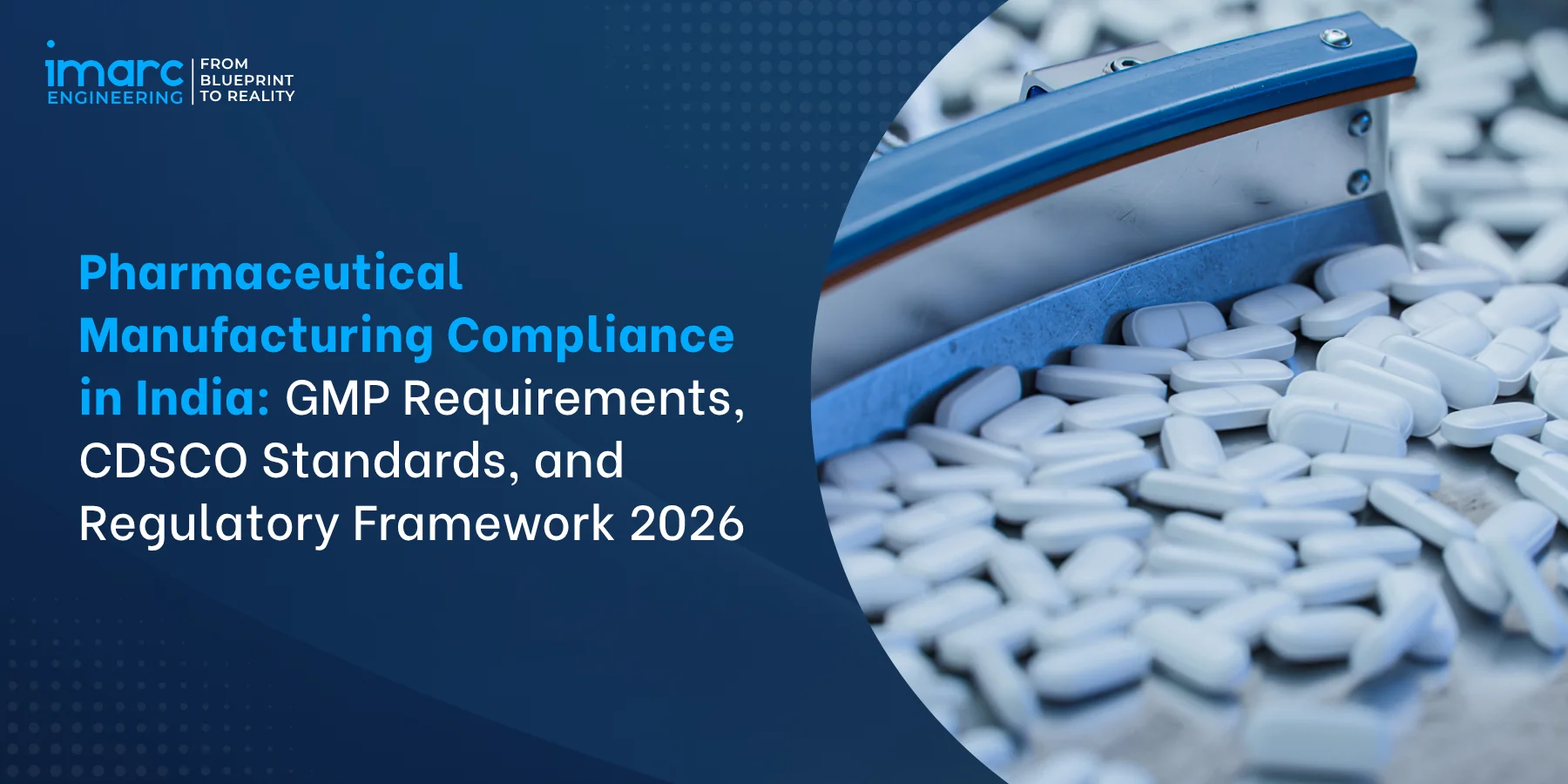
Pharmaceutical Manufacturing Compliance in India: GMP Requirements, CDSCO Standards, and Regulatory Framework 2026
Introduction
Pharmaceutical manufacturing compliance in India entered a structural transition in 2024-2026 with the implementation of the Revised Schedule M to the Drugs and Cosmetics Rules 1945, notified on 28 December 2023 and published in the Gazette of India on 5 January 2024.
The revised framework brings Indian Good Manufacturing Practice (GMP) requirements substantially closer to WHO-GMP, EU-GMP, and USFDA expectations, introducing structured Pharmaceutical Quality Systems (PQS), Product Quality Review (PQR), Quality Risk Management (QRM), validation, computerised systems compliance, and data integrity discipline aligned to ALCOA+ principles.
Large pharma manufacturers (turnover above INR 250 crore) were required to comply by June 2024; MSME manufacturers (turnover up to INR 250 crore) faced an original 12-month deadline of 31 December 2024, subsequently extended to 31 December 2025 for those that formally applied through Form A within the stipulated time. CDSCO has directed state and Union Territory drug controllers to begin compliance inspections with monthly findings reporting.
Scope of This Guide
This guide answers the manufacturer's planning question directly: how do I align my facility, processes, and documentation with the India pharma manufacturing regulations in 2026 and pass CDSCO, WHO-GMP, and international regulator audits. It walks through the regulatory framework, Revised Schedule M requirements, drug licence application process, GMP certification workflow, WHO-GMP export certification, and the audit checklist that distinguishes compliance-ready manufacturers from those exposed to licence suspension or recall.
Table of Contents
- Introduction
- Why Pharmaceutical Manufacturing Compliance in India Matters in 2026
- Pharma Regulatory Framework in India - Statutes and Authorities
- Revised Schedule M Compliance Requirements for Indian Pharma Manufacturers
- CDSCO Drug Manufacturing Licence Application Process
- How to Obtain GMP Certification in India (Step by Step Instructions)
- WHO-GMP Certification Process for Indian Pharma Exports
- Pharmaceutical Manufacturing Audit Checklist
- Common Mistakes and Best Practices
- Conclusion
1. Why Pharmaceutical Manufacturing Compliance in India Matters in 2026
Four structural drivers make rigorous compliance non-negotiable in 2026.
1.1 Regulatory Enforcement Is Active and Visible
CDSCO has directed state and Union Territory drug controllers to commence Revised Schedule M inspections with monthly findings reporting. Non-compliant manufacturers face show-cause notices, licence suspension, product recall orders, and facility closure - with remediation costs commonly ranging INR 2-10 crore per facility plus lost output. The enforcement architecture is materially more active than the pre-2024 regime where periodic inspections allowed gradual upgrade trajectories.
1.2 Global Market Access Requires Audit-Ready Operations
India is home to approximately 10,500 pharma manufacturing units per the Department of Pharmaceuticals, with around 500 USFDA-approved facilities - more than any country outside the US. Indian generic exports serve 200+ countries supplying approximately 20 percent of global generic supply and 60 percent of global vaccine supply. USFDA, EU EMA, WHO PQ, UK MHRA, ANVISA Brazil, Health Canada, TGA Australia, and other regulators conduct increasingly frequent risk-based inspections. A single Warning Letter or Import Alert can cost 20-40 percent of regulated-market revenue while remediation runs 12-24 months.
1.3 Schedule M Alignment Captures Commercial Value
Revised Schedule M alignment brings Indian GMP standards substantially closer to international expectations - reducing the audit deviation gap between Indian and global facility benchmarks. Manufacturers that achieve and maintain Revised Schedule M compliance are positioned for accelerated export market expansion, contract manufacturing relationships with multinational sponsors, and premium domestic positioning. The compliance investment converts into commercial differentiation rather than pure cost.
1.4 PLI Schemes and Industry Investment Tailwind
The PLI Scheme for Pharmaceuticals (INR 15,000 crore outlay) and PLI for KSMs/Drug Intermediates/APIs (INR 6,940 crore for Bulk Drugs Parks and PLI together) channel structured Government support to capacity expansion. The Pharmaceutical Technology Upgradation Assistance Scheme (PTUAS) under Department of Pharmaceuticals provides subsidies and soft loans specifically supporting MSME facility upgrades to Revised Schedule M standards. Compliance investment is structurally subsidised for qualifying manufacturers.
2. Pharma Regulatory Framework in India - Statutes and Authorities
The pharma regulatory framework in India spans century-old statutes, modern operational rules, and an evolving authority architecture. Understanding the structure is the foundation of compliant operations.
2.1 The Statutory Stack
| Instrument | Year | Scope |
|---|---|---|
| Drugs and Cosmetics Act | 1940 | Parent statute for drug regulation |
| Drugs and Cosmetics Rules | 1945 | Operational rules incl. Schedule M (GMP) |
| Pharmacy Act | 1948 | Pharmacy practice regulation |
| Drugs and Magic Remedies (Objectionable Advertisements) Act | 1954 | Advertising restrictions |
| Patents Act | 1970 | Pharmaceutical patent framework |
| Medical Devices Rules | 2017 | Medical device manufacturing and licensing |
| New Drugs and Clinical Trials Rules | 2019 | Clinical trials, new drug approvals |
| DPCO (Drugs (Prices Control) Order) | 2013 | Essential drug pricing under NPPA |
| Revised Schedule M (G.S.R. 922(E) | 2023 | Updated GMP requirements aligned with WHO-GMP |
2.2 The Authority Architecture
Multiple authorities operate the pharmaceutical regulatory framework. Central Drugs Standard Control Organisation (CDSCO) under Ministry of Health and Family Welfare is the apex regulator, headed by the Drugs Controller General of India (DCGI). State Drug Control Departments (often known as State FDA) administer manufacturing licensing under the Drugs and Cosmetics Act 1940. National Pharmaceutical Pricing Authority (NPPA) administers drug pricing under DPCO 2013. Indian Pharmacopoeia Commission (IPC) maintains the Indian Pharmacopoeia. Department of Pharmaceuticals (DoP) under Ministry of Chemicals and Fertilizers operates industrial promotion schemes including PLI and PTUAS. Pharmacy Council of India regulates pharmacy practice. The Central Insecticides Board and Registration Committee handles veterinary and agricultural products separately.
2.3 Digital Platforms - SUGAM and CDSCO Online Services
CDSCO operates the SUGAM online portal (cdscoonline.gov.in) as the integrated platform for various pharmaceutical applications including drug import licences, new drug approvals, clinical trial applications, and select state-level applications. Cosmetic Division updates effective from 16 August 2024 have refreshed portal workflows. State Drug Control Departments operate their own online portals for state-level manufacturing licences. Sponsors should verify current portal allocation - some workflows remain CDSCO direct while others have migrated to state portals - at project initiation to plan submission pathways correctly.
2.4 Recent Regulatory Direction
Several directional shifts are shaping the regulatory environment in 2026. Risk-based inspection methodology aligning with WHO and other international regulators; expanded data integrity expectations following ALCOA+ principles; computerised systems compliance per 21 CFR Part 11 equivalent requirements under Revised Schedule M; structured Pharmaceutical Quality System (PQS) and Quality Risk Management (QRM) implementation; increased focus on environmental controls, cross-contamination prevention, and supply chain traceability. Manufacturers should plan for continuing regulatory tightening rather than a static compliance environment.
3. Revised Schedule M Compliance Requirements for Indian Pharma Manufacturers
The GMP requirements in India under Revised Schedule M represent the most significant pharma regulatory update in over two decades. Manufacturers must align facility design, quality systems, documentation, and operational discipline with the updated framework.
3.1 Schedule M Compliance Timeline
| Manufacturer Category | Original Deadline | Status (2026) |
|---|---|---|
| Large pharma (turnover > INR 250 cr) | 6 months post-notification (~mid-2024) | Active inspections; compliance mandatory |
| MSME pharma (turnover up to INR 250 cr) | 31 December 2024 (12-month) | Extended to 31 December 2025 on Form A application by 4 April 2025 |
| New facilities (post-notification) | Compliant at commissioning | Mandatory from start |
3.2 The Twelve Subparts of Revised Schedule M
Revised Schedule M consolidates GMP requirements across twelve structured subparts. Subpart 1 covers Pharmaceutical Quality System (PQS) - the foundational quality management framework. Subpart 2 addresses premises, equipment, and warehousing. Subpart 3 covers personnel, training, and qualification. Subpart 4 addresses documentation and records (with structured data integrity per ALCOA+). Subpart 5 covers manufacturing operations and process controls. Subpart 6 addresses Quality Control (QC) laboratories. Subpart 7 covers contract manufacturing and analysis. Subpart 8 addresses complaints, returns, and product recall. Subpart 9 covers self-inspection and audits. Subpart 10 addresses Quality Risk Management (QRM). Subpart 11 covers Product Quality Review (PQR). Subpart 12 addresses computerised systems and data integrity.
3.3 Critical New Requirements
- Pharmaceutical Quality System (PQS) - documented quality framework with management responsibility
- Quality Risk Management (QRM) - structured risk assessment across processes and decisions
- Product Quality Review (PQR) - annual product-level quality assessment
- Validation and qualification - structured IQ/OQ/PQ across equipment, processes, cleaning, computerised systems
- Computerised systems and data integrity - ALCOA+ compliance, audit trails, electronic records
- Cross-contamination prevention - structured risk-based controls
- Environmental monitoring - HVAC qualification, particulate and microbial monitoring
- Cleaning validation - structured cleaning procedures with residue limit science
- Supplier qualification and material management - audit-based supplier approval
- Pharmacovigilance integration with quality systems
3.4 Infrastructure and Validation Upgrades
Revised Schedule M typically drives material facility upgrades. HVAC system rebuilds to current cleanroom specifications (Grade A/B/C/D classifications per WHO and ISO 14644); validated air handling with HEPA filtration meeting specified leak test criteria; pressure differential cascades and controlled airflow patterns; environmental monitoring infrastructure.
Process equipment upgrades including manufacturing equipment qualification, in-process testing infrastructure, and laboratory instrumentation calibration programmes. Computerised systems including ERP, MES, LIMS, and instrument software validated per CSV (Computer Systems Validation) requirements. Documentation upgrades to support digital records with audit trails. Total facility upgrade cost for typical MSME pharma facilities ranges INR 2-15 crore depending on starting condition and product portfolio.
4. CDSCO Drug Manufacturing Licence Application Process
The CDSCO guidelines for pharmaceutical manufacturing licensing operate primarily through State Drug Control Departments under the Drugs and Cosmetics Act 1940 and Rules 1945, with CDSCO coordination for centralised products and exports.
4.1 The Licensing Forms
| Form | Purpose | Authority |
|---|---|---|
| Form 25 | Manufacturing licence for drugs other than those covered in Form 28 | State Licensing Authority |
| Form 25-A | Loan licence (manufacturing in another's premises) | State Licensing Authority |
| Form 28 | Manufacturing licence for drugs in Schedule C and C(1) | State Licensing Authority |
| Form 28-A | Loan licence for Schedule C/C(1) drugs | State Licensing Authority |
4.2 The Application Workflow
Step 1: Pre-application preparation including site selection, facility design per Schedule M, equipment specification, personnel hiring, and SOP development.
Step 2: Site verification with State Drug Control Department - facility readiness assessment.
Step 3: Application submission via state portal (or paper-based where state portal not operational) with prescribed fees.
Step 4: State Drug Control inspection of the facility for compliance with Schedule M requirements.
Step 5: Deficiency rectification (if any) based on inspection findings.
Step 6: Manufacturing licence grant on Form 25/28 (or applicable) with product-specific endorsements. End-to-end timeline typically runs 6-12 months for new facilities; 3-6 months for product additions to existing licences.
For greenfield pharmaceutical manufacturing projects, compliance planning should begin during facility design rather than after construction. Layout design, HVAC zoning, material and personnel flow, utility systems, and cleanroom classifications must be aligned with Schedule M requirements before commissioning to avoid costly retrofits later.
4.3 Documents Required for Licence Application
- Company incorporation documents (Companies Act 2013 compliance)
- Property title or registered lease deed for manufacturing premises
- Site layout and plant master file
- Building plan approval from local authority
- Pollution Control Board CTE / CTO
- Fire NOC (Provisional then Final)
- Factory registration under OSH Code 2020
- Qualified personnel certificates - production, QA, QC heads
- List of equipment with calibration certificates
- Standard Operating Procedures (SOPs) covering Schedule M scope
- Validation Master Plan (VMP)
- Quality Manual aligned with Revised Schedule M
- Product list and master formulae
4.4 Drug Manufacturing Licence Renewal
Manufacturing licences are generally granted with perpetual validity subject to payment of applicable retention fees and continued compliance with licence conditions and regulatory requirements. The drug manufacturing licence renewal process in India involves: renewal application via Form 25/28 with prescribed renewal fee; updated facility documentation; inspection by State Drug Control Department; rectification of any compliance gaps; renewal grant.
Continuing compliance with Revised Schedule M, ongoing inspection clearance, and absence of significant deviation history support smooth renewal. Manufacturers should initiate renewal applications 6-12 months before licence expiry to avoid commercial disruption from any extended review.
5. How to Obtain GMP Certification in India (Step by Step Instructions)
The GMP certification process in India follows a structured workflow combining facility readiness, documentation, inspection, and certification. The same workflow underpins both domestic CDSCO licensing and WHO-GMP export certification with category-specific overlays.
5.1 The Six-Step GMP Certification Workflow
| Step | Activity | Typical Duration |
|---|---|---|
| 1. Gap Assessment | Schedule M and WHO-GMP compliance gap analysis | 4-8 weeks |
| 2. Upgrade Planning | Facility, equipment, documentation upgrade roadmap | 2-4 weeks |
| 3. Implementation | Infrastructure, validation, SOP, training execution | 6-18 months |
| 4. Mock Audit | Internal audit and consultant-led mock audits | 4-8 weeks |
| 5. CAPA Closure | Deviation closure and audit-readiness verification | 4-8 weeks |
| 6. Regulatory Inspection | State / CDSCO / WHO-GMP audit and certification | 2-4 weeks |
5.2 Gap Assessment and Upgrade Planning
The starting point is structured gap assessment against Revised Schedule M and target certification standards (WHO-GMP, EU-GMP, USFDA depending on market focus). Gap assessment covers: facility infrastructure (HVAC, cleanrooms, water systems, utilities); equipment qualification and calibration; documentation completeness; SOP coverage and currency; personnel qualification and training; quality systems (PQS, QRM, PQR, validation, change control, deviation management); QC laboratory capability; supplier and material management. The assessment produces a documented gap register prioritised by criticality, regulatory deadline, and capex investment - feeding into the upgrade planning workstream.
5.3 Implementation - The Heavy Lift
Implementation is typically the longest workstream - 6-18 months depending on starting facility condition. Infrastructure upgrades including HVAC rebuilds, cleanroom requalification, water system upgrades (Purified Water and Water for Injection systems per Indian Pharmacopoeia), utility system improvements; equipment qualification including IQ/OQ/PQ across manufacturing and QC equipment; documentation upgrades including SOP rewriting, validation protocols, master batch records, specifications, and Pharmaceutical Quality System manual; personnel training across all functions; computerised systems implementation and validation (LIMS, ERP, MES, instrument software). Phased implementation against operational continuity is the norm - few facilities can shut down for full upgrade duration.
5.4 Mock Audit and Regulatory Inspection
Pre-inspection mock audits - typically led by experienced GMP consultants - replicate the regulatory audit experience and surface gaps before formal inspection. Mock audit scope: facility tour, document review, batch record verification, deviation history review, change control assessment, complaint and recall review, employee interviews, sampling and testing capability verification. CAPA closure follows mock audit findings - addressing all material gaps before regulatory inspection. The regulatory inspection (State Drug Control for licence, CDSCO for centralised products, WHO-GMP audit for export certification) typically runs 2-5 days on-site followed by findings response and certification grant.
6. WHO-GMP Certification Process for Indian Pharma Exports
Indian pharma exports serving regulated markets require WHO-GMP certification under the WHO TRS framework (Technical Report Series). Pharmaceutical manufacturing approval in India for export typically follows the WHO-GMP route administered by State Drug Control Departments with CDSCO coordination.
6.1 WHO-GMP Framework
WHO-GMP certification follows WHO Technical Report Series 986, Annex 2 (the current operational GMP guideline) and Annex 3 (validation and qualification). The certification confirms that the manufacturing facility complies with WHO Good Manufacturing Practice requirements for pharmaceutical products. WHO-GMP is recognised in approximately 100 countries for market entry, complementing or substituting national GMP requirements. For India-based manufacturers, WHO-GMP certification typically operates through State Drug Control Department audits with WHO standard application.
6.2 WHO-GMP Application and Inspection
Application process: submission to State Drug Control Department in prescribed format with comprehensive Site Master File covering site organisation, premises, equipment, documentation, manufacturing operations, QC laboratory, distribution, complaints/recall, self-inspection, and contract activities; payment of prescribed fees; facility readiness for inspection. State Drug Control Department audit team conducts WHO-GMP inspection covering all operational areas - typically 3-5 days for routine inspections; longer for new facilities or facilities with material changes. Findings categorisation: Critical (major non-compliance affecting product quality), Major (significant deviations), and Other (minor observations). Certificate grant follows successful inspection and CAPA closure.
6.3 Certificate of Pharmaceutical Product (CoPP)
Certificate of Pharmaceutical Product (CoPP) - issued in WHO-recommended format - confirms the regulatory status of a specific product manufactured at a WHO-GMP certified facility. CoPP is issued per export consignment or product, typically by CDSCO for centralised products and State Drug Control for state-licensed products. CoPP application requires: WHO-GMP certificate; product registration documentation; manufacturing licence reference; importing country regulatory requirements. CoPP enables product registration and import licence in the destination country - making CoPP the critical export documentation.
6.4 Multi-Jurisdiction Audit Readiness
Indian exporters increasingly maintain multi-jurisdiction audit readiness covering WHO-GMP, USFDA, EU-GMP, UK MHRA, Health Canada, TGA Australia, ANVISA Brazil, and other regulators. The Indian pharma regulatory framework for foreign manufacturers similarly applies to foreign-owned facilities operating in India - through Indian subsidiaries or joint ventures. Audit-ready operations combine continuous internal audit programmes, structured deviation and CAPA tracking, change control discipline, training currency, supplier audit programmes, and documentation discipline that distinguishes facilities able to host international audits with limited preparation.
7. Pharmaceutical Manufacturing Audit Checklist
A practical Indian pharmaceutical manufacturing audit checklist synthesises Revised Schedule M, WHO-GMP, and international regulator expectations into structured pre-inspection preparation. Disciplined step by step pharma GMP audit preparation distinguishes facilities ready for unannounced inspections from those requiring extensive pre-audit reactivation.
7.1 Quality System Audit Areas
- Pharmaceutical Quality System (PQS) manual and policy framework
- Quality Risk Management (QRM) documentation and recent risk assessments
- Product Quality Review (PQR) reports - current year and prior 2 years
- Deviation management and CAPA system - effectiveness and closure timeliness
- Change control system and recent significant changes
- Complaint handling and recall procedures with recent case files
- Self-inspection programme - schedule, findings, closure status
- Management review of quality system - frequency and findings
7.2 Facility and Equipment Audit Areas
- HVAC system qualification - current certificate and revalidation records
- Cleanroom classifications and current environmental monitoring data
- Water systems (Purified Water, WFI) - validation and routine monitoring
- Manufacturing equipment - IQ/OQ/PQ documentation and calibration status
- Cleaning validation - protocol, residue limits, current campaign data
- Cross-contamination prevention - assessed and documented controls
- Utilities (compressed air, nitrogen, steam) - qualification and monitoring
- Computerised systems - validation status, audit trails, electronic records
7.3 Documentation and Records Audit
- Batch Manufacturing Records (BMRs) and Batch Packaging Records (BPRs)
- Specifications for materials, in-process, and finished products
- Master Formula Records and current standard operating procedures
- Validation protocols and reports - process, cleaning, computerised systems
- Stability study data and ongoing stability programme
- Training records - personnel qualification and current training
- QC analytical methods and method validation
- Supplier qualification files and recent supplier audits
7.4 Personnel and Operational Audit
Audit teams routinely verify personnel competency through targeted interviews and observation of operational practices.
Personnel audit scope: organisational structure and role definitions; qualification of key personnel (Production Head, QA Head, QC Head per Schedule M requirements); training programmes and competency assessment; gowning and behaviour in classified areas; data entry discipline and ALCOA+ behaviour; understanding of SOPs and deviation reporting; emergency response readiness. Operational audit covers actual manufacturing observation, in-process testing observation, and QC laboratory observation - matching documented practice against operational reality.
8. Common Mistakes and Best Practices
8.1 Treating Compliance as Documentation-Only Exercise
Manufacturers that focus on SOP documentation without operational implementation routinely fail audits when inspector observations don't match documented practice.
Best practice: documentation discipline aligned with actual operational discipline; structured personnel training; continuous self-inspection verification.
8.2 Data Integrity Gaps
Data integrity findings - particularly around audit trails, electronic records, paper record practices, and computerised systems compliance - are the most common cause of international audit failures.
Best practice: ALCOA+ training across all functions; structured electronic records strategy; periodic data integrity assessments; CSV (Computer Systems Validation) for all GxP systems.
8.3 Inadequate Schedule M Gap Closure
Manufacturers that approach Revised Schedule M as marginal adjustments rather than structural upgrades face deep gap exposure at inspection.
Best practice: comprehensive gap assessment against all 12 Subparts; structured upgrade roadmap with realistic timelines and capex; PTUAS scheme support where eligible for MSME.
8.4 Weak Supplier Qualification
Audit findings increasingly focus on supplier qualification - especially for APIs, excipients, and primary packaging. Manufacturers without audit-based supplier qualification face material findings.
Best practice: structured supplier audit programme; risk-based supplier categorisation; ongoing supplier performance monitoring; documented supplier change controls.
8.5 Insufficient Training and Competency Programmes
Training records that document attendance without competency assessment fail current audit expectations.
Best practice: structured training matrix by role; competency assessments post-training; periodic refresher training; specific training for new SOPs and significant changes.
How IMARC Engineering Supports Pharmaceutical Manufacturing Compliance in India
IMARC Engineering supports clients across the full pharmaceutical manufacturing compliance lifecycle, from greenfield facility planning and Schedule M gap assessments to GMP implementation, regulatory approvals, and audit readiness. Our team assists with facility design reviews, HVAC and utility compliance planning, Pharmaceutical Quality System (PQS) implementation, Quality Risk Management (QRM), validation master planning, documentation development, data integrity frameworks, and regulatory compliance programmes aligned with Revised Schedule M requirements.
We also support manufacturers with drug manufacturing licence applications, WHO-GMP preparedness, CAPA implementation, mock audits, technical documentation, and compliance upgrades for export-oriented facilities. Whether you are establishing a new pharmaceutical manufacturing facility, upgrading an existing plant to meet Revised Schedule M requirements, pursuing WHO-GMP certification, or preparing for regulatory inspections, IMARC Engineering provides end-to-end technical, regulatory, and compliance advisory support.
Conclusion
Pharmaceutical manufacturing compliance in India in 2026 operates in a transformed regulatory environment versus the pre-2024 era. The Revised Schedule M aligns Indian GMP requirements more closely with WHO-GMP, EU-GMP, and USFDA standards. Compliance is already mandatory for large manufacturers. CDSCO has intensified inspections, and Government schemes such as PLI and PTUAS support compliance upgrades and capacity expansion.
Three closing reminders for pharma manufacturers planning Schedule M compliance and regulatory positioning. First, treat Revised Schedule M as a structural transformation rather than incremental adjustment - the 12 Subparts collectively reshape facility, process, quality system, documentation, and data integrity expectations versus the prior framework.
Second, integrate compliance with commercial strategy - audit-ready operations command premium positioning in domestic markets, export markets, contract manufacturing relationships, and PLI scheme participation.
Third, address data integrity at the operational level - ALCOA+ compliance is the most common audit finding category across Indian and international regulator inspections, and operational data integrity discipline cannot be retrofitted through documentation alone.
PLANNING A PHARMA PLANT INVESTMENT?
IMARC Engineering's Pharma plant compliance services in India team supports developers across statutory approvals, patent related compliance, and licensing. Whether you are a large pharma manufacturer operating multiple facilities, an MSME pharma sponsor navigating Schedule M upgrade timelines, a contract manufacturing organisation serving global brands, an export-focused operation pursuing WHO-GMP and international approvals, or a foreign manufacturer entering India through subsidiary establishment, IMARC Engineering provides end-to-end pharmaceutical manufacturing compliance advisory across the lifecycle.
→ Contact our team to discuss how this framework can be applied to your specific compliance plan
Frequently Asked Questions
Large pharma manufacturers (turnover above INR 250 crore) were required to comply within 6 months of the December 2023 notification. MSME manufacturers had until 31 December 2024, extended to 31 December 2025 for those who applied through Form A by 4 April 2025. GMP requirements in India are now actively enforced through CDSCO-directed inspections.
End-to-end timeline for a new facility typically runs 6-12 months from application to licence grant. Product additions to existing licences typically take 3-6 months. Timelines depend on facility readiness, state authority workload, and inspection findings closure.
Revised Schedule M is the Indian GMP framework under the Drugs and Cosmetics Rules 1945. WHO-GMP follows WHO TRS 986 (Annex 2) - the international framework. Revised Schedule M is substantially aligned with WHO-GMP but operates under Indian statutory authority. CDSCO guidelines for pharmaceutical manufacturing require both for export-oriented operations.
Yes. Foreign manufacturers operate through Indian subsidiaries under the Companies Act 2013 with 100 percent FDI permitted under the automatic route. The subsidiary applies for manufacturing licence under Form 25/28 from State Drug Control Department per standard procedures.
The Pharmaceutical Technology Upgradation Assistance Scheme (PTUAS) under Department of Pharmaceuticals provides subsidies and soft loans for MSME facility upgrades to Revised Schedule M. Drug manufacturing compliance in India upgrades for qualifying MSMEs can be partly funded through PTUAS.
Risk-based inspection methodology - facility risk profile, product complexity, deviation history, and inspection findings drive inspection frequency. High-risk facilities may be inspected annually or semi-annually; lower-risk facilities typically face inspections at 2-3 year intervals. Schedule M compliance inspections are currently being prioritised across all facility risk categories.
Non-compliance triggers show-cause notices, licence suspension, product recalls, and facility closure under Drugs and Cosmetics Act 1940. Commercial impact typically runs INR 2-10 crore per facility in lost output and remediation. Repeat or severe non-compliance can lead to permanent licence cancellation and criminal proceedings.
Recent Post




Trusted by Industry Leaders
We partner with global enterprises and ambitious businesses across sectors to deliver operational excellence, strategic insights, and sustainable growth through integrated solutions.









Success in Their Words
Real feedback from clients across industries. Discover how our solutions delivered measurable impact and operational excellence.

I wanted to express my sincere appreciation for your efforts in handling this matter. Your dedication and commitment have been truly commendable, and it is evident that you have put in tremendous hard work and expertise into resolving the issues at hand. We are greatly interested in continuing our collaboration with you in the future, as your professionalism and reliability have made you a trusted partner. Thank you once again for your invaluable contribution. We look forward to strengthening our partnership ahead.

It has been a pleasure working with the IMARC team. The insights provided were structured, clear, and highly valuable, helping us strengthen both our technical and financial planning with confidence. We deeply appreciate the team’s professionalism, responsiveness, and attention to detail throughout the engagement. Every requirement was well understood and effectively incorporated, resulting in a comprehensive and actionable output. Overall, our experience has been excellent, and I would gladly recommend IMARC to organizations seeking a reliable research partner.

Your service is truly exceptional. Working with the IMARC team has been a seamless and professional experience. The clarity of communication, responsiveness to queries, and consistent support at every stage made the entire engagement highly efficient. The insights shared were well-structured, practical, and perfectly aligned with our requirements, helping us make informed decisions with confidence. Overall, the dedication and professionalism demonstrated by your team stand out, and I would be glad to recommend IMARC as a reliable and trustworthy research partner.

IMARC did an outstanding job in preparing our study. They were punctual, precise, and consistently responsive throughout the entire process. The team delivered all the data we required in a clear, well-organized, and highly professional format. Their strong attention to detail, combined with their ability to meet every deadline without compromising quality, truly set them apart. Overall, their reliability and commitment made them an exceptional partner for our project, and we would gladly work with them again in the future.

IMARC made the whole process incredibly easy from start to finish. Everyone I interacted with via email was polite, professional, and straightforward to deal with, always keeping their promises regarding delivery timelines and remaining consistently solutions-focused. From my very first contact, I appreciated the professionalism and support shown by the entire IMARC team. I highly recommend IMARC to anyone seeking timely, affordable, and reliable information or advice. My experience with IMARC was excellent, and I truly cannot fault any aspect of it.

I’d like to express my sincere gratitude for the excellent work you accomplished with the study. Your ability to quickly understand our requirements and deliver high-quality results under tight timelines truly reflects your expertise, exceptional work ethic, and unwavering commitment to your customer’s success. The professionalism and responsiveness you demonstrated throughout the process made a significant difference. Our entire team and company are incredibly thankful for your dedication, reliability, and support. Once again, thank you for your outstanding contribution.