Manufacturing
September 15 2026
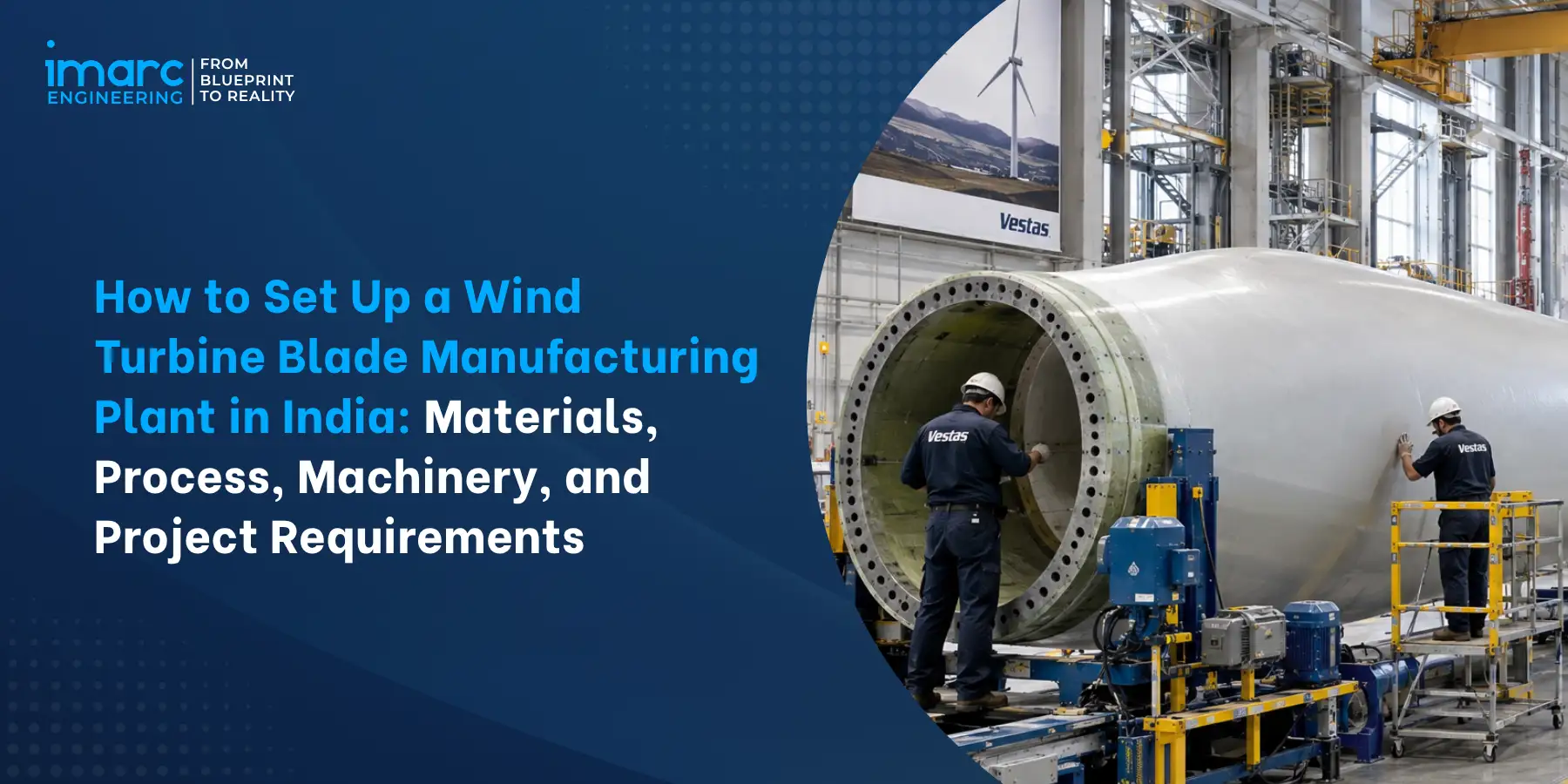
How to Set Up a Wind Turbine Blade Manufacturing Plant in India: Materials, Process, Machinery, and Project Requirements
Introduction
For wind OEMs, composite manufacturers, and project sponsors evaluating a wind turbine blade manufacturing plant in India in 2026, disciplined integration across blade design specifications, turbine platform strategy, composite materials, moulding and infusion technology, facility layout, oversized blade logistics, applicable MNRE requirements, quality and certification requirements, and project economics determine commercial viability. India's wind capacity reached 58.14 GW (July 2026) with 6.05 GW added in FY26 - a record year. Target of 100 GW wind by 2030 supports strong domestic demand alongside INR 12,000 crore wind equipment exports FY26.
Scope of this Guide
This guide answers the sponsor's question directly. How can manufacturers plan a commercially viable wind turbine blade plant in India based on blade specifications, composite materials, manufacturing technology, production capacity, equipment, facility requirements, logistics, and project economics? It walks through blade design and platform selection, composite materials (fiberglass, carbon fiber, epoxy resin, core materials), VARTM manufacturing process, quality control per IEC 61400 standards, facility layout for oversized blades, applicable MNRE ALMM-Wind and ALMM-WTC requirements, turbine type-certification considerations, and relevant IEC standards, and investment brackets anchored to explicit turbine class and capacity assumptions.
Table of Contents
- Introduction
- Why Wind Turbine Blade Manufacturing Matters for India in 2026
- What a Wind Turbine Blade Manufacturing Plant is and Why It Matters in India
- Blade Design Specifications and Turbine Platform Selection for Wind Turbine Blade Manufacturing in India
- Composite Materials and Raw Material Sourcing for Wind Turbine Blade Manufacturing in India
- Manufacturing Process Moulding Infusion and Curing for Wind Turbine Blade Manufacturing in India
- Blade Finishing Bonding and Quality Control for Wind Turbine Blade Manufacturing in India
- Facility Layout Material Handling and Oversized Blade Logistics for Wind Turbine Blade Manufacturing in India
- Regulatory Compliance ALMM Certification and Project Economics for Wind Turbine Blade Manufacturing in India
- Conclusion
1. Why Wind Turbine Blade Manufacturing Matters for India in 2026
Four drivers make disciplined wind turbine blade manufacturing plant setup a strategic priority for Indian composite manufacturers and wind sector investors in 2026.
1.1 Domestic Wind Sector Growth
India's wind turbine blade manufacturing in India ecosystem serves the country's rapidly growing wind capacity. Cumulative installed wind capacity reached 58.14 GW (July 2026) with 6.05 GW added in FY26 - the sector's best year. India targets 100 GW wind by 2030 requiring sustained annual additions of ~10 GW. Live pipeline of ~43 GW under construction supports strong demand visibility.
Domestic turbine manufacturing capacity has grown to 24 GW/year (from 10 GW in 2014) with 70-80 percent domestic value addition. Blade manufacturing is critical value-addition segment representing 20-25 percent of turbine cost.
1.2 ALMM Framework and Localization
Ministry of New and Renewable Energy (MNRE) renamed Revised List of Models and Manufacturers (RLMM) to Approved List of Models and Manufacturers (Wind) - ALMM (Wind) in July 2025. Stricter localization and component sourcing norms require Type Certificate of wind turbine models to mandatorily include Blade, Tower, Gearbox, Generator, and Special Bearings assembly/manufacturing facility.
MNRE's current wind-manufacturing framework includes ALMM-Wind for turbine models and ALMM-WTC for specified wind-turbine components, with requirements governing eligible manufacturing facilities and component sourcing. Blade manufacturers supplying turbines covered by these requirements should assess the latest ALMM-WTC procedure, amendments, enlistment conditions, and OEM/type-certification requirements during project planning.
1.3 Export Opportunity
India's wind energy equipment manufacturing sector has become a global export hub. Wind equipment exports crossed INR 12,000 crore in FY26 (up nearly 50 percent). India's cost-competitive manufacturing, engineering capability, and strategic location support exports to Middle East, Africa, Southeast Asia, and Latin America.
Blade manufacturing exports face logistics constraints (oversized cargo) but coastal plants offer advantages. Global blade OEMs increasingly use India as manufacturing base for both domestic supply and select export markets - reinforcing investment case for scale plants.
1.4 Turbine Platform Evolution
Wind turbine platforms in India have scaled rapidly from 1.5-2 MW class dominant a decade ago to 3-4.2 MW class today, with blade lengths growing from 40-50m to 75-80m. GE Vernova's 3.8 MW-154m rotor (June 2026 launch) and Senvion 4.2M160 (4.2 MW, 160m rotor, ALMM Dec 2025) reflect current platform. Larger blades require larger plants, moulds, cranes, and logistics.
Manufacturers investing in new capacity should select the target turbine and blade platform based on confirmed OEM requirements, market demand, production strategy, and expected platform evolution. Where commercially justified, facility layouts and material-handling systems can incorporate flexibility for larger future blade platforms. Blade manufacturing plants have long useful lives requiring platform-flexible design.
2. What a Wind Turbine Blade Manufacturing Plant is and Why It Matters in India
Understanding what a wind turbine blade manufacturing plant is and why it matters in India begins with defining large-scale composite manufacturing distinct from general engineering plants.
2.1 Definition and Scope
A wind turbine blade manufacturing facility is a purpose-built large-scale composite manufacturing plant producing rotor blades meeting turbine OEM specifications and international standards (IEC 61400 series). Facilities span vast footprints accommodating oversized moulds and blades.
Manufacturing combines composite processing (fiberglass, carbon fiber, epoxy resin), automated and manual layup, vacuum-assisted resin transfer moulding (VARTM), curing, shell bonding, precision trimming, surface finishing, and validated quality control. Composite blade manufacturing differs fundamentally from other composite applications through scale (blade lengths 60-100+ meters), tolerance requirements (aerodynamic performance), and structural loads (fatigue life 20-25 years).
2.2 Plant Components
| Component | Function | Illustrative Elements |
|---|---|---|
| Material Warehouse | Raw material storage | Fiberglass rolls, resin drums, cores |
| Mould Bay | Blade shell moulding | Large, heated moulds, layup platforms |
| Infusion Area | Vacuum resin infusion | Resin mixing/dispensing, vacuum systems |
| Curing Zone | Composite curing | Integrated mould heating or ovens |
| Bonding Station | Shell assembly | Adhesive dispensing, jigs, alignment |
| Finishing Area | Trimming and coating | CNC machines, sanding, painting |
| Quality Lab | NDT and inspection | Ultrasonic, thermography, CMM |
| Dispatch Yard | Finished blade storage | Cradles, transport preparation |
2.3 Plant Scale Determinants
Wind turbine blade plant scale depends primarily on target blade specifications and production volume. Blade length drives mould size, factory bay dimensions, overhead crane spans, and handling equipment sizing. Turbine class (2-3 MW, 3-4 MW, 4-6 MW) determines material intensity and structural complexity.
Production volume (100-800+ blades/year) affects number of mould sets, staffing, and utility sizing. Multi-line facilities producing multiple platforms simultaneously offer scale advantages but require careful layout planning. Plant scope decisions should follow OEM contract commitments and platform strategy rather than assume universal configuration.
3. Blade Design Specifications and Turbine Platform Selection for Wind Turbine Blade Manufacturing in India
Understanding blade design specifications and turbine platform selection for wind turbine blade manufacturing in India establishes the strategic foundation. Platform decisions cascade across all engineering, capital, and operational decisions.
3.1 Turbine Platform Landscape
The turbine classes, rotor diameters and blade lengths below are indicative examples rather than fixed industry relationships. Blade dimensions vary by turbine OEM, specific turbine model, rotor configuration, wind class, aerodynamic design and site application. Plant design should therefore be based on the specific blade platform or defined design envelope rather than turbine MW rating alone.
| Turbine Class | Rotor Diameter | Blade Length | Application |
|---|---|---|---|
| 2-3 MW class | 115-130 m | 55-65 m | Older sites, repowering |
| 3-4 MW class | 140-155 m | 70-75 m | Current onshore mainstream |
| 4-6 MW class | 155-175 m | 75-85 m | Emerging onshore workhorse |
| Offshore 6-15 MW | 170-240+ m | 85-115+ m | Future offshore deployment |
3.2 Blade Design Elements
- Aerodynamic profile: airfoil selection along blade span optimizing power capture
- Structural design: spar caps carrying flapwise loads, shear webs supporting shell
- Root section: bolted joint with hub, thickest cross-section
- Tip section: aerodynamically optimized, thin, potentially serrated for noise reduction
- Lightning protection: internal down conductor per IEC 61400-24
- Ice protection: heated leading edge for cold climate variants
3.3 Blade Design Sourcing Options
- Turbine platform and blade design licensing strategies
- OEM-owned design: Vestas, Siemens Gamesa, GE Vernova, Envision use proprietary blade designs
- Independent blade OEMs: LM Wind Power (GE), TPI Composites - supply multiple turbine OEMs
- Licensed designs: Aerodyn, SGRE partial designs available for licensing
- In-house development: significant R&D investment, multi-year timeline, established for Suzlon and others
- Joint ventures: technology partnerships combining Indian manufacturing with global design
3.4 Platform Selection Impact
Platform selection profoundly affects plant configuration and CAPEX. Blade length determines mould size and factory bay dimensions - a 55m blade plant differs substantially from an 80m blade plant. Turbine class affects material intensity (larger blades use more fiberglass and require carbon fiber spar caps). Multi-platform capability requires larger facilities and additional mould sets. Future platform flexibility (accommodating growth from 3.8 MW to 5 MW class) should be considered in facility design.
4. Composite Materials and Raw Material Sourcing for Wind Turbine Blade Manufacturing in India
Understanding composite materials and raw material sourcing for wind turbine blade manufacturing in India covers the largest single OPEX category. Materials account for 55-70 percent of variable operating cost.
4.1 Reinforcement Materials
- Composite materials for wind turbine blades combine reinforcement fibers with polymer matrix
- Fiberglass (E-glass and S-glass) is the dominant reinforcement - E-glass for cost-optimized applications, S-glass for higher performance zones
- Carbon fiber used selectively in spar caps of larger blades (typically 60m+) for weight and stiffness optimization
- Fabric formats: unidirectional (UD) for spar caps, biaxial and triaxial for shells
- Fiber content typically 60-70 percent by weight in cured composite
4.2 Matrix and Core Materials
- Epoxy resin is the dominant matrix system - proven fatigue performance, infusion compatibility, process robustness
- Core materials provide sandwich structure in shell panels - PVC foam, PET foam (recyclable), balsa wood, or SAN foam
- Adhesives: specialized epoxy paste for shell-to-shell bonding (large volume application)
- Gelcoats and paints for surface finish and UV/erosion protection
- Lightning protection materials: copper down conductor, receptor systems
- Root fittings: high-strength steel/aluminum bolted joint components
4.3 Raw Material Sourcing
| Material | Typical Source | Considerations |
|---|---|---|
| Fiberglass fabric | Owens Corning, Jushi, PPG | Global suppliers, some India |
| Carbon fiber | Toray, Hexcel, Mitsubishi | Primarily imported |
| Epoxy resin | Hexion, Olin, Domestic | Growing domestic capability |
| Foam cores | Diab, 3A Composites, Armacell | Import + domestic |
| Adhesives | Henkel, 3M, Sika, domestic | Growing localization |
4.4 Material Supply Strategy
Material supply strategy addresses cost, quality, and continuity. Long-term supply agreements with primary vendors typical for major materials. Multi-source strategy across geographies reduces single-supplier risk. Local sourcing capability growing for standard materials (fiberglass, epoxy) while specialty materials (carbon fiber, high-performance cores) remain import dependent.
Material qualification is prerequisite for OEM certification. Material specification changes require Type Certificate re-verification. Storage requirements (temperature/humidity control for resins, moisture protection for fabrics) affect warehouse design.
5. Manufacturing Process Moulding Infusion and Curing for Wind Turbine Blade Manufacturing in India
Moulding, infusion, and curing are core value-addition stages in wind turbine blade manufacturing, with process quality directly influencing blade reliability, aerodynamic performance, and warranty exposure.
Wind turbine blade manufacturing processes vary by blade design, OEM technology, material system and production strategy. The sequence below describes a representative infused-composite blade manufacturing route. Specific facilities may use different reinforcement formats, preforms, pultruded structural elements, resin systems, infusion strategies, curing methods, automation levels and assembly sequences.
5.1 Blade Manufacturing Sequence
- Wind turbine blade manufacturing process through composite shell fabrication and assembly
- Mould preparation: release agent application, gelcoat spray in mould surface
- Composite layup with dry fabric placement per ply schedule - suction side and pressure side separately
- Spar cap placement (pre-formed pultruded or laid up separately) providing primary structural load path
- Core material placement in sandwich zones with adhesive bonding
- Vacuum bagging with sealed vacuum membrane and resin distribution channels
5.2 Resin Infusion Process
- Vacuum-assisted resin infusion, including VARTM-type processes, is widely used for manufacturing large wind turbine blade composite structures
- Resin infusion through resin distribution network with vacuum-driven flow through fiber laminate
- Resin mixing/dispensing with degassing and temperature control
- Infusion time typically 3-8 hours depending on blade size and process parameters (indicative)
- Real-time monitoring: temperature, pressure, resin flow tracking
- Void content targeting <2 percent for structural integrity
5.3 Blade Curing and Shell Assembly
- Blade curing through integrated mould heating (dominant modern practice) or oven curing (older facilities)
- Curing temperature typically 70-80°C for epoxy resin, curing time 4-8 hours
- Blade shell manufacturing produces two half-shells (suction side and pressure side) separately
- Shear web manufactured separately and installed between shells
- Blade bonding with adhesive applied at trailing edge and shear web joints, followed by mould closure and bond curing
5.4 Process Cycle Times
Total blade production cycle from mould preparation to demoulding typically 24-72 hours for modern plants depending on blade size and process automation. Cycle time directly determines plant capacity per mould set. Small blades (55m class) achieve shorter cycles than large blades (75m+). Multi-shift operation with parallel activities across multiple moulds is standard.
Automation (automated fabric laying, robotic gelcoat application) reduces cycle time but requires higher capital. Well-optimized plants achieve 200-300 blades per mould per year at 4-6 MW class (may vary due to factors that have been assumed constant). Modern facilities often have 3-6 mould sets per blade type.
6. Blade Finishing Bonding and Quality Control for Wind Turbine Blade Manufacturing in India
Understanding blade finishing bonding and quality control for wind turbine blade manufacturing in India covers post-moulding operations preparing blades for shipment and installation. Quality control is critical for warranty and safety compliance.
6.1 Trimming and Finishing
- Trimming and finishing operations after demoulding produce final blade geometry
- CNC trimming of root and leading/trailing edges for dimensional accuracy
- Manual/robotic sanding removing surface irregularities and preparing for coating
- Root drilling and insertion of bolt fittings for hub connection
- Surface coating (multi-layer paint system: primer, top coat, leading edge protection) for durability
- Aerodynamic add-ons: vortex generators, serrations, leading edge protection tapes
6.2 Dimensional Inspection
- Dimensional inspection verifying blade geometry against design specifications
- Full-length blade measurement using laser trackers or photogrammetric systems
- Cross-section verification at multiple stations along blade span
- Twist and cone angle verification for aerodynamic performance
- Root plane flatness and bolt circle diameter accuracy
- Digital data capture supporting 100 percent traceability per blade
6.3 Non-Destructive Testing
- Non-destructive testing (NDT) verifying internal composite integrity
- Ultrasonic testing for delamination, void content, and bond line integrity
- Thermography for defect detection and bond quality assessment
- Tap testing (manual or automated) for quick surface defect screening
- Visual inspection with documented protocols per critical zones
- Blade balancing for rotor set matching within tolerance limits
6.4 Quality Control Framework
Quality control framework covers incoming materials, in-process controls, and final blade validation. IEC 61400-23 specifies full-scale structural testing (static and fatigue) for Type Certification at accredited facilities. Fatigue testing typically 1-3 months duration simulating 20–25-year service life through accelerated loading. Blade rejection rate should be tracked and root caused.
ISO 9001 QMS certification standard. Modern facilities incorporate MES (Manufacturing Execution System) with process parameter tracking, deviation alerts, and blade-specific quality records. Digital blade passport increasingly required by turbine OEMs for full lifecycle traceability.
7. Facility Layout Material Handling and Oversized Blade Logistics for Wind Turbine Blade Manufacturing in India
Understanding facility layout material handling and oversized blade logistics for wind turbine blade manufacturing in India covers infrastructure requirements. Oversized blades create unique facility and transportation challenges affecting site selection.
Facility dimensions, crane capacities, environmental conditions and utility requirements vary materially with blade length, mould configuration, number of production lines, material system, automation level and annual production target. The following values are indicative planning ranges and should not be treated as universal design criteria. Final bay dimensions, clear heights, floor area, lifting capacity, HVAC conditions, power demand and environmental systems should be established from the selected blade platform and production process.
7.1 Facility Layout and Dimensions
- Plant layout for wind turbine blade manufacturing requires large, enclosed workshops accommodating oversized moulds
- Clear height 15-25m accommodating cranes and mould handling
- Total plant footprint typically 50,000-150,000+ sqm for commercial-scale plants (indicative)
- Adjacent finishing hall for post-mould operations and QC
- Material warehouse with temperature-controlled areas for resin/adhesives
- Blade storage yard for finished blades awaiting dispatch
7.2 Material Handling Systems
- Material handling systems sized for oversized workpieces (blades 60-100+ meters)
- Mould handling through gantry cranes, mould tilters, or fixed positioning
- Overhead cranes: gantry or double-girder, capacity 20-50 tonnes, wide spans
- Blade turning fixtures for reorientation during finishing operations
- Custom blade cradles for finishing station transfer
- Fabric/core roll handling with dedicated equipment
- Resin drum handling with pumping and metering systems
7.3 Oversized Blade Logistics
Oversized blade transportation is the single largest logistics challenge. Blades 60-100 meters cannot be moved on standard trailers - specialized blade transport equipment (self-steering trailers, blade lifters) essential. Oversized/overweight load permits per Motor Vehicles Act 1988 with route surveys and police escorts. Port proximity (Gujarat, Tamil Nadu, Andhra Pradesh coasts) offers major logistics advantages for both raw material import and finished blade shipment. Coastal plants support both domestic wind farm supply and export shipment. Wind turbine blade factory location decisions should weigh logistics costs against land, labor, and utility considerations.
7.4 Utilities and Environmental Systems
- Process utilities supporting composite manufacturing operations
- Power: typical 2-8 MW for medium blade plant, higher for large facilities
- HVAC with temperature/humidity control (20-25°C, 40-60 percent RH) for infusion consistency
- Compressed air for vacuum systems, tooling, pneumatic operations
- VOC capture and treatment systems, such as localized extraction and appropriate abatement technologies where required by the selected resin/coating process and applicable emission-control requirements
- Dust extraction with HEPA filtration for sanding operations
- Effluent treatment for cleaning water and process wastes
8. Regulatory Compliance ALMM Certification and Project Economics for Wind Turbine Blade Manufacturing in India
Understanding regulatory compliance ALMM certification and standards for wind turbine blade manufacturing in India alongside capital investment and project economics for wind turbine blade manufacturing in India completes the project development framework.
8.1 MNRE ALMM Framework
The approvals applicable to a wind turbine blade manufacturing facility depend on plant location, manufacturing processes, resin and coating systems, chemicals stored and handled, waste streams, workforce, building configuration and state-specific requirements. The following approvals are therefore indicative and should be confirmed during project-specific regulatory due diligence.
| Requirement | Authority | Standard/Framework |
|---|---|---|
| ALMM (Wind) Enlistment | MNRE | MNRE ALMM (Wind) 2025 procedure |
| ALMM (Wind Turbine Component) | MNRE | Blade sourcing from listed facilities |
| Type Certificate | NIWE/DNV/TUV | IEC 61400 series |
| Blade Structural Testing | Accredited labs | IEC 61400-23 full-scale test |
| QMS Certification | Notified Body | ISO 9001 |
MNRE renamed RLMM to ALMM (Wind) in July 2025 with stricter localization and component sourcing norms. Type Certificate of wind turbine models must mandatorily include Blade, Tower, Gearbox, Generator, and Special Bearings assembly/manufacturing facility - blades sourced only from ALMM (Wind Turbine Component) listed facilities.
National Institute of Wind Energy (NIWE) coordinates Type Certification with international certification bodies. IEC 61400 series govern wind turbine including blade design and testing requirements. Component sourcing portal (WT-MARUT) monitors manufacturing and supply chain.
8.2 Other Regulatory Approvals
| Approval | Authority | Framework |
|---|---|---|
| Factory Licence | State Directorate of Factories | OSH Code 2020 |
| SPCB CTE/CTO | State Pollution Control Board | Water Act 1974, Air Act 1981 |
| Fire NOC | State Fire Services | NBC 2016 Part 4 |
| Hazardous Waste Authorization | SPCB | Hazardous Waste Rules 2016 |
8.3 Capital Investment by Plant Scale
The investment ranges below are indicative planning benchmarks based on the stated blade classes and annual production assumptions, not standard costs for wind turbine blade plants. Actual investment can vary materially with blade design, number and type of mould sets, degree of automation, building dimensions, land and site development, imported versus localized equipment, composite-material systems, testing scope, logistics infrastructure, utility systems and whether the facility is dedicated to one OEM platform or designed for multiple platforms.
| Configuration | Scale Assumption | Investment (INR) (Indicative in Nature, May Vary) |
|---|---|---|
| Small | 100-150 blades/year, 2-3 MW class | 300-800 crore |
| Medium | 200-400 blades/year, 3-4 MW class | 800-2,500 crore |
| Large | 400-800 blades/year, 4-6 MW class | 2,500-6,000 crore |
| Very Large | 800+ blades/year, offshore capable | 6,000-15,000 crore |
8.4 CAPEX/OPEX and Project Commissioning
- CAPEX and OPEX composition vary with plant scale and blade class
- Moulds (major single item): 25-35 percent of CAPEX; single mould INR 30-100+ crore for 4+ MW class
- Building and civil works: 20-30 percent (large, enclosed workshops)
- Handling equipment (cranes, tilters): 10-15 percent
- Process equipment (infusion, curing, CNC, NDT): 15-25 percent
- Utilities and environmental: 5-10 percent
- Materials 55-70 percent of variable OPEX; labor 15-25 percent; utilities 8-15 percent
- Project feasibility and commissioning typically 24-42 months from investment decision covering civil, mould procurement, equipment installation, ALMM enlistment, and Type Certification testing
Conclusion
Setting up a wind turbine blade manufacturing plant in India in 2026 requires careful turbine platform and blade design selection, composite materials planning, VARTM manufacturing, shell bonding, finishing, quality testing, facility design, material handling, oversized logistics, utilities, and regulatory compliance. Key requirements include MNRE ALMM enlistment, IEC-based Type Certification, SPCB consents, factory licensing, and CAPEX planning based on blade size and production volume.
Three priorities should guide sponsors: platform selection determines plant scale and mould investment; location significantly affects oversized blade logistics and export economics; and mould strategy is critical to CAPEX and long-term production economics.
PURSUING WIND TURBINE BLADE MANUFACTURING?
IMARC Engineering’s wind turbine blade plant development advisory team supports composite manufacturers, wind OEMs, and project sponsors with turbine and blade platform selection, blade design sourcing, composite materials, VARTM manufacturing, quality control and structural testing, facility layout, material handling, oversized logistics, utilities, regulatory approvals, CAPEX/OPEX planning, and integrated commissioning. The team covers fiberglass and carbon-fiber composites, epoxy systems, core materials, lightning protection, NDT, and IEC 61400 compliance, with project planning tailored to blade size, production volume, and onshore or offshore applications.
→ Schedule a free wind turbine blade plant scoping consultation with an IMARC specialist
Frequently Asked Questions
Wind turbine blades are manufactured through composite processing: mould preparation, dry fabric layup with fiberglass/carbon fiber, vacuum-assisted resin infusion (VARTM) with epoxy resin, curing, demoulding, spar cap and shear web integration, two-shell bonding, CNC trimming, surface coating, NDT inspection, and balancing before shipment.
Setting up a wind turbine blade manufacturing plant in India involves turbine platform selection, blade design licensing or development, mould procurement, facility design, equipment installation, ALMM (Wind Turbine Component) enlistment via MNRE, IEC 61400 certification testing, and commercial commissioning across 24-42 months.
Wind turbine blade materials include fiberglass (E-glass and S-glass) and carbon fiber (primarily for spar caps), epoxy resin (dominant matrix), core materials (PVC/PET foam, balsa), adhesives for bonding, gelcoat/coatings, lightning protection systems, and bolt fasteners for root attachment. Material selection follows blade design specifications.
Wind turbine blade manufacturing equipment includes blade moulds (60-100+ meters with integrated heating), vacuum resin infusion systems, gantry cranes, CNC trimming stations, robotic sanding and coating equipment, NDT systems (ultrasonic, thermography), balancing rigs, resin mixing and dispensing systems, and material handling systems for oversized workpieces.
Blade size directly determines plant footprint, mould dimensions, overhead crane spans, curing/finishing zones, and workpiece handling systems. Larger blades require larger moulds (single mould INR 30-100+ crore), longer cycle times, and more floor space per production line reducing plant capacity.
Wind turbine blade QC includes dimensional inspection, non-destructive testing (ultrasonic, thermography, tap testing), blade balancing, adhesive bond line inspection, material property testing (fiber content, void content), and full-scale IEC 61400-23 structural testing (bench-fatigue and static) at certified facilities per Type Certification and ALMM (Wind) requirements.
Wind turbine blade plant cost in India varies with blade size and capacity. Small plants (100-150 blades/year, 2-3 MW class) INR 300-800 crore. Medium plants (200-400 blades/year, 3-4 MW class) INR 800-2,500 crore. Large plants (400-800 blades/year, 4-6 MW class) INR 2,500-6,000 crore excluding land.
Wind turbine blade manufacturing project feasibility depends on turbine platform strategy, order visibility, blade size trajectory, ALMM component listing readiness, port proximity for oversized logistics (blades 60-100m), skilled workforce availability, land area, and adequate utility access. Coastal locations near ports offer logistics advantages.
Recent Post


Trusted by Industry Leaders
We partner with global enterprises and ambitious businesses across sectors to deliver operational excellence, strategic insights, and sustainable growth through integrated solutions.











Success in Their Words
Real feedback from clients across industries. Discover how our solutions delivered measurable impact and operational excellence.

I wanted to express my sincere appreciation for your efforts in handling this matter. Your dedication and commitment have been truly commendable, and it is evident that you have put in tremendous hard work and expertise into resolving the issues at hand. We are greatly interested in continuing our collaboration with you in the future, as your professionalism and reliability have made you a trusted partner. Thank you once again for your invaluable contribution. We look forward to strengthening our partnership ahead.

It has been a pleasure working with the IMARC team. The insights provided were structured, clear, and highly valuable, helping us strengthen both our technical and financial planning with confidence. We deeply appreciate the team’s professionalism, responsiveness, and attention to detail throughout the engagement. Every requirement was well understood and effectively incorporated, resulting in a comprehensive and actionable output. Overall, our experience has been excellent, and I would gladly recommend IMARC to organizations seeking a reliable research partner.

Your service is truly exceptional. Working with the IMARC team has been a seamless and professional experience. The clarity of communication, responsiveness to queries, and consistent support at every stage made the entire engagement highly efficient. The insights shared were well-structured, practical, and perfectly aligned with our requirements, helping us make informed decisions with confidence. Overall, the dedication and professionalism demonstrated by your team stand out, and I would be glad to recommend IMARC as a reliable and trustworthy research partner.

IMARC did an outstanding job in preparing our study. They were punctual, precise, and consistently responsive throughout the entire process. The team delivered all the data we required in a clear, well-organized, and highly professional format. Their strong attention to detail, combined with their ability to meet every deadline without compromising quality, truly set them apart. Overall, their reliability and commitment made them an exceptional partner for our project, and we would gladly work with them again in the future.

IMARC made the whole process incredibly easy from start to finish. Everyone I interacted with via email was polite, professional, and straightforward to deal with, always keeping their promises regarding delivery timelines and remaining consistently solutions-focused. From my very first contact, I appreciated the professionalism and support shown by the entire IMARC team. I highly recommend IMARC to anyone seeking timely, affordable, and reliable information or advice. My experience with IMARC was excellent, and I truly cannot fault any aspect of it.

I’d like to express my sincere gratitude for the excellent work you accomplished with the study. Your ability to quickly understand our requirements and deliver high-quality results under tight timelines truly reflects your expertise, exceptional work ethic, and unwavering commitment to your customer’s success. The professionalism and responsiveness you demonstrated throughout the process made a significant difference. Our entire team and company are incredibly thankful for your dedication, reliability, and support. Once again, thank you for your outstanding contribution.