Manufacturing
September 15 2026
How to Set Up a Precast Concrete Electric Pole Manufacturing Plant in India: Process, Machinery, Cost, and Project Requirements
Introduction
For precast manufacturers, utility suppliers, and project sponsors evaluating an electric pole manufacturing plant in India in 2026, disciplined integration across pole type selection (RCC or PSC), production capacity, raw materials, mould strategy, batching and casting technology, curing, quality testing, and storage/dispatch logistics determines commercial viability.
Continued rural electrification, distribution network strengthening under RDSS, and grid expansion sustain demand from state DISCOMs and utility contractors, with pole specifications, conformity requirements, and procurement conditions determined by applicable BIS standards and purchaser/utility requirements.
Scope of this Guide
This guide answers the sponsor's question directly. How can manufacturers plan a commercially viable precast concrete electric pole manufacturing plant based on pole specifications, production technology, raw materials, plant capacity, machinery, quality requirements, and project economics? It walks through RCC vs PSC differences, raw material sourcing (cement, aggregates, reinforcement steel or prestressing wire), batching/casting/curing/demoulding operations, mould strategy, quality testing per IS 2905, plant layout with dedicated curing and storage zones, and investment brackets anchored to explicit capacity and technology assumptions.
Table of Contents
- Introduction
- Why Electric Pole Manufacturing Matters for India in 2026
- What a Precast Concrete Electric Pole Manufacturing Plant is and Why It Matters in India
- RCC vs PSC Production Route Selection for Electric Pole Manufacturing in India
- Raw Materials and Reinforcement Sourcing for Concrete Electric Pole Manufacturing in India
- Batching Mixing and Casting Process for Electric Pole Manufacturing in India
- Moulds Curing and Demoulding Operations for Electric Pole Manufacturing in India
- Quality Testing and BIS Compliance for Electric Pole Manufacturing in India
- Plant Layout Material Handling Storage and Project Economics for Electric Pole Manufacturing in India
- Conclusion
1. Why Electric Pole Manufacturing Matters for India in 2026
Four drivers make disciplined precast concrete electric pole manufacturing plant setup a strategic opportunity for precast concrete manufacturers and utility suppliers in 2026.
1.1 Continued Distribution Network Expansion
India's cement electric pole manufacturing industry serves the country's continuously expanding electricity distribution network. Distribution utility investments through RDSS (Revamped Distribution Sector Scheme) and state DISCOM capex programs drive sustained demand for concrete poles. New connections, LT/HT network strengthening, replacement of ageing or damaged poles, and rural electrification initiatives continue to support demand for concrete electric poles. However, demand varies by state, DISCOM procurement cycles, infrastructure programmes, pole specifications, and project pipelines, making regional demand assessment important when planning new manufacturing capacity.
1.2 Concrete Advantage vs Alternatives
Concrete poles have become dominant choice for distribution networks in India due to cost economics, availability of raw materials, weather resistance, low maintenance requirements, and standardization through BIS specifications. Alternative materials (wooden - decreasing due to environmental concerns; steel tubular - higher cost, corrosion concerns; composite - emerging but limited scale) have specific applications but concrete remains mainstream for LT/HT distribution lines. Established REC/DISCOM specifications favor concrete pole procurement. Regional manufacturing viability is strong given weight/logistics economics limiting economical delivery radius.
1.3 Local Manufacturing Economics
Concrete pole manufacturing can favour regional production because finished poles are relatively heavy and elongated, making outbound transportation an important component of delivered cost. The economical delivery radius varies with pole dimensions and weight, truck payload and utilisation, freight rates, road conditions, order size, and customer location. This can support regional manufacturing rather than highly centralized production. RCC and PSC pole capacity should therefore be planned around the target market catchment, DISCOM and contractor demand, transportation economics, and expected order pipeline. Locating plants closer to major consumption centres can help reduce logistics costs and improve dispatch efficiency.
1.4 Manageable Entry Barriers
Compared to complex manufacturing sectors, concrete pole plants have relatively modest entry barriers - technology is mature, moulds are readily procurable, raw materials are widely available, and skilled labour requirements are moderate. Small entrants can start with single-line facilities at INR 2-8 crore CAPEX and scale up based on order visibility. However, working capital requirements (28-day water curing before dispatch, DISCOM payment cycles) can be substantial. Applicable BIS certification is a prerequisite requiring disciplined approach.
2. What a Precast Concrete Electric Pole Manufacturing Plant is and Why It Matters in India
Understanding what a precast concrete electric pole manufacturing plant is and why it matters in India begins with defining large-format precast manufacturing distinct from general concrete production.
Plant dimensions, pole sizes, production capacities and storage requirements vary with the applicable pole standard, purchaser specification, RCC or PSC route, mould inventory, curing method and target production volume. Any numerical ranges in this section are indicative planning references rather than standard plant-design requirements. Final facility sizing should be based on the selected product portfolio and customer specifications.
2.1 Definition and Scope
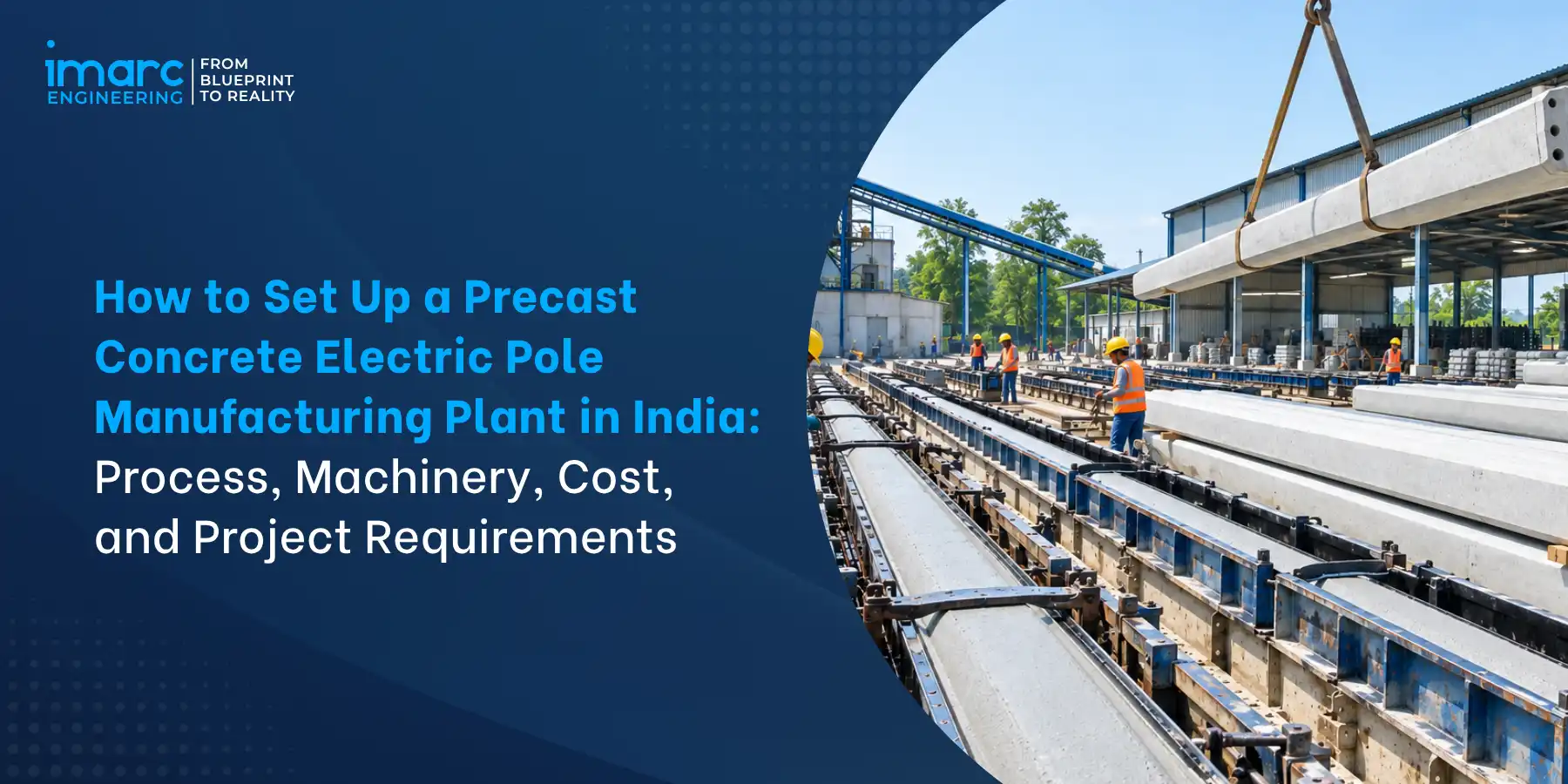
A concrete electric pole manufacturing plant is a dedicated precast concrete facility producing electric poles per BIS specifications (IS 785 for RCC; IS 1678 for PSC) and utility purchaser requirements (REC, state DISCOMs). Facilities span footprints from 5,000 sqm (small plants) to 40,000+ sqm (large plants with dispatch yards). Operations combine concrete batching, reinforcement/prestressing preparation, casting, controlled curing, and multi-stage quality testing. Distinguishing feature versus general precast is the elongated product (8-11+ meters) requiring long moulds, dedicated curing/storage zones, and specialized handling equipment.
2.2 Plant Components
| Component | Function | Illustrative Elements |
|---|---|---|
| Material Yard | Cement, aggregate, steel storage | Silos, stockpiles, steel racks |
| Batching Plant | Concrete production | Batching plant, mixer, controls |
| Reinforcement Shop | Cage/wire preparation | Cutting, bending, tensioning |
| Casting Bay | Mould filling and vibration | Steel moulds, vibrators, cranes |
| Curing Zone | Steam or water curing | Steam chamber or curing tanks |
| Demoulding Area | Mould release, cleanup | EOT crane, mould turning |
| Testing Lab | Concrete/pole testing | Compression, transverse load test |
| Storage Yard | 28-day curing, dispatch | Racks, cranes, dispatch access |
2.3 Plant Scale Determinants
Plant scale primarily depends on target pole types, production volume, and market catchment. Pole length (8m, 9m, 9.5m, 11m common) determines mould length and casting bay dimensions. Pole cross-section (rectangular, tapered) affects mould design. Production capacity (5,000 poles/year small plant to 250,000+ poles/year large) affects number of mould sets, batching plant sizing, and utility infrastructure. Multi-length capability requires additional mould inventory.
Storage yard sizing is often the largest area requirement due to 28-day water curing before dispatch - a plant producing 500 poles/day requires storage for 14,000+ poles at any time. These decisions should follow specific market plan and OEM/DISCOM contracts rather than assume standard configuration.
3. RCC vs PSC Production Route Selection for Electric Pole Manufacturing in India
Understanding RCC vs PSC production route selection for electric pole manufacturing in India is the single most consequential technology decision. The two routes have distinct engineering, equipment, and cost profiles.
3.1 RCC and PSC Comparison
| Attribute | RCC Poles (IS 785) | PSC Poles (IS 1678) |
|---|---|---|
| Reinforcement | HYSD bars (IS 1786) | HT wires/strands (IS 6003/6006) |
| Pre-tensioning | Not required | Required (pretensioned system) |
| Concrete grade | Typically M30-M40 | Typically M40-M50 |
| Weight per pole | Higher (heavier cage) | Lower (efficient section) |
| Crack resistance | Standard | Higher |
| Equipment | Standard casting | Prestressing beds + jacks |
| Application | LT distribution | LT and HT distribution |
Concrete grade, reinforcement configuration, prestressing steel, pole dimensions and design transverse load should follow the applicable BIS standard, purchaser specification and qualified pole design; the ranges above are indicative only.
3.2 RCC Poles
- RCC electric pole manufacturing plant uses conventional reinforced concrete with steel bar cages
- Reinforcement cage prepared from HYSD steel bars (IS 1786) with cutting, bending, tying
- Cage placed in steel mould with cover blocks maintaining specified concrete cover
- Concrete poured, vibrated for compaction, and cured typically at ambient conditions
- Simpler equipment requirements - no prestressing infrastructure needed
- Suitable for shorter/lower-load applications and LT distribution networks
3.3 PSC Poles
- PSC pole manufacturing plant uses prestressed concrete pole manufacturing with pretensioned high-tensile steel wires or strands
- Prestressing wires (IS 6003 indented / IS 1785 plain) or 7-wire strands (IS 6006) placed and tensioned before casting
- Concrete cast around tensioned wires with vibration for compaction
- After the concrete achieves the specified transfer strength for the applicable pole design and manufacturing procedure, the prestressing force is released in a controlled manner and transferred to the concrete
- Wires bond with concrete transferring compressive prestress
- Higher structural efficiency - lighter, more crack-resistant, better cyclic load performance
- Requires prestressing beds, hydraulic jacks, and controlled release infrastructure
3.4 Route Selection Framework
Route selection follows utility/DISCOM specifications, target applications, and business economics. PSC has become the mainstream choice for distribution networks (11 KV, LT) with REC Specifications covering PSC poles for 22/11 KV and LT lines with Factor of Safety 2.5. RCC remains viable for shorter poles, lower-load applications, and where prestressing infrastructure isn't justified. Many plants produce both types serving different customer segments.
Investment differential: PSC plants generally require additional investment in prestressing beds, hydraulic tensioning equipment, anchorage systems and controlled prestress-transfer arrangements compared with RCC-only production. The actual investment differential depends on capacity, pole design, mould configuration and automation level.
4. Raw Materials and Reinforcement Sourcing for Concrete Electric Pole Manufacturing in India
Understanding raw materials and reinforcement sourcing for concrete electric pole manufacturing in India establishes the physical and economic foundation. Raw materials 55-70 percent of variable OPEX with cement and steel as major cost drivers.
Raw-material specifications and consumption vary with the applicable pole standard, structural design, concrete grade, reinforcement or prestressing system, aggregate properties and approved mix design. The values below are indicative and should not replace product-specific mix design, structural calculations or purchaser requirements.
4.1 Cementitious Materials
- Cement (OPC 43/53 grade per IS 269 or PPC per IS 1489) is the primary binder
- OPC 53 grade preferred for PSC poles requiring higher strength development
- Typical cement consumption: 380-420 kg/m³ concrete for M40-M50 grade
- Silica fume or fly ash supplementary cementitious materials for durability enhancement
- Cement quality verification per IS 4031 series (test methods)
- Sourcing typically from major domestic cement companies with quality certification
4.2 Aggregates and Water
- Aggregates (coarse and fine) per IS 383 - major volume component of concrete
- Coarse aggregate: 20mm and 10mm crushed stone with specified gradation, low silt/clay
- Fine aggregate: natural river sand or manufactured sand (M-sand) with fineness modulus 2.4-3.2
- Water: potable quality meeting IS 456 requirements for concrete mixing
- Aggregate quality directly affects concrete strength and pole durability
- Local sourcing typical for economics - stockpile management addresses seasonality
4.3 Reinforcement Materials
- Reinforcement steel for RCC poles: HYSD bars (IS 1786) Grade Fe 415/500 in cage configuration
- Prestressing wire for PSC poles: indented wire (IS 6003) or plain hard-drawn steel wire (IS 1785)
- 7-wire strand (IS 6006) for larger PSC poles requiring higher prestress
- Typical wire diameters: 3-5 mm for PSC poles; typical HYSD bars: 8-16 mm for RCC
- Reinforcement quality certification through mill test certificates and on-site verification
- Admixtures: plasticizers/superplasticizers for workability at low w/c ratio
4.4 Material Sourcing Strategy
| Material | Typical Source | Strategy |
|---|---|---|
| Cement | Local cement companies | Long-term rate contracts |
| Aggregates | Regional quarries | Multi-source, quality checks |
| HYSD steel bars | SAIL, JSW, Tata, JSPL | Grade certification |
| PSC wire/strand | Tata, Usha Martin, imports | Consistent supplier critical |
| Admixtures | BASF, Fosroc, MC, Sika | Trial testing per mix design |
5. Batching Mixing and Casting Process for Electric Pole Manufacturing in India
Understanding batching mixing and casting process for electric pole manufacturing in India covers core value-addition operations. Process discipline directly determines concrete strength, pole quality, and reject rate.
Concrete mix design, batching capacity, workability, casting sequence, compaction method and prestressing parameters vary with pole type, structural design, applicable standard, purchaser specification, production volume and curing method. The following process and numerical ranges are representative examples rather than universal manufacturing requirements.
5.1 Concrete Mix Design
- Concrete batching starts with mix design achieving target strength with workability and durability
- Target 28-day compressive strength: M40 (400 kg/cm²) for standard PSC; M45-M50 for premium grades
- Water-cement ratio typically 0.35-0.45 for target strength with admixture support
- Mix proportions verified through trial mixes and cube testing before production
- Mix design per IS 10262 methodology with certificated verification
5.2 Batching and Mixing
- Concrete mixing through pan or planetary concrete mixer producing uniform concrete
- Weigh-batching plant with cement, aggregate, water, admixture proportioning per mix design
- Batching plant capacity typically 15-60 m³/hour depending on plant scale
- Automated batching with recorded proportioning ensures consistency
- Mixer discharge onto skip/tremie for transport to casting bay
- Concrete workability (slump 25-75 mm) verified per batch
5.3 Casting and Compaction
- Concrete casting into prepared steel moulds with reinforcement cage (RCC) or tensioned wires (PSC)
- Vibration and compaction through high-frequency internal vibrators, form vibrators, or vibrating tables
- Layered casting with intermediate vibration for uniform compaction
- Surface finishing at exposed face with trowelling
- Cover blocks maintaining specified concrete cover throughout
- Casting cycle 20-40 minutes per pole depending on size and automation
5.4 Prestressing (PSC Only)
For PSC poles, prestressing sequence: wires/strands cut to length, placed through mould end plates, tensioned to specified stress (typically 70-75 percent of ultimate tensile strength) using hydraulic jacks against prestressing bed abutments, then concrete cast around tensioned wires. After concrete achieves transfer strength (~50 percent of 28-day strength, typically 24-48 hours with steam curing), wires cut releasing prestress transferred to concrete via bond. Long-line prestressing beds accommodate multiple moulds in sequence - single tensioning operation serving 6-15 poles typical.
6. Moulds Curing and Demoulding Operations for Electric Pole Manufacturing in India
Understanding moulds curing and demoulding operations for electric pole manufacturing in India covers infrastructure and process operations that determine cycle time and pole quality. Mould strategy is a key CAPEX and productivity decision.
6.1 Steel Moulds
- Steel moulds are the primary production infrastructure - typically fabricated from mild steel plate
- Pole moulds match specific pole dimensions - tapered rectangular section, length 8-11+ meters
- Mould sets typically openable for cage placement and pole removal
- Precision-machined mating surfaces ensuring dimensional accuracy of poles
- End plates with holes for prestressing wire pass-through (PSC moulds)
- Mould life: 2,000-5,000+ casting cycles with proper maintenance
- Number of mould sets determines daily production capacity per pole type
6.2 Curing Operations
- Curing sequence: initial curing in mould followed by extended water curing after demoulding
- Steam curing (accelerated) reduces initial curing time to 6-12 hours achieving transfer strength
- Ambient water spray curing extends initial period to 18-24 hours before demoulding
- Steam temperature typically 55-70°C with controlled ramp-up/hold/cool-down cycle
- Post-demoulding water curing in tanks or continuous water spray for 28 days total
- Curing quality directly affects final strength, durability, and crack resistance
6.3 Demoulding Operations
- Demoulding after concrete achieves specified transfer strength
- For PSC: prestress transfer through controlled wire cutting before demoulding
- Mould opening through hydraulic or manual mechanisms
- Pole lifting through overhead crane using lifting attachments
- Mould cleaning and preparation for next cycle (release agent application)
- Mould inspection for wear and dimensional integrity
- Poles transferred to curing yard for extended water curing
6.4 Production Cycle
Total production cycle from mould preparation to storage yard placement typically 24-72 hours per mould depending on curing method. Steam-cured PSC operations achieve one casting per mould per day; ambient-cured RCC may take 2-3 days per cycle. Multi-mould operations with staggered casting enable continuous production. Plant capacity: 100 moulds with daily turnover yields 100 poles/day (~30,000 poles/year at 80 percent utilization); 300 moulds with steam curing enables 300+ poles/day (~90,000+ poles/year). Optimal mould inventory balances CAPEX against production capacity - too few limits output, too many increases capital tie-up.
7. Quality Testing and BIS Compliance for Electric Pole Manufacturing in India
Understanding quality testing and BIS compliance for electric pole manufacturing in India covers testing protocols essential for BIS certification and REC/DISCOM empanelment.
7.1 Applicable Standards
| Standard | Scope | Application |
|---|---|---|
| IS 785:1998 | Reinforced Concrete Poles | RCC pole product standard |
| IS 1678:1998 | Prestressed Concrete Poles | PSC pole product standard |
| IS 2905:1989 | Methods of Test | Test procedures for concrete poles |
| IS 7321:1974 | Selection/Handling/Erection | Code of practice |
| IS 456 | RCC Code of Practice | Design and materials |
| IS 1343 | PSC Code of Practice | Prestressed concrete design |
7.2 Pole Testing per IS 2905
- Pole testing per IS 2905:1989 (First Revision) includes structural and dimensional verification
- Transverse load test at working load - deflection measurement
- Permanent set test - residual deflection after load removal
- Ultimate load test - load at failure
- Cover measurement - specified concrete cover over reinforcement
- Uprightness/straightness check within specified tolerance
7.3 Concrete Quality Testing
- Concrete strength testing with 150 mm cube samples cast and cured per IS 516
- 28-day compressive strength verifying design mix (M40, M45, M50 as applicable)
- Transfer strength testing (early-age cubes) for PSC operations
- Slump test per batch verifying workability
- Dimensional inspection of finished poles including length, cross-section, straightness
7.4 Certification and Empanelment
Manufacturers should comply with the applicable BIS product standards, including IS 785 for RCC poles and IS 1678 for PSC poles, together with applicable utility/REC specifications. Where BIS licensing or certification is mandated by the applicable regulatory or procurement framework, the manufacturer should obtain the relevant BIS licence and maintain the prescribed conformity-assessment and testing arrangements. DISCOM empanelment and purchaser-specific qualification requirements should be assessed separately.
8. Plant Layout Material Handling Storage and Project Economics for Electric Pole Manufacturing in India
Plant layout, material handling, curing and storage infrastructure, and project economics are closely linked in an electric pole manufacturing plant. These factors determine production flow, space requirements, handling efficiency, dispatch capacity, and the overall capital and operating cost of the facility.
8.1 Plant Layout
- Plant layout optimizes material flow from raw materials through casting to dispatch
- Raw material storage adjacent to batching plant minimizing handling
- Casting bay with long parallel mould rows accommodating multi-mould operation
- Curing zone (steam chamber or water tanks) close to casting for minimal transport
- Storage yard (largest area component) with organized racks by pole type and cure day
- Dispatch area with truck access, loading equipment, and staging space
- Testing lab centrally located with sample access from all production areas
8.2 Material Handling
- Material handling systems sized for long/heavy poles
- Gantry crane (or EOT overhead cranes) spanning casting bay for mould/pole handling
- Crane capacity 5-15 tonnes typical - poles 300-1,500 kg with lifting attachments
- Lifting yokes/spreader beams for balanced pole handling
- Trolleys/transfer cars for movement between casting, curing, storage
- Concrete transport: skip/bucket with crane, or ready-mix truck for larger operations
8.3 Storage Yard
The storage yard is often the largest single area requirement due to mandatory 28-day water curing before dispatch. A plant producing 200 poles/day requires storage for ~5,600 poles at any time; a plant producing 500 poles/day requires 14,000+ pole storage. Yard design with organized racks/stacks by pole type and cure day, water spray or immersion curing provision, and crane/forklift access. Yard area typically 40-60 percent of total plant footprint.
8.4 Capital Investment
The investment ranges below are indicative planning benchmarks based on the stated capacity assumptions and should not be treated as standard costs for an electric pole manufacturing plant. Actual CAPEX varies materially with land and site development, RCC versus PSC route, pole specifications, mould quantity and design, batching capacity, curing infrastructure, prestressing systems, automation, material handling, testing facilities, utilities and storage-yard development. Project-specific vendor quotations and engineering estimates should be used for investment decisions.
| Configuration | Scale Assumption | Investment (INR) |
|---|---|---|
| Small | 5,000-20,000 poles/year, single line | 2-8 crore |
| Medium | 20,000-100,000 poles/year, multi-line | 8-30 crore |
| Large | 100,000-250,000 poles/year, automated | 30-100 crore |
| Very Large | 250,000+ poles/year, multi-facility | 100+ crore |
8.5 CAPEX/OPEX and Commissioning
The CAPEX and OPEX shares below are indicative planning ranges and can vary with plant capacity, RCC or PSC route, mould inventory, automation level, curing system, material-handling configuration, local construction costs, and raw-material prices.
- Moulds (major single item): 25-40 percent of CAPEX depending on quantity
- Batching plant and mixer: 10-20 percent (larger share for smaller plants)
- Cranes and handling: 10-15 percent
- Building/civil works: 15-25 percent (storage yard often largest)
- Prestressing equipment (PSC): additional 10-15 percent vs RCC-only
- Materials 55-70 percent variable OPEX; labor 15-25 percent; utilities 5-10 percent
- Project feasibility and commissioning typically 8-18 months from investment decision (shorter than most manufacturing due to mature technology) covering land/civil, mould procurement (2-4 months lead time), batching plant installation, BIS certification, and initial DISCOM empanelment
Conclusion
Setting up an electric pole manufacturing plant in India requires selecting the appropriate RCC or PSC route, sourcing BIS-compliant materials, and establishing controlled batching, casting, prestressing, moulding, curing, and quality-testing systems. Key requirements include BIS certification, REC/DISCOM empanelment, suitable plant layout and storage, material handling, factory and environmental approvals, CAPEX planning, and commissioning within the planned project timeline.
Three priorities should guide plant sponsors: first, size capacity around regional DISCOM demand and logistics economics; second, provide adequate storage and curing space to prevent yard constraints from limiting production; and third, secure BIS certification and relevant DISCOM empanelment early, as these are critical to market access.
PURSUING PRECAST CONCRETE ELECTRIC POLE MANUFACTURING?
IMARC Engineering supports precast manufacturers, utility suppliers, and project sponsors with RCC/PSC route selection, pole design, raw-material sourcing, concrete batching and casting, mould and curing strategy, quality testing, BIS certification and REC/DISCOM empanelment. The advisory covers plant layout, material handling, storage and dispatch logistics, utilities, regulatory approvals including factory licensing and SPCB consents, CAPEX planning, and integrated project commissioning. Technical considerations include applicable BIS/REC specifications, concrete grades, reinforcement or prestressing systems, production capacity, quality-control requirements, and project timelines.
→ Schedule a free concrete electric pole plant scoping consultation with an IMARC specialist
Frequently Asked Questions
Concrete electric poles are manufactured through mould preparation, reinforcement/prestressing cage placement, concrete batching (typically M40-M50), casting with vibration/compaction, curing (steam or water 24-72 hours), demoulding, extended water curing (28 days), quality testing per IS 2905, and storage in dedicated yards before dispatch to utilities.
Electric pole manufacturing plant in India setup involves market/utility assessment, RCC or PSC route selection, plant capacity sizing (5,000-250,000+ poles/year), mould procurement, concrete batching plant installation, BIS certification (IS 785 for RCC / IS 1678 for PSC), REC/DISCOM specification compliance, and commissioning across 8-18 months.
RCC (Reinforced Concrete) poles use conventional steel reinforcement bars/cages per IS 785. PSC (Prestressed Concrete) poles use pre-tensioned high-tensile steel wires providing higher strength-to-weight ratio per IS 1678. PSC poles are lighter, more crack-resistant, and preferred for distribution; RCC poles remain viable for shorter/lower-load applications.
Concrete electric pole raw materials include OPC/PPC cement (IS 269/IS 1489), coarse and fine aggregates (IS 383), water (IS 456 quality), reinforcement steel bars (IS 1786) for RCC poles, prestressing wire or strand (IS 6003/IS 1785/IS 6006) for PSC poles, admixtures, and earthing wire.
Electric pole manufacturing machinery includes steel moulds (per pole size), concrete batching plant, concrete mixer, high-frequency vibrators or vibrating tables, prestressing beds and hydraulic jacks (PSC), gantry/EOT cranes, steam curing chamber or water curing tanks, and pole testing equipment (compression, transverse load) per IS 2905.
Electric pole manufacturing cost in India varies significantly with capacity, automation level, and technology route. Small plants (5,000-20,000 poles/year, single line) typically INR 2-8 crore. Medium plants (20,000-100,000 poles/year, multi-line) around INR 8-30 crore. Large plants (100,000-250,000 poles/year, automated) INR 30-100 crore excluding land cost.
Concrete electric pole quality per IS 2905:1989 includes transverse load test (working and ultimate), permanent set test, ultimate load test, cover measurement, uprightness check, and concrete cube compressive strength. Standards: IS 785 (RCC poles), IS 1678 (PSC poles), IS 456 and IS 1343 (design codes).
Electric pole plant project feasibility depends on utility/DISCOM order visibility, catchment demand (concrete poles have ~200-500 km economical delivery radius due to weight/logistics), mould capacity and cycle time, curing area sizing, storage yard capacity (crucial for 28-day water curing), material access, and REC/BIS certification readiness.
Recent Post




Trusted by Industry Leaders
We partner with global enterprises and ambitious businesses across sectors to deliver operational excellence, strategic insights, and sustainable growth through integrated solutions.












Success in Their Words
Real feedback from clients across industries. Discover how our solutions delivered measurable impact and operational excellence.

I wanted to express my sincere appreciation for your efforts in handling this matter. Your dedication and commitment have been truly commendable, and it is evident that you have put in tremendous hard work and expertise into resolving the issues at hand. We are greatly interested in continuing our collaboration with you in the future, as your professionalism and reliability have made you a trusted partner. Thank you once again for your invaluable contribution. We look forward to strengthening our partnership ahead.

It has been a pleasure working with the IMARC team. The insights provided were structured, clear, and highly valuable, helping us strengthen both our technical and financial planning with confidence. We deeply appreciate the team’s professionalism, responsiveness, and attention to detail throughout the engagement. Every requirement was well understood and effectively incorporated, resulting in a comprehensive and actionable output. Overall, our experience has been excellent, and I would gladly recommend IMARC to organizations seeking a reliable research partner.

Your service is truly exceptional. Working with the IMARC team has been a seamless and professional experience. The clarity of communication, responsiveness to queries, and consistent support at every stage made the entire engagement highly efficient. The insights shared were well-structured, practical, and perfectly aligned with our requirements, helping us make informed decisions with confidence. Overall, the dedication and professionalism demonstrated by your team stand out, and I would be glad to recommend IMARC as a reliable and trustworthy research partner.

IMARC did an outstanding job in preparing our study. They were punctual, precise, and consistently responsive throughout the entire process. The team delivered all the data we required in a clear, well-organized, and highly professional format. Their strong attention to detail, combined with their ability to meet every deadline without compromising quality, truly set them apart. Overall, their reliability and commitment made them an exceptional partner for our project, and we would gladly work with them again in the future.

IMARC made the whole process incredibly easy from start to finish. Everyone I interacted with via email was polite, professional, and straightforward to deal with, always keeping their promises regarding delivery timelines and remaining consistently solutions-focused. From my very first contact, I appreciated the professionalism and support shown by the entire IMARC team. I highly recommend IMARC to anyone seeking timely, affordable, and reliable information or advice. My experience with IMARC was excellent, and I truly cannot fault any aspect of it.

I’d like to express my sincere gratitude for the excellent work you accomplished with the study. Your ability to quickly understand our requirements and deliver high-quality results under tight timelines truly reflects your expertise, exceptional work ethic, and unwavering commitment to your customer’s success. The professionalism and responsiveness you demonstrated throughout the process made a significant difference. Our entire team and company are incredibly thankful for your dedication, reliability, and support. Once again, thank you for your outstanding contribution.