Manufacturing
July 03 2026
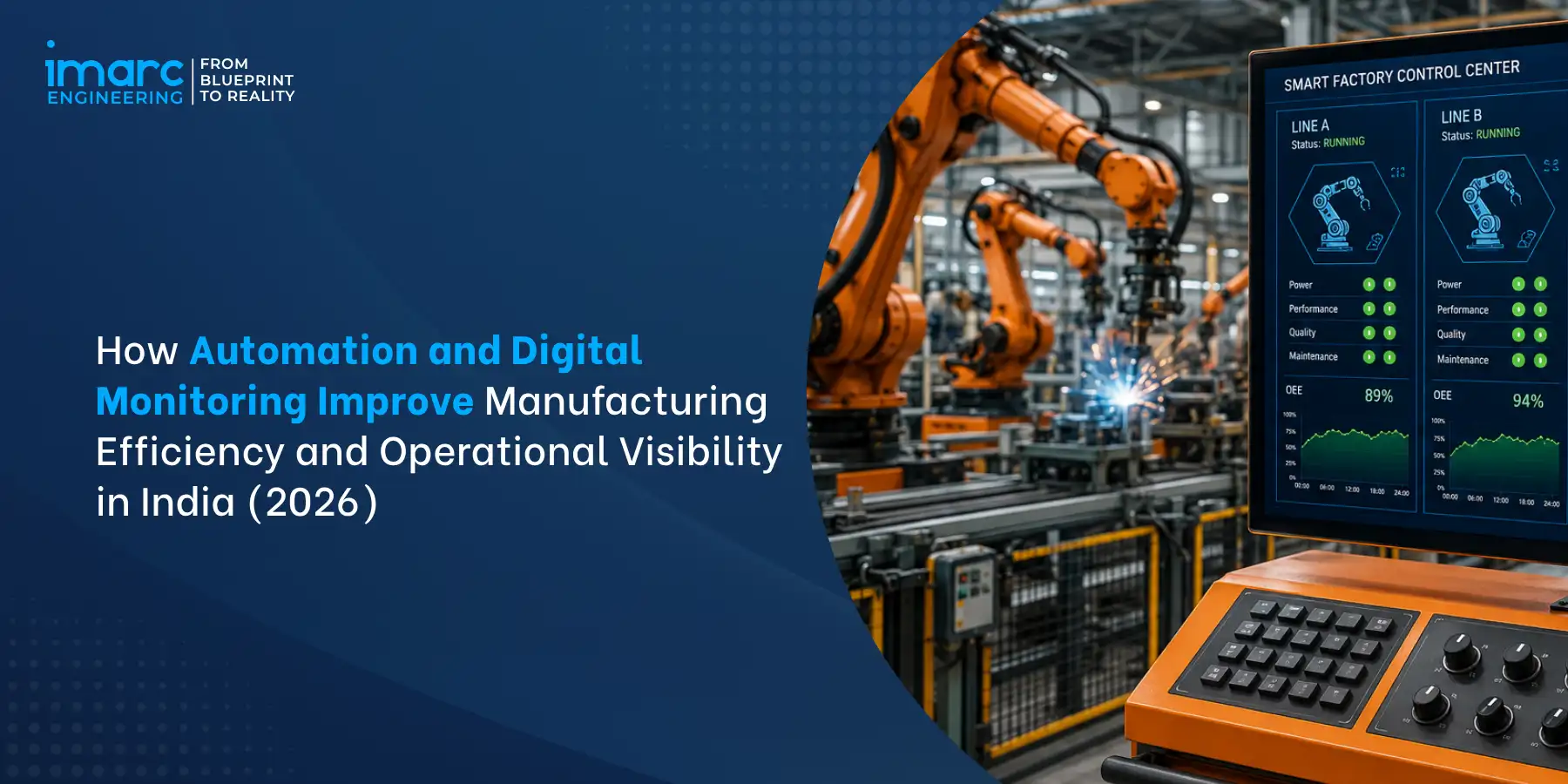
How Automation and Digital Monitoring Improve Manufacturing Efficiency and Operational Visibility in India (2026)
Introduction
Manufacturing in India is undergoing its most substantial technological transformation in decades. Industrial automation in India has moved from an option for large enterprises to a foundational capability across sectors and scales.
Automation is equally important for greenfield manufacturing facilities designing digital infrastructure from the outset and brownfield plants modernising legacy operations through phased automation upgrades.
PLI Scheme expansion across 14 sectors with combined outlay exceeding INR 1.97 lakh crore, semiconductor mission investments, EV battery gigafactory build-out, and the broader Make in India push have collectively brought sophisticated automation, digital monitoring, and Industry 4.0 architectures into new facilities as baseline expectations rather than aspirations. Existing facilities are simultaneously modernising to remain competitive on cost, quality, and delivery.
Scope of This Guide
This guide answers the operations leader's question directly. How do automation and digital monitoring, spanning SCADA, DCS, PLCs, MES, Industrial IoT, predictive analytics, and digital twins, improve manufacturing efficiency and operational visibility for Indian manufacturers in 2026. It walks through the automation architecture, Industry 4.0 framework, real-time production monitoring, IoT platforms, predictive maintenance, cybersecurity discipline, and the practices that distinguish successful digital transformations from those producing partial or reversed outcomes.
Table of Contents
- Introduction
- Why Industrial Automation in India Matters in 2026
- The Automation Pyramid - From Field Devices to Enterprise
- How Automation and Digital Monitoring Improve Manufacturing Efficiency in India
- Industry 4.0 Implementation for Indian Manufacturers
- Real-Time Production Monitoring Solutions for Factories India
- Industrial IoT Platforms for Smart Manufacturing India
- Predictive Maintenance and Condition Monitoring Services India
- Cybersecurity, Standards, and Data Integrity
- Common Mistakes and Best Practices
- Conclusion
1. Why Industrial Automation in India Matters in 2026
Five structural drivers make automation and digital monitoring investments strategically essential for Indian manufacturers in 2026.
1.1 Manufacturing Sector Growth Requires Capacity Scaling
The Indian manufacturing sector contributes approximately 17 percent of GDP. The Make in India initiative targets manufacturing GDP share of 25 percent - a growth trajectory that requires productivity gains beyond capacity additions alone. Automation delivers throughput increases without proportional workforce scaling, quality consistency across shifts, and utilisation improvements that convert existing capital into higher output. Manufacturers pursuing scale without automation face structural cost disadvantage against automated competitors.
1.2 Sector-Specific Regulatory Push
Regulatory frameworks increasingly mandate data-driven operations. Revised Schedule M under Drugs and Cosmetics Rules 1945 (effective 1 July 2024 for large pharma manufacturers) mandates Computerised System Validation and data integrity aligned with ALCOA+ principles. FSSAI food safety compliance encourages digital traceability. BIS Quality Control Orders demand structured quality data. IATF 16949 for automotive requires digital quality tracking. Environmental clearance compliance increasingly requires digital emission monitoring under CPCB directives.
1.3 Customer and Export Market Expectations
Global OEMs, pharma sponsors, retail chains, and export customers increasingly require digital traceability, real-time quality data, and integrated supply chain visibility from Indian suppliers. Automotive Tier-1 suppliers must connect to OEM production systems. Pharma contract manufacturers must provide batch-level electronic records. Food exporters must demonstrate cold-chain integrity through connected sensors. Manufacturers without digital capability face progressive exclusion from premium customer segments.
1.4 Labour Cost and Availability Dynamics
Skilled manufacturing labour is increasingly scarce and expensive relative to a decade ago. Higher-value automation supports remaining workforce in supervisory and technical roles rather than repetitive tasks. Automation also captures institutional knowledge that would otherwise walk out with retiring or transitioning employees. Facilities that automate proactively face lower workforce risk than facilities dependent on ever-larger unskilled or semi-skilled workforce.
1.5 Government Programme Support
Central and state initiatives support automation investments. SAMARTH Udyog Bharat 4.0 under Ministry of Heavy Industries provides framework and support. Design Linked Incentive (DLI) scheme supports semiconductor and electronics design. State-level industrial policies increasingly incentivise Industry 4.0 investments. Skill India Digital initiatives address workforce upskilling. Public infrastructure investment in 5G, fibre, and cloud data centres reduces the connectivity and compute constraint that historically limited plant floor digitalization.
2. The Automation Pyramid - From Field Devices to Enterprise
Understanding the classical automation pyramid provides essential context for plant automation systems design. The pyramid describes five layers from physical field devices at the bottom to enterprise systems at the top, each layer serving specific functions and communicating with adjacent layers.
2.1 The Five Layers
| Level | Layer | Typical Systems |
|---|---|---|
| Level 4 | Enterprise Planning | ERP (SAP, Oracle) - order to cash, procurement, finance |
| Level 3 | Manufacturing Operations | MES, MOM, LIMS, CMMS - production execution |
| Level 2 | Supervisory Control | SCADA, DCS, HMI, Historian - plant supervision |
| Level 1 | Basic Control | PLCs, PID controllers, safety systems |
| Level 0 | Field Devices | Sensors, transmitters, valves, motors, drives, VFDs |
2.2 Field Devices and Basic Control
Level 0 and Level 1 form the physical foundation. Sensors measure temperature, pressure, flow, level, vibration, and other process variables. Actuators including control valves, variable frequency drives (VFDs), and servo drives translate control decisions into physical action. PLCs and DCS controllers execute control logic in real time with response times measured in milliseconds. Safety Instrumented Systems (SIS) provide independent protection layers per IEC 61511. Reliable Level 0 and Level 1 architecture is the non-negotiable foundation of all higher-level digital initiatives.
2.3 Supervisory Control and Data Acquisition
Level 2 provides plant-wide operational visibility through SCADA and DCS platforms. Human Machine Interfaces (HMIs) enable operator interaction with process. Historian systems capture process data at millisecond intervals for trending, analysis, and record-keeping.
Alarm management systems distinguish critical from routine deviations. Batch control systems per ISA-88 support recipe-driven operations. Level 2 architecture from vendors such as Siemens, Rockwell, Schneider Electric, ABB, Emerson, Yokogawa, and Honeywell forms the backbone of most process industry operations.
2.4 Manufacturing Operations and Enterprise Integration
Level 3 Manufacturing Execution Systems (MES) manage production execution - dispatching orders, tracking work-in-progress, capturing quality data, managing genealogy, and reporting production metrics. Level 4 ERP systems handle order management, procurement, finance, and enterprise planning. ISA-95 defines the integration between Level 3 and Level 4.
Effective integration eliminates data silos between plant floor and enterprise systems, supporting decisions with complete operational context. Historically fragmented integrations are giving way to unified digital architectures in modern implementations.
3. How Automation and Digital Monitoring Improve Manufacturing Efficiency in India
The efficiency improvement mechanism through automation for manufacturing plants operates across multiple dimensions simultaneously. Understanding how automation and digital monitoring improve manufacturing efficiency in India helps sponsors evaluate investment cases with realistic expectations.
3.1 The Efficiency Dimensions
| Dimension | Automation Mechanism | Typical Improvement |
|---|---|---|
| Availability | Reduced downtime; predictive maintenance | 5-15 percentage points |
| Performance | Optimised throughput; reduced speed loss | 3-10 percentage points |
| Quality | Consistent process; early defect detection | 20-50% defect reduction |
| Energy Efficiency | VFD control; load optimisation | 5-20% energy reduction |
| Labour Productivity | Automated tasks; augmented decisions | 10-30% improvement |
| Material Utilisation | Precise dosing; yield tracking | 2-10% yield improvement |
3.2 Availability and Downtime Reduction
Automation reduces unplanned downtime through consistent operation, early anomaly detection, and predictive maintenance signals. Condition monitoring sensors detect bearing wear, motor degradation, and lubrication issues before failure. Automated alerts trigger maintenance before breakdown. Root cause analysis of downtime events benefits from complete process data captured by historians. Facilities implementing structured automation programmes typically see Availability improvements of 5-15 percentage points over 12-24 months - a material contributor to OEE gains.
3.3 Quality Consistency and Defect Reduction
Automated process control produces materially more consistent output than manual control. Statistical Process Control (SPC) integrated with real-time data enables early detection of process drift. Machine vision systems catch defects before they compound into batch failures. First-pass yield improves. Rework reduces. Customer complaints decrease. Manufacturers implementing automation-supported quality programmes typically see 20-50 percent defect reduction over 12-24 months, with corresponding cost savings and customer satisfaction gains.
3.4 Operational Visibility Beyond the Plant Floor
Traditional operations rely on periodic reports and end-of-shift summaries. Modern industrial digital monitoring transforms this pattern by making operational data continuously visible. Digital monitoring systems in India provide continuous visibility to operations leaders, corporate quality teams, remote experts, and customers where appropriate. Live dashboards showing OEE, throughput, quality metrics, and equipment status support faster decision-making. Alert-driven exception management focuses attention on issues rather than routine status. Remote experts can support plant teams without physical travel. The visibility gain often produces larger returns than the direct automation of physical processes.
4. Industry 4.0 Implementation for Indian Manufacturers
The Industry 4.0 framework provides a structured lens for automation and digital transformation. Industry 4.0 in India is progressively adopted across sectors with variable maturity levels. Successful Industry 4.0 implementation for Indian manufacturers requires disciplined choice of technology bets aligned with commercial priorities.
4.1 The Nine Core Technologies
| Technology | Purpose | Common Application |
|---|---|---|
| Industrial IoT | Connected devices and data | Sensor networks, connected equipment |
| Big Data and Analytics | Insights from operational data | OEE analytics, quality prediction |
| Cloud Computing | Scalable compute and storage | MES, analytics, digital thread |
| Cybersecurity | OT/IT security | IEC 62443-aligned protection |
| Simulation / Digital Twin | Virtual model of physical | Process optimisation, scenario testing |
| Autonomous Robots | Automated physical tasks | Material handling, welding, assembly |
| Additive Manufacturing | 3D printing | Prototyping, spares, low-volume parts |
| Augmented Reality | Real-world data overlay | Maintenance guidance, training |
| System Integration | Vertical / horizontal linking | Plant-to-enterprise integration |
4.2 Sector-Specific Adoption Patterns
Adoption patterns vary by sector. Automotive Tier-1 suppliers lead in system integration, digital quality, and connected supply chains. Pharma manufacturers focus on data integrity, batch traceability, and process control. Semiconductor fabs operate at the leading edge of full-plant automation. Electronics contract manufacturers emphasise machine vision and quality monitoring. Food and beverage processors prioritise cold-chain monitoring and hygiene traceability. Chemicals and process industries focus on safety instrumented systems and asset reliability. Sector-appropriate smart manufacturing in India adoption prioritises technologies that address the specific sector's economic and quality drivers.
4.3 The Maturity Journey
Most Indian manufacturers progress through five maturity levels. Level 1 - basic automation with PLCs and standalone SCADA. Level 2 - integrated SCADA and DCS with historians for data collection. Level 3 - MES implementation with production tracking and quality data. Level 4 - Industrial IoT with predictive analytics and connected supply chain. Level 5 - autonomous operations with digital twins and AI-driven optimisation. Most Indian manufacturers today operate at Levels 2-3; sector leaders reach Level 4; only frontier facilities operate at Level 5. Progressive maturity building yields better outcomes than attempting frontier implementations without foundation discipline.
4.4 Business Case Discipline
Industry 4.0 investments must deliver measurable business outcomes. Effective business cases quantify baseline operations, target improvements, investment cost, and payback period. Typical automation initiatives target 3-5-year payback through combined efficiency gains, quality improvement, downtime reduction, and labour productivity. Business case discipline prevents the technology-driven implementations that fail to deliver commercial returns. It also supports post-implementation verification of actual outcomes against projections.
5. Real-Time Production Monitoring Solutions for Factories India
Real-time production monitoring represents the most immediately valuable application of automation and digital monitoring for many Indian manufacturers. Real-time production monitoring solutions for factories make operational reality visible, supporting faster and better decisions across shift changes, quality events, and improvement initiatives.
5.1 What Real-Time Monitoring Delivers
- Live OEE tracking with Availability, Performance, and Quality dimensions
- Real-time production count against plan by line, shift, and product
- Quality metrics including first-pass yield, scrap, and rework
- Equipment status with running, idle, and downtime classification
- Energy consumption per unit produced
- Material consumption and inventory positions
- Operator performance and shift metrics
- Downtime reason coding for root cause analysis
5.2 Implementation Approaches
Implementation typically follows one of three patterns. Full MES implementation from vendors such as Siemens Opcenter, Rockwell FactoryTalk, GE Proficy, SAP Digital Manufacturing, or open-source alternatives - comprehensive but higher effort. Purpose-built OEE tracking platforms from vendors focused on specific use cases - faster deployment for defined scope. Custom implementations using SCADA/Historian data with reporting tools - lower cost but higher long-term maintenance. The right choice depends on facility complexity, budget, and strategic direction.
5.3 Data Architecture Foundation
Real-time monitoring requires clean data foundation. SCADA DCS MES integration services address the data plumbing that makes visibility possible. Sources include PLCs, SCADA, DCS, Historian, LIMS, and manual entry systems. Data quality, timestamps, unit consistency, tag naming discipline, must be verified. Data models must map physical assets to logical production units. Master data (products, work centres, materials) must be consistent across systems. Poor data foundation produces dashboards that mislead rather than inform.
5.4 Change Management Considerations
Real-time monitoring exposes operational reality that has often been obscured by shift-end reporting. Employees may initially resist visibility they perceive as surveillance. Effective implementations position monitoring as team performance enablement rather than individual scrutiny.
Training on interpreting dashboards, response protocols for alerts, and structured improvement forums integrate the monitoring platform into daily work. Change management often determines whether real-time monitoring produces sustained value or becomes shelfware.
6. Industrial IoT Platforms for Smart Manufacturing India
Industrial IoT solutions represent one of the most transformative Industry 4.0 pillars. Industrial IoT platforms for smart manufacturing connect physical assets to digital analytics, producing actionable insights that traditional automation architectures cannot deliver at scale.
6.1 The Industrial IoT Architecture
An Industrial IoT architecture typically comprises five layers. Field layer includes sensors, actuators, and connected equipment producing operational data. Edge layer includes gateways, edge computing devices, and local processing for latency-sensitive applications. Connectivity layer includes wired networks, industrial wireless, 5G, and secure VPN links. Platform layer provides device management, data ingestion, storage, and analytics. Application layer delivers insights through dashboards, mobile apps, alerts, and integration with other systems. Each layer requires specific vendor selection and integration effort.
6.2 Major IIoT Platform Categories
| Platform Category | Representative Vendors | Common Use Cases |
|---|---|---|
| Automation Vendor Platforms | Siemens Xcelerator, Rockwell FactoryTalk | Native integration with control systems |
| Hyperscale Cloud IoT | Azure IoT, AWS IoT, Google Cloud IoT | Large-scale data and AI/ML |
| Independent IoT Platforms | PTC ThingWorx, GE Digital, Software AG | Cross-vendor connectivity |
| Specialised Vertical Platforms | Sector-specific vendors | Pre-built solutions for specific industries |
| Open Source | Node-RED, Grafana, InfluxDB, Kafka | Custom builds with lower licensing cost |
6.3 Connectivity and Communication Standards
Field-to-platform communication uses various protocols. OPC UA has emerged as the leading vendor-neutral standard for industrial data exchange. Modbus and Ethernet/IP remain widely used for legacy device integration. MQTT provides efficient message-oriented communication for constrained devices. Industrial 5G is emerging for high-bandwidth wireless applications.
Time-Sensitive Networking (TSN) supports deterministic Ethernet for real-time applications. Effective architecture typically layers OPC UA on top of protocol-specific device connectivity to provide platform-independent data exchange.
6.4 Data Value Chain
IIoT investments deliver value through the analytics they enable rather than through connectivity alone. Descriptive analytics (what happened) support monitoring and reporting. Diagnostic analytics (why it happened) support root cause investigation.
Predictive analytics (what will happen) support proactive intervention. Prescriptive analytics (what should we do) support optimised decisions. Most facilities extract descriptive and diagnostic value first; predictive and prescriptive analytics require additional data science capability and sustained operational discipline.
7. Predictive Maintenance and Condition Monitoring Services India
Predictive maintenance and condition monitoring services deliver among the highest ROI applications of automation and Industrial IoT. They shift maintenance from reactive breakdown response to proactive intervention based on equipment condition indicators.
7.1 The Maintenance Strategy Spectrum
| Strategy | Basis | Typical Cost |
|---|---|---|
| Reactive / Breakdown | Fix on failure | Highest downtime cost |
| Preventive (Time-Based) | Scheduled intervals | Over-maintenance risk |
| Condition-Based | Sensor-driven condition data | Better resource allocation |
| Predictive (Analytics-Driven) | Failure prediction models | Optimal maintenance timing |
| Prescriptive | Optimisation of interventions | Highest value; complex |
7.2 Condition Monitoring Technologies
- Vibration analysis - rotating equipment (pumps, motors, gearboxes, compressors)
- Thermography - electrical panels, transformers, insulation issues
- Oil analysis - gearbox wear, hydraulic system degradation, contamination
- Ultrasonic testing - air leaks, bearing lubrication, electrical arcing
- Motor Current Signature Analysis (MCSA) - motor health
- Acoustic emission monitoring - crack initiation in pressure vessels
- Corrosion monitoring - piping, tanks, and vessels in aggressive service
7.3 Implementation Approach
Effective predictive maintenance programmes typically follow a structured build-out. Asset criticality analysis identifies high-value candidates for monitoring. Failure mode analysis identifies which failure modes each sensor can detect. Sensor selection matches technology to failure mode. Baseline data collection establishes normal behaviour.
Alert thresholds are calibrated over 3-6 months. Analytics models mature as data accumulates. Response protocols embed predictive alerts into work order systems. Typical programmes cover 20-40 percent of critical assets in the first 12-18 months with progressive expansion.
7.4 Business Case Considerations
Predictive maintenance business cases combine downtime reduction, maintenance cost optimisation, and spare parts optimisation. Typical returns include 20-40 percent reduction in unplanned downtime for monitored assets, 10-25 percent reduction in maintenance cost through fewer emergency interventions, and 15-30 percent reduction in spare parts inventory through better prediction.
Payback periods of 12-24 months are typical for well-designed programmes. Poorly designed programmes with weak sensor selection, inadequate baseline, or poor alert response produce disappointing returns and reputational damage to broader digital initiatives.
8. Cybersecurity, Standards, and Data Integrity
Automation and digital monitoring introduce cybersecurity, standards, and data integrity requirements that traditional isolated OT operations did not face. Sponsors must integrate these dimensions from project inception rather than treating them as retrofit concerns.
8.1 OT Cybersecurity Framework
Operational Technology cybersecurity operates under different constraints than IT cybersecurity. Availability priority exceeds confidentiality. Latency budgets are tight. Legacy systems may not support modern security. IEC 62443 provides the leading international framework for industrial cybersecurity - covering security levels, zones and conduits, security lifecycles, and technical requirements. NIST Cybersecurity Framework provides complementary guidance.
Indian Computer Emergency Response Team (CERT-In) directions on OT security apply to critical infrastructure operators. Structured cybersecurity design from project inception costs materially less than retrofit.
8.2 Key Standards Landscape
- IEC 62443 - Industrial Cybersecurity (multi-part standard)
- ISA-95 - Enterprise-Control System Integration
- ISA-88 - Batch Control
- OPC UA (IEC 62541) - Machine-to-machine communication
- IEC 61131-3 - Programmable Controller Programming Languages
- IEC 61508 / 61511 - Functional Safety / Process Safety
- ISO 22400 - KPIs for Manufacturing Operations Management
- ISO 55001 - Asset Management System
8.3 Data Integrity for Regulated Sectors
Regulated sectors face data integrity obligations that extend into automation architecture. Revised Schedule M Subpart 12 covers computerised systems and data integrity per ALCOA+ principles. USFDA 21 CFR Part 11 governs electronic records and electronic signatures. EU Annex 11 covers computerised systems.
Computer System Validation (CSV) is required for GxP systems - covering user requirements, functional specification, design, testing, and lifecycle documentation. Automation architects working in regulated sectors must design for CSV from inception rather than adding validation as afterthought.
8.4 Emerging Regulatory and Compliance Trends
Additional compliance dimensions are emerging alongside traditional data integrity requirements. CERT-In directions on cybersecurity incident reporting apply to critical infrastructure operators including many industrial facilities. SEBI BRSR Core reporting introduces limited assurance requirements for ESG data - creating demand for verifiable environmental monitoring data captured through automation.
State Pollution Control Board Continuous Emission Monitoring System (CEMS) requirements mandate real-time environmental data reporting for regulated sectors. IEC 62443 industrial cybersecurity certification is increasingly requested by international customers as part of supplier qualification. Sponsors architecting automation programmes should map these emerging compliance dimensions into system design rather than facing them as retrofit challenges once production has commenced.
9. Common Mistakes and Best Practices
9.1 Technology-First Instead of Business-First
Automation initiatives driven by technology enthusiasm rather than business need routinely fail to deliver commercial returns.
Best practice: start with business outcomes - efficiency, quality, downtime, safety - and select technology to deliver those outcomes; quantify baseline and target improvements; require business case discipline for major investments.
9.2 Underestimating Data Foundation
Analytics platforms built on poor-quality plant data produce misleading insights. Master data inconsistencies, timestamp errors, and tag naming chaos undermine dashboards regardless of visual polish.
Best practice: invest in data foundation before analytics tooling; establish tag standards, master data governance, and time synchronisation; treat data quality as ongoing discipline rather than one-time cleanup.
9.3 Ignoring Change Management
Technology deployment without corresponding change management routinely produces shelfware. Plant floor digitalization services for Indian manufacturers must combine technology implementation with employee engagement, training, and structured operational integration.
Best practice: identify change champions at plant floor; train comprehensively on new tools; embed digital metrics into performance management; sustain engagement through structured improvement forums.
9.4 Cybersecurity as Afterthought
OT cybersecurity treated as post-deployment concern faces material cost and disruption during retrofit.
Best practice: integrate cybersecurity from architecture design; IEC 62443 alignment from inception; structured zone and conduit design; secure remote access from day one; incident response planning before incidents.
9.5 Over-Reliance on Single Vendor
Complete solutions from single vendor create lock-in and limit flexibility.
Best practice: architect for interoperability using standards (OPC UA, ISA-95, MQTT); use hyperscale cloud for scale-out; use specialised vendors for specialised applications; maintain skills and contracts across multiple partners.
9.6 Ignoring Digital Twin Opportunities
Digital twins remain under-utilised despite their value for scenario testing, training, and optimisation.
Best practice: identify high-value use cases first (critical assets, complex process areas); build twin fidelity to match use case need; integrate twins with real-time data; digital twin implementation for manufacturing projects should aim at operational insight rather than visualisation aesthetics.
Conclusion
Industrial automation in India and connected digital monitoring in 2026 represent one of the most consequential strategic frontiers for manufacturers across sectors and scales. The confluence of PLI-driven capacity expansion, regulatory push toward data-driven operations under frameworks such as Revised Schedule M, customer expectations for real-time visibility, labour dynamics favouring automated operations, and structured Government support through initiatives such as SAMARTH Udyog Bharat 4.0 has produced the most favourable environment for automation investments in recent decades.
Manufacturing automation solutions spanning SCADA, DCS, PLCs, MES, IIoT, predictive analytics, and digital twins are increasingly accessible to mid-sized manufacturers as well as large enterprises — shifting the strategic question from whether to invest to how to invest with discipline that delivers returns.
Three closing reminders for operations leaders planning automation and digital monitoring investments. First, anchor every initiative in quantified business outcomes - Availability improvement, quality gains, downtime reduction, energy efficiency, labour productivity - rather than technology enthusiasm alone. The most valuable investments deliver measurable operational returns within 12-24 months.
Second, invest in data foundation before analytics sophistication - clean tag standards, master data governance, time synchronisation, and OPC UA-based interoperability produce more sustained value than any single analytics platform.
Third, integrate cybersecurity from inception - IEC 62443 alignment, zone and conduit design, and secure remote access designed from the start cost materially less than retrofit and protect the operational continuity that automation itself is intended to strengthen.
PLANNING YOUR AUTOMATION OR DIGITAL MONITORING PROGRAMME?
IMARC Engineering's industrial automation and digital transformation team supports plant leaders, operations heads, digital transformation teams, and CIOs across sectors, from strategic roadmap development through technology selection, implementation partnership, cybersecurity architecture, MES and IIoT platform deployment, predictive maintenance programmes, and post-implementation performance optimisation.
→ Schedule a free automation and digital transformation consultation with an IMARC specialist
Frequently Asked Questions
SCADA (Supervisory Control and Data Acquisition) and DCS (Distributed Control Systems) are Level 2 systems providing plant-wide operational visibility and control. MES (Manufacturing Execution System) is a Level 3 system managing production execution, work-in-progress, quality data, and genealogy. Most manufacturers need both, integrated per ISA-95.
Costs vary widely by scope, sector, and facility complexity. SCADA implementation for a medium plant typically ranges INR 50 lakh to INR 5 crore. MES implementation ranges INR 1 crore to INR 15 crore. Full Industry 4.0 for a mid-sized plant can range INR 5 crore to INR 50 crore. IoT sensor deployments range INR 5,000 to INR 1,00,000 per data point depending on complexity.
Well-designed automation programmes typically deliver 3-5 year payback through combined efficiency, quality, downtime, and productivity gains. Automation for manufacturing plants can improve Availability by 5-15 percentage points, reduce defects by 20-50 percent, cut energy consumption by 5-20 percent, and improve labour productivity by 10-30 percent.
Not necessarily. Modern automation increasingly retrofits existing equipment through IoT sensors, edge gateways, and connectivity solutions. Full equipment replacement is only needed when equipment is at end-of-life or has fundamental automation limitations. Retrofit approaches often deliver 60-80 percent of full-automation benefits at 20-40 percent of cost.
Industry 4.0 encompasses nine core technologies including IIoT, big data analytics, cloud, cybersecurity, digital twins, autonomous robots, additive manufacturing, augmented reality, and system integration. Industry 4.0 in India adoption typically starts with real-time production monitoring and predictive maintenance, highest-return applications with manageable implementation complexity.
Timelines vary by scope. SCADA and PLC upgrades typically take 3-9 months. MES implementations typically take 12-24 months. IIoT platforms typically deploy in 6-18 months. Full Industry 4.0 transformations run 24-48 months across multiple sub-projects. Phased implementation delivers value throughout rather than waiting for complete transformation.
Connected automation creates cyberattack surface that isolated OT operations did not face. Risks include ransomware, industrial espionage, safety system compromise, and data integrity attacks. Structured cybersecurity design per IEC 62443, secure remote access, network segmentation, and incident response planning materially reduce risk exposure.
Yes. Automation supports GMP compliance through Computer System Validation, data integrity aligned with ALCOA+ principles, batch record electronic capture, audit trail generation, and environmental monitoring. Regulated sectors including pharma, medical devices, and food increasingly require automation to meet contemporary compliance expectations.
A digital twin is a virtual model of physical assets connected to real-time operational data. Digital twins support scenario testing, optimisation, training, and predictive maintenance. Best applications: critical assets, complex process areas, high-cost failure scenarios. Digital twin value depends on use case clarity and fidelity match rather than technology sophistication.
Recent Post




Trusted by Industry Leaders
We partner with global enterprises and ambitious businesses across sectors to deliver operational excellence, strategic insights, and sustainable growth through integrated solutions.












Success in Their Words
Real feedback from clients across industries. Discover how our solutions delivered measurable impact and operational excellence.

I wanted to express my sincere appreciation for your efforts in handling this matter. Your dedication and commitment have been truly commendable, and it is evident that you have put in tremendous hard work and expertise into resolving the issues at hand. We are greatly interested in continuing our collaboration with you in the future, as your professionalism and reliability have made you a trusted partner. Thank you once again for your invaluable contribution. We look forward to strengthening our partnership ahead.

It has been a pleasure working with the IMARC team. The insights provided were structured, clear, and highly valuable, helping us strengthen both our technical and financial planning with confidence. We deeply appreciate the team’s professionalism, responsiveness, and attention to detail throughout the engagement. Every requirement was well understood and effectively incorporated, resulting in a comprehensive and actionable output. Overall, our experience has been excellent, and I would gladly recommend IMARC to organizations seeking a reliable research partner.

Your service is truly exceptional. Working with the IMARC team has been a seamless and professional experience. The clarity of communication, responsiveness to queries, and consistent support at every stage made the entire engagement highly efficient. The insights shared were well-structured, practical, and perfectly aligned with our requirements, helping us make informed decisions with confidence. Overall, the dedication and professionalism demonstrated by your team stand out, and I would be glad to recommend IMARC as a reliable and trustworthy research partner.

IMARC did an outstanding job in preparing our study. They were punctual, precise, and consistently responsive throughout the entire process. The team delivered all the data we required in a clear, well-organized, and highly professional format. Their strong attention to detail, combined with their ability to meet every deadline without compromising quality, truly set them apart. Overall, their reliability and commitment made them an exceptional partner for our project, and we would gladly work with them again in the future.

IMARC made the whole process incredibly easy from start to finish. Everyone I interacted with via email was polite, professional, and straightforward to deal with, always keeping their promises regarding delivery timelines and remaining consistently solutions-focused. From my very first contact, I appreciated the professionalism and support shown by the entire IMARC team. I highly recommend IMARC to anyone seeking timely, affordable, and reliable information or advice. My experience with IMARC was excellent, and I truly cannot fault any aspect of it.

I’d like to express my sincere gratitude for the excellent work you accomplished with the study. Your ability to quickly understand our requirements and deliver high-quality results under tight timelines truly reflects your expertise, exceptional work ethic, and unwavering commitment to your customer’s success. The professionalism and responsiveness you demonstrated throughout the process made a significant difference. Our entire team and company are incredibly thankful for your dedication, reliability, and support. Once again, thank you for your outstanding contribution.