Manufacturing
July 09 2026
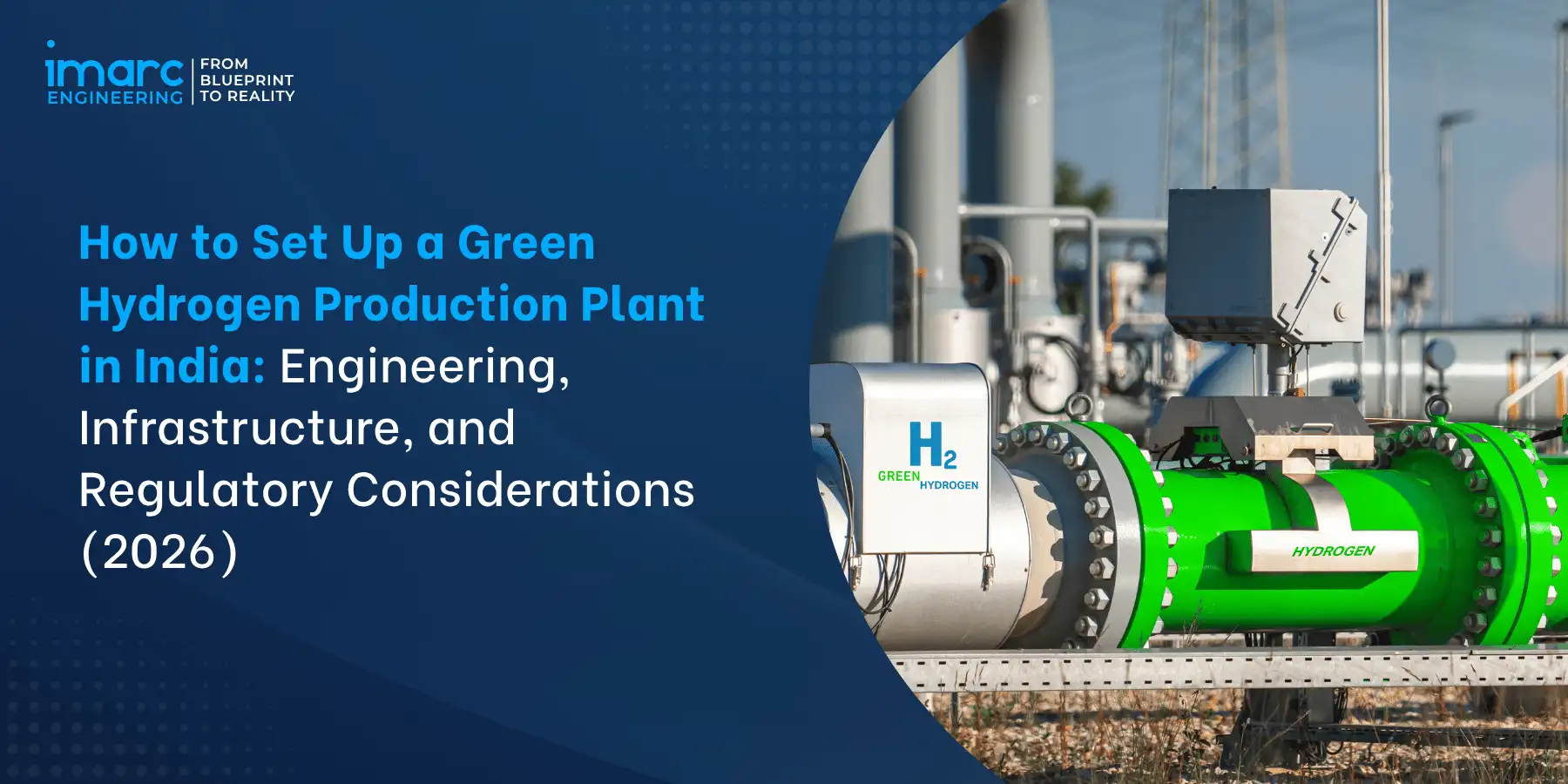
How to Set Up a Green Hydrogen Production Plant in India: Engineering, Infrastructure, and Regulatory Considerations (2026)
Introduction
A green hydrogen production plant in India uses renewable electricity to produce hydrogen through water electrolysis, providing a clean alternative to fossil fuel-based hydrogen production. As India accelerates the National Green Hydrogen Mission, expands renewable energy capacity, and strengthens industrial decarbonisation initiatives, investment in green hydrogen projects is growing rapidly.
However, developing a commercially viable green hydrogen production facility requires much more than selecting an electrolyser. Investors must evaluate project feasibility, renewable power integration, water availability, utility infrastructure, site selection, regulatory approvals, safety requirements, and engineering design to build a technically and commercially viable project.
For promoters and investors planning a green hydrogen production plant in India in 2026, the opportunity is significant, but project execution remains complex. Government initiatives such as the National Green Hydrogen Mission, SIGHT incentives, and MNRE-SECI programmes are encouraging investment, while growing demand from refineries, fertilizer plants, steel manufacturers, and export-oriented ammonia projects is strengthening the commercial outlook. Successfully developing a hydrogen production facility still requires careful planning across engineering, infrastructure, utilities, approvals, and project execution.
Scope of this Guide
This guide answers the sponsor's engineering, infrastructure, and regulatory question directly. What must a promoter evaluate before committing capital to a green hydrogen plant setup in India. It walks through the policy context, electrolyser technology selection, step-by-step setup pathway, feasibility discipline, regulatory approvals, engineering considerations, cost benchmarks, and the practices that separate well-executed hydrogen projects from those facing cost overruns, off-take shortfalls, or utility-integration failures.
Table of Contents
- Introduction
- Why Green Hydrogen Production in India Matters in 2026
- Electrolyser Technologies and Plant Configurations
- How to Set Up a Green Hydrogen Production Plant in India
- Hydrogen Plant Feasibility Study in India
- Regulatory Approvals for Green Hydrogen Plant in India
- Green Hydrogen Plant Engineering and Design Services in India
- Green Hydrogen Plant Setup Cost in India
- Common Mistakes and Best Practices
- Conclusion
1. Why Green Hydrogen Production in India Matters in 2026
Four structural drivers make green hydrogen production a strategically compelling investment opportunity for Indian and international sponsors in 2026.
1.1 National Green Hydrogen Mission Policy Framework
The National Green Hydrogen Mission launched in January 2023 with total outlay of INR 19,744 crore for FY 2023-24 to FY 2029-30 targets 5 million metric tons per annum (MMTPA) of domestic green hydrogen production capacity by 2030 alongside 125 GW of associated renewable energy capacity addition. The Ministry of New and Renewable Energy (MNRE) is the nodal ministry with Solar Energy Corporation of India (SECI) as implementing agency.
The SIGHT (Strategic Interventions for Green Hydrogen Transition) Programme provides structured incentives, Component I with INR 4,440 crore for electrolyser manufacturing over 5 years and Component II with INR 13,050 crore for green hydrogen production over 3 years.
1.2 Structural Demand from Hard-to-Abate Sectors
Green hydrogen demand in India is anchored by structural industrial applications rather than speculative markets. Refineries substituting grey hydrogen with green hydrogen in hydrotreating, and hydrocracking operations represent the largest near-term offtake. Fertilizer sector substitution of natural-gas-derived ammonia with green ammonia is scale-defining.
Steel decarbonisation through hydrogen-based Direct Reduced Iron (DRI) production is emerging. Green methanol, green ammonia for export as clean-energy carrier, and heavy-transport applications provide additional demand streams. Structured off-take from these sectors distinguishes green hydrogen from many other emerging technology opportunities.
1.3 Renewable Energy Abundance
India has emerged as one of the world's most competitive locations for utility-scale renewable power generation. Solar tariffs discovered in recent competitive bids at INR 2.5-3.5 per kWh and wind tariffs at INR 3-4 per kWh translate to some of the world's lowest levelised cost of electricity for green hydrogen production.
Combined with high solar irradiation across Rajasthan, Gujarat, Andhra Pradesh, Karnataka, and Madhya Pradesh and strong wind resource across Tamil Nadu, Gujarat, and Karnataka, India's renewable resource base underpins competitive levelised cost of hydrogen (LCOH) that supports export ambitions.
1.4 Export Opportunity and Strategic Positioning
Green hydrogen, ammonia, and methanol markets in Japan, South Korea, European Union, and Singapore are progressively opening for structured long-term off-take. India's cost competitiveness combined with policy support positions the country as a potential global export hub. Multiple recent SIGHT awards target export-oriented projects.
Bilateral clean-energy partnerships with Japan, EU, Germany, and Singapore create additional structured demand channels. Sponsors evaluating projects should assess both domestic and export off-take opportunities in feasibility work.
2. Electrolyser Technologies and Plant Configurations
The most consequential early decision in green hydrogen project planning is electrolyser technology selection. Choice of technology determines capital intensity, efficiency, response characteristics, footprint, and supply chain dependencies. Structured electrolyser technology selection for green hydrogen requires evaluation against project-specific renewable power profile, off-take contract requirements, and financing considerations.
2.1 The Four Electrolyser Technology Options
| Technology | Maturity | Typical CAPEX Range |
|---|---|---|
| Alkaline (AEL) | Mature commercial | USD 500-1,000 per kW |
| Proton Exchange Membrane (PEM) | Commercial and scaling | USD 800-1,400 per kW |
| Solid Oxide Electrolysis (SOEC) | Early commercial | USD 2,000-3,000 per kW |
| Anion Exchange Membrane (AEM) | Emerging pilot | Under development |
2.2 Alkaline vs PEM Electrolysers
Alkaline electrolysers represent the mature commercial baseline with the largest installed base globally. Advantages include lower capital cost, established supply chain, absence of precious-metal catalyst requirements, and proven multi-decade operating life. Disadvantages include slower response to variable power input (relevant for renewable-integrated operations), larger footprint, and lower current density.
PEM electrolysers offer higher efficiency, faster load-following response ideal for solar-plus-wind hybrid input, higher current density, and smaller footprint but at higher capital cost and dependence on iridium and platinum catalysts. Selection between AEL and PEM turns on the renewable power profile, off-take contract dynamics, and long-term operating strategy.
2.3 SOEC and Emerging Technologies
Solid Oxide Electrolysis Cell (SOEC) operates at high temperature (700-800 degrees Celsius) delivering the highest theoretical efficiency by using heat energy alongside electrical energy. SOEC particularly suits sites with waste heat availability such as integration with steel plants or industrial heat sources.
Current disadvantages include higher capital cost, thermal cycling degradation concerns, and limited commercial scale. Anion Exchange Membrane (AEM) electrolysers combine PEM-like response with alkaline-like precious-metal-free operation and are progressively moving from pilot to commercial phase. Sponsors evaluating frontier technology should balance efficiency potential against commercial risk.
2.4 Plant Configuration Options
Green hydrogen plants fall into several configuration categories. Behind-the-meter integrated plants co-locate renewable generation with electrolyser and hydrogen storage typically for on-site industrial consumption. Grid-connected plants source renewable power through Renewable Energy Certificates, group captive arrangements, or open access with grid backup for stability.
Merchant plants sell hydrogen to external off-takers with structured supply agreements. Export-oriented plants integrate with ammonia or methanol synthesis for downstream carrier production and port logistics. Configuration choice materially affects capital cost, complexity, and financing structure.
3. How to Set Up a Green Hydrogen Production Plant in India
The end-to-end pathway from concept to Commercial Operations Date (COD) typically runs 30-54 months. Understanding how to set up a green hydrogen production plant in India helps sponsors plan realistic timelines and sequenced investment commitments.
3.1 The Six-Stage Project Roadmap
| Stage | Activities | Typical Duration |
|---|---|---|
| 1. Feasibility & Strategy | Off-take, location, technology, SIGHT participation | 3-6 months |
| 2. Approvals & Financing | EC, PESO, land, financing, SECI bidding | 12-24 months |
| 3. Detailed Engineering | Process, RE, storage, utilities, safety | 6-12 months |
| 4. Construction | Civil, MEP, electrolyser installation, RE plant | 18-30 months |
| 5. Commissioning | Cold and hot commissioning, PGT, ramp-up | 3-6 months |
| 6. Commercial Operations | Sustained production against off-take | COD milestone |
3.2 Concept and Off-Take Strategy
Concept-stage work establishes off-take strategy, target production scale, technology architecture, and location choice. Off-take decisions include end-use category (refinery substitution, fertilizer/ammonia, steel, methanol, export), contracting structure (long-term purchase agreements, SECI bucket-based procurement, spot sales), price mechanism, and volume commitments.
Location assessment covers renewable resource quality (solar irradiation, wind speed), grid connectivity, land availability, water access, port proximity for export projects, and workforce availability. Concept documents form the basis for pre-feasibility studies and internal go/no-go decisions.
3.3 Approvals and Financing
Approvals initiation and financing arrangement run in parallel to compress timeline. Environmental Clearance under EIA Notification 2006 requires 12-18 months. Petroleum and Explosives Safety Organisation (PESO) approvals for hydrogen storage and handling are hydrogen-specific and require careful early engagement.
Land acquisition or lease finalisation, grid connectivity approval from Central Electricity Authority, and water sourcing permits from Central Ground Water Authority all run concurrently. Term loan financing typically at 65:35 to 75:25 debt-equity is negotiated during approvals period. Sponsors targeting SIGHT incentives submit SECI bids in relevant tender windows.
3.4 Engineering, Construction, and Commissioning
Detailed engineering covers electrolyser package (including power electronics), balance of plant, renewable power integration, hydrogen purification and drying, storage systems, safety infrastructure (hydrogen detection, ventilation, blast walls, emergency response), civil works, and utility connections. Construction runs 18-30 months.
Commissioning covers cold commissioning of utilities, hot commissioning of electrolyser stack, hydrogen purity qualification per ISO 14687, performance guarantee testing, and initial off-take delivery. Renewable power plant commissioning must synchronise with electrolyser readiness to avoid extended standby.
4. Hydrogen Plant Feasibility Study in India
A rigorous hydrogen plant feasibility study is the foundation of investment-grade decision-making. Structured feasibility study work covers technical, commercial, regulatory, financial, and infrastructure integration dimensions.
4.1 Technical Feasibility
Technical feasibility covers electrolyser technology selection and sizing, renewable power resource assessment (solar irradiation studies, wind resource assessment through multi-year data), water availability quantification (approximately 9-10 litres of demineralised water per kilogram of hydrogen produced), site suitability, hydrogen purity requirements per off-take specification, storage strategy, and safety-integrated layout.
Balance of plant sizing including compressors, dryers, purification units, cooling systems, and instrumentation must match the electrolyser package. Grid connectivity design considers renewable variability, power quality, and interaction with the electrolyser load profile.
4.2 Water Sourcing Assessment
Water sourcing for green hydrogen production is a critical feasibility dimension. Each kilogram of hydrogen requires approximately 9-10 litres of high-purity water; a 500 tonne per day plant needs around 4.5-5 million litres per day. Options include freshwater from surface or ground sources with CGWA approval, seawater desalination for coastal sites, treated wastewater reuse in industrial clusters, and demineralised water production integrated with plant utilities.
Water availability constraints have emerged as a major site-selection factor, several proposed projects have shifted to coastal locations for desalination access. Water strategy should be validated at feasibility stage, not deferred to construction.
4.3 Commercial and Off-Take Assessment
Commercial feasibility covers off-take contracting including price mechanism (fixed, indexed, or hybrid), volume commitments, delivery specifications, and force majeure provisions. Refinery off-take typically ties to hydrogen pipeline delivery from adjacent renewable installation. Fertilizer off-take commonly integrates with ammonia synthesis on-site.
Export off-take requires ammonia or methanol synthesis integration and port logistics. Renewable power supply arrangements including group captive shareholding, open access approvals, and Renewable Energy Certificate mechanisms must be structured alongside off-take contracts.
4.4 Financial Modelling
Financial modelling integrates capital cost estimates, operating cost projections (dominated by renewable power cost at 55-70 percent of variable cost), revenue projections at off-take pricing, working capital requirements, financing structure, tax provisions, SIGHT incentive projections where applicable, and sensitivity analysis.
Bank-quality models test outcomes under electrolyser efficiency scenarios, renewable power cost scenarios, off-take price scenarios, and capacity utilisation scenarios. Sensitivity to renewable power cost is typically the largest single variable driving project economics.
5. Regulatory Approvals for Green Hydrogen Plant in India
Regulatory approvals for green hydrogen plant in India span Central and State levels with several hydrogen-specific approvals unique to combustible-gas handling. Structured green hydrogen regulatory approvals planning avoids the sequential-approval trap that extends project timelines.
5.1 The Approvals Map
| Approval | Issuing Authority | Timing |
|---|---|---|
| Environmental Clearance | MoEFCC / State EIAA | Pre-construction |
| Consent to Establish/Operate | State Pollution Control Board | Pre-construction/COD |
| PESO Licence for H2 Storage | PESO under Explosives Act | Pre-commissioning |
| Factory Licence | State Directorate of Factories | Pre-COD |
| Fire NOC | State Fire Services | Pre-COD |
| CEA Grid Connectivity | Central Electricity Authority | Pre-RE integration |
| CGWA Water Withdrawal | Central Ground Water Authority | Pre-construction |
| SIGHT Scheme Registration | MNRE / SECI | Pre-investment |
5.2 Environmental Clearance
Green hydrogen production plants typically fall under Category A or Category B classification depending on capacity and configuration under EIA Notification 2006. Process includes Form 1 application, Terms of Reference (ToR) from the Expert Appraisal Committee, baseline environmental studies, Environmental Impact Assessment (EIA) report, public consultation including public hearing, EAC appraisal, and clearance letter with binding conditions.
Timelines typically span 12-18 months from application. Environmental Management Plan commitments become binding operational obligations. Integrated projects with renewable generation may face additional consideration.
5.3 PESO and Hydrogen-Specific Safety Approvals
Hydrogen storage and handling is governed by the Petroleum and Explosives Safety Organisation (PESO) under the Explosives Act 1884. Applicable rules include the Gas Cylinder Rules 2016 for gaseous hydrogen cylinder storage, and Static and Mobile Pressure Vessels (Unfired) Rules 2016 for bulk pressure storage.
Approvals cover storage tank design, layout with statutory setback distances, dyke and containment, fire protection, gas detection, ventilation, and blast wall provisions. PESO approval is typically the most sector-specific approval and should be initiated during detailed engineering to avoid schedule slippage.
5.4 SIGHT Scheme and SECI Bidding
National Green Hydrogen Mission incentives under the SIGHT Programme are administered by SECI through structured competitive bids. Component I supports electrolyser manufacturing capacity awards through capacity-linked incentives. Component II supports green hydrogen production through per-kilogram production incentives declining over the incentive period.
Mode 1 uses bucket-based technology-differentiated tenders; Mode 2 uses technology-agnostic bidding. Sponsors targeting incentives should track SECI tender windows and structure applications with rigorous documentation. Missing incentive qualification affects project IRR materially.
6. Green Hydrogen Plant Engineering and Design Services in India
Green hydrogen plant engineering and design services integrate process, mechanical, electrical, instrumentation, civil, and safety disciplines across the plant boundary. Structured green hydrogen engineering reduces field rework, protects schedule, and delivers the operating asset that project economics depend on.
6.1 Electrolyser Package Engineering
Electrolyser package engineering covers stack integration with power electronics (rectifier, transformer, controls), gas-liquid separation, oxygen and hydrogen handling, cooling systems, deionised water supply, and stack management systems. Effective electrolyser plant setup in India involves careful vendor selection from both established international suppliers and emerging domestic manufacturers.
India-based options include Ohmium, Reliance-Nel partnership, L&T-McPhy collaboration, and Adani-Ballard alliance. Vendor selection considers technology fit, reference-plant performance, India footprint, spares availability, and PLI-aligned domestic content strategy.
6.2 Renewable Power Integration
Renewable power integration for green hydrogen is the largest engineering discipline outside the electrolyser package. Options include dedicated solar PV, dedicated wind, hybrid solar-plus-wind, and grid-connected sourcing through Renewable Energy Certificates or group captive structures. Battery Energy Storage System (BESS) is increasingly integrated for load-following support and utilisation improvement.
Power electronics architecture, transformer sizing, harmonic mitigation, and reactive power management must accommodate the variable renewable input and the electrolyser load characteristics. Grid connectivity design at Central Electricity Authority notified standards ensures compliance and export flexibility.
6.3 Hydrogen Storage, Purification, and Transportation
Green hydrogen storage and transportation engineering covers post-electrolyser purification through pressure swing adsorption (PSA) or membrane systems to reach ISO 14687 fuel purity, dehydration, compression to 30-350 bar for gaseous storage or to cryogenic temperatures for liquid hydrogen, tank farm design per PESO standards, and delivery infrastructure.
Ammonia and methanol synthesis integration provides carrier options for export logistics. Trailer-based gaseous hydrogen delivery, cryogenic liquid hydrogen tankers, and pipeline delivery each suit specific off-take profiles. Material selection using API 941 guidance for hydrogen service is critical to avoid hydrogen embrittlement failures.
6.4 Safety, Fire, and Emergency Systems
Hydrogen's high flammability, low ignition energy, wide flammability range (4-75 percent in air), and rapid diffusion characteristics require rigorous safety engineering. Hazardous area classification per IEC 60079 with explosion-proof electrical equipment in classified zones is fundamental.
Hydrogen-specific gas detection, ultraviolet-and-infrared flame detection, natural or forced ventilation to prevent hydrogen accumulation, blast walls or setback distances between storage and personnel areas, and structured emergency shutdown systems are essential. NFPA 2 (Hydrogen Technologies Code) and ISO 22734 (Hydrogen generators using water electrolysis) provide international reference frameworks. Safety engineering should be integrated from concept stage rather than retrofit.
7. Green Hydrogen Plant Setup Cost in India
Green hydrogen plant setup cost in India varies significantly by capacity, electrolyser technology, renewable integration approach, and configuration. Understanding the cost structure supports informed investment planning and effective bank engagement.
7.1 Capital Cost Ranges
| Configuration | Capacity Scale | Indicative Capital Cost |
|---|---|---|
| Pilot / Demonstration | 5-20 MW electrolyser | INR 30-100 crore |
| Small Commercial | 50-100 MW electrolyser | INR 300-800 crore |
| Medium Commercial | 200-500 MW electrolyser | INR 1,500-4,500 crore |
| Large / Hub Scale | 1 GW electrolyser | INR 4,000-8,000 crore |
| Fully Integrated (RE + H2 + Carrier) | 500 MW + downstream | INR 6,000-15,000 crore |
7.2 Cost Component Breakdown
- Electrolyser stack and package: 30-40 percent
- Renewable power generation (if integrated): 20-30 percent
- Balance of plant (compressors, dryers, purification): 10-15 percent
- Hydrogen storage and delivery infrastructure: 8-15 percent
- Civil works, buildings, tank farm, roads: 5-10 percent
- Electrical, instrumentation, and controls: 5-8 percent
- Safety systems, fire protection, emergency response: 3-5 percent
- Erection, commissioning, project management, contingency: 8-12 percent
7.3 Levelised Cost of Hydrogen (LCOH)
Current Levelised Cost of Hydrogen (LCOH) in India ranges INR 300-400 per kilogram (approximately USD 3.5-5.0 per kg) depending on renewable power cost, electrolyser efficiency, and capacity utilisation. The National Green Hydrogen Mission targets LCOH reduction to INR 100-150 per kilogram (approximately USD 1.5-2.0 per kg) by 2030 through electrolyser cost reduction (targeting USD 200-300 per kW), renewable power cost reduction, capacity utilisation improvement, and scale effects. Renewable power cost typically accounts for 55-70 percent of variable operating cost; electrolyser efficiency (currently 50-55 kWh per kilogram of hydrogen) improvement is the second-largest driver.
7.4 Financing and Incentives
Term loan financing typically at 65:35 to 75:25 debt-equity ratio. State Bank of India, Punjab National Bank, Union Bank, Bank of Baroda, Power Finance Corporation, and Indian Renewable Energy Development Agency (IREDA) are common financiers. Multilateral funding from World Bank, ADB, and green climate funds is increasingly available. SIGHT incentives materially improve project IRR when incorporated in financial models. Concessional interest rates through renewable-energy-focused lending, priority sector treatment, and expedited processing for SIGHT-awarded projects further support financing. Sponsors should evaluate the full incentive stack including Central SIGHT, state-level policies, and international climate finance.
8. Common Mistakes and Best Practices
8.1 Under-Scoped Water Sourcing
Water sourcing constraints have emerged as a leading cause of feasibility failure and construction-stage disruption.
Best practice: quantify water balance at concept stage; validate sourcing arrangements before site commitment; evaluate desalination for coastal sites; consider treated wastewater partnerships; secure CGWA approvals early where groundwater is used.
8.2 Weak Renewable Power Integration Design
Mismatched renewable power profile against electrolyser response characteristics reduces capacity utilisation and undermines project economics.
Best practice: multi-year renewable resource data; realistic capacity factor estimation; BESS sizing analysis; grid backup evaluation; power electronics architecture designed for actual variability; harmonic and reactive power management.
8.3 Deferred Safety Engineering
Hydrogen safety retrofits after design freeze cost materially more than upfront integration.
Best practice: integrate hydrogen safety engineering from concept stage; hazardous area classification early; PESO engagement during detailed engineering; blast wall and setback distance planning; emergency response protocol development pre-COD; structured incident scenarios in HAZOP studies.
8.4 Sequential Rather Than Parallel Approvals
Waiting for one approval before initiating the next extends approvals stage from typical 12-18 months to 24-36 months.
Best practice: parallel initiation of Environmental Clearance, PESO consultation, land acquisition, financing, CEA connectivity, and SIGHT application; dedicated approvals coordinator; structured escalation for delays.
8.5 Weak Off-Take Contract Discipline
Ambiguous off-take terms produce financing challenges and post-COD commercial disputes.
Best practice: structured long-term purchase agreements with clear price mechanism, volume commitments, delivery specifications, and force majeure provisions; multiple off-take streams to reduce concentration risk; export options where feasible; SECI bucket-based procurement where aligned with strategy.
Conclusion
For any promoter considering a green hydrogen production plant in India in 2026, the strategic opportunity is materially compelling, but execution complexity is substantial. National Green Hydrogen Mission incentives, SIGHT Programme electrolyser and production support, renewable power cost competitiveness, structural demand from refineries, fertilizers, steel, and export ammonia, and India's positioning as a potential global export hub collectively define one of the most structurally supported clean-energy investment opportunities available.
Sponsors that combine structured feasibility, disciplined approvals sequencing, rigorous engineering, and experienced execution management consistently deliver projects that achieve Commercial Operations Date on schedule and meet Internal Rate of Return targets across the project lifecycle.
Three closing reminders for green hydrogen project sponsors. First, invest in structured feasibility discipline before financial closure - off-take strategy, water sourcing validation, renewable power resource assessment, electrolyser technology selection, SIGHT qualification pathway, and financial modelling that survives bank scrutiny materially determine downstream outcomes.
Second, sequence approvals in parallel rather than serially - Environmental Clearance, PESO consultation, CEA grid connectivity, CGWA water withdrawal, State Pollution Control Board consents, and SIGHT application initiation can and should progress simultaneously through structured coordination.
Third, integrate hydrogen safety engineering from concept stage - retrofit safety on hydrogen infrastructure is materially expensive and schedule-disruptive, while upfront integration is manageable through disciplined HAZOP and structured PESO engagement.
PLANNING YOUR GREEN HYDROGEN PROJECT?
IMARC Engineering's green hydrogen project advisory team supports promoters, investors, and project development teams across off-take strategy, feasibility studies, SIGHT qualification analysis, approvals coordination, electrolyser technology selection, renewable power integration design, hydrogen safety engineering, construction management, commissioning support, and post-COD operations optimisation for pilot, commercial, and gigawatt-scale hydrogen projects across alkaline, PEM, SOEC, and AEM technology platforms.
→ Schedule a free green hydrogen project scoping consultation with an IMARC specialist
Frequently Asked Questions
Costs vary by scale and technology. Green hydrogen plant setup cost in India typically ranges INR 30-100 crore for pilot plants (5-20 MW); INR 300-800 crore for small commercial plants (50-100 MW); INR 1,500-4,500 crore for medium plants (200-500 MW); INR 4,000-8,000 crore for gigawatt-scale hubs; and up to INR 15,000 crore for fully integrated plants with downstream ammonia or methanol synthesis.
The National Green Hydrogen Mission with total outlay of INR 19,744 crore supports the sector through the SIGHT Programme - Component I with INR 4,440 crore for electrolyser manufacturing over 5 years and Component II with INR 13,050 crore for green hydrogen production over 3 years. State EV and renewable energy policies stack additional incentives.
Depends on project profile. Alkaline (AEL) offers lower CAPEX and mature supply chain, suits stable operations. PEM offers higher efficiency and fast response, suits variable renewable input. SOEC offers highest efficiency at high temperature, suits waste-heat integration. AEM is emerging. Structured electrolyser plant setup in India decisions balance CAPEX against operating profile and long-term strategy.
End-to-end timeline from concept to Commercial Operations Date is typically 30-54 months. Parallel approvals and engineering-construction overlap can compress timelines, but structural steps like Environmental Clearance (12-18 months) and PESO approvals require inherent processing time.
Approximately 9-10 litres of demineralised water per kilogram of hydrogen produced. A 500 tonne per day plant requires around 4.5-5 million litres per day of high-purity water. Sourcing options include freshwater with CGWA approval, seawater desalination, treated wastewater, or integrated DM water production.
Key approvals include Environmental Clearance under EIA Notification 2006, State Pollution Control Board consents, PESO licence for hydrogen storage under the Explosives Act 1884 framework, Factory Licence, Fire NOC, CEA grid connectivity, CGWA water withdrawal, and SIGHT scheme registration. Structured green hydrogen regulatory approvals planning avoids sequential-approval delays.
Primary domestic off-take comes from refineries (grey hydrogen substitution), fertiliser producers (green ammonia synthesis), steel decarbonisation (hydrogen-based DRI), and green methanol producers. Export off-take through ammonia or methanol carriers targets Japan, South Korea, EU, and Singapore markets. SECI bucket-based procurement provides structured domestic off-take pathway.
Current green hydrogen levelised cost in India ranges INR 300-400 per kilogram against grey hydrogen at INR 130-200 per kilogram. The Mission targets green hydrogen cost reduction to INR 100-150 per kilogram by 2030 through electrolyser cost reduction, renewable power cost reduction, and scale effects - reaching cost parity with grey hydrogen in favourable configurations.
Yes. Smaller green hydrogen production plant opportunities exist at pilot and small commercial scale with capital deployment of INR 30-800 crore for 5-100 MW electrolyser capacities. Off-take arrangements with local industrial consumers, refineries, or fertiliser plants make right-sized projects viable for mid-scale investors.
Recent Post
Trusted by Industry Leaders
We partner with global enterprises and ambitious businesses across sectors to deliver operational excellence, strategic insights, and sustainable growth through integrated solutions.







Success in Their Words
Real feedback from clients across industries. Discover how our solutions delivered measurable impact and operational excellence.

I wanted to express my sincere appreciation for your efforts in handling this matter. Your dedication and commitment have been truly commendable, and it is evident that you have put in tremendous hard work and expertise into resolving the issues at hand. We are greatly interested in continuing our collaboration with you in the future, as your professionalism and reliability have made you a trusted partner. Thank you once again for your invaluable contribution. We look forward to strengthening our partnership ahead.

It has been a pleasure working with the IMARC team. The insights provided were structured, clear, and highly valuable, helping us strengthen both our technical and financial planning with confidence. We deeply appreciate the team’s professionalism, responsiveness, and attention to detail throughout the engagement. Every requirement was well understood and effectively incorporated, resulting in a comprehensive and actionable output. Overall, our experience has been excellent, and I would gladly recommend IMARC to organizations seeking a reliable research partner.

Your service is truly exceptional. Working with the IMARC team has been a seamless and professional experience. The clarity of communication, responsiveness to queries, and consistent support at every stage made the entire engagement highly efficient. The insights shared were well-structured, practical, and perfectly aligned with our requirements, helping us make informed decisions with confidence. Overall, the dedication and professionalism demonstrated by your team stand out, and I would be glad to recommend IMARC as a reliable and trustworthy research partner.

IMARC did an outstanding job in preparing our study. They were punctual, precise, and consistently responsive throughout the entire process. The team delivered all the data we required in a clear, well-organized, and highly professional format. Their strong attention to detail, combined with their ability to meet every deadline without compromising quality, truly set them apart. Overall, their reliability and commitment made them an exceptional partner for our project, and we would gladly work with them again in the future.

IMARC made the whole process incredibly easy from start to finish. Everyone I interacted with via email was polite, professional, and straightforward to deal with, always keeping their promises regarding delivery timelines and remaining consistently solutions-focused. From my very first contact, I appreciated the professionalism and support shown by the entire IMARC team. I highly recommend IMARC to anyone seeking timely, affordable, and reliable information or advice. My experience with IMARC was excellent, and I truly cannot fault any aspect of it.

I’d like to express my sincere gratitude for the excellent work you accomplished with the study. Your ability to quickly understand our requirements and deliver high-quality results under tight timelines truly reflects your expertise, exceptional work ethic, and unwavering commitment to your customer’s success. The professionalism and responsiveness you demonstrated throughout the process made a significant difference. Our entire team and company are incredibly thankful for your dedication, reliability, and support. Once again, thank you for your outstanding contribution.