Manufacturing
July 27 2026
How to Develop an E-Waste Recycling Facility in India: Plant Design, Process Selection, and Infrastructure Guide
Introduction
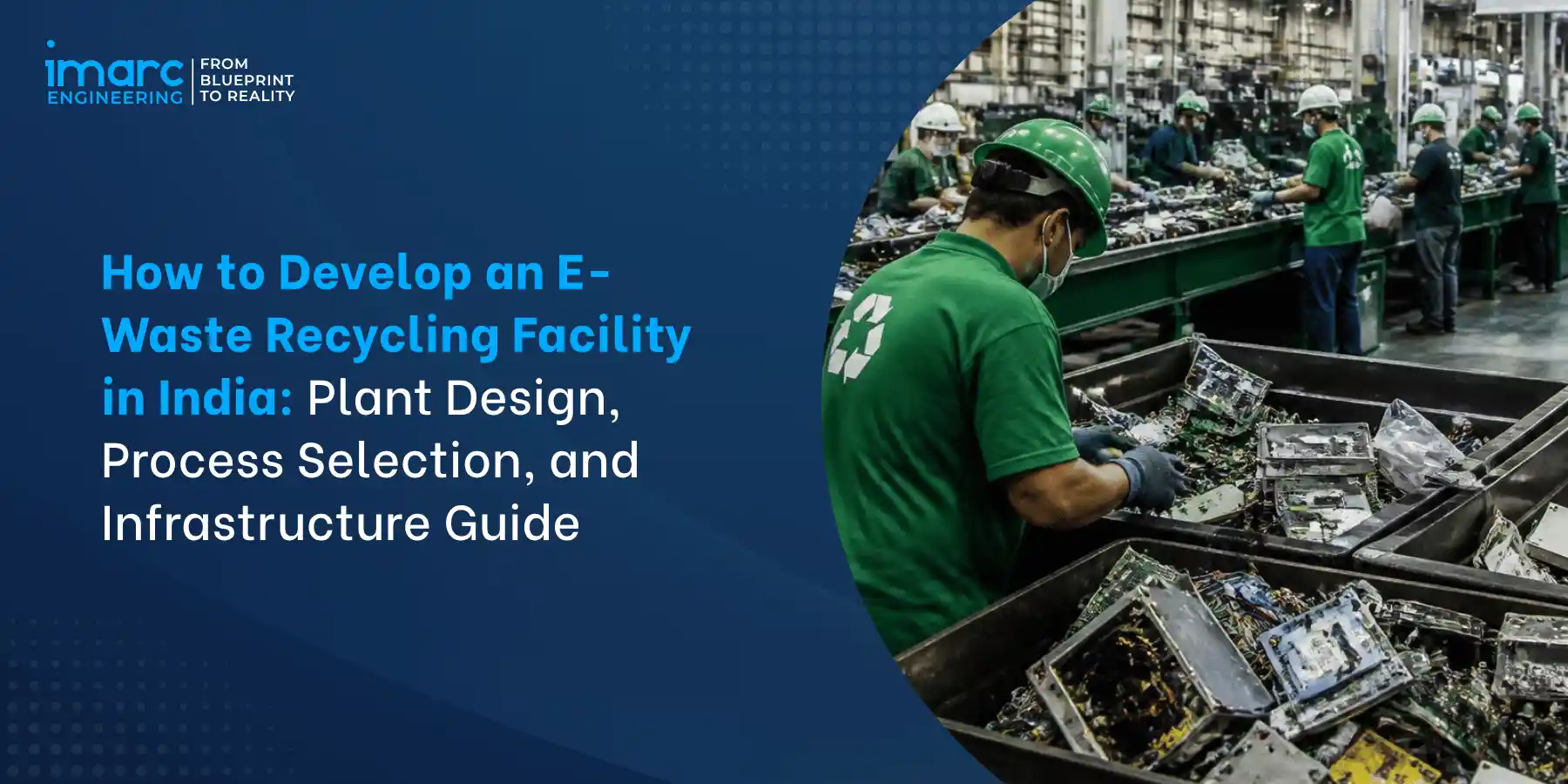
For any investor, recycling company, or circular economy sponsor planning an e-waste recycling facility in India, developing the project involves far more than selecting recycling equipment. Successful facilities integrate process technology selection, plant layout design, material flow optimisation, utility and infrastructure planning, environmental and regulatory compliance, safety systems, and future capacity expansion into a coherent development programme.
India's E-Waste (Management) Rules 2022, growing Extended Producer Responsibility (EPR) obligations, and structural growth in generated e-waste volumes collectively make this an attractive but engineering-intensive sector to enter.
Scope of this Guide
This guide answers the sponsor's development question directly. How should investors evaluate process technologies, design plant layout, plan supporting infrastructure, and address regulatory requirements to build an efficient, compliant, and scalable electronic waste recycling operation? It walks through the sector context, structured development lifecycle, process selection, plant design, infrastructure planning, regulatory approvals, capex modelling, and the engineering and project development practices that help facilities achieve high material recovery, regulatory compliance, operational efficiency, and long-term commercial viability.
Table of Contents
- Introduction
- Why E-Waste Recycling in India Matters
- How to Develop an E-Waste Recycling Facility in India
- E-Waste Recycling Process Selection in India
- E-Waste Recycling Plant Design and Layout in India
- E-Waste Recycling Infrastructure Planning in India
- E-Waste Recycling Regulatory Approvals in India
- E-Waste Recycling Facility Capex and Financial Modelling in India
- Common Mistakes and Best Practices
- Conclusion
1. Why E-Waste Recycling in India Matters
Four structural drivers make e-waste recycling a strategically attractive sector for Indian investors.
1.1 Growing E-Waste Volumes
India is among the largest e-waste generators globally with progressively growing volumes driven by rising digital adoption, shorter product lifecycles, and expanding installed base of electronic devices. According to CPCB reported figures, India generated approximately 1.6-1.8 million tonnes of e-waste in 2022. Formal recycling still captures a modest share of total generated e-waste with the remainder handled by the informal sector. Structured e-waste recycling in India through formal facilities is expected to expand materially as EPR compliance and regulatory enforcement progress.
1.2 Extended Producer Responsibility (EPR)
The E-Waste (Management) Rules 2022 in force from April 1, 2023 (replacing the 2016 Rules) impose structured EPR obligations on producers, importers, and brand owners across ten e-waste categories. Compliance requires collection and processing through CPCB-registered recyclers meeting annual targets.
CPCB EPR Portal registration is mandatory for producers, recyclers, refurbishers, and dismantlers. Structured EPR compliance creates guaranteed material flow for registered recyclers building sector viability.
1.3 Circular Economy and Value Recovery
E-waste contains valuable materials including copper, aluminium, iron, precious metals (gold, silver, palladium, platinum), rare earths, and plastics. Modern recycling recovers 90-98 percent of metals and 60-80 percent of plastics with structured processes.
Recovered materials substitute virgin material demand supporting circular economy outcomes. Precious metals from Printed Circuit Boards (PCBs) alone can constitute 40-70 percent of recycler revenue in operations with structured precious metals extraction.
1.4 ESG and Corporate Buyer Demand
Global corporate ESG commitments increasingly require documented e-waste recycling through certified channels. R2 (Responsible Recycling), e-Stewards, WEEELABEX, and buyer-specific certifications distinguish preferred recyclers.
Multinational corporations, IT services companies, financial institutions, and government departments increasingly source recycling services from certified operators at premium pricing. Structured facilities meeting international certification standards access commercial opportunities that unstructured operators cannot.
2. How to Develop an E-Waste Recycling Facility in India
Understanding how to develop an e-waste recycling facility in India helps sponsors sequence engineering and commercial decisions correctly. Structured development integrates feasibility, technology selection, engineering design, statutory approvals, and construction into a coherent programme rather than sequential.
2.1 The Six-Stage Development Roadmap
| Stage | Activities | Typical Duration |
|---|---|---|
| Feasibility and DPR | Market study, feedstock, technology, financial | 3-6 months |
| Site and Technology Selection | Land, layout, process pathway, licensing | 3-6 months |
| Detailed Engineering | Process design, MEP, civil, utilities, safety | 6-12 months |
| Regulatory Approvals | EC, CTE, CTO, EPR authorisation, HW auth | 6-12 months |
| Construction and Commissioning | Civil, installation, testing, ramp-up | 12-24 months |
| Commercial Operations | Feedstock supply, production, EPR reporting | Ongoing |
2.2 Feasibility and Market Study
Feasibility assessment covers feedstock availability (formal collection agreements, EPR partnership opportunities, informal sector interfaces), technology selection matched to feedstock characteristics and target output materials, financial modelling with realistic material recovery yields and pricing, regulatory pathway with timelines, and commercial arrangements for output material offtake. Feedstock reliability is often the most consequential single variable for facility viability. Structured feedstock contracts with producers, brand owners, or aggregator networks materially reduce operational risk versus reliance on spot procurement.
2.3 Detailed Project Report (DPR)
The Detailed Project Report consolidates feasibility findings into investment-grade documentation supporting board approval, debt financing, and regulatory submissions. DPR components include market analysis, feedstock sourcing strategy, technology selection with alternatives evaluated, site selection and layout, engineering summary, statutory approval pathway, implementation schedule, capex and opex projections, risk register with mitigation, multi-scenario financial modelling, and expansion provisioning. Well-structured DPRs typically take 3-5 months to develop for e-waste recycling projects.
3. E-Waste Recycling Process Selection in India
E-waste recycling process selection matches feedstock characteristics, target output materials, and capex-opex trade-offs to the appropriate technology combination. The e-waste recycling process typically combines multiple stages rather than any single technology delivering complete material recovery.
3.1 Standard Process Stages
| Stage | Purpose | Common Technologies |
|---|---|---|
| Collection and Transportation | Aggregation to facility | Bulk containers, tracked logistics |
| Segregation and Sorting | Category-based separation | Manual sorting, optical sorters |
| Manual Dismantling | Component separation | Trained operators with PPE |
| Mechanical Processing | Size reduction and separation | Shredders, magnetic, eddy current |
| Metal Recovery | Base and precious metals | Hydrometallurgy, pyrometallurgy |
| Plastic Processing | Plastic recovery | Density separation, pelletisation |
| Hazardous Waste Handling | CRT glass, batteries, mercury | Authorised TSDF, specialist recyclers |
3.2 E-Waste Recycling Technology Comparison
E-waste recycling technology comparison evaluates mechanical, hydrometallurgical, and pyrometallurgical pathways. Mechanical processing (shredding, magnetic separation, eddy current, air classification) provides base separation suitable for most feedstocks. Hydrometallurgy uses acidic or alkaline leaching followed by solvent extraction or electrowinning for precious metals recovery, higher capex but selective recovery.
Pyrometallurgy uses smelting for base metals, economical at scale but requires stringent emission controls. Most Indian facilities combine mechanical processing with either domestic hydrometallurgy or export of PCB concentrates for pyrometallurgical processing abroad.
3.3 Battery Recycling and Lithium-Ion Recovery
Battery recycling and lithium-ion recovery has emerged as a distinct opportunity within the broader recycling sector. Lithium-ion batteries from consumer electronics, EVs, and energy storage require specialised processes including safe discharge, mechanical dismantling under inert atmosphere, hydrometallurgical extraction of lithium, cobalt, nickel, and manganese, and cathode material recovery.
Battery Waste Management Rules 2022 impose distinct EPR obligations. Structured battery recycling facilities typically require materially higher capex than conventional e-waste recyclers but access growing supply from the expanding EV and energy storage sectors.
3.4 Precious Metals Extraction
Precious metals extraction from PCBs (Printed Circuit Boards) is often the most economically important recovery stream. Gold, silver, palladium, and platinum concentrations in high-grade PCBs can substantially exceed natural ore grades.
Hydrometallurgical processes using cyanide leaching, thiourea leaching, or aqua regia followed by solvent extraction or electrowinning support recovery. High capex and specialised expertise typically confine PCB precious metals refining to a few large facilities with smaller recyclers producing PCB concentrates for downstream processing.
4. E-Waste Recycling Plant Design and Layout in India
E-waste recycling plant design and layout translates process selection into constructible facility configuration. Well-designed e-waste recycling plant design optimises material flow, worker safety, environmental containment, and expansion potential.
4.1 Material Flow Optimisation
Material flow optimisation minimises internal handling, cross-flow contamination, and material losses. Structured plant layouts follow one-way material progression from receiving through processing to dispatch.
Dedicated zones for receiving/weighing, storage, manual dismantling, mechanical processing, metal recovery, plastic processing, hazardous waste storage, and finished goods dispatch prevent operational congestion. Structured material flow typically reduces handling cost by 15-25 percent versus poorly organised layouts.
4.2 Zone Design and Segregation
- Receiving area with weighbridge, sorting, and preliminary staging
- Storage areas with segregation by category and hazard class
- Manual dismantling stations with structured worker positions
- Mechanical processing hall with dust extraction infrastructure
- Metal recovery area with wet processing (hydrometallurgy) if applicable
- Hazardous waste storage compliant with Rule 6 of HW Rules 2016
- Product storage and dispatch
- Administrative and support facilities
4.3 Material Recovery Facility Design for E-Waste
Material recovery facility design for e-waste integrates process, mechanical, electrical, instrumentation, civil, and utility engineering in coordinated packages. Basic engineering (FEED) establishes Process Flow Diagrams, layout planning, equipment sizing, utility loads, and safety philosophy.
Detailed engineering translates FEED into constructible documents. Structured FEED to detailed engineering handover with defined change management prevents cost overruns. E-waste recycling facilities typically require 6-9 months FEED and 6-12 months detailed engineering.
4.4 Worker Safety and Ergonomics
Worker safety is central to plant design given the mix of physical hazards (sharp materials, heavy items, machinery), chemical hazards (heavy metals, brominated flame retardants), and electrical hazards (charged capacitors).
Personal Protective Equipment (PPE) provisions, ergonomic workstation design, adequate ventilation, dust extraction, safety showers, first aid facilities, and structured Standard Operating Procedures collectively protect workers. Occupational Safety, Health and Working Conditions Code 2020 compliance forms the regulatory baseline.
5. E-Waste Recycling Infrastructure Planning in India
E-waste recycling infrastructure planning covers the supporting infrastructure that recycling operations require. Recycling plant engineering combines process engineering with facility infrastructure into an integrated design.
5.1 Utility Requirements
- Power supply: typically HT connection at 11kV or 22kV for medium facilities
- Water: process water for wet processing, cooling, fire protection, sanitation
- Compressed air: for pneumatic operations and dust removal
- Ventilation: adequate air changes and dust extraction throughout process areas
- Fire protection: hydrant network, sprinklers, portable extinguishers per NBC 2016
- Waste heat management: for pyrometallurgy or drying operations
5.2 Environmental Management Infrastructure
Environmental management infrastructure supports compliance with SPCB consents. Effluent Treatment Plants (ETPs) treat process wastewater from hydrometallurgy and cleaning operations. Air Pollution Control equipment including bag filters, wet scrubbers, and cyclones capture particulates and gaseous emissions.
Hazardous waste storage per Rule 6 of Hazardous and Other Wastes Rules 2016 covers segregated storage with impervious flooring, secondary containment, and structured signage. Environmental monitoring systems support both compliance verification and process optimisation.
5.3 E-Waste Recycling Equipment
E-waste recycling equipment selection covers primary and secondary shredders, magnetic separators for ferrous recovery, eddy current separators for non-ferrous separation, air classifiers or density separators for plastic separation, optical sorters where feasible, cable strippers for wire recovery, wet processing tanks for hydrometallurgical operations, precious metals refining equipment where applicable, dust collection systems, weighbridges, and material handling equipment. Equipment selection matches feedstock characteristics and target output materials.
5.4 Digital Systems and Traceability
Digital systems support both regulatory compliance and operational management. CPCB EPR Portal integration for compliance reporting. Material traceability from receipt through processing to dispatch supporting EPR audit trails. Weight tracking, batch identification, and yield calculation.
Environmental monitoring data logging. Structured digital documentation materially reduces both compliance risk and administrative burden. R2, e-Stewards, and buyer-specific certifications increasingly require structured digital records.
6. E-Waste Recycling Regulatory Approvals in India
E-waste recycling regulatory approvals span central and state agencies covering environmental, hazardous waste, EPR, and safety dimensions. Structured approval sequencing at project outset materially compresses total timelines.
6.1 The Statutory Approvals Framework
| Approval | Authority | Purpose |
|---|---|---|
| Environmental Clearance | MoEFCC / SEIAA (per EIA 2006) | Pre-construction approval |
| Consent to Establish (CTE) | State Pollution Control Board | Pre-construction consent |
| Consent to Operate (CTO) | State Pollution Control Board | Pre-commissioning consent |
| Hazardous Waste Authorization | SPCB under HW Rules 2016 | Waste storage, handling, disposal |
| E-Waste EPR Registration | CPCB under E-Waste Rules 2022 | Recycler registration on EPR Portal |
| Battery EPR Registration | CPCB under Battery Rules 2022 | If handling batteries |
| Fire NOC | State Fire Services | Fire safety compliance |
| Factory Licence | State Directorate of Factories | OSH Code 2020 compliance |
6.2 E-Waste Rules 2022 Framework
The E-Waste (Management) Rules 2022 in force from April 1, 2023 provide the parent framework. Key provisions include mandatory CPCB EPR Portal registration for producers, recyclers, refurbishers, and dismantlers; ten e-waste categories with distinct compliance treatment; annual EPR targets for producers; structured collection and processing through registered channels; audit and verification mechanisms; and penalties for non-compliance. Rules apply to all handlers of e-waste covered under the ten categories.
6.3 Certifications and Voluntary Standards
Voluntary certifications distinguish preferred recyclers. R2 (Responsible Recycling) provides globally recognised certification emphasising environmental, health, and safety practices. e-Stewards focuses on developed-market export prevention and worker protection.
WEEELABEX provides European standard. ISO 14001 (EMS), ISO 45001 (OH&S), and ISO 27001 (data security) support broader operational quality. Structured certification pursuit typically follows initial commercial operations with certification supporting premium buyer engagements.
6.4 Ongoing Compliance
Ongoing compliance includes monthly analytical monitoring per SPCB consent conditions, annual returns (Form 5 for hazardous waste, EPR annual reports through CPCB Portal), waste manifest documentation, environmental monitoring, corrective action tracking for any non-compliances, and audit-ready records. Digital compliance management systems increasingly support this administrative workload. Structured proactive compliance materially reduces both administrative burden and enforcement risk.
7. E-Waste Recycling Facility Capex and Financial Modelling in India
E-waste recycling facility capex and financial modelling translates project scope into investment decisions. Financial viability depends critically on feedstock cost, material recovery yields, output pricing, and utility costs alongside capex.
7.1 Facility Capex by Scale
| Facility Type | Capacity (tonnes per annum) | Indicative Capex |
|---|---|---|
| Small dismantler | 100-500 | INR 50 lakh - 2 crore |
| Medium recycler | 500-5,000 | INR 2-25 crore |
| Large integrated recycler | 5,000-50,000 | INR 25-200 crore |
| Precious metals refining | Additional stream | INR 25-100 crore |
| Battery recycling (Li-ion) | 500-10,000 | INR 25-500 crore |
7.2 Capex Component Breakdown
- Land and civil works: 20-35 percent of capex
- Process equipment: 30-45 percent
- Utility infrastructure: 8-15 percent
- Environmental management (ETP, APC, HW storage): 5-12 percent
- Instrumentation and control: 3-7 percent
- Contingency: 8-12 percent
- Pre-operative and working capital: 5-10 percent
7.3 Revenue Streams and Economics
Revenue streams include recovered metals (base metals like copper, aluminium, iron; precious metals from PCBs; rare earths), recovered plastics, EPR service fees from producers/brand owners, and government tipping fees where applicable. Operating economics depend materially on feedstock cost (paid or received), material recovery yields, output pricing (heavily commodity-linked), labour costs, and utility costs. Structured operations typically achieve 20-40 percent EBITDA margins in mature commercial phase though early-stage operations face lower margins during ramp-up.
7.4 Project Timeline and Financial Viability
Total project timeline from feasibility to commercial operations typically extends 24-42 months. Feasibility and DPR: 3-6 months. Design and engineering: 6-12 months. Approvals: 6-12 months (parallel). Construction: 12-24 months. Commissioning: 3-6 months. Structured parallel execution compresses total elapsed time. Financial viability requires realistic revenue projections, conservative material yield assumptions, and adequate working capital for feedstock and inventory.
8. Common Mistakes and Best Practices
8.1 Underestimating Feedstock Complexity
Facilities designed for uniform feedstock struggle with the mixed reality of collected e-waste.
Best practice: feedstock characterisation across expected sources; process flexibility for feedstock variability; pilot studies before large capex commitment; structured feedstock contracts with producers reducing spot procurement risk.
8.2 Skipping Structured Technology Evaluation
Technology selection driven by vendor sales rather than structured evaluation produces suboptimal matches.
Best practice: multi-technology evaluation with defined criteria; independent process engineering review; reference plant visits; performance guarantees with clear KPIs; techno-commercial evaluation before commitment.
8.3 Weak Environmental Management Design
Environmental management retrofit onto completed process design produces expensive rework.
Best practice: environmental engineering integrated during basic engineering; ETP, air pollution control, and hazardous waste storage sized against realistic loads; environmental monitoring designed into operations; compliance culture built from Day 1.
8.4 Deferred Certification Pursuit
R2, e-Stewards, and buyer certifications deferred until premium buyers are lost produce sub-optimal commercial positioning.
Best practice: certification pathway defined at project outset; documentation systems designed to support certification from Day 1; structured pursuit of certifications during initial commercial operations; buyer engagement strategy aligned with certification credentials.
8.5 Inadequate Working Capital
E-waste recycling requires substantial working capital for feedstock procurement, inventory, and receivables.
Best practice: working capital sized at 8-15 percent of annual revenue; structured lines of credit before ramp-up; supplier and customer term negotiation supporting cash cycle; conservative early-stage revenue projections.
Conclusion
Structured development of an e-waste recycling facility in India combines process technology selection, plant design, infrastructure planning, environmental compliance, regulatory approvals, and financial modelling into an integrated project development discipline.
Successful e-waste recycling projects begin with secure feedstock supply, technology selection based on independent techno-commercial evaluation, and integrated project advisory that aligns engineering, regulatory, and commercial requirements for long-term viability.
PLANNING YOUR E-WASTE RECYCLING FACILITY?
IMARC Engineering's end-to-end e-waste recycling facility plant design and project development advisory team supports investors, recycling companies, and circular economy sponsors across feasibility and market studies, feedstock supply chain design, technology pathway evaluation, DPR preparation, plant design and layout engineering (FEED and detailed engineering), material flow optimisation, utility and environmental infrastructure design, safety systems, statutory approvals coordination including Environmental Clearance, SPCB consents, and CPCB EPR registration, R2 and e-Stewards certification support, EPC or EPCM contractor evaluation, construction supervision, commissioning coordination, and commercial operations ramp-up for e-waste recycling, precious metals refining, and battery recycling projects across small, medium, and large-scale developments in India.
→ Schedule a free e-waste recycling facility scoping consultation with an IMARC specialist
Frequently Asked Questions
An e-waste recycling facility is an authorised industrial facility that collects, dismantles, processes, and recovers materials from end-of-life electrical and electronic equipment. Facilities range from small dismantlers to large integrated recyclers with metal recovery, plastic processing, and precious metals refining. All must be CPCB-registered under E-Waste Rules 2022.
The E-Waste (Management) Rules 2022 in force from April 1, 2023 provide the parent framework with mandatory CPCB EPR Portal registration for producers, recyclers, refurbishers, and dismantlers. Complementary rules include Hazardous and Other Wastes Rules 2016, Battery Waste Management Rules 2022, EIA Notification 2006, Water Act 1974, Air Act 1981, and OSH Code 2020.
Small dismantlers (100-500 tonnes per annum) typically require INR 50 lakh - 2 crore capex. Medium recyclers (500-5,000 tonnes per annum) typically require INR 2-25 crore. Large integrated recyclers (5,000-50,000 tonnes per annum) typically require INR 25-200 crore. Precious metals refining adds INR 25-100 crore. Battery recycling typically requires INR 25-500 crore depending on scale.
The E-Waste Rules 2022 cover ten categories: IT and telecommunication equipment, consumer electricals and electronics, large appliances, small appliances, lamps, toys and sports equipment, medical devices, monitoring instruments, automatic dispensers, and solar photovoltaic panels. Each category has distinct handling requirements.
Extended Producer Responsibility (EPR) requires producers, importers, and brand owners of electronic products to arrange collection and processing of end-of-life products meeting annual targets set under E-Waste Rules 2022. Recyclers registered on the CPCB EPR Portal serve as processing partners. EPR creates guaranteed material flow for compliant e-waste recycling facility operators.
Common e-waste recycling technology combines manual dismantling, mechanical processing (shredding, magnetic separation, eddy current, air classification), hydrometallurgy for precious metals (leaching, solvent extraction, electrowinning), pyrometallurgy for base metals (smelting), and specialised battery processing for lithium-ion recovery. Most facilities combine multiple technologies rather than any single pathway.
Total project timeline typically extends 24-42 months from feasibility to commercial operations. Feasibility and DPR: 3-6 months. Design and engineering: 6-12 months. Approvals: 6-12 months (parallel). Construction: 12-24 months. Commissioning: 3-6 months. Structured parallel execution compresses total elapsed time.
Voluntary certifications include R2 (Responsible Recycling) and e-Stewards providing global recognition, WEEELABEX for European standards, and ISO 14001 (EMS), ISO 45001 (OH&S), and ISO 27001 (data security) for broader operational quality. Certifications support premium buyer engagement particularly with multinationals, IT services companies, and government contracts.
Yes. Battery recycling and lithium-ion recovery requires specialised processes including safe discharge, mechanical dismantling under inert atmosphere, hydrometallurgical extraction of lithium, cobalt, nickel, and manganese, and cathode material recovery. Battery Waste Management Rules 2022 impose distinct EPR obligations separate from general e-waste rules.
Recent Post
Trusted by Industry Leaders
We partner with global enterprises and ambitious businesses across sectors to deliver operational excellence, strategic insights, and sustainable growth through integrated solutions.









Success in Their Words
Real feedback from clients across industries. Discover how our solutions delivered measurable impact and operational excellence.

I wanted to express my sincere appreciation for your efforts in handling this matter. Your dedication and commitment have been truly commendable, and it is evident that you have put in tremendous hard work and expertise into resolving the issues at hand. We are greatly interested in continuing our collaboration with you in the future, as your professionalism and reliability have made you a trusted partner. Thank you once again for your invaluable contribution. We look forward to strengthening our partnership ahead.

It has been a pleasure working with the IMARC team. The insights provided were structured, clear, and highly valuable, helping us strengthen both our technical and financial planning with confidence. We deeply appreciate the team’s professionalism, responsiveness, and attention to detail throughout the engagement. Every requirement was well understood and effectively incorporated, resulting in a comprehensive and actionable output. Overall, our experience has been excellent, and I would gladly recommend IMARC to organizations seeking a reliable research partner.

Your service is truly exceptional. Working with the IMARC team has been a seamless and professional experience. The clarity of communication, responsiveness to queries, and consistent support at every stage made the entire engagement highly efficient. The insights shared were well-structured, practical, and perfectly aligned with our requirements, helping us make informed decisions with confidence. Overall, the dedication and professionalism demonstrated by your team stand out, and I would be glad to recommend IMARC as a reliable and trustworthy research partner.

IMARC did an outstanding job in preparing our study. They were punctual, precise, and consistently responsive throughout the entire process. The team delivered all the data we required in a clear, well-organized, and highly professional format. Their strong attention to detail, combined with their ability to meet every deadline without compromising quality, truly set them apart. Overall, their reliability and commitment made them an exceptional partner for our project, and we would gladly work with them again in the future.

IMARC made the whole process incredibly easy from start to finish. Everyone I interacted with via email was polite, professional, and straightforward to deal with, always keeping their promises regarding delivery timelines and remaining consistently solutions-focused. From my very first contact, I appreciated the professionalism and support shown by the entire IMARC team. I highly recommend IMARC to anyone seeking timely, affordable, and reliable information or advice. My experience with IMARC was excellent, and I truly cannot fault any aspect of it.

I’d like to express my sincere gratitude for the excellent work you accomplished with the study. Your ability to quickly understand our requirements and deliver high-quality results under tight timelines truly reflects your expertise, exceptional work ethic, and unwavering commitment to your customer’s success. The professionalism and responsiveness you demonstrated throughout the process made a significant difference. Our entire team and company are incredibly thankful for your dedication, reliability, and support. Once again, thank you for your outstanding contribution.