INR 7,597 Crore Telangana Highway Expansion Project Highlights Growing Importance of Brownfield Project Management in India
June 09, 2026
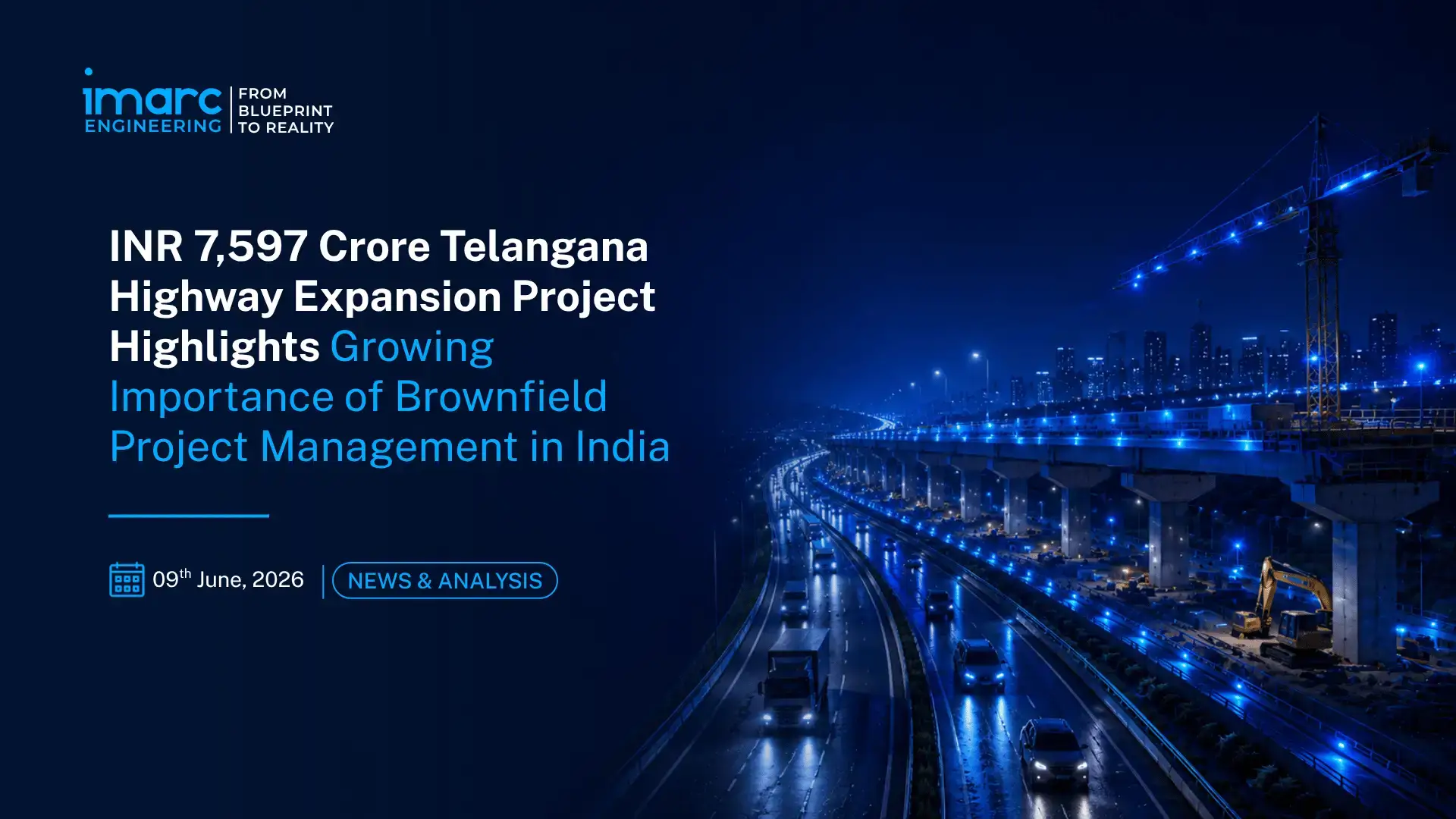
In June 2026, the Cabinet Committee on Economic Affairs chaired by Prime Minister Narendra Modi approved the widening of two key National Highway stretches in Telangana, the Armoor-Jagtial-Mancherial section of NH-63 and the Jagtial-Karimnagar section of NH-563, at a combined capital cost of INR 7,597 crore across three work packages spanning 191 kilometres.
The NH-63 stretch runs through Nizamabad, Jagtial, and Mancherial districts, passing built-up centres at Anksapoor, Korutla, Jagtial, Dharmapuri, Lakshettipet, and Mancherial, all of which face severe congestion that has choked freight movement, industrial logistics, and commuter traffic for years. The NH-563 Jagtial-Karimnagar corridor passes through Potharam, Gangadhara, and Karimnagar, equally congested and economically critical nodes. Both projects will be widened to 4-lane standard: NH-63 under the Hybrid Annuity Model (HAM) and NH-563 under Build-Operate-Transfer (Toll).
The CCEA approval, announced just hours ago, makes this the most current large-scale brownfield infrastructure development in India approval available, and it is an instructive case study in exactly why brownfield project management has become one of the most commercially and operationally demanding disciplines in India's infrastructure sector.
Why this is a Brownfield Project and Why that Distinction Matters
The term 'brownfield' is sometimes used loosely to mean any expansion of existing capacity. In infrastructure, it has a specific and consequential meaning: a brownfield highway expansion project is one where the new 4-lane carriageway must be built alongside, around, and through an existing operational 2-lane highway, one that cannot be closed, one that continues to carry trucks, buses, and motorcycles while the construction machinery works metres away.
The Telangana highway project is quintessentially brownfield in this sense. The NH-63 corridor passes through multiple built-up urban centres where the existing road forms the spine of local commercial activity. Buildings sit tight on both sides. Utility lines like electricity, water, telecom, run beneath and alongside the carriageway. Junctions feed local markets. Pedestrians and two-wheelers merge with national highway traffic at dozens of ungoverned crossings.
Widening this corridor to 4-lane standard requires demolishing and rebuilding utility infrastructure, managing land acquisition and structure removal in densely occupied strips, maintaining live traffic flow throughout construction, and sequencing work packages so that each section's disruption is minimised. This is not a simple doubling of road width. It is one of the most complex categories of brownfield expansion projects in the infrastructure domain.
The CCEA's choice of project delivery models reflects the brownfield complexity. The HAM Hybrid Annuity Model, applied to the NH-63 Armoor-Jagtial-Mancherial section, splits financial risk between government and concessionaire: 40% of the project cost is paid as construction-phase annuities and 60% post-completion as operations-phase annuities, linked to performance. The BOT Toll model on NH-563 Jagtial-Karimnagar places full upfront capital risk on the concessionaire, who then recovers costs through toll collection over the concession period.
Both models require the concessionaire to bring sophisticated brownfield project management capability because a HAM contract that runs over schedule or a BOT project with construction delays both generate financial losses that no financing structure can absorb indefinitely. The project management competence of the engineering, procurement, and construction team executing the widening determines the financial outcome for every stakeholder.
The National Context: Brownfield Highway Expansion at Scale
The Telangana project is one of dozens approved under India's National Highway development programme in 2026 alone. The same June 3 CCEA meeting approved a INR 3,936 crore four-lane highway corridor between Khagaria and Purnea in Bihar, a INR 8,300 crore Rameshwar-Paradeep Coastal Highway in Odisha, and a INR 4,415 crore road development project in Madhya Pradesh, all brownfield or hybrid projects widening existing corridors through populated territories.
Minister Nitin Gadkari had committed INR 2 lakh crore in highway projects for Telangana over three to four years in May 2025, foundation stone ceremony for INR 3,900 crore of road projects at Sirpur Kagajnagar. The Surat-Nashik-Kurnool-Hyderabad-Chennai-Thiruvananthapuram Greenfield Highway was targeted for April 2026 completion. INR 1.25 lakh crore has already been invested in Telangana highway development over the last decade.
India's National Infrastructure Pipeline allocates INR 111 lakh crore across infrastructure sectors through 2030, with roads and highways accounting for the largest single sector share. The vast majority of highway investment, in a country where the national highway network already spans over 1.46 lakh kilometres, is brownfield: widening 2-lane roads to 4-lane divided carriageways, upgrading 4-lane sections to 6-lane, adding bypasses around congested towns, and integrating access control and service roads along existing alignments.
Each of these categories presents distinct brownfield project management challenges that differ fundamentally from greenfield highway construction on vacant agricultural land. PM GatiShakti's integrated multimodal infrastructure planning framework has made visible the national priority of upgrading these existing corridors, turning what was previously a disjointed sequence of individual project approvals into a national logistics optimisation programme with defined corridor priorities and connectivity targets.
The Core Brownfield Project Management Challenges in Highway Expansion
Land acquisition and utility shifting are the two most common causes of brownfield highway expansion delays in India and the Telangana corridors will face both at scale. Built-up stretches through Jagtial, Mancherial, and Karimnagar mean that the 4-lane footprint will require the removal or reconstruction of structures that encroach on the right-of-way.
Under the National Highways Act, NHAI can acquire land after a prescribed notification and compensation process, but in densely occupied urban stretches, this process intersects with elected local interests, community displacement concerns, and commercial property rights in ways that require skilled stakeholder management alongside technical execution.
Utility shifting like relocating power lines, water mains, telecom conduits, and drainage infrastructure must be coordinated across multiple service providers, each with their own engineering teams, procurement requirements, and approval processes. A single unresolved utility conflict can stall a work package for months.
Traffic management during construction is the third defining challenge of brownfield highway project management. On an operational national highway carrying thousands of vehicles per day, construction-phase traffic management must maintain safe, continuous flow while enabling the earthwork, bridgework, and carriageway laying that the contract requires.
This means designing and executing temporary diversion arrangements, maintaining working-width constraints that allow both lanes of traffic and construction equipment simultaneously, lighting and signage the temporary diversions adequately, and adjusting the traffic management plan as the work front moves along the corridor. Poor traffic management on a brownfield highway project does not just create safety risks, it generates community opposition, attracts media attention, and triggers NHAI performance deductions that directly impact the concessionaire's revenue.
Quality control in brownfield highway projects carries a specific complexity absent from greenfield: the need to match levels, drainage gradients, and surface finishes across the interface between new construction and the existing pavement or bridge structures that are being retained. A new 4-lane section that ties back into an existing 2-lane bridge at an incompatible level creates a permanent safety hazard.
Interface management between the new works and the existing retained infrastructure is a specialised discipline that requires detailed survey data, precision design at tie-in points, and construction supervision capable of identifying and resolving level conflicts before they are built in.
Infrastructure Modernization in India: The Broader Pattern This Project Reflects
The INR 7,597 crore Telangana approval is one data point in a national pattern of infrastructure modernization in India that is accelerating across every mode. India's railway network, after INR 41,677 crore of investment in Telangana alone, is being modernised through a combination of greenfield high-speed rail corridors and brownfield capacity enhancement on existing routes. Urban metro systems are being extended through densely developed city centres, quintessentially brownfield projects requiring tunnel boring through occupied urban areas.
Port capacity is being expanded through brownfield berth additions and cargo handling upgrades at existing facilities. And the national highway network is being systematically upgraded from 2-lane to 4-lane and 4-lane to 6-lane, corridor by corridor, district by district, through the combined machinery of NHAI's project pipeline and the HAM/BOT financing structures that make private capital available for public infrastructure.
What this pattern reveals is that India's infrastructure investment story in 2026 is not primarily a greenfield story. The most active and commercially immediate infrastructure project execution opportunity in India is brownfield, upgrading, widening, and modernising the infrastructure that already exists in a country with 1.4 billion users, a rapidly growing economy, and a logistics cost structure that urgently needs the efficiency gains that 4-lane highways, electrified railways, and upgraded port capacity deliver.
The brownfield project management capability required to execute these projects, technically, commercially, and operationally, is the scarcest and most valuable engineering competence in India's infrastructure sector. The Telangana highway approval approved yesterday is a microcosm of that national imperative. And with Rs 2 lakh crore in further Telangana highway projects in the pipeline, it is only the beginning.
India's infrastructure story in 2026 is being written in widened carriageways, shifted utilities, and live-traffic construction zones. The engineering teams that master brownfield project management will execute the most consequential infrastructure programme in the country's history.
IMARC Engineering Perspective about the Development
From IMARC Engineering's vantage point as a practitioner of brownfield manufacturing facility expansions, the Telangana highway approval underscores a broader truth about India's current infrastructure phase: brownfield project management has become the most complex and commercially critical execution discipline across sectors.
The challenges highlighted in the highway project, maintaining live operations during construction, coordinating utility shifts across multiple agencies, managing interfaces between new and existing assets, and navigating densely occupied corridors, mirror those encountered daily in pharmaceutical and chemical plant expansions where production cannot stop.
India's accelerating infrastructure modernisation wave, from highways to railways to metros, demands specialised brownfield competence. Projects that master live-site execution, interface management, and stakeholder coordination will define the nation's next decade of development.
Latest News
-
China's Tunnel Boring Machine Export Controls Put Focus on India's Proposed USD 1.2 Billion Manufacturing Incentive Scheme
October 22, 2026
-
NTPC Plans Nuclear Power Project Feasibility Studies in More Indian States, Including Uttar Pradesh
October 21, 2026
-
NITI Aayog Releases Data Centre Evaluation Framework, Highlights Power and Water Planning Risks
October 20, 2026
-
Tamil Nadu Allocates INR 98 Lakh for DPR Preparation of Five Infrastructure Projects in Chennai
October 16, 2026
-
SunBridge BioEnergy Starts Commercial Production at INR 350 Crore, 300 KLD Ethanol Plant in Madhya Pradesh
October 15, 2026
Trusted by Industry Leaders
We partner with global enterprises and ambitious businesses across sectors to deliver operational excellence, strategic insights, and sustainable growth through integrated solutions.












Success in Their Words
Real feedback from clients across industries. Discover how our solutions delivered measurable impact and operational excellence.

I wanted to express my sincere appreciation for your efforts in handling this matter. Your dedication and commitment have been truly commendable, and it is evident that you have put in tremendous hard work and expertise into resolving the issues at hand. We are greatly interested in continuing our collaboration with you in the future, as your professionalism and reliability have made you a trusted partner. Thank you once again for your invaluable contribution. We look forward to strengthening our partnership ahead.

It has been a pleasure working with the IMARC team. The insights provided were structured, clear, and highly valuable, helping us strengthen both our technical and financial planning with confidence. We deeply appreciate the team’s professionalism, responsiveness, and attention to detail throughout the engagement. Every requirement was well understood and effectively incorporated, resulting in a comprehensive and actionable output. Overall, our experience has been excellent, and I would gladly recommend IMARC to organizations seeking a reliable research partner.

Your service is truly exceptional. Working with the IMARC team has been a seamless and professional experience. The clarity of communication, responsiveness to queries, and consistent support at every stage made the entire engagement highly efficient. The insights shared were well-structured, practical, and perfectly aligned with our requirements, helping us make informed decisions with confidence. Overall, the dedication and professionalism demonstrated by your team stand out, and I would be glad to recommend IMARC as a reliable and trustworthy research partner.

IMARC did an outstanding job in preparing our study. They were punctual, precise, and consistently responsive throughout the entire process. The team delivered all the data we required in a clear, well-organized, and highly professional format. Their strong attention to detail, combined with their ability to meet every deadline without compromising quality, truly set them apart. Overall, their reliability and commitment made them an exceptional partner for our project, and we would gladly work with them again in the future.

IMARC made the whole process incredibly easy from start to finish. Everyone I interacted with via email was polite, professional, and straightforward to deal with, always keeping their promises regarding delivery timelines and remaining consistently solutions-focused. From my very first contact, I appreciated the professionalism and support shown by the entire IMARC team. I highly recommend IMARC to anyone seeking timely, affordable, and reliable information or advice. My experience with IMARC was excellent, and I truly cannot fault any aspect of it.

I’d like to express my sincere gratitude for the excellent work you accomplished with the study. Your ability to quickly understand our requirements and deliver high-quality results under tight timelines truly reflects your expertise, exceptional work ethic, and unwavering commitment to your customer’s success. The professionalism and responsiveness you demonstrated throughout the process made a significant difference. Our entire team and company are incredibly thankful for your dedication, reliability, and support. Once again, thank you for your outstanding contribution.
Ready to Experience the IMARC Advantage?
Whether you're planning a new facility, expanding operations, optimizing performance, or facing complex challenges—IMARC Engineering brings the expertise, experience, and commitment needed for success.