PSLV Technology Transfer Initiative Signals New Growth Phase for India's Space Manufacturing Ecosystem
June 10, 2026
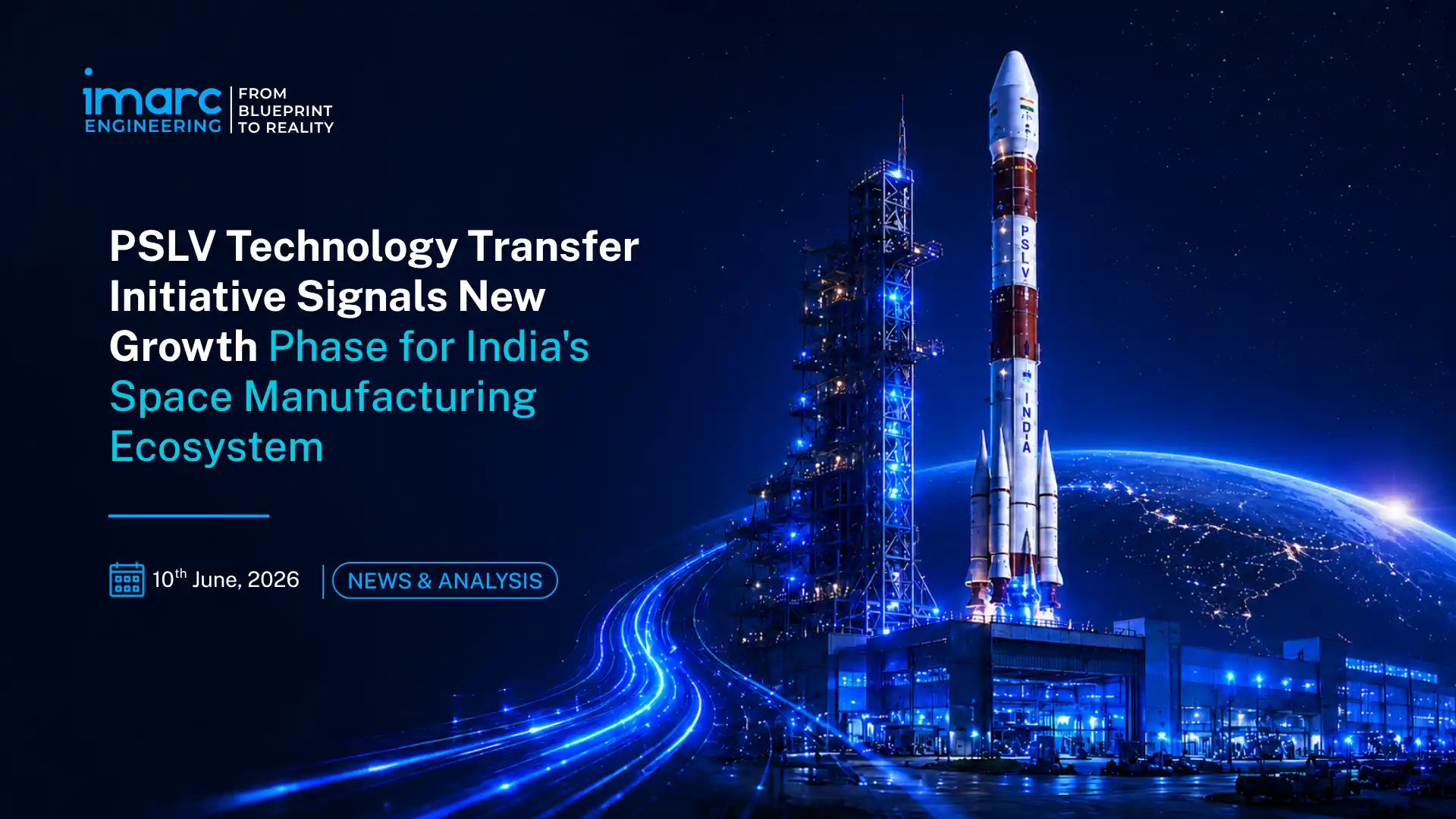
For more than six decades, India's most reliable rocket was built entirely by ISRO. That changed in early 2026, when the PSLV-N1, a Polar Satellite Launch Vehicle assembled from first bolt to final integration by a HAL L&T PSLV industrial consortium without ISRO doing the build, completed hardware delivery and entered pre-launch preparations.
This milestone was made possible through technology transfer, which enabled the private sector to take over end-to-end production. The first privately manufactured PSLV in India's history is carrying the EOS-10 Earth Observation satellite and marks the completion of a PSLV technology transfer process that ISRO initiated formally in 2023 when it contracted HAL and L&T to manufacture five PSLV units.
Once this mission and one follow-on launch are successfully completed, ISRO Chairman V. Narayanan has confirmed that 50% of all future PSLV production will be formally assigned to the private sector. For space manufacturing in India, this is no longer a pilot programme; it marks the beginning of a new industrial era for India's space sector.
The PSLV Technology Transfer: What Was Actually Transferred and to Whom
The PSLV, with over 57 successful launches, is India's most proven orbital workhorse, the rocket that launched Chandrayaan-1, Mangalyaan, and hundreds of domestic and foreign commercial satellites. Transferring its production to the private sector required not just assembly know-how but the full design-fabricate-integrate-test cycle: structural manufacturing, propulsion stage assembly, avionics integration, and systems qualification.
HAL and L&T assumed full responsibility for all of these functions, with hardware delivery to ISRO commencing in late 2025 and overcoming initial component challenges through collaborative engineering with ISRO's technical teams. Industry leaders expect two to three PSLV launches in 2026 alone, with a successful first private launch expected to trigger a serial production pipeline that could exceed the original five-rocket contract scope.
ISRO's decision to transfer 50% of future PSLV work to private industry is directly linked to India's launch ambitions. Prime Minister Modi has set a target of 50 rocket launches per year, more than four times India's current annual launch cadence of 10 to 12. That ambition is mathematically impossible if ISRO remains the sole rocket manufacturer.
Indian industries were already supplying 80 to 85% of the systems used in ISRO mission. The PSLV technology transfer represents the conversion of component supply relationships into full systems manufacturing responsibility. The distinction matters commercially: a component supplier builds a part to specification; a systems manufacturer owns the integration, qualification, and delivery of the complete launch vehicle.
SSLV Transfer to HAL: The Second and Structurally More Significant Deal
Even more consequential for India's long-term space manufacturing ecosystem is the SSLV technology transfer completed in September 2025. NewSpace India Limited (NSIL), ISRO, IN-SPACe, and HAL signed the SSLV technology transfer agreement, transferring not just manufacturing rights but the complete design package, making it the first time any space agency anywhere in the world has transferred the full design of a launch vehicle to private industry, per IN-SPACe Chairman Pawan Goenka.
The SSLV is a quick-turnaround, on-demand launch vehicle designed for the global small satellite market, a market growing at double-digit rates as Earth Observation, IoT connectivity, and broadband constellation demand accelerates. HAL will now build, market and sell SSLVs commercially, with launches possible from both Sriharikota (inclined orbits) and the new Kulasekarapattinam facility (polar orbits). By combining PSLV production responsibility with full SSLV ownership, HAL has become India's first industrial-scale rocket manufacturer, a position that did not exist 18 months ago. The development also strengthens the broader aerospace manufacturing in India ecosystem by creating new opportunities for advanced fabrication, propulsion systems, avionics integration, and precision engineering suppliers.
The Ecosystem That Has Been Built Around These Transfers
The PSLV and SSLV transfers are the most visible milestones of a broader transformation in India's private space sector that the Indian Space Policy 2023 enabled, and IN-SPACe has systematically operationalised. India's private space sector has grown from single-digit startups in 2019 to over 400 by early 2026. Private investment in the sector crossed USD 600 million (approximately INR 5,000 crore), as confirmed by Union Minister Jitendra Singh three weeks ago.
Cumulative equity funding for Indian space startups stands at approximately USD 650 to 700 million across 230-plus active companies, per the SatNxt Indian Space Startup Ecosystem Report 2026 published in April. IN-SPACe has received over 1,000 applications from startups, MSMEs, and academic institutions since its inception, granting 129 authorisations. NSIL has signed approximately 78 technology transfer agreements with Indian industries, and IN-SPACe has signed 75 Transfer of Technology agreements as of December 2024.
The financial architecture supporting this ecosystem has also deepened substantially. The government approved an INR 1,000 crore venture capital fund under IN-SPACe in October 2024. In February 2026, plans for an INR 500 crore Technology Adoption Fund were announced to sustain and scale early-stage space startups. A 12-satellite Earth Observation constellation, India's first private-led EO network, is being deployed under an INR 1,200 crore public-private partnership by a consortium led by Pixxel, with partners including PierSight Space, SatSure, and Dhruva Space.
India became the fourth nation globally to demonstrate autonomous satellite docking through the SpaDeX mission in late 2025, a capability that will be foundational to future on-orbit servicing, space station assembly, and deep space mission infrastructure.
Space manufacturing clusters are being developed in Kerala and Tamil Nadu near the Thiruvananthapuram and Sriharikota launch sites, creating the geographic concentration of talent, supply chain, and test infrastructure that characterises mature aerospace manufacturing ecosystems.
The Market India is Competing For and the Manufacturing Edge it is Building
The Indian space economy was valued at USD 8.4 billion in 2025 and is projected to reach USD 44 billion by 2033, a compound growth rate that positions India among the fastest-expanding national space economies globally. Between 2015 and 2024, India launched 393 foreign and 3 domestic commercial satellites through ISRO's commercial launch services, generating nearly USD 439 million in foreign exchange.
The commercialisation of PSLV production through HAL and L&T, and the full transfer of SSLV to HAL for commercial sale, are designed to dramatically increase this international revenue capture by enabling higher launch cadence, more competitive pricing, and dedicated customer-facing commercial relationships that ISRO's research-and-mission mandate did not permit.
India's fundamental cost advantage in space manufacturing, aerospace engineering salaries running at a fraction of US or European equivalents, an established precision manufacturing base, and deep familiarity with ISRO's rigorous quality systems, is now being channelled into commercial products rather than government missions alone.
Agnikul Cosmos with its 3D-printed rocket engine, Skyroot Aerospace with its Vikram launch vehicles, and a generation of satellite bus, propulsion, avionics, and ground station companies are building the supply chain depth that the HAL and L&T prime contractors need.
India's space economy 2026 is capital-efficient by design: the country that put a mission on Mars for less than the production budget of the Hollywood film 'Gravity' is now applying the same engineering discipline to building an industrial-scale launch and satellite manufacturing business.
The PSLV technology transfer is the symbolic and structural watershed of this transition. When HAL successfully launches PSLV-N1 carrying EOS-10, it will not just be India's most reliable rocket completing another mission, it will be the first commercially manufactured Indian rocket demonstrating that the country's aerospace industrial base can own and execute the full value chain of launch vehicle production. The 50% PSLV production allocation that follows, combined with HAL's new SSLV ownership, means that India's two proven orbital launch vehicles will both be industrially manufactured within this decade.
The government missions, deep space ambitions, and human spaceflight programme that Chandrayaan-4, LUPEX, and Gaganyaan represent will continue, but they will be supported by an industrial space manufacturing ecosystem that generates its own revenue, employs its own engineers, and competes on its own terms in the global space economy.
PSLV-N1 is more than a rocket. It is proof that India's space manufacturing ecosystem has crossed the threshold from government programme to industrial capability. The next 50 launches will be built by industry, and the ecosystem around that production is only beginning.
IMARC Engineering Perspective
From IMARC Engineering’s standpoint, the PSLV technology transfer initiative marks a definitive structural shift from ISRO-driven production to a scalable, industry-led manufacturing paradigm for India’s space sector. The successful assembly of PSLV-N1 by the HAL-L&T consortium validates that complex launch vehicle integration, encompassing structural fabrication, propulsion staging, avionics, and full systems qualification, can be executed entirely outside ISRO’s facilities, turning a 60-year-old institutional monopoly into a replicable industrial template.
With 50% of future PSLV production earmarked for private industry and the SSLV design package transferred outright to HAL for commercial sale, India is no longer just augmenting its launch cadence but building a capital‑efficient, export‑competitive space manufacturing ecosystem.
For engineering and project management professionals, the key takeaway is that technology transfer has moved beyond component supply to end-to-end systems ownership, directly enabling the government's target of 50 annual launches while positioning Indian industry as a prime contractor in the global space economy. The success of these programmes also highlights the growing importance of technology transfer services in India as a mechanism for accelerating industrial capability development, localisation, and commercial innovation.
Planning a manufacturing expansion or technology transfer initiative? Get in touch with IMARC Engineering's experts today.
Latest News
-
China's Tunnel Boring Machine Export Controls Put Focus on India's Proposed USD 1.2 Billion Manufacturing Incentive Scheme
October 22, 2026
-
NTPC Plans Nuclear Power Project Feasibility Studies in More Indian States, Including Uttar Pradesh
October 21, 2026
-
NITI Aayog Releases Data Centre Evaluation Framework, Highlights Power and Water Planning Risks
October 20, 2026
-
Tamil Nadu Allocates INR 98 Lakh for DPR Preparation of Five Infrastructure Projects in Chennai
October 16, 2026
-
SunBridge BioEnergy Starts Commercial Production at INR 350 Crore, 300 KLD Ethanol Plant in Madhya Pradesh
October 15, 2026
Trusted by Industry Leaders
We partner with global enterprises and ambitious businesses across sectors to deliver operational excellence, strategic insights, and sustainable growth through integrated solutions.












Success in Their Words
Real feedback from clients across industries. Discover how our solutions delivered measurable impact and operational excellence.

I wanted to express my sincere appreciation for your efforts in handling this matter. Your dedication and commitment have been truly commendable, and it is evident that you have put in tremendous hard work and expertise into resolving the issues at hand. We are greatly interested in continuing our collaboration with you in the future, as your professionalism and reliability have made you a trusted partner. Thank you once again for your invaluable contribution. We look forward to strengthening our partnership ahead.

It has been a pleasure working with the IMARC team. The insights provided were structured, clear, and highly valuable, helping us strengthen both our technical and financial planning with confidence. We deeply appreciate the team’s professionalism, responsiveness, and attention to detail throughout the engagement. Every requirement was well understood and effectively incorporated, resulting in a comprehensive and actionable output. Overall, our experience has been excellent, and I would gladly recommend IMARC to organizations seeking a reliable research partner.

Your service is truly exceptional. Working with the IMARC team has been a seamless and professional experience. The clarity of communication, responsiveness to queries, and consistent support at every stage made the entire engagement highly efficient. The insights shared were well-structured, practical, and perfectly aligned with our requirements, helping us make informed decisions with confidence. Overall, the dedication and professionalism demonstrated by your team stand out, and I would be glad to recommend IMARC as a reliable and trustworthy research partner.

IMARC did an outstanding job in preparing our study. They were punctual, precise, and consistently responsive throughout the entire process. The team delivered all the data we required in a clear, well-organized, and highly professional format. Their strong attention to detail, combined with their ability to meet every deadline without compromising quality, truly set them apart. Overall, their reliability and commitment made them an exceptional partner for our project, and we would gladly work with them again in the future.

IMARC made the whole process incredibly easy from start to finish. Everyone I interacted with via email was polite, professional, and straightforward to deal with, always keeping their promises regarding delivery timelines and remaining consistently solutions-focused. From my very first contact, I appreciated the professionalism and support shown by the entire IMARC team. I highly recommend IMARC to anyone seeking timely, affordable, and reliable information or advice. My experience with IMARC was excellent, and I truly cannot fault any aspect of it.

I’d like to express my sincere gratitude for the excellent work you accomplished with the study. Your ability to quickly understand our requirements and deliver high-quality results under tight timelines truly reflects your expertise, exceptional work ethic, and unwavering commitment to your customer’s success. The professionalism and responsiveness you demonstrated throughout the process made a significant difference. Our entire team and company are incredibly thankful for your dedication, reliability, and support. Once again, thank you for your outstanding contribution.
Ready to Experience the IMARC Advantage?
Whether you're planning a new facility, expanding operations, optimizing performance, or facing complex challenges—IMARC Engineering brings the expertise, experience, and commitment needed for success.