Porsche, MHP, and ADMARES Collaboration Highlights the Growing Shift Toward Smart Factory Production Systems
June 01, 2026
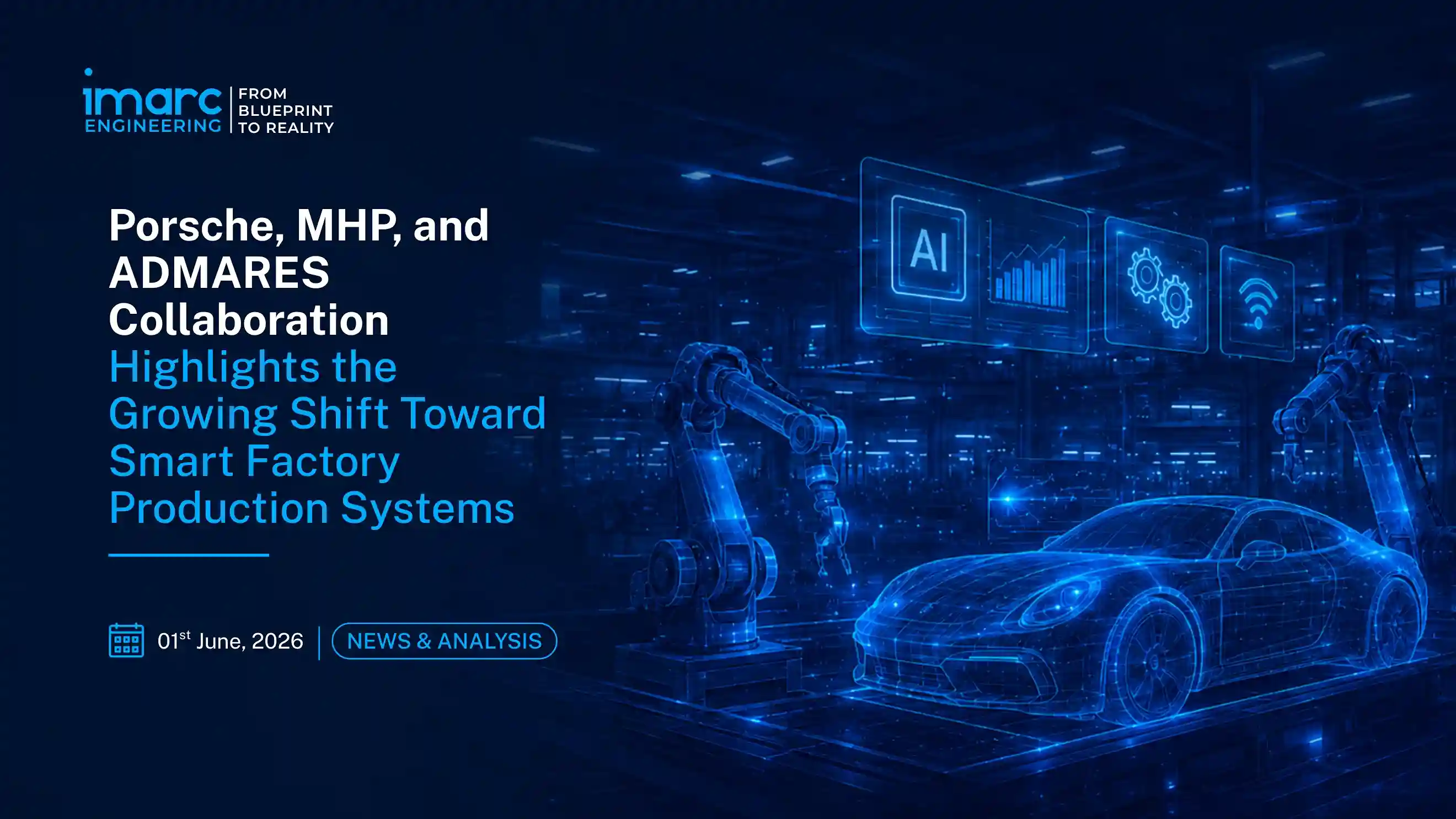
In March 2026, the Porsche Newsroom highlighted a major collaboration between ADMARES, MHP, Porsche Consulting, EDAG Group, Siemens Digital Industries Software, ABB Robotics, and NVIDIA to develop a fully digital and highly automated smart factory production system for modular residential manufacturing. The project represents one of the most advanced applications of integrated smart manufacturing systems outside traditional industrial sectors.
The planned 310,000-square-metre facility is designed to produce up to 16,320 fully finished homes annually, more than 50 units per working day. This level of productivity is driven by the application of automotive manufacturing automation principles, including digital production planning, robotics integration, and connected manufacturing operations.
For every manufacturer and industrial developer watching from India, the ADMARES collaboration is not just a construction story. It is a blueprint for what smart manufacturing systems can achieve when designed with full commitment to digital integration from the outset.
What the ADMARES Smart Factory Actually Built and Why it is Unprecedented
The ADMARES project represents one of the most advanced examples of integrated smart factory production systems in modern manufacturing. Unlike earlier modular construction models, the entire production environment was digitally designed before physical installation began. Factory layouts, workflows, and logistics systems were created and tested in a virtual environment using Siemens Tecnomatix Plant Simulation software. Production performance and factory output were validated through simulation before construction started.
The facility uses robots across multiple production lines operate within connected smart manufacturing systems rather than as standalone automation units. The project uses an industrial metaverse framework that links design, simulation, production configuration, and live operations through shared data structures. Siemens digital twin technology and industrial AI continuously optimise manufacturing performance in real time.
ABB Robotics supplies the advanced robotics and AI-driven automation infrastructure, while NVIDIA technologies support the AI operating system responsible for predictive maintenance, production planning, and real-time monitoring. These integrated intelligent manufacturing systems allow the factory to continuously learn, adapt, and improve over its operational lifecycle instead of simply maintaining fixed production processes.
MHP played a central role in designing the broader digital ecosystem, covering IT architecture, enterprise integration, production planning, and scalability frameworks. This transforms the facility from a conventional automated plant into a unified manufacturing platform where hardware, software, operational intelligence, and data systems function together.
The project demonstrates how advanced factory automation technologies developed within the automotive industry can now be transferred into sectors such as construction, pharmaceuticals, food processing, electronics assembly, and renewable energy manufacturing.
The broader significance lies in the export of automotive manufacturing automation principles into new industries. Over the last four decades, automotive manufacturers have refined digital production systems, robotics integration, and continuous improvement methodologies at global scale. The ADMARES project shows how these capabilities are now driving wider industrial digital transformation across multiple manufacturing sectors worldwide.
India's Manufacturing Modernisation Gap: The Urgency is Growing
India's manufacturing sector is at an inflection point. PLI schemes have attracted INR 2 lakh crore in committed greenfield investment across 14 sectors. The semiconductor fab at Dholera, the EV gigafactories in Gujarat and Tamil Nadu, the pharmaceutical plant upgrades mandated by revised Schedule M, each represents a manufacturing facility that is being designed, built, or upgraded right now.
The question is whether these facilities are being built with the factory automation technologies, digital twin capabilities, and connected production systems that define global manufacturing competitiveness in 2026, or whether they are replicating the production architectures of the previous decade.
India's industrial automation adoption gap is well-documented. The World Robotics Report ranked India at just 7 robots per 10,000 manufacturing employees, compared to 470 in China, 429 in Germany, and 419 in Japan. This is not a permanent structural condition; it is a consequence of historically low labour costs reducing the economic urgency of automation investment, and of a manufacturing base that has been predominantly brownfield, incremental, and under-capitalised.
As PLI-driven greenfield investment accelerates, as global clients imposing quality, traceability, and throughput requirements on Indian contract manufacturers become more demanding, and as labour cost differentials narrow, the automation adoption calculus is changing rapidly.
The greenfield factory planning decisions being made in India today by pharmaceutical companies, EV manufacturers, food processors, electronics assemblers, and industrial component makers will determine the country's manufacturing cost structure and quality competitiveness for the next 15-20 years.
Smart Factories Under Make in India: Policy Push Meets Execution Reality
The Government of India has increasingly integrated smart manufacturing into its industrial policy framework. Programmes under the National Manufacturing Competitiveness Programme promote lean manufacturing and technology adoption. Production Linked Incentive (PLI) schemes also indirectly encourage manufacturing efficiency, as companies that achieve higher output from the same capital base can improve overall incentive returns.
India’s industrial infrastructure projects are also being planned around digital manufacturing requirements. Greenfield industrial corridors and smart industrial cities such as Dholera, KIADB developments, and Vikram Udyogpuri are being designed with high-speed connectivity, reliable power infrastructure, and digital utility management systems as core infrastructure elements.
Simultaneously, the Make in India framework is attracting the global technology partners like Siemens, ABB, Rockwell Automation, Fanuc, Kuka, Mitsubishi Electric, and others, who supply the factory automation technologies that smart factories require. Siemens has operated multiple manufacturing innovation hub in India. Robot System Product, an independent entity over two decades ago after operating within ABB’s robotics opened manufacturing facility in Chennai. Fanuc has a dedicated Indian operation serving automotive, electronics, and pharmaceutical manufacturers.
The global smart manufacturing technology ecosystem is in India. What has historically been missing is the integration capability, the project-level expertise to design, specify, procure, and commission smart factory production systems as coherent, digitally integrated wholes rather than as assemblies of individual equipment purchases.
Digital Twins and Connected Production Systems: From Concept to Deployment
One of the most commercially significant aspects of the ADMARES model is its use of digital twin architecture. The company designed and tested its factory in a virtual environment before physical construction began. This allowed the team to simulate operations, identify bottlenecks, and optimise layouts before equipment installation.
This approach is already widely used in advanced automotive and aerospace manufacturing globally. It reduces the costly discovery of design and process errors during construction and commissioning. For greenfield pharmaceutical, food processing, or EV battery plants in India, digital twins can reduce commissioning risk and accelerate the path to full production capacity.
The long-term value of digital twins depends on connected production systems. These systems integrate machines, sensors, ERP platforms, quality-management systems, and supply-chain tools through real-time data sharing. This creates continuous operational visibility and supports ongoing process optimisation throughout the plant lifecycle.
India is already seeing rapid adoption of digitally integrated smart manufacturing systems. Tata Motors’ Chakan EV facility operates with extensive robotics and digital integration, while Mahindra & Mahindra’s EV plant in Pune was designed with digital production management from the beginning. Semiconductor facilities in Sanand and Krishnagiri are also being developed to international cleanroom and digital process standards.
The ADMARES collaboration shows that advanced digital manufacturing is increasingly becoming a competitive requirement across modern industrial sectors, not just the automotive industry.
What Indian Manufacturers and Developers Can Take From the ADMARES Model
The lessons from the Porsche-MHP-ADMARES collaboration are directly applicable to India's greenfield factory planning wave. First: design the production system digitally before designing the building. In India, the conventional project sequence puts civil construction ahead of production system design, leading to factory layouts that constrain production flows, create material handling inefficiencies, and require expensive retrofits when operational realities diverge from construction-stage assumptions. The ADMARES model reverses this sequence.
Second: treat the digital twin as infrastructure, not an optional add-on. The Siemens Tecnomatix simulation that validated ADMARES's factory performance before installation is the same tool available to pharmaceutical, food processing, and component manufacturing plant developers in India. The marginal cost of digital factory simulation relative to total project cost is small; the risk reduction benefit is large.
Third: plan automation and integration as a system, not as a procurement list. Buying robots and buying a smart factory are not the same exercise. The value of factory automation technologies is realised only when robots, sensors, data systems, and human workflows are designed as an integrated system from the start, which is the expertise that MHP, EDAG, and Siemens collectively provide in the ADMARES project, and which specialist industrial consulting firms bring to manufacturing investments in India.
The ADMARES factory produces 50 units homes per day because it was designed as a system, not assembled as a collection of equipment. India's manufacturing decade will be won by the same principle.
Talk to our experts for smart factory and Industry 4.0 integration consulting support through IMARC Engineering.
About IMARC Engineering
IMARC Engineering supports manufacturers and industrial developers with Smart Factory and Industry 4.0 Integration, and Process Optimization and Lean Consulting across India. Whether you are designing a greenfield facility or modernising an existing plant, IMARC Engineering brings the technical depth and manufacturing systems expertise to make your factory future-ready.
Latest News
-
PM Modi Launches INR 753.68 Crore VOC Port Infrastructure Projects in Tamil Nadu
October 14, 2026
-
India's Manufacturing Sector Shows Recovery in Q2 FY27 as 95% of Firms Report Stable or Higher Output
October 12, 2026
-
Puri Greenfield Airport Gets Environmental Clearance, Advancing INR 5,631 Crore Project in Odisha
October 09, 2026
-
IEX Subsidiary Applies for Coal Exchange Registration Under India’s New Coal Exchange Rules 2026
September 30, 2026
-
India Pushes Domestic Shipping Container Manufacturing with INR 10,000 Crore Assistance Scheme
September 25, 2026
Trusted by Industry Leaders
We partner with global enterprises and ambitious businesses across sectors to deliver operational excellence, strategic insights, and sustainable growth through integrated solutions.












Success in Their Words
Real feedback from clients across industries. Discover how our solutions delivered measurable impact and operational excellence.

I wanted to express my sincere appreciation for your efforts in handling this matter. Your dedication and commitment have been truly commendable, and it is evident that you have put in tremendous hard work and expertise into resolving the issues at hand. We are greatly interested in continuing our collaboration with you in the future, as your professionalism and reliability have made you a trusted partner. Thank you once again for your invaluable contribution. We look forward to strengthening our partnership ahead.

It has been a pleasure working with the IMARC team. The insights provided were structured, clear, and highly valuable, helping us strengthen both our technical and financial planning with confidence. We deeply appreciate the team’s professionalism, responsiveness, and attention to detail throughout the engagement. Every requirement was well understood and effectively incorporated, resulting in a comprehensive and actionable output. Overall, our experience has been excellent, and I would gladly recommend IMARC to organizations seeking a reliable research partner.

Your service is truly exceptional. Working with the IMARC team has been a seamless and professional experience. The clarity of communication, responsiveness to queries, and consistent support at every stage made the entire engagement highly efficient. The insights shared were well-structured, practical, and perfectly aligned with our requirements, helping us make informed decisions with confidence. Overall, the dedication and professionalism demonstrated by your team stand out, and I would be glad to recommend IMARC as a reliable and trustworthy research partner.

IMARC did an outstanding job in preparing our study. They were punctual, precise, and consistently responsive throughout the entire process. The team delivered all the data we required in a clear, well-organized, and highly professional format. Their strong attention to detail, combined with their ability to meet every deadline without compromising quality, truly set them apart. Overall, their reliability and commitment made them an exceptional partner for our project, and we would gladly work with them again in the future.

IMARC made the whole process incredibly easy from start to finish. Everyone I interacted with via email was polite, professional, and straightforward to deal with, always keeping their promises regarding delivery timelines and remaining consistently solutions-focused. From my very first contact, I appreciated the professionalism and support shown by the entire IMARC team. I highly recommend IMARC to anyone seeking timely, affordable, and reliable information or advice. My experience with IMARC was excellent, and I truly cannot fault any aspect of it.

I’d like to express my sincere gratitude for the excellent work you accomplished with the study. Your ability to quickly understand our requirements and deliver high-quality results under tight timelines truly reflects your expertise, exceptional work ethic, and unwavering commitment to your customer’s success. The professionalism and responsiveness you demonstrated throughout the process made a significant difference. Our entire team and company are incredibly thankful for your dedication, reliability, and support. Once again, thank you for your outstanding contribution.
Ready to Experience the IMARC Advantage?
Whether you're planning a new facility, expanding operations, optimizing performance, or facing complex challenges—IMARC Engineering brings the expertise, experience, and commitment needed for success.