Manufacturing
September 23 2026
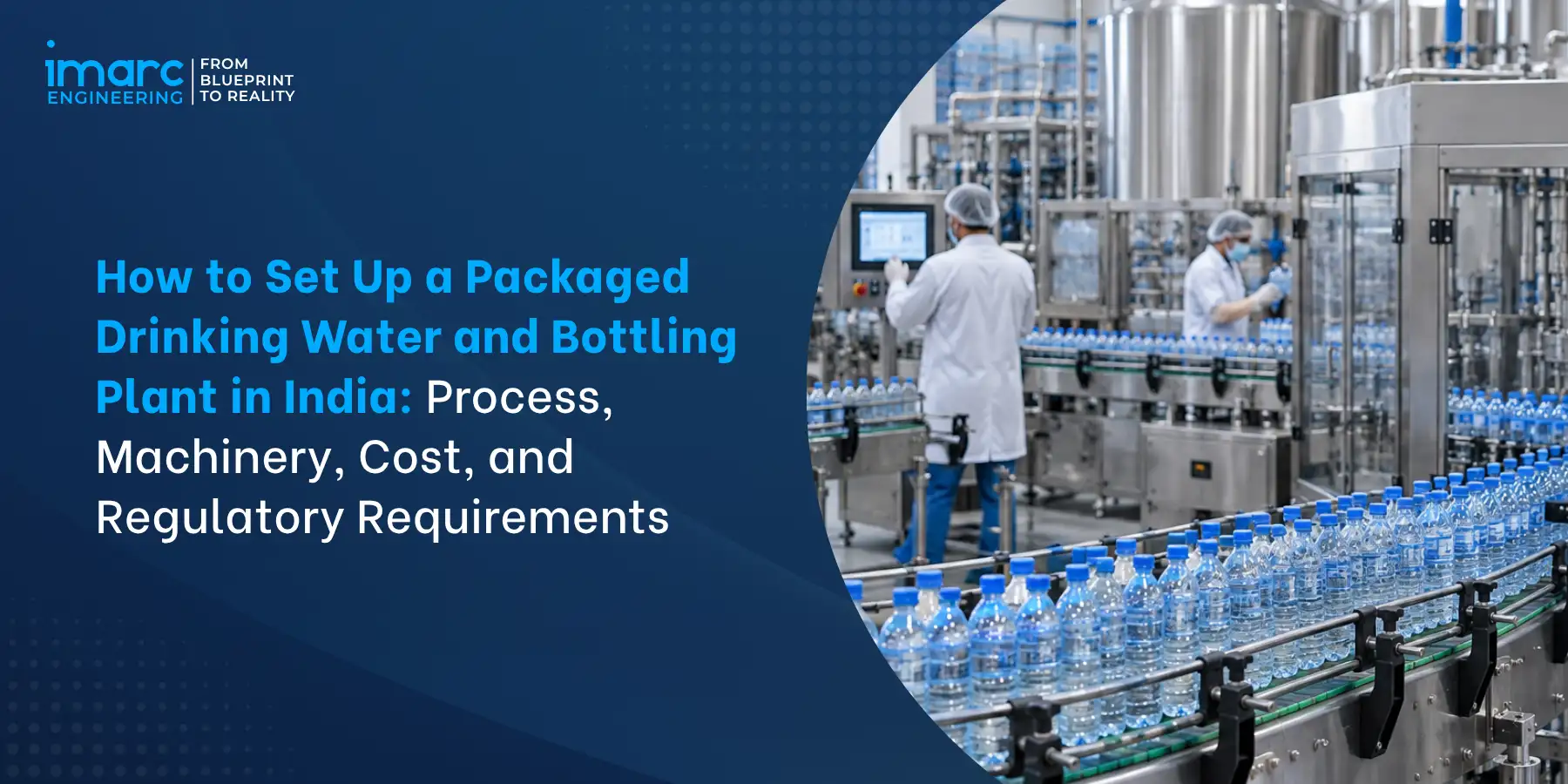
How to Set Up a Packaged Drinking Water and Bottling Plant in India: Process, Machinery, Cost, and Regulatory Requirements
Introduction
For investors, manufacturers, and project development teams planning a packaged drinking water plant in India in 2026, disciplined integration across water-source assessment, treatment technology, bottling machinery, packaging strategy, utilities, quality control, and regulatory compliance determines commercial viability. The regulatory landscape changed significantly in 2026. FSSAI removed the mandatory BIS certification requirement for packaged drinking water and mineral water and introduced a mandatory Scheme of Testing effective 1 January 2026.
FSSAI registration or licensing applies based on the applicable eligibility criteria, while groundwater permissions, SPCB consents, factory and occupational-safety requirements, and other approvals apply where required by the project's location and operations.
Scope of this Guide
This guide answers the sponsor's question directly. How should investors plan a packaged drinking water manufacturing plant from water-source assessment through treatment-process design, machinery selection, bottling, utilities, regulatory compliance, project cost, and commissioning? It walks through raw water assessment, RO/UV/ozonation treatment design, bottling line configuration by capacity, PET preform in-house vs procured decision, utilities/layout, and FSSAI Scheme of Testing compliance.
Table of Contents
- Introduction
- Why Packaged Drinking Water Plant Investment Matters for India in 2026
- What a Packaged Drinking Water Plant is and Why It Matters in India
- Raw Water Source Assessment and Treatment Train Selection for Packaged Drinking Water Plants in India
- RO UV Ozonation and Remineralization Process for Packaged Drinking Water Manufacturing in India
- Bottling Line Filling Capping and Packaging Equipment for Water Bottling Plants in India
- PET Preform Bottle Blowing and In-house vs Procured Bottle Strategy for Packaged Water Plants in India
- Utilities Plant Layout and Quality Control Laboratory for Packaged Drinking Water Plants in India
- FSSAI Licensing Testing Scheme and Project Economics for Packaged Drinking Water Plants in India
- Conclusion
1. Why Packaged Drinking Water Plant Investment Matters for India in 2026
Four drivers make disciplined, packaged drinking water plant setup a strategic opportunity for investors and manufacturers in 2026.
1.1 Sustained Market Demand
India's packaged drinking water manufacturing in India continues to grow with rising urbanisation, safety concerns over municipal water quality, expanding out-of-home consumption, hospitality/HORECA channels, e-commerce delivery, and 20-litre home/office jar segments. Packaged water is consumed across price tiers from institutional bulk (jars) to premium/mineral segments. Regional plants dominate due to logistics economics - bottled water is heavy relative to value, keeping economical delivery radius typically within 200-400 km of the plant.
1.2 Regulatory Modernisation
- FSSAI order 17 December 2025 removed mandatory BIS ISI mark for PDW and Mineral Water (built on 17 October 2024 gazette notification)
- New FSSAI Scheme of Testing effective 1 January 2026 - continuous testing regime replacing one-time certification model
- IS 14543 (PDW) and IS 13428 (Natural Mineral Water) remain reference technical standards
- FSSAI State/Central Licence remains mandatory under FSS Act 2006
- Schedule IV of FSS Licensing Regulations 2011 governs GMP/GHP requirements
- FSS (Packaging) Regulations 2018 apply to packaging materials
- CGWA NOC via NOCAP portal mandatory for groundwater extraction with 2026 digital telemetry requirements
1.3 Segment Diversification
Product formats have diversified beyond standard 500 ml/1 L bottles. Small packs (200 ml, 250 ml) for hospitality; premium branded (750 ml glass, PET) for on-premises HORECA; 20-litre jars for home/office; mineral/spring water for premium segments; alkaline/functional waters for wellness segments. Plants can serve single format or multi-format markets - decision affects bottling line configuration, changeover time, storage, and dispatch logistics. Multi-format plants offer market flexibility but require more investment and operational complexity.
1.4 Manageable Entry Threshold
Compared to complex manufacturing sectors, packaged water plant in India has relatively modest entry threshold - technology is mature, machinery readily available domestically and imported, and initial CAPEX for small operations (2,000-5,000 BPH single line) around INR 1-3 crore excluding land. Larger plants (20,000+ BPH multi-format) require INR 8-20+ crore. This attracts both small regional entrants and larger branded manufacturers. However, licensing complexity (FSSAI + CGWA + SPCB + OSH), continuous compliance discipline (new Scheme of Testing), and market crowding create real barriers requiring disciplined approach.
2. What a Packaged Drinking Water Plant is and Why It Matters in India
Understanding what a packaged drinking water plant is and why it matters in India begins with placing it as an integrated water-treatment and high-speed packaging manufacturing project - not a generic bottled-water business.
2.1 Definition and Distinction
- Packaged drinking water plant (per IS 14543): treated water from any source (borewell, municipal, surface) using full treatment including RO, UF, UV, and ozonation as needed
- Mineral water plant in India (per IS 13428): natural mineral water from certified natural underground source with minimum TDS 250 mg/L; only limited filtration/aeration allowed - cannot alter natural mineral composition
- Most new water bottling plants apply under IS 14543 framework because it permits full treatment without natural spring source requirement
- Both categories require FSSAI State/Central Licence and follow the new FSSAI Scheme of Testing effective January 2026
2.2 Plant Components
| Component | Function | Illustrative Elements |
|---|---|---|
| Raw water intake | Source water supply | Borewell, storage, transfer pumps |
| Water treatment plant | Purification train | Filters, RO, UV, ozone, tanks |
| Treated water storage | Buffer for bottling | SS tanks with air breather |
| Bottle washing | Bottle preparation | Rinser (integrated with filler) |
| Bottling line | Filling and capping | Rinser-filler-capper monobloc |
| Labelling/packing | Product finishing | Labeller, shrink wrap, conveyors |
| QC laboratory | Testing/monitoring | Physico-chemical, microbio equipment |
| Utilities | Support services | Compressor, chiller, power, boiler |
2.3 Plant Scale Determinants
Plant scale depends on target market, production capacity, and packaging strategy. Small plants (2,000-5,000 BPH single line) serve local/regional markets in bottle sizes 200 ml-2 L. Medium plants (5,000-15,000 BPH) serve district/state markets with multiple bottle sizes. Large plants (20,000-60,000+ BPH multi-format) serve state/regional/national markets. Very large plants integrate multiple bottling lines with in-house PET preform blowing. Decisions on capacity, formats, in-house vs procured bottles, and treatment technology should follow market plan not standard assumptions - the plant must fit the market, not the reverse.
3. Raw Water Source Assessment and Treatment Train Selection for Packaged Drinking Water Plants in India
Understanding raw water source assessment and treatment train selection for packaged drinking water plants in India is the most consequential early decision. Source characteristics determine treatment complexity, equipment cost, and OPEX.
3.1 Raw Water Source Options
| Source | Typical Considerations | Regulatory |
|---|---|---|
| Groundwater (borewell) | Deep aquifer, variable TDS/hardness | CGWA NOC (If applicable) |
| Municipal water | Pre-treated but variable quality | Local body supply agreement |
| Surface water | River/lake, needs full treatment | State water dept approval |
| Natural spring (mineral water) | Certified underground source | IS 13428 route + CGWA |
3.2 Water Quality Assessment
- Water quality assessment precedes treatment design
- Physical parameters: turbidity, colour, odour, TDS, EC, temperature
- Chemical parameters: pH, hardness, alkalinity, chlorides, sulphates, nitrates, iron, arsenic, fluoride
- Microbiological parameters: total coliforms, E. coli, faecal coliforms, HPC (heterotrophic plate count)
- Heavy metals: lead, cadmium, mercury per IS 14543 permissible limits
- Pesticide residues where surface/agricultural runoff is a risk
- Seasonal variation testing across pre-monsoon, monsoon, post-monsoon
- Comparison against IS 14543 finished water specifications determines treatment gap
3.3 CGWA NOC for Groundwater
- Groundwater extraction may require CGWA NOC under Environment Protection Act 1986
- Online application via NOCAP portal with fee INR 10,000 fresh / INR 5,000 renewal (via bharatkosh.gov.in)
- Hydrogeological Report from accredited consultant with pumping tests, aquifer analysis, water balance, rainwater harvesting proposal
- Categories: Safe / Semi-Critical / Critical / Over-Exploited with varying abstraction charges
- Digital flow meters with telemetry and piezometer for real-time monitoring; monthly digital readings to CGWA (2026 requirement)
- New packaged-water industries are not eligible for groundwater NOC in over-exploited assessment units, including MSMEs
- NOC validity typically 3-5 years; renewal well before expiry
3.4 Treatment Train Selection
Treatment train tailored to raw water quality and finished water specifications. Low-TDS groundwater (200-500 mg/L) with good microbial quality may need only sand filter, activated carbon, UV, and ozonation - RO not always required. High-TDS/hardness water (1,000+ mg/L) needs RO for TDS reduction. Iron-rich water requires oxidation-filtration before RO. Municipal water may only need residual chlorine removal, polishing, UV/ozone. Natural mineral water (IS 13428) allows only limited filtration and aeration - cannot use RO or other treatment altering natural mineral composition. Over-engineering treatment inflates CAPEX and OPEX without benefit; under-engineering fails IS 14543 compliance and FSSAI Scheme of Testing.
4. RO UV Ozonation and Remineralization Process for Packaged Drinking Water Manufacturing in India
Understanding RO UV ozonation and remineralization process for packaged drinking water manufacturing in India covers the core water purification value chain typical for IS 14543-route plants.
4.1 Pre-treatment
- Raw water storage buffer tanks (typically 1-2 days production capacity)
- Sand filtration (multi-media filter) removes suspended solids and turbidity
- Activated carbon filtration removes chlorine, organics, colour, odour, and protects RO membranes
- Water softener where hardness reduction needed; micron cartridge filters (5, 1, 0.2 micron) for polishing before RO
4.2 Membrane Treatment
- Reverse osmosis (RO system) reduces TDS 90-99 percent, hardness, heavy metals, dissolved impurities
- RO recovery and system capacity should be designed around feed-water quality, product demand and operating requirements
- Ultrafiltration (UF) alternative for good-quality low-TDS water where RO is not needed - retains natural minerals
4.3 Post-treatment
- Remineralization adds back essential minerals (calcium, magnesium) to RO-treated water for taste and health
- UV disinfection (typically 254 nm) inactivates microbial contamination without chemical residue
- Ozonation provides residual disinfection during storage/bottling and enhances shelf life (ozone 0.1-0.4 mg/L residual)
- Treated water storage in food-grade SS tanks with 0.2 micron air breather; recirculation loop maintaining ozone
4.4 Process Sequencing
Typical treatment sequence: Raw Water Intake > Raw Water Storage > Sand Filter > Activated Carbon > Water Softener (if needed) > Micron Filters > RO/UF > Remineralizer > UV > Ozone > Treated Water Storage > Bottling. Actual sequence and equipment vary with source quality. All contact surfaces food-grade (SS 316 or food-grade PVC/PP). CIP (Clean-In-Place) system for sanitization between production batches or shifts. Instrumentation: TDS, pH, ORP (for ozone), flow meters at critical points. Data logging supports FSSAI Scheme of Testing compliance from January 2026.
5. Bottling Line Filling Capping and Packaging Equipment for Water Bottling Plants in India
Understanding bottling line filling capping and packaging equipment for water bottling plants in India covers the high-speed packaging value chain that determines plant capacity and output economics.
5.1 Bottling Line Configuration
| Capacity Class | BPH Range | Typical Configuration |
|---|---|---|
| Small | 2,000-5,000 BPH | Semi-auto, single format |
| Medium | 5,000-15,000 BPH | Fully auto monobloc, 2-3 formats |
| Large | 20,000-40,000 BPH | High-speed monobloc, multi-format |
| Very Large | 40,000-60,000+ BPH | Multiple lines, integrated blowing |
5.2 Rinser-Filler-Capper Monobloc
- Rinsing filling capping machine (monobloc) integrates three operations for hygiene and speed
- Bottle rinsing with treated water (single or double rinse) removing preform residue and airborne particles
- Filling and capping - gravity, pressure, or electronic volumetric fillers; screw cap or crown cap depending on format
- Star-wheel or neck-handling transfer between operations minimizing bottle contact
- Speed matching between rinser, filler, and capper for smooth operation
- Positive pressure clean room enclosure over the monobloc reduces contamination risk
5.3 Packaging Equipment
- Labelling machine - shrink sleeve, wrap-around, or self-adhesive per bottle format
- Shrink wrapping for multi-pack (6, 12, 24 bottles per pack) with shrink tunnel
- Secondary packaging into corrugated cartons for dispatch (varies by SKU)
- Conveyor systems with speed control connecting all sections
- Coding/marking machine (inkjet or laser) for batch number, mfg/expiry date, MRP
- Palletiser (manual/semi-auto/robotic) for warehouse stacking
5.4 Special Formats
20-litre jar line separate from PET bottle line due to different bottle handling: bottle inspection, hot water/detergent washing, rinsing, filling, capping, sealing, and labelling. Jar production typically 200-800 jars/hour with dedicated washer capable of handling returned jars. Glass bottle lines (premium/mineral segment) require additional bottle inspection, warm rinsing, and different capping systems. Multi-format plants require format-change tooling and clean changeover procedures - factor these into capacity planning and operational discipline.
6. PET Preform Bottle Blowing and In-house vs Procured Bottle Strategy for Packaged Water Plants in India
Understanding PET preform bottle blowing and in-house vs procured bottle strategy for packaged water plants in India is a critical CAPEX and operational decision. It is not required that every plant makes its own bottles.
6.1 In-house PET Bottle Manufacturing
- PET preforms (moulded PET blanks) purchased and converted to bottles at the plant
- Stretch blow moulding machine heats preforms in oven, stretches and blows to bottle shape in the mould
- Bottle blowing machine typical capacity 1,500-15,000+ bottles per hour depending on cavities and format
- Requires high-pressure compressed air (25-40 bar) at significant CFM
- Mould change for different bottle formats (5-30 minutes changeover)
- Bottles blown just-in-time or short buffer for feeding bottling line
6.2 Procured Bottles Route
- PET bottles procured from external converter as ready-to-fill bottles
- Simpler plant operation - no blow moulding line, no high-pressure compressed air, no preform storage
- Higher per-bottle cost (typically 5-15 percent premium) but eliminates CAPEX
- Bottle logistics: bulk delivery in trailers requires substantial warehouse space (bottles are volume-heavy)
- Supply reliability critical - stockout halts production; supplier concentration risk manageable through dual sourcing
- Suitable for small-medium plants and multi-format operations where blowing complexity outweighs savings
6.3 Decision Framework
| Factor | In-house Blowing Favoured | Procured Bottles Favoured |
|---|---|---|
| Volume | Large single-format runs | Small-medium, multi-format |
| CAPEX | Justified at scale | Preserves capital |
| Bottle logistics | Reduces inbound freight | Simple supplier tie-ups |
| Format flexibility | Requires mould inventory | Easier for varied SKUs |
| Operational complexity | Higher (2 processes) | Lower (bottle in, filled out) |
| Break-even | 10,000+ BPH typical | Small-medium plants |
6.4 Bottle Quality Requirements
- Food-grade PET (virgin resin per FSS Packaging Regulations 2018)
- Clarity, wall thickness uniformity, top-load strength per specifications
- Dimensional consistency for smooth handling on filler
- Neck finish standard (typically 28mm PCO/BPF thread for water bottles)
- Preform storage/handling in clean environment away from odours
- Cap compatibility (screw threading, tamper-evident) between bottle neck and cap supplier
7. Utilities Plant Layout and Quality Control Laboratory for Packaged Drinking Water Plants in India
Understanding utilities plant layout and quality control laboratory for packaged drinking water plants in India covers the supporting infrastructure that determines operational reliability and compliance.
7.1 Utilities Requirements
| Utility | Typical Range | Application |
|---|---|---|
| Power | 50-500 kVA | Depending on scale/PET blowing |
| Compressed air (low) | 20-100 CFM at 6-8 bar | Instrumentation, packaging |
| Compressed air (high) | 50-500 CFM at 25-40 bar | PET blow moulding (if in-house) |
| Chilling water | Optional | Temp control if needed |
| Steam | Small boiler | Shrink wrap, jar washing |
| Water for utilities | 2-5x product volume | Cleaning, cooling |
| Nitrogen | Optional | Blanketing for premium products |
7.2 Wastewater Management
- Wastewater management covers RO reject water, CIP effluent, and cleaning wastewater
- RO reject water (25-50 percent of feed) - can be reused for cleaning, gardening, or wet scrubber where quality permits
- Backwash water from sand filter and carbon filter - typically low-strength effluent
- CIP effluent contains detergents/sanitizers - requires ETP or connection to sewage treatment
- Zero Liquid Discharge (ZLD) considered where SPCB requires or water scarcity dictates
- SPCB CTE/CTO under Water Act 1974 for discharge; Air Act 1981 for emissions where applicable
7.3 Plant Layout
- Plant layout optimized for hygienic flow, contamination prevention, and expansion
- Raw material yard (empty bottles/preforms) separated from clean production area
- Treatment area with proper ventilation, drainage, and access for maintenance
- Bottling hall as controlled clean area with positive pressure over monobloc
- Warehouse for finished goods with dispatch bay separate from raw material
- QC lab centrally located with easy sample access from all critical points
- Utility block (compressor, boiler, tanks) separated from production for safety
- Change rooms and hygiene facilities at production entry
7.4 Quality Control Laboratory
- Quality control laboratory and microbiological testing arrangements are FSSAI Scheme of Testing critical
- Physico-chemical testing equipment: pH meter, TDS/conductivity meter, turbidity meter, colorimeter, spectrophotometer
- Microbiological testing: incubator, autoclave, laminar flow, membrane filter unit, colony counter
- Water testing per IS 14543 parameter list and FSSAI Scheme of Testing frequency
- In-house testing OR NABL-accredited third-party lab agreement for parameters beyond in-house scope
- Data recording per FSSAI Scheme of Testing effective January 2026
- Corrective action protocols for out-of-specification results
8. FSSAI Licensing Testing Scheme and Project Economics for Packaged Drinking Water Plants in India
Understanding FSSAI licensing testing scheme and regulatory compliance for packaged drinking water plants in India alongside CAPEX OPEX and project economics for packaged drinking water plants in India completes the framework.
8.1 FSSAI Licensing
- FSSAI State Licence: typical for medium plants (turnover INR 1.5 Crore to INR 50 crore)
- FSSAI Central Licence: large plants (turnover above INR 50 crore) or multi-state operations
- Application via FSSAI FoSCoS portal with plant details, technical staff qualifications, food safety plan
- FSSAI registration or licensing applies according to the applicable eligibility criteria and current FoSCoS requirements
- Schedule IV of FSS Licensing Regulations 2011 - GMP/GHP requirements
- Trained food safety supervisor mandatory (FoSTaC-certified)
- Packaged drinking water and mineral water are classified as High Risk Food Categories, with applicable inspection and audit requirements
8.2 FSSAI Scheme of Testing (from January 2026)
- Packaged drinking water compliance under new FSSAI Scheme of Testing effective 1 January 2026
- Compulsory scheme after FSSAI removed mandatory BIS ISI mark (order 17 December 2025 building on 17 October 2024 notification)
- Continuous testing regime replacing one-time certification model
- Detailed test records for source water and finished product; batch-wise consumption records of added minerals
- FSS (Packaging) Regulations 2018 compliance
- Non-conforming products separately disposed; repeated non-compliance triggers risk-based FSSAI inspections
- IS 14543 remains reference technical standard; voluntary BIS certification available
8.3 Other Regulatory Compliance
- CGWA NOC via NOCAP portal (INR 10,000 application fee; digital telemetry + piezometer required)
- SPCB Consent to Establish/Consent to Operate under Water Act 1974/Air Act 1981
- OSH Code 2020 factory licence (in force from 21 November 2025)
- Fire NOC per NBC 2016
- EPR (Extended Producer Responsibility) for plastic packaging waste per Plastic Waste Management Rules
- Trademark registration for brand protection
- Legal Metrology approval for pack declarations
8.4 Project Economics
Project economics for a packaged drinking water plant are influenced by the treatment system, bottling and packaging equipment, PET bottle production where applicable, utilities, and civil and storage infrastructure. Operating costs are driven mainly by packaging materials, energy and utilities, labour, transportation, quality testing, and regulatory compliance. Overall investment requirements and commissioning timelines vary according to plant capacity, automation, packaging formats, equipment configuration, site conditions, and project scope.
Conclusion
Setting up a packaged drinking water plant in India requires the right product standard, water-source assessment, source-specific treatment, bottling-line and PET packaging decisions, utilities, wastewater management, quality control, and regulatory approvals. Key requirements include FSSAI licensing and testing, CGWA approval where applicable, SPCB consents, factory and fire approvals, and EPR compliance. Project costs and commissioning timelines vary by capacity, format, and plant configuration.
Three priorities are critical. First, design the treatment system around raw-water quality rather than assuming RO is necessary. Second, select PET bottle production or procurement based on plant scale and product formats. Third, build the required FSSAI testing and record-keeping systems into the plant from the start.
PURSUING A PACKAGED DRINKING WATER PLANT?
IMARC Engineering’s packaged drinking water and bottling plant advisory supports investors and manufacturers with product-route selection, water-source assessment, treatment and bottling-line design, plant layout, utilities, wastewater management, quality control, regulatory approvals, packaging, and commissioning. The service also covers FSSAI licensing, CGWA requirements, environmental compliance, and capacity-based project planning.
→ Schedule a free packaged drinking water plant scoping consultation with an IMARC specialist
Frequently Asked Questions
Packaged drinking water plant in India may require reliable water source, CGWA NOC for groundwater, SPCB CTE/CTO, FSSAI State/Central Licence, OSH Code 2020 factory licence, Fire NOC, water treatment plant (RO/UV/ozonation), bottling line, quality control laboratory, and compliance with FSSAI Scheme of Testing effective January 2026.
Packaged drinking water manufacturing process: raw water intake, storage, pre-filtration (sand filter), activated carbon filtration, cartridge filters, RO/UF treatment, remineralization, UV disinfection, ozonation, treated water storage, bottle rinsing, filling, capping via rinser-filler-capper monobloc, labelling, shrink wrapping, and secondary packaging with quality control per FSSAI Scheme.
Packaged drinking water plant machinery typically includes complete water treatment train (sand filter, activated carbon, cartridge, RO/UF, UV, ozone, remineralizer, storage tanks), bottling line (rinser-filler-capper monobloc, labeller, shrink wrapper, conveyors), optional PET preform stretch blow moulding machine, air compressor, chiller, and quality control laboratory equipment.
Raw water quality (TDS, hardness, iron, arsenic, microbial load) determines treatment train complexity. High-TDS/hardness water requires RO; moderate quality may need only UF/UV/carbon. Iron-rich water requires oxidation-filtration; microbial contamination needs UV/ozone. Treatment sequence tailored to source ensures compliance with IS 14543 specifications without over-engineering costs.
Higher production capacity requires faster bottling lines (small 2,000-5,000 BPH, medium 5,000-15,000, large 20,000-60,000+ BPH). Larger sizes need bigger storage tanks, higher compressor CFM, more power (50-500+ kVA), and expanded plant layout with wider conveyors, larger warehouse space, and dispatch bay for multiple bottle SKUs.
Packaged drinking water (IS 14543) is treated water from any source (borewell, municipal, surface) allowing RO/UV treatment. Natural mineral water (IS 13428) must come from certified natural underground source with minimum TDS 250 mg/L, cannot undergo treatment that alters natural composition, only limited filtration allowed.
Packaged drinking water plant cost depends on production capacity (BPH), treatment train complexity, bottling line speed, in-house PET blowing vs procured bottles, packaging formats, and plant location. Small plants (2-5,000 BPH) INR 1-3 crore; medium INR 3-8 crore; large plants INR 8-20+ crore excluding land.
Packaged drinking water plants require FSSAI State/Central Licence per FSS Act 2006, FSSAI Scheme of Testing from January 2026 (replacing BIS ISI), Schedule IV GMP/GHP, FSS Packaging Regulations 2018, CGWA NOC, SPCB CTE/CTO, OSH Code 2020 factory licence, Fire NOC, and EPR for plastic waste.
Recent Post
Trusted by Industry Leaders
We partner with global enterprises and ambitious businesses across sectors to deliver operational excellence, strategic insights, and sustainable growth through integrated solutions.








Success in Their Words
Real feedback from clients across industries. Discover how our solutions delivered measurable impact and operational excellence.

I wanted to express my sincere appreciation for your efforts in handling this matter. Your dedication and commitment have been truly commendable, and it is evident that you have put in tremendous hard work and expertise into resolving the issues at hand. We are greatly interested in continuing our collaboration with you in the future, as your professionalism and reliability have made you a trusted partner. Thank you once again for your invaluable contribution. We look forward to strengthening our partnership ahead.

It has been a pleasure working with the IMARC team. The insights provided were structured, clear, and highly valuable, helping us strengthen both our technical and financial planning with confidence. We deeply appreciate the team’s professionalism, responsiveness, and attention to detail throughout the engagement. Every requirement was well understood and effectively incorporated, resulting in a comprehensive and actionable output. Overall, our experience has been excellent, and I would gladly recommend IMARC to organizations seeking a reliable research partner.

Your service is truly exceptional. Working with the IMARC team has been a seamless and professional experience. The clarity of communication, responsiveness to queries, and consistent support at every stage made the entire engagement highly efficient. The insights shared were well-structured, practical, and perfectly aligned with our requirements, helping us make informed decisions with confidence. Overall, the dedication and professionalism demonstrated by your team stand out, and I would be glad to recommend IMARC as a reliable and trustworthy research partner.

IMARC did an outstanding job in preparing our study. They were punctual, precise, and consistently responsive throughout the entire process. The team delivered all the data we required in a clear, well-organized, and highly professional format. Their strong attention to detail, combined with their ability to meet every deadline without compromising quality, truly set them apart. Overall, their reliability and commitment made them an exceptional partner for our project, and we would gladly work with them again in the future.

IMARC made the whole process incredibly easy from start to finish. Everyone I interacted with via email was polite, professional, and straightforward to deal with, always keeping their promises regarding delivery timelines and remaining consistently solutions-focused. From my very first contact, I appreciated the professionalism and support shown by the entire IMARC team. I highly recommend IMARC to anyone seeking timely, affordable, and reliable information or advice. My experience with IMARC was excellent, and I truly cannot fault any aspect of it.

I’d like to express my sincere gratitude for the excellent work you accomplished with the study. Your ability to quickly understand our requirements and deliver high-quality results under tight timelines truly reflects your expertise, exceptional work ethic, and unwavering commitment to your customer’s success. The professionalism and responsiveness you demonstrated throughout the process made a significant difference. Our entire team and company are incredibly thankful for your dedication, reliability, and support. Once again, thank you for your outstanding contribution.