Manufacturing
June 02 2026
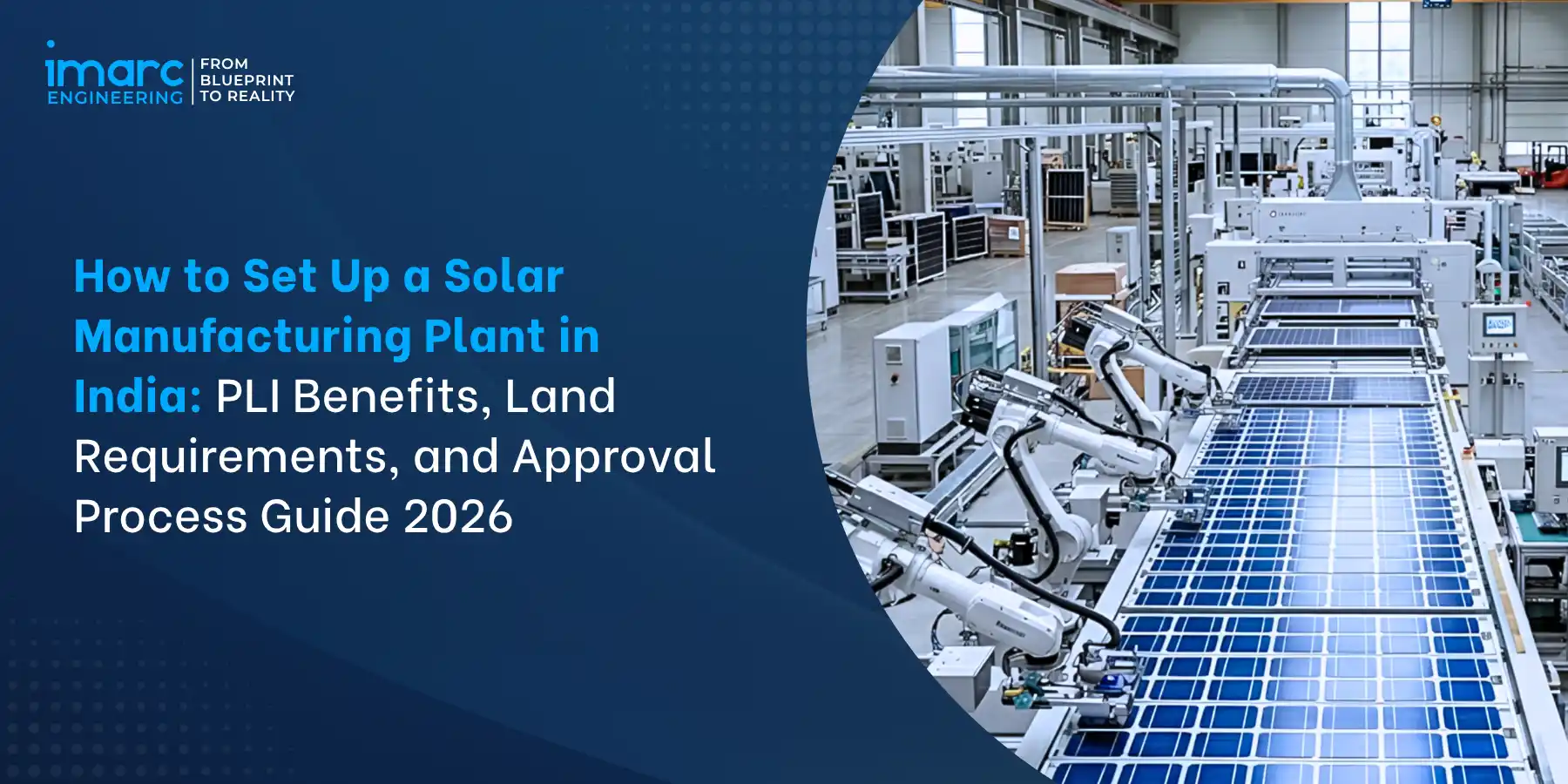
How to Set Up a Solar Manufacturing Plant in India: PLI Benefits, Land Requirements, and Approval Process Guide 2026
Introduction
India's solar manufacturing landscape has transformed dramatically since the launch of the Production Linked Incentive (PLI) Scheme for High Efficiency Solar PV Modules in 2021. From just 2.3 GW of solar PV module manufacturing capacity in 2014, India crossed the landmark 100 GW threshold under the Approved List of Models and Manufacturers (ALMM) in August 2025 and reached 121.7 GW by November 2025, a transformation driven directly by the PLI architecture, declining import dependence, and India's commitment to 500 GW of non-fossil-fuel capacity by 2030.
For any company evaluating a solar manufacturing plant in India in 2026, the strategic case is the strongest it has been in two decades: policy support is robust, demand visibility is exceptional, and a fully-integrated upstream-to-downstream manufacturing ecosystem is now economically viable for the first time.
The opportunity is significant, but a solar manufacturing plant setup in India involves considerable execution complexity. These projects are among the most capital-intensive and regulation-heavy manufacturing investments, requiring coordination across land acquisition, environmental approvals, BIS certification, ALMM enlistment, factory licensing, and compliance with PLI scheme solar manufacturing requirements, including domestic value-addition commitments.
Execution risks remain substantial. By June 2025, only 31 GW of the targeted 65 GW PLI-supported module capacity had been commissioned despite committed investments of INR 48,120 crore. Cost overruns and delays remain common, making disciplined project management, early planning, and integrated execution critical for a successful solar manufacturing plant in India.
Drawing on IMARC Engineering's experience supporting feasibility studies, site selection, regulatory and scheme advisory, equipment specification, EPC execution, and factory setup consultants in India services across pharmaceuticals, EV battery, electronics, and renewable energy projects, this guide lays out a structured approach to solar factory setup in India in 2026.
You will find a clear view on why the opportunity is now, the PLI architecture and benefits, plant scale and configuration choices, land requirements and site selection, the end-to-end approval process, equipment and capex considerations, common pitfalls, a checklist for project teams, partner-selection guidance, and a frequently-asked-questions section. The objective is to make renewable energy manufacturing in India practical and predictable for your project, regulatory, and commercial teams.
Table of Contents
- Introduction
- Why Solar Manufacturing Is a Strategic Opportunity in 2026
- The PLI Scheme - Architecture, Tranches, and Benefits
- Plant Scale and Configuration
- Land Requirements and Site Selection
- The Approval Process - Step-by-Step Framework
- Equipment, Process Technology, and Capex
- Common Mistakes and How to Avoid Them
- Solar Manufacturing Plant Setup Checklist
- How to Choose Project Consultants and EPC Partners
- Conclusion
1. Why Solar Manufacturing Is a Strategic Opportunity in 2026
Understanding why solar industry investment in India has become a strategic priority for Indian and international capital starts with five structural drivers that converge for the first time in a generation.
1.1 The Demand Equation Is Exceptional
India's commitment to 500 GW of non-fossil-fuel capacity by 2030, a target reaffirmed at multiple international forums - creates one of the largest single-country renewable demand backlogs in the world. Solar PV is expected to contribute the majority of that capacity through grid-scale, distributed, and rooftop installations.
The structural demand visibility extends through at least 2030 and most likely through 2035, providing a 10-year demand backbone that few industrial sectors can match. For module and cell manufacturers, this translates into a sustained order book that supports large-scale capacity investment with manageable demand risk.
1.2 The Policy Architecture Is Aligned
India's solar manufacturing strategy is supported by multiple policy instruments working together. The PLI scheme solar manufacturing provides direct incentives, while ALMM, Domestic Content Requirement (DCR) provisions, and Basic Customs Duty (BCD) on imported cells and modules help strengthen the position of domestic manufacturers.
Additional support comes from state industrial policies and other incentive programmes. Together, these measures create a strong policy framework that improves the competitiveness of solar manufacturing plant in India projects and encourages greater investment in domestic production.
1.3 The PLI Scheme Has Demonstrated Real Traction
As of June 30, 2025, PLI-linked capacity additions stood at 18.5 GW of module manufacturing, 9.7 GW of solar cell manufacturing, and 2.2 GW of ingot-wafer manufacturing - meaningful capacity in absolute terms, even if below original PLI targets. Cumulative ALMM-enlisted module capacity reached 121.7 GW by November 2025, up from just 2.3 GW in 2014.
1.4 The Integrated Manufacturing Window Is Open
The PLI scheme explicitly rewards integrated manufacturing, ingot to wafer to cell to module, with higher incentives for deeper integration. Solar cell and module integrated manufacturing in India is now economically viable at scale for the first time, and the small number of fully-integrated PLI awardees demonstrates that the model works. For new entrants, the integrated path is operationally complex but offers superior long-term economics through reduced cost-of-goods, technology control, and supply-chain insulation, particularly important as China-Plus-One supply-chain diversification continues to drive global buyers toward Indian suppliers.
1.5 The Capital and Talent Ecosystem Has Matured
India's solar manufacturing ecosystem now has the support infrastructure that early entrants lacked: equipment vendors with localised support; trained operating talent across cell and module operations; established raw-material supply chains for cell-junction-box, glass, EVA, backsheet, and frame; debt and equity capital with familiarity in the sector; and the technical and EPC capability to execute large gigawatt-scale projects. The maturation reduces execution risk for new entrants and makes the timeline-to-commissioning more predictable than it was three years ago.
2. The PLI Scheme - Architecture, Tranches, and Benefits
The PLI scheme solar manufacturing architecture is the single most consequential policy lever for any new solar plant in India. Understanding the structure, tranches, and conditions in detail is essential to designing a project that captures full incentive value.
2.1 Scheme Overview
The Production Linked Incentive (PLI) Scheme for National Programme on High Efficiency Solar PV Modules was approved by the Union Cabinet on 7 April 2021 and notified by the Ministry of New and Renewable Energy (MNRE) through Scheme Guidelines dated 28 April 2021. The implementing agency is the Indian Renewable Energy Development Agency Limited (IREDA).
The total scheme outlay across both tranches is INR 24,000 crore, with the objective of building gigawatt-scale domestic manufacturing capacity in high-efficiency solar PV modules. Incentives are paid over five years post-commissioning, based on actual production and sale of high-efficiency modules. Incentive rates are higher for deeper backward integration (cell to module, ingot-wafer-cell-module) and for higher module efficiency.
2.2 Tranche I and Tranche II
| Tranche | Outlay | Capacity Awarded | Bidders | Notification |
|---|---|---|---|---|
| Tranche I | INR 4,500 crore | 8,737 MW (fully integrated) | 3 bidders | April 2021 / Awards Nov-Dec 2021 |
| Tranche II | INR 19,500 crore | 39,600 MW (fully / partially integrated) | 11 bidders | Expansion in 2022 / Awards March 2023 |
| Total | INR 24,000 crore | 48,337 MW (~48.3 GW) | 14 bidders | Combined PLI architecture |
2.3 What the Scheme Rewards
The PLI scheme solar manufacturing is designed to reward four key dimensions of manufacturing performance: integration depth, module efficiency, domestic value addition (DVA), and actual production. Higher incentives are available for more integrated manufacturing models, such as cell-to-module and ingot-wafer-cell-module facilities, compared with module-only plants.
The scheme also rewards higher-efficiency modules and increasing levels of domestic value addition over time. Importantly, incentives are linked to commissioned capacity and actual sales rather than announced investments. This structure is intended to encourage real execution and operational performance in solar manufacturing plant in India projects.
2.4 What the Scheme Requires
The PLI scheme solar manufacturing comes with significant obligations. Selected manufacturers must meet committed investment levels, commissioning milestones, domestic value-addition (DVA) targets, module-efficiency requirements, and prescribed technology standards for high-efficiency solar modules.
Participants must also comply with ongoing reporting and verification requirements. Failure to meet these commitments can reduce or eliminate incentive eligibility. The PLI application process, administered through IREDA, involves detailed technical, financial, and performance-based evaluation of proposed solar manufacturing plant in India projects.
2.5 The ALMM Overlay
Beyond PLI, the Approved List of Models and Manufacturers (ALMM) is a critical commercial gating mechanism. ALMM was introduced by MNRE in 2019; the first list enlisted 8.2 GW of capacity from 21 manufacturers and has surged to cover 121.7 GW from 100 manufacturers operating 123 manufacturing units as of end of 2025.
ALMM enlistment is mandatory for selling solar modules to government tenders, MNRE schemes, PSU procurement, and most large central / state government renewable procurement programmes. ALMM approval for solar manufacturers in India involves factory inspection by an MNRE-empaneled inspection agency, document review, and product testing against IS specifications. ALMM is essentially the commercial market-access ticket for the Indian government-driven solar market.
3. Plant Scale and Configuration
The scale, configuration, and integration depth of a solar panel manufacturing plant in India are the most consequential strategic decisions in the entire setup process. They determine capital cost, PLI eligibility, operating economics, technology choice, and long-term competitive position.
3.1 The Four Levels of Integration
| Integration Level | What It Covers | Typical Capex Range (1 GW Plant) | Strategic Position |
|---|---|---|---|
| Module assembly only | Cell to module assembly using imported cells | Lower (modest scale) | Entry-level; commodity competitive |
| Cell + module | Cell manufacturing from imported wafers; module assembly | Moderate-higher | Significant value capture; PLI eligible |
| Wafer + cell + module | Ingot-to-wafer slicing; cell; module | Substantially higher | Deep integration; strong PLI incentives |
| Polysilicon to module | Polysilicon production + full downstream | Highest | Fully integrated; maximum PLI; strategic moat |
3.2 Capacity-Scale Decisions
Current industry benchmarks for a solar manufacturing plant in India vary by integration level. Module assembly plants typically range from 100 MW to 5–10 GW, while cell manufacturing generally requires at least 500 MW for viable economics, with 2–5 GW being common. Wafer manufacturing usually requires 1–2 GW scale, and polysilicon facilities typically need a minimum capacity of around 5,000 tonnes per year.
Final capacity decisions depend on market demand, capital availability, PLI scheme solar manufacturing eligibility, and the chosen level of integration. Most successful PLI-backed projects have targeted 1–5 GW of integrated manufacturing capacity.
3.3 Technology Choice
Module technology choice has shifted decisively toward TOPCon (Tunnel Oxide Passivated Contact) and HJT (Heterojunction Technology) cells, with PERC (Passivated Emitter Rear Contact) now considered the legacy baseline. Bifacial modules with 580 W+ output are increasingly the standard. New entrants should design for current-generation technology rather than legacy PERC, even at higher initial cost - the operating economics and PLI efficiency thresholds favour the newer technology. Technology partnerships with established global equipment suppliers (typically German, Korean, Chinese, or Japanese OEMs) are common.
3.4 The Demand Mix Decision
A solar manufacturing plant in India should be designed around its target market. The three main segments are utility-scale solar projects, which require ALMM compliance and competitive pricing; rooftop and commercial & industrial (C&I) markets, which offer higher margins but depend more on branding and distribution; and export markets, including the US, Middle East, Africa, and other emerging regions.
Most successful solar module manufacturing in India projects serve multiple customer segments. A diversified market mix helps reduce demand volatility and creates access to different revenue and margin opportunities.
3.5 Brownfield vs Greenfield
For greenfield manufacturing projects in India, the design choice is to optimise the plant from scratch around the chosen technology, scale, and integration depth, typically 24-36 months from FID to commissioning. For brownfield expansion at an existing solar manufacturing site, capacity addition can be substantially faster (12-18 months) but constrains technology choice and integration scope.
Most large PLI awardees have pursued greenfield projects to capture the optimal design; mid-size players often pursue brownfield expansion of existing module-assembly capacity into cell or wafer integration.
4. Land Requirements and Site Selection
Site selection and land are foundational decisions for any solar manufacturing project. Understanding land requirements for solar manufacturing plant and the broader land requirement for solar manufacturing factory in India is essential to project planning and capital allocation.
4.1 Indicative Land Footprint by Configuration
Indicative land footprint scales with capacity and integration depth. A standalone module assembly plant of 1-2 GW typically requires modest land area for the manufacturing building, finished-goods storage, raw-material storage, utility yard, and parking. A cell + module integrated plant requires materially more land for the cell line, chemical storage, effluent treatment, and process utility infrastructure. A wafer + cell + module plant adds ingot growth and wafer slicing areas.
A fully integrated polysilicon-to-module plant is a major industrial complex on the scale of a chemical plant - hundreds of acres for the polysilicon facility alone, plus additional area for downstream operations. Specific footprint depends on chosen technology, layout efficiency, and future expansion provision.
4.2 Critical Site Characteristics
Beyond land availability, a solar manufacturing plant setup in India requires reliable infrastructure. Key requirements include adequate power supply, reliable water availability, effluent and waste-treatment facilities, and strong logistics connectivity for both raw-material sourcing and finished-product movement, particularly for export-oriented plants.
Sites must also offer access to skilled labour, industrial-use zoning approvals, and proximity to established industrial areas. In addition, developers should assess environmental restrictions and local climate conditions, as factors such as dust, humidity, and temperature can affect manufacturing operations and product testing. Weakness in any of these areas can significantly impact project viability.
4.3 The Three Routes to Land
Industrial land for a solar manufacturing plant in India is typically sourced through three routes. The most common is allotment from State Industrial Development Corporations such as MIDC, GIDC, KIADB, TSIIC, and SIPCOT, usually on long-term leases with industrial-use restrictions. This is generally the preferred option for PLI scheme solar manufacturing projects due to clearer title, existing infrastructure, and a simpler approvals process.
The other options are direct purchase from private landowners, which offers greater flexibility but requires more extensive due diligence, and government acquisition under the RFCTLARR Act, 2013, which is uncommon for private manufacturing projects. Most successful solar factory setup in India projects have relied on SIDC allotments because of their speed and lower land-risk profile.
4.4 State Selection Considerations
State selection has a major impact on the cost and timeline of a solar manufacturing plant setup in India. Key evaluation factors include state incentives, SGST reimbursements, stamp-duty benefits, ease of doing business, power tariffs, water availability, logistics connectivity, workforce availability, and the efficiency of environmental approval processes.
States such as Gujarat, Tamil Nadu, Andhra Pradesh, Karnataka, Maharashtra, and Rajasthan have emerged as leading destinations for solar manufacturing plant in India projects. Each offers different advantages in infrastructure, incentives, and industrial ecosystem, making careful state-level evaluation essential before final site selection.
4.5 Site Selection Process Discipline
A structured site selection process for a solar manufacturing plant setup in India typically begins with state-level screening based on incentives, infrastructure, PLI alignment, and strategic fit. This is followed by identification of potential sites through State Industrial Development Corporations and the India Industrial Land Bank (IILB).
Shortlisted sites are then evaluated on technical, regulatory, infrastructure, commercial, and ESG criteria, followed by detailed due diligence covering land title, zoning, utilities, and environmental factors. The process concludes with land negotiations, final site selection, and investment approval. A thorough site-selection exercise typically takes 3–6 months and can significantly influence project success.
5. The Approval Process - Step-by-Step Framework
Knowing how to set up a solar manufacturing plant in India means mastering an interlocking approval architecture spanning central, state, and sectoral regulators. The step-by-step process to set up solar manufacturing plant in India covers eight workstreams that must run in parallel from feasibility through commissioning to capture the full PLI economics within the prescribed milestones.
| Workstream | Approval / Output | Authority |
|---|---|---|
| 1. Feasibility and FID | DPR, financial model, FID | Internal (sponsor / board) |
| 2. Site and SIDC | Land allotment / lease deed | State Industrial Development Corporation |
| 3. PLI award | PLI Letter of Award | IREDA / MNRE |
| 4. Environmental | EC (if applicable), CTE, CTO | MoEFCC / SEIAA / SPCB |
| 5. Factory / building | Section 6 approval; building plans; factory licence | Chief Inspector of Factories |
| 6. Sectoral approvals | BIS certification; ALMM enlistment | BIS; MNRE |
| 7. Tax / commercial | GST, customs, scheme registrations | GST, Customs, DPIIT, MNRE |
| 8. Statutory continuing | Annual returns, monitoring, PLI compliance | Multiple ongoing |
5.1 Workstream 1 - Feasibility and FID
Develop a detailed feasibility study covering market, technology, scale, integration depth, PLI eligibility, financial model, sensitivity analysis, and risk register. The output is a Detailed Project Report (DPR) supporting the Final Investment Decision (FID) by the sponsor board. This stage typically runs 2-4 months and is foundational - every downstream workstream is built on the strategic choices made here.
5.2 Workstream 2 - Site and SIDC Allotment
Engage the relevant State Industrial Development Corporation for land allotment in a designated solar / industrial estate. Submit project profile, capacity, investment, and employment commitments. Negotiate allotment letter, lease deed, premium / lease rent, infrastructure provisioning, and time-bound commissioning obligations.
SIDC allotment typically takes 2-4 months for clean applications; large investments often qualify for fast-track support. Verify that the allotment conditions allow the proposed manufacturing activity, future expansion, and (where applicable) exports.
5.3 Workstream 3 - PLI Application and Award
If the PLI scheme remains open or new tranches are notified, prepare and submit the PLI application through IREDA. The bid covers committed investment, committed capacity, integration level, technology, milestones, DVA roadmap, and financial bid parameters. PLI selection is through a structured competitive process. On selection, the Letter of Award establishes the binding commitments. Even for projects outside PLI, the scheme conditions provide a useful benchmark for plant design and milestones.
5.4 Workstream 4 - Environmental Approvals
For projects requiring it, file the Environmental Clearance (EC) application under the EIA Notification 2006 - solar manufacturing falls within several EIA project categories depending on capacity and integration depth. EC typically takes 12-24 months for Category A projects.
In parallel, file Consent to Establish (CTE) under Water Act 1974 and Air Act 1981; CTE is required before construction commences. After construction and equipment installation, file Consent to Operate (CTO) before commercial production. Hazardous waste authorisation under HOWM Rules 2016 covers wafer-slicing slurry, cell-line chemicals, and other regulated waste streams.
5.5 Workstream 5 - Factory and Building Approvals
Under the Factories Act 1948, Section 6 site and construction approval must be obtained from the Chief Inspector of Factories before any material construction commences. Building plans are sanctioned in parallel. After construction, the factory licence is applied for, with pre-grant inspection and approval. For solar manufacturing, the licensing covers worker safety, fire safety, hazardous-substance handling, ventilation, sanitation, and welfare facilities.
Industrial licensing for solar manufacturing under the Industries (Development and Regulation) Act 1951 is not required, solar manufacturing is not in the reserved sectors requiring IDRA licence; only the Factories Act licensing under state Factories Rules applies.
5.6 Workstream 6 - Sectoral Approvals (BIS, ALMM)
Two critical sectoral approvals shape commercial market access. First, BIS certification for solar PV modules in India under the relevant Quality Control Order, solar PV modules and cells are notified for BIS certification, with certification covering testing against IS specifications at BIS-recognised laboratories.
Second, ALMM enlistment by MNRE, which involves factory inspection, document review, and product testing. BIS certification is a prerequisite for ALMM. Both must be obtained before commercial production for government-procurement markets and feature on solar manufacturing approvals in India checklists for any serious project.
5.7 Workstream 7 - Tax and Commercial Registrations
Complete GST registration in the state of manufacture and any other state where operations require it. Apply for import-export code (IEC) for raw-material imports and module exports. Register for any applicable state-level industrial-policy benefits (capital subsidy, SGST reimbursement, stamp-duty waiver). Register for PLI scheme administration, MNRE reporting, and monitoring. Complete customs and DGFT registrations for SEZ or EOU benefits if applicable to the project structure.
5.8 Workstream 8 - Continuing Compliance
After commissioning, a solar manufacturing plant in India enters an ongoing compliance phase. Key obligations include PLI reporting to IREDA, ALMM inspections, BIS surveillance, CTO renewals, environmental filings, hazardous-waste returns, GST and tax compliance, factory licence renewals, and EPR obligations where applicable.
These requirements directly affect market access and eligibility under the PLI scheme solar manufacturing. A structured compliance calendar with clearly assigned responsibilities is essential to ensure timely filings and avoid disruptions to operations or incentive disbursements.
6. Equipment, Process Technology, and Capex
Equipment and process-technology choices shape both capital cost and long-term operating economics for any solar module manufacturing in India operation. The choices in turn drive the practical answer to the solar manufacturing plant setup cost in India question that every feasibility study must address.
6.1 Module Manufacturing Equipment
Module assembly line equipment covers: stringer / tabber for cell interconnection; layup station; laminator (the highest-capex single equipment in module assembly); framing and junction-box installation; testing (electroluminescence imaging, IV curve testing, sun simulator); sorting and packing.
Typical module line throughput ranges from 60-200 MW per single line with industry-standard automation; large plants run multiple parallel lines. Equipment is primarily sourced from German, Italian, Korean, Chinese, and increasingly Indian OEMs (with domestic-equipment incentives under the PLI structure).
6.2 Cell Manufacturing Equipment
Cell manufacturing is significantly more complex and capital-intensive than module assembly. A typical cell line includes texturing, diffusion, PECVD, screen printing, firing, testing, and sorting equipment. These facilities require tightly controlled environments, specialised utilities such as DI water and process gases, and a skilled workforce to maintain quality and throughput.
Typical cell-line capacity ranges from 500 MW to 2,000 MW. For new solar manufacturing plant projects, TOPCon and HJT have become the preferred technologies, while PERC is increasingly viewed as a legacy technology and is rarely chosen for new installations.
6.3 Wafer and Ingot Equipment
Ingot and wafer manufacturing requires specialised equipment such as mono-silicon crystal pullers, squaring machines, wire saws, cleaning systems, and inspection lines. These operations are resource-intensive, requiring significant power, argon gas, high-purity water, and chemical inputs, while wafer slicing generates regulated waste streams that must be managed appropriately.
Wafer technology continues to advance, with standard wafer thickness declining from around 180 microns historically to approximately 130–150 microns today. For a solar manufacturing plant in India, wafer facilities typically require 1–3 GW of capacity to achieve viable economics.
6.4 Polysilicon (Optional, for Fully Integrated Plants)
Polysilicon production is a major industrial complex on the scale of a chemical plant - Siemens process or Fluidized Bed Reactor (FBR) technology, with associated TCS (trichlorosilane) handling, hydrogen recovery, and very high power and steam requirements.
Polysilicon plants typically operate at 5,000-30,000 tonnes per year and serve multiple downstream cell / wafer plants. Polysilicon manufacturing is the most capital-intensive segment of the solar value chain and has the longest setup timeline - typically 36-48 months from FID to commercial production.
6.5 Capex Considerations
Industry experience suggests the following indicative capex pattern: module assembly is the least capital-intensive per GW; cell manufacturing requires meaningfully more capex per GW; wafer adds further capex; polysilicon represents the highest capex per output unit. Total project capex scales with capacity, integration depth, technology choice (TOPCon / HJT vs PERC), level of automation, and inclusion of in-house captive utilities.
Specific capex figures vary materially by project; financial modelling should be supported by detailed equipment-vendor quotations during DPR development. The PLI scheme committed investments of INR 48,120 crore against the original target of INR 94,000 crore (per IEEFA / JMK Research data, June 2025) provide a real-world benchmark for the scale of capital involved.
7. Common Mistakes and How to Avoid Them
The mistakes below are the recurring patterns we see across solar manufacturing engagements - and the ones most likely to cause PLI milestone slippage, capital cost overrun, or commissioning delay.
7.1 Underestimating Approval and Setup Timelines
The most common project failure mode is underestimating the cumulative timeline across PLI conditions, EC, factory licensing, BIS certification, ALMM enlistment, and EPC execution.
7.2 Treating PLI as a Stand-Alone Workstream
PLI commitments interact with every other project workstream - DVA targets affect raw-material sourcing decisions; commissioning milestones drive EPC scheduling; reporting requirements affect financial-systems design; module efficiency commitments affect technology and equipment choices. Treating PLI as a separate workstream handled by a separate team produces fragmentation that surfaces as missed milestones.
7.3 Weak Technology Choice
Choosing PERC technology for new plants - because it appears cheaper or because the project team is more familiar with it - is a frequent mistake. PERC is the legacy baseline; TOPCon and HJT are the current and future standard. PERC plants face declining demand, lower module efficiency, and competitive disadvantage within 3-5 years of commissioning.
7.4 Inadequate Land and Utility Provisioning
Sites selected for low cost without rigorous utility, water, logistics, and skilled-labour analysis routinely become operational bottlenecks. The pattern: lowest-cost SIDC plot is chosen; power supply turns out unreliable; water allocation insufficient; logistics inadequate.
7.5 Equipment Selection Without End-to-End Process Validation
Buying equipment component-by-component from multiple vendors without integrated process validation routinely produces lines that work as individual stations but underperform at line level. Throughput, yield, and quality all suffer.
7.6 Weak EPC Execution Discipline
Solar manufacturing projects involve complex construction, mechanical, electrical, instrumentation, and clean-room work. Weak EPC discipline - inadequate sequencing, poor commissioning, late equipment installation, scope creep - is a leading cause of capex overrun and timeline slippage.
7.7 Treating BIS and ALMM as Pre-Commissioning Tasks
BIS certification and ALMM enlistment have their own multi-month timelines including factory inspection, sample testing, document review, and approval cycles. Treating these as pre-commissioning tasks rather than parallel workstreams routinely delays commercial production by 2-6 months after physical commissioning.
7.8 Underestimating Working Capital Requirements
Solar manufacturing has substantial working capital intensity - raw material inventory (silicon, glass, EVA, backsheet, frames, junction boxes), work-in-progress through long process cycles, finished module inventory, and receivables in government-procurement market. Operating models that focus only on capex routinely underestimate the working capital needed to operate at scale.
8. Solar Manufacturing Plant Setup Checklist
The checklist below consolidates the operational decision points across the project lifecycle into a structured solar manufacturing plant approvals checklist in India that project, regulatory, and finance teams can apply directly to the next setup project.
8.1 Pre-FID Phase
- Detailed feasibility study with market, technology, scale, and financial modelling
- PLI scheme eligibility assessment - integration depth, capacity, efficiency, DVA roadmap
- State shortlist developed against project requirements and policy benefits
- Technology choice confirmed (TOPCon / HJT / hybrid; integration depth)
- Equipment-vendor long-listing with indicative cost and timeline
- Capital structure modelled (equity, debt, PLI receipts, working capital)
- Board approval / FID with documented investment thesis
8.2 Land and Site Phase
- State Industrial Development Corporation engagement and allotment letter received
- Lease deed executed; possession obtained
- Site characteristics verified - power, water, logistics, skilled labour
- Land title trace and conversion status confirmed (for non-SIDC routes)
- Building plan preparation initiated
8.3 PLI and Sectoral Phase
- PLI application submitted to IREDA (when scheme is open)
- PLI Letter of Award received with committed milestones
- BIS certification roadmap mapped; recognised laboratory engaged
- ALMM enlistment plan with inspection-agency engagement
- MNRE registrations and scheme administration set up
8.4 Regulatory Phase
- Environmental Clearance applied (where applicable per EIA Notification 2006)
- Consent to Establish (CTE) under Water Act 1974 and Air Act 1981 received
- Section 6 factory site and construction approval received before construction
- Building plan sanction from Chief Inspector of Factories
- Hazardous waste authorisation applied (for cell / wafer / polysilicon)
- Forest, CRZ, wildlife, CGWA approvals (where applicable)
8.5 Construction and Equipment Phase
- EPC contractor / in-house project team appointed with proven track record
- Equipment procurement contracts with technology and warranty terms
- Construction per approved building plans; deviations formalised
- Utility infrastructure - power, water, gases, effluent - commissioned and validated
- Clean-room and environmental controls verified for cell / wafer operations
- Stability certificate from registered structural engineer obtained
8.6 Commissioning and Commercial Phase
- Form 2 factory licence application filed with all supporting documents
- Consent to Operate (CTO) before commercial production commencement
- BIS sample testing completed at recognised laboratory
- ALMM factory inspection and product testing completed
- BIS certificate received; ALMM enlistment received
- Trial production runs; yield and efficiency validation
- First commercial production batches dispatched
- PLI milestone completion notification to IREDA
8.7 Continuing Compliance Phase
- PLI quarterly and annual reporting to IREDA
- ALMM annual inspection cycles
- BIS surveillance and renewal calendar
- CTO renewals and Form V Annual Environment Statement
- Hazardous waste returns; EPR returns where applicable
- Factory licence renewals
- Integrated compliance dashboard with named ownership
9. How to Choose Project Consultants and EPC Partners
Solar manufacturing project execution involves multiple specialist disciplines - PLI advisory, regulatory and approvals, civil and structural engineering, mechanical and process engineering, electrical and instrumentation, clean-room design, equipment specification, EPC execution, and commissioning. For most investors, engaging specialist partners is the most efficient path to capability access.
9.1 The Six Selection Criteria
- Solar manufacturing track record - documented engagements with PLI awardees or comparable scale projects
- Multi-disciplinary capability - feasibility, regulatory, engineering, EPC under one project lead
- PLI scheme familiarity - hands-on experience with PLI conditions, IREDA processes, ALMM
- Engineering depth in electronics-grade manufacturing (clean-room, process utilities, automation)
- State-specific presence in the target manufacturing state
- Engagement model - fixed scope, fixed fee, clear deliverables, on-time on-budget incentives
9.2 Red Flags to Watch
Consultants quoting substantially below market on a clearly-defined scope typically deliver templated outputs without the integration discipline that drives on-time commissioning. Consultants promising specific outcomes (commissioning in X months, no cost overruns) before doing the work are signalling either over-optimism or willingness to take shortcuts that surface as scope creep and rework. Consultants without verifiable solar / electronics manufacturing track record - particularly in the integration-depth being attempted - are likely to learn at the project's expense.
Conclusion
Setting up a solar manufacturing plant in India in 2026 is one of the most strategically attractive industrial opportunities available globally. The outlook for a solar manufacturing plant in India remains strong. Demand is supported by India's 500 GW non-fossil fuel target, the PLI scheme solar manufacturing, ALMM-backed procurement, declining import dependence, and more than 121 GW of domestic module capacity already enlisted under ALMM. At the same time, global supply-chain diversification is creating new export opportunities for Indian manufacturers.
Three factors are critical for success. First, align technology choice and integration depth with long-term business objectives. Second, run approvals, land acquisition, licensing, BIS, ALMM, and EPC activities in parallel rather than sequentially. Third, build realistic timelines and budgets based on actual project execution experience. IMARC Engineering provides end-to-end support for solar manufacturing plant setup in India, from feasibility and approvals through commissioning and operational readiness.
HAVE A QUESTION NOT ANSWERED HERE?
IMARC Engineering's solar manufacturing specialists are ready to help. Whether you are evaluating a new plant, scoping PLI alignment, selecting your state, navigating BIS and ALMM, or executing construction and commissioning, our team can support you with end-to-end advisory and execution.
Frequently Asked Questions
A solar manufacturing plant setup in India typically takes 12–18 months for module assembly, 18–24 months for cell-module plants, and 24–48 months for more integrated facilities. First-time entrants should budget additional contingency for execution and commissioning.
The existing PLI scheme solar manufacturing capacity has already been allocated. However, future tranches may be announced by MNRE. New projects can still benefit from ALMM, BCD protection, and various state incentives supporting solar industry investment in India.
PLI provides financial incentives for eligible manufacturers, while ALMM is a market-access requirement for supplying modules to government-backed projects. For many solar panel manufacturing plant in India projects, both are strategically important.
TOPCon is currently the preferred choice for new solar module manufacturing in India projects due to its balance of efficiency, cost, and scalability. HJT targets premium segments, while PERC is generally no longer recommended for new facilities.
Yes. The sector permits 100% FDI under the Automatic Route. Foreign investors can establish a wholly owned subsidiary or joint venture, subject to FEMA compliance and appropriate technology-transfer and IP arrangements.
IMARC Engineering provides end-to-end support, including feasibility studies, site selection, solar manufacturing approvals in India, PLI and ALMM advisory, equipment planning, EPC execution, commissioning, and compliance management.
Beyond renewable energy manufacturing in India, IMARC supports EV and battery manufacturing, pharmaceuticals, chemicals, food processing, electronics, automotive, engineering goods, and other greenfield manufacturing projects in India.
Recent Post





Trusted by Industry Leaders
We partner with global enterprises and ambitious businesses across sectors to deliver operational excellence, strategic insights, and sustainable growth through integrated solutions.












Success in Their Words
Real feedback from clients across industries. Discover how our solutions delivered measurable impact and operational excellence.

I wanted to express my sincere appreciation for your efforts in handling this matter. Your dedication and commitment have been truly commendable, and it is evident that you have put in tremendous hard work and expertise into resolving the issues at hand. We are greatly interested in continuing our collaboration with you in the future, as your professionalism and reliability have made you a trusted partner. Thank you once again for your invaluable contribution. We look forward to strengthening our partnership ahead.

It has been a pleasure working with the IMARC team. The insights provided were structured, clear, and highly valuable, helping us strengthen both our technical and financial planning with confidence. We deeply appreciate the team’s professionalism, responsiveness, and attention to detail throughout the engagement. Every requirement was well understood and effectively incorporated, resulting in a comprehensive and actionable output. Overall, our experience has been excellent, and I would gladly recommend IMARC to organizations seeking a reliable research partner.

Your service is truly exceptional. Working with the IMARC team has been a seamless and professional experience. The clarity of communication, responsiveness to queries, and consistent support at every stage made the entire engagement highly efficient. The insights shared were well-structured, practical, and perfectly aligned with our requirements, helping us make informed decisions with confidence. Overall, the dedication and professionalism demonstrated by your team stand out, and I would be glad to recommend IMARC as a reliable and trustworthy research partner.

IMARC did an outstanding job in preparing our study. They were punctual, precise, and consistently responsive throughout the entire process. The team delivered all the data we required in a clear, well-organized, and highly professional format. Their strong attention to detail, combined with their ability to meet every deadline without compromising quality, truly set them apart. Overall, their reliability and commitment made them an exceptional partner for our project, and we would gladly work with them again in the future.

IMARC made the whole process incredibly easy from start to finish. Everyone I interacted with via email was polite, professional, and straightforward to deal with, always keeping their promises regarding delivery timelines and remaining consistently solutions-focused. From my very first contact, I appreciated the professionalism and support shown by the entire IMARC team. I highly recommend IMARC to anyone seeking timely, affordable, and reliable information or advice. My experience with IMARC was excellent, and I truly cannot fault any aspect of it.

I’d like to express my sincere gratitude for the excellent work you accomplished with the study. Your ability to quickly understand our requirements and deliver high-quality results under tight timelines truly reflects your expertise, exceptional work ethic, and unwavering commitment to your customer’s success. The professionalism and responsiveness you demonstrated throughout the process made a significant difference. Our entire team and company are incredibly thankful for your dedication, reliability, and support. Once again, thank you for your outstanding contribution.