Manufacturing
July 16 2026
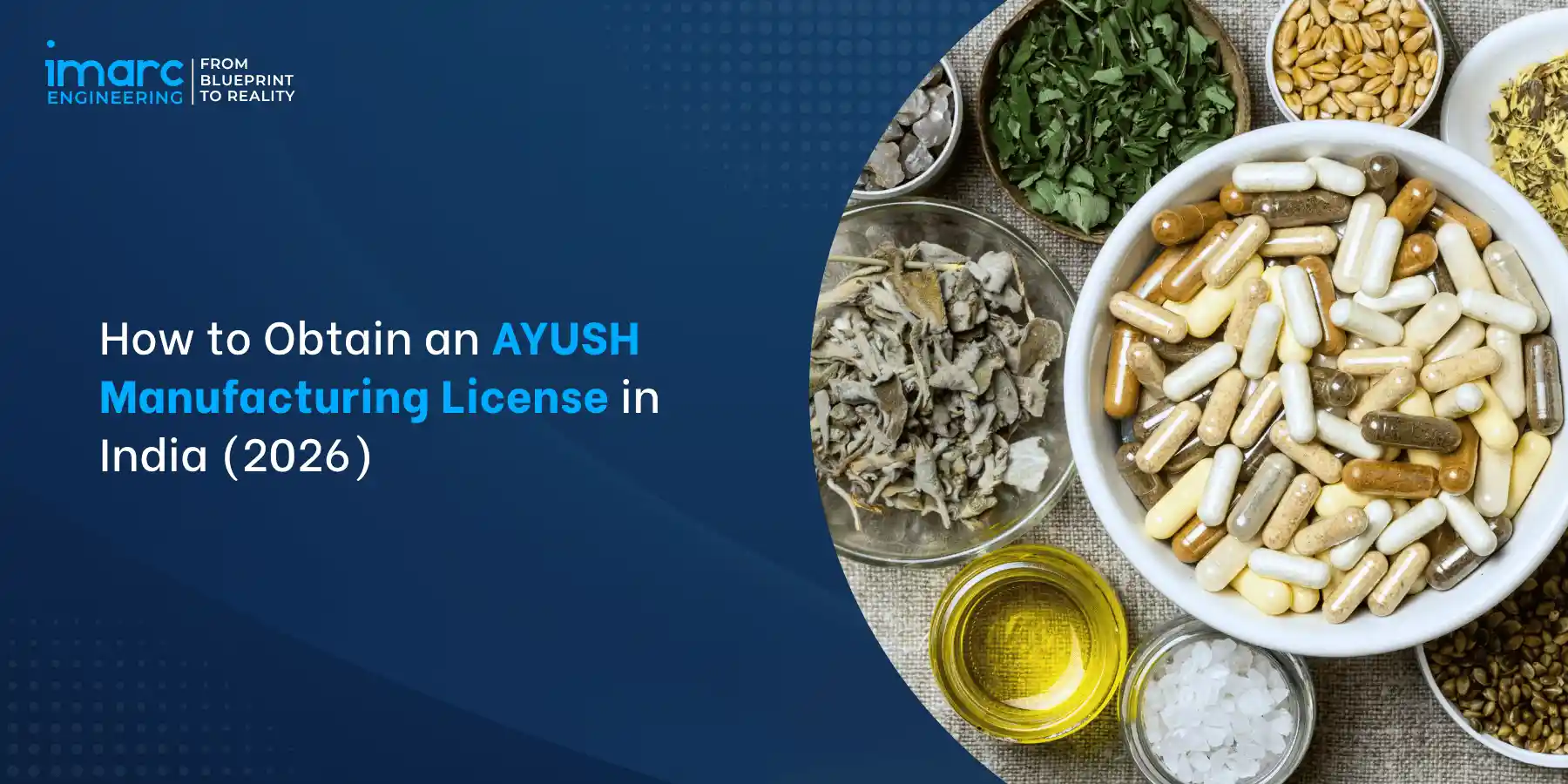
How to Obtain an AYUSH Manufacturing License in India (2026)
Introduction
For any promoter planning to establish an Ayurvedic, Unani, Siddha, or Homoeopathic products manufacturing facility in India in 2026, an AYUSH manufacturing license in India is the regulatory foundation for lawful commercial production. But obtaining the license is only one component of setting up a compliant facility.
Manufacturers must equally evaluate plant layout, utility planning, Schedule T GMP compliance, technical infrastructure, documentation systems, environmental approvals, and parallel regulatory licenses before commercial production can begin.
Scope of this Guide
This guide answers the promoter's compliance question directly. What regulatory approvals, GMP requirements, facility standards, and licensing steps must be completed to obtain an AYUSH manufacturing license and operate a compliant facility? It walks through the sector context, license framework, step-by-step application pathway, Schedule T GMP compliance discipline, facility setup requirements, cost and timeline benchmarks, and the practices that separate smooth licensing from delayed applications and rejected inspections.
Table of Contents
- Introduction
- Why AYUSH Manufacturing in India Matters in 2026
- Understanding the AYUSH Manufacturing License Framework
- How to Obtain AYUSH Manufacturing License in India
- AYUSH Manufacturing License Application Process in India
- Schedule T GMP Compliance for Ayurvedic Manufacturers
- AYUSH Facility Setup and Layout Requirements in India
- AYUSH Manufacturing License Cost and Timeline in India
- Common Mistakes and Best Practices
- Conclusion
1. Why AYUSH Manufacturing in India Matters in 2026
Four structural drivers make AYUSH manufacturing an attractive investment opportunity for Indian and international sponsors in 2026.
1.1 Sector Growth and Structural Demand
The AYUSH sector in India covers Ayurveda, Yoga and Naturopathy, Unani, Siddha, Homoeopathy, and Sowa-Rigpa systems. Domestic demand across health supplements, wellness products, personal care, cosmeceuticals, and classical formulations has progressively expanded.
Rising consumer awareness of natural and traditional healthcare products, increasing wellness spending among Indian households, and growing acceptance of AYUSH systems in urban Tier 1 and Tier 2 markets collectively support sustained demand growth.
1.2 Government Support and Policy Framework
The Ministry of AYUSH established as a separate ministry in 2014 provides dedicated policy support. National AYUSH Mission (NAM) supports state-level infrastructure development, quality control, and market development.
National Medicinal Plants Board (NMPB) supports raw material development. AYUSH Export Promotion Council and dedicated schemes support export growth. Government procurement for public health programmes creates institutional demand. Policy support materially reduces investment risk for structured entrants.
1.3 Export Opportunity
AYUSH product exports have progressively grown across herbal supplements, Ayurvedic cosmetics, essential oils, and classical formulations. Export markets include the United States, European Union, ASEAN, Middle East, Africa, and Latin America.
Emerging bilateral cooperation agreements support AYUSH product acceptance. Export-focused manufacturing facilities positioned with proper certification (GMP, ISO, buyer-country regulatory registration) access premium market positioning.
1.4 Regulatory Framework Stability
The regulatory framework governing AYUSH manufacturing operates under the Drugs and Cosmetics Act 1940 and Drugs and Cosmetics Rules 1945 with Chapter IVA governing Ayurvedic, Siddha, and Unani (ASU) drugs.
Schedule T of the D&C Rules specifies Good Manufacturing Practice requirements. State Licensing Authorities issue manufacturing licenses. The framework has matured over decades providing regulatory predictability that supports long-term investment planning.
2. Understanding the AYUSH Manufacturing License Framework
The AYUSH license for manufacturers operates under a structured framework combining Central legislation, State-level administration, and product-category-specific requirements. Understanding the framework helps promoters map the right pathway for their product portfolio.
2.1 The Legal Foundation
The Drugs and Cosmetics Act 1940 and Drugs and Cosmetics Rules 1945 provide the parent legislation. Chapter IVA of the Act (added in 1964) covers Ayurvedic, Siddha, and Unani drugs. Homoeopathic drugs are covered under separate rules within the D&C framework. Schedule T of the Rules specifies Good Manufacturing Practice requirements.
Rules 157, 158, and associated provisions govern licensing procedures. State Licensing Authorities under respective State AYUSH Directorates administer the framework at ground level.
2.2 License Categories
| License Type | Typical Use |
|---|---|
| Manufacturing License | Full manufacturing at own facility |
| Loan License | Using another licensed facility |
| Repacking License | Repacking approved products |
| Contract Manufacturing | Dedicated third-party arrangement |
| Homoeopathic Manufacturing | Homoeopathic products |
2.3 AYUSH Product Categories and License Classes in India
AYUSH product categories and license classes cover several distinct product types. Classical formulations follow authoritative Ayurvedic, Unani, Siddha, or Homoeopathic pharmacopoeial texts and typically fall under an Ayurvedic manufacturing license where Ayurvedic products are involved. Patent and proprietary medicines are manufacturer-developed formulations conforming to AYUSH principles.
Herbal cosmetics with medicinal claims fall under AYUSH; those without medicinal claims fall under standard cosmetics regulation. AYUSH nutraceuticals and health supplements require additional FSSAI registration. Each category has specific documentation, testing, and label declaration requirements.
2.4 The Applicable Pharmacopoeias
AYUSH manufacturing operates against structured pharmacopoeia references. The Ayurvedic Pharmacopoeia of India (API) published by the Pharmacopoeia Commission for Indian Medicine and Homoeopathy (PCIM&H) covers Ayurvedic drugs across multiple volumes.
The Unani Pharmacopoeia of India (UPI), Siddha Pharmacopoeia of India (SPI), and Homoeopathic Pharmacopoeia of India (HPI) cover respective systems. Manufacturers must maintain the applicable pharmacopoeia editions and conform testing methodologies accordingly. Non-pharmacopoeial products require in-house standards approved by the licensing authority.
3. How to Obtain AYUSH Manufacturing License in India
Understanding how to obtain AYUSH manufacturing license in India helps promoters sequence decisions correctly. Licensing is not a standalone form-filling exercise. It sits within a structured project that combines facility development, GMP-compliant infrastructure, personnel qualification, documentation, and parallel regulatory approvals.
3.1 The Six-Stage License Roadmap
| Stage | Activities | Typical Duration |
|---|---|---|
| 1. Feasibility and Planning | Product portfolio, category, framework choice | 1-2 months |
| 2. Facility Development | Land, layout, construction, equipment installation | 6-12 months |
| 3. Documentation Preparation | Master formulas, SOPs, testing protocols | 2-3 months |
| 4. Application Filing | Form 24-D submission with annexures | 2-4 weeks |
| 5. Inspection and Approval | Site inspection, deficiency closure, license grant | 3-6 months |
| 6. Commercial Operations | Post-license operations, renewal cycles | Ongoing |
3.2 Pre-Application Groundwork
Effective pre-application groundwork significantly reduces total licensing timeline. Product portfolio definition covers categories (classical vs proprietary, dosage forms, therapeutic segments) and target market positioning.
Framework choice between own manufacturing, loan license, or contract manufacturing shapes facility investment requirements. State selection affects specific procedural requirements though the overall framework operates nationally. Structured pre-application groundwork prevents mid-process reworks that extend timelines by 3-6 months.
3.3 Parallel Approvals
AYUSH licensing operates alongside several parallel regulatory approvals that must be sequenced correctly. State Pollution Control Board Consent to Establish is prerequisite for construction. Central Ground Water Authority approval covers groundwater withdrawal. Factory Licence under the OSH Code 2020 covers workplace compliance. Fire NOC covers safety.
Trade licence from local municipality supports commercial operation. FSSAI registration is required if any product falls under nutraceuticals or food supplements. Structured parallel initiation prevents sequential-approval delays.
3.4 Personnel Qualification Requirements
AYUSH manufacturing requires qualified technical personnel. Ayurvedic manufacturing typically requires a technical staff member with Bachelor of Ayurvedic Medicine and Surgery (BAMS), Ayurvedacharya, or equivalent qualification with typically 2-5 years-experience.
Similar qualifications apply for Unani (Bachelor of Unani Medicine and Surgery or equivalent), Siddha, and Homoeopathic (Bachelor of Homoeopathic Medicine and Surgery or equivalent). Quality Control operations require a chemist with appropriate qualifications. Personnel qualification must be demonstrated at application stage.
4. AYUSH Manufacturing License Application Process in India
The AYUSH manufacturing license application process combines documentation preparation, application filing, inspection, and license grant. Structured AYUSH license application process management reduces total licensing time from 9-12 months (typical for unstructured applications) to 5-7 months (achievable with structured discipline).
4.1 Form 24-D and Required Annexures
Form 24-D is the primary application for manufacturing license under Chapter IVA. Required annexures include site plan, layout drawing showing segregation of areas, list of products applied for with authoritative text references or protocols, technical personnel qualifications and experience certificates, list of machinery and equipment with capacity specifications, water source and quality analysis, waste disposal arrangement, source of raw materials, master formula records for each product, and specimen labels. Applications with incomplete annexures face processing delays or rejection.
4.2 State Licensing Authority Interface
State licensing authority AYUSH approval process varies in procedural detail across states though the substantive framework is uniform. Most states have transitioned to online application portals reducing processing time. Payment of prescribed fees, submission of Form 24-D, submission of scanned annexures, and payment of inspection fees typically initiate the process. State AYUSH Directorate scrutinises documentation and schedules site inspection. Structured relationship with State Licensing Authority through professional engagement typically supports smoother processing.
4.3 Site Inspection
Site inspection is the most consequential stage of the application process. The Licensing Authority inspector or Drug Inspector evaluates the facility against Schedule T GMP requirements. Common inspection areas include factory premises and layout compliance, water supply and quality, machinery and equipment adequacy, personnel qualifications and health checks, documentation systems, quality control facility, raw material storage, in-process controls, finished goods storage, and waste disposal. Deficiencies identified during inspection typically require closure with follow-up verification.
4.4 License Grant and Product Approvals
License grant occurs after satisfactory inspection and deficiency closure. Manufacturing license certificate forms specify approved products, manufacturing categories, and validity period (typically 5 years). Additional products can be added post-license through supplementary applications with product-specific technical review.
Classical formulations from authoritative texts follow simpler approval; proprietary formulations require stability data, safety assessment, and additional documentation. Structured product portfolio planning at license application stage prevents multiple subsequent applications.
5. Schedule T GMP Compliance for Ayurvedic Manufacturers
Schedule T GMP compliance for Ayurvedic manufacturers is the operational discipline that supports license grant, inspection satisfaction, and product quality. Structured Schedule T GMP compliance must be built into facility design rather than retrofitted after commissioning.
5.1 The Schedule T Framework
Schedule T of the Drugs and Cosmetics Rules 1945 specifies Good Manufacturing Practice requirements for Ayurvedic, Siddha, and Unani drug manufacturing. The Schedule covers factory premises, water supply, waste disposal, sanitation of workers, machinery and equipment, batch manufacturing records, distribution records, recall procedures, documentation systems, and quality control. Compliance is not optional, it is prerequisite for license grant and continued authorisation. Non-compliance during inspection triggers license suspension or cancellation.
5.2 GMP Certification for AYUSH Manufacturers
GMP certification for AYUSH manufacturers covers both mandatory Schedule T compliance and voluntary certifications supporting market credibility. Mandatory GMP compliance under Schedule T is prerequisite for the manufacturing license itself.
Voluntary GMP certifications from independent bodies including ISO 9001:2015, WHO-GMP for export-oriented facilities, and buyer-specific GMP audits (particularly for cosmetic and export markets) supplement the statutory framework. Structured layered compliance supports both domestic license and export market access.
5.3 Key Schedule T Requirements
- Factory premises with adequate segregation of raw material, manufacturing, packing, quality control, and finished goods areas
- Water supply meeting Bureau of Indian Standards potable water specifications with periodic testing
- Machinery and equipment appropriate for the dosage forms manufactured
- Personnel with qualified technical staff and quality control chemist
- Batch manufacturing records with structured documentation for each production batch
- Distribution records enabling product traceability
- Recall procedures with structured triggering, communication, and reconciliation
- Documentation systems covering master formulas, SOPs, testing protocols, and stability data
- Quality control laboratory equipped for pharmacopoeial testing
- Waste disposal arrangements meeting environmental compliance
5.4 AYUSH GMP Audit and Inspection Preparation
AYUSH GMP audit and inspection preparation covers routine inspection readiness rather than reactive last-minute compliance. Best-in-class facilities operate as if inspection could happen any day — documentation current, SOPs followed, batch records complete, testing protocols documented, personnel trained.
Structured internal audit programmes at defined intervals (monthly for critical items, quarterly for full GMP review) surface issues before external inspection. Mock inspections by external consultants further prepare organisations for regulatory reviews.
6. AYUSH Facility Setup and Layout Requirements in India
AYUSH facility setup and layout requirements combine Schedule T mandates with dosage-form-specific engineering. Understanding AYUSH manufacturing facility requirements helps sponsors design facilities that satisfy inspection while supporting operational efficiency.
6.1 Minimum Space and Segregation
Minimum facility area typically ranges 1,200-2,000 square feet for a small-to-medium AYUSH manufacturing unit though state-specific requirements and dosage forms may require larger area. Segregation is fundamental — raw material store, sampling area, dispensing area, manufacturing area (separate for different dosage forms), packing area, quarantine area, finished goods store, quality control laboratory, and utility areas must be physically or functionally separated.
Cross-contamination prevention through dedicated equipment or validated cleaning between products is expected. Structured facility layout supports both compliance and operational flow.
6.2 Dosage-Form-Specific Manufacturing Areas
Different dosage forms have specific manufacturing area requirements. Kwatha Churna (herbal powders) requires grinding, sieving, and blending equipment with dust extraction. Asava and Arishta (fermented preparations) require fermentation vessels with temperature and time control. Bhasma and Rasa preparations (mineral formulations) require dedicated calcination and processing areas away from other dosage forms.
Vati and Gutika (tablets) require compression machinery with granulation upstream. Ghrita and Taila (oil-based) require oil processing equipment. Avaleha (semi-solid) requires cooking vessels. Segregating these dosage forms and using appropriate equipment is essential for GMP compliance and product quality.
6.3 Water Supply and Utility Infrastructure
Water quality is central to AYUSH product quality. Water supply for pharmaceutical use must meet Bureau of Indian Standards potable water specifications (IS 10500) with periodic testing. Manufacturing water systems typically include softening, filtration, and where required for specific products, demineralisation or reverse osmosis.
Air handling with adequate ventilation prevents cross-contamination. Compressed air where used must be oil-free for direct product contact. Steam for sterilisation must meet appropriate quality. Electricity supply with backup power protects continuous operations.
6.4 Herbal Products Manufacturing Facility Setup
Herbal products manufacturing facility setup also covers herbal product manufacturing license in India for products at the intersection of AYUSH and cosmetics. Facilities producing both AYUSH products and herbal cosmetics require careful category segregation with separate licensing where applicable. Cosmetic manufacturing under the D&C Act requires separate license framework distinct from AYUSH Chapter IVA licensing. Structured facility planning at design stage prevents post-commissioning license category confusion.
7. AYUSH Manufacturing License Cost and Timeline in India
AYUSH manufacturing license cost and timeline vary by facility scale, product portfolio, and state-specific processes. Understanding the cost structure supports informed investment planning.
7.1 License Fees and Timeline
| Element | Typical Cost / Duration | Notes |
|---|---|---|
| License Application Fee | INR 5,000 - 25,000 | State-specific |
| Inspection Fees | INR 2,000 - 10,000 | May apply separately |
| Application Processing | 3-6 months | Post-facility readiness |
| License Validity | 5 years | Renewable |
| Renewal Application | 3 months before expiry | Continuous compliance required |
| Product Addition (post-license) | Case-by-case | Supplementary applications |
7.2 Facility Investment Ranges
| Facility Scale | Typical Investment Range | Suitable For |
|---|---|---|
| Small unit | INR 20-50 lakh | Startups, 5-15 products |
| Medium unit | INR 50 lakh - 5 crore | Growing brands, wider portfolio |
| Large integrated unit | INR 5-50 crore | Established brands, export focus |
| Contract manufacturing (loan license) | From INR 10 lakh | Brand owners without own facility |
7.3 Investment Cost Components
- Land and civil works: 25-40 percent of total
- Machinery and equipment: 30-45 percent
- Utilities (water, HVAC, electrical, steam): 10-15 percent
- Documentation and license preparation: 3-8 percent
- Working capital (raw materials, packaging): 8-15 percent
- Contingency and pre-operating expenses: 5-10 percent
7.4 AYUSH License Requirements Summary
Understanding the full spectrum of AYUSH license requirements helps sponsors budget realistically. Direct costs include license fees, inspection fees, and product testing. Facility investment includes land, construction, equipment, utilities, and documentation. Personnel costs include qualified technical staff and quality control chemist. Ongoing costs include renewal fees, external testing, GMP audit fees, and continuous compliance maintenance. Structured budgeting at planning stage prevents mid-project cost surprises.
8. Common Mistakes and Best Practices
8.1 Applying Before Facility Readiness
Applications filed before facility is ready for inspection produce delays and rework.
Best practice: complete facility construction, equipment installation, and documentation system setup before filing application; mock inspection by external consultant to identify gaps; submit application only when confident of inspection readiness.
8.2 Underestimating Documentation
Documentation is often under-scoped by first-time applicants.
Best practice: master formula records for every product; SOPs covering every operational activity; batch manufacturing records template ready before license grant; testing protocols aligned with applicable pharmacopoeia; personnel qualification and training records; equipment calibration records — all in place before application.
8.3 Weak Personnel Planning
Qualified technical personnel and quality control chemist are non-negotiable Schedule T requirements.
Best practice: identify and appoint qualified personnel during facility construction; document their qualifications, experience, and health status; ensure appointments are formalised before inspection; structured succession planning for continuity.
8.4 Neglecting Parallel Approvals
SPCB, CGWA, Factory Licence, Fire NOC, and FSSAI (for nutraceuticals) delays often become the actual critical path even after AYUSH license grants.
Best practice: parallel initiation of all applicable approvals; dedicated approvals coordinator; structured tracking against milestone dates; escalation protocols for delays.
8.5 Overlooking Renewal and Compliance Continuity
License validity is typically 5 years. Renewal requires continuous compliance rather than fresh submission.
Best practice: annual internal GMP audits; structured deviation and CAPA management; documentation currency maintenance; renewal application 3 months before expiry; refresher training for personnel; ongoing compliance culture.
Conclusion
Obtaining an AYUSH Manufacturing License in India in 2026 is a structured project combining Chapter IVA licensing under the Drugs and Cosmetics Act 1940, Schedule T GMP compliance, facility development, personnel qualification, documentation systems, and parallel regulatory approvals. Sector growth driven by structural demand, government policy support, export opportunity, and framework stability makes AYUSH manufacturing an attractive investment.
Three closing reminders for AYUSH manufacturing sponsors. First, treat licensing as a project rather than a form-filling exercise. Facility development, GMP infrastructure, documentation systems, and personnel qualification must all be in place before application filing. Attempts to compress or skip these stages produce inspection rejections and cumulative delays.
Second, understand the framework applicable to your product portfolio. Classical formulations, patent and proprietary medicines, cosmetics with herbal ingredients, and nutraceuticals each have distinct pathways. Portfolio-specific planning at concept stage prevents post-license category confusion.
Third, sequence parallel approvals in parallel with AYUSH licensing. SPCB, CGWA, Factory Licence, Fire NOC, and FSSAI (where applicable) form the actual critical path in many projects. Structured coordination prevents non-AYUSH approvals from becoming the licensing constraint.
PLANNING YOUR AYUSH MANUFACTURING FACILITY?
IMARC Engineering's AYUSH licensing and facility setup advisory team supports promoters, investors, and manufacturing entrepreneurs across product portfolio definition, framework choice (own manufacturing vs loan license vs contract), facility design with Schedule T GMP compliance, dosage-form-specific manufacturing area planning, documentation system development, personnel identification and qualification, application preparation, State Licensing Authority engagement, inspection readiness, parallel regulatory approvals coordination, and post-license compliance sustaining for Ayurvedic, Unani, Siddha, Homoeopathic, and integrated AYUSH product manufacturing.
→ Schedule a free AYUSH manufacturing licensing scoping consultation with an IMARC specialist
Frequently Asked Questions
An AYUSH manufacturing license in India is the statutory authorisation to manufacture Ayurvedic, Unani, Siddha, or Homoeopathic drugs and formulations under the Drugs and Cosmetics Act 1940 with Chapter IVA provisions. Any entity intending to commercially manufacture AYUSH products, whether classical formulations, patent and proprietary medicines, or products for third-party contract manufacturing, requires the license from the State Licensing Authority.
Well-prepared applications with facility readiness, complete documentation, and qualified personnel typically achieve license grant within 3-6 months of filing. Poorly prepared applications with facility gaps or documentation deficiencies extend timelines to 9-18 months due to inspection rejections and deficiency closures. Total timeline from concept to license typically runs 12-18 months including facility construction.
Schedule T of the Drugs and Cosmetics Rules 1945 specify Good Manufacturing Practice requirements for Ayurvedic, Siddha, and Unani drug manufacturing. Schedule T covers factory premises, water supply, machinery, personnel, batch records, distribution, recall, documentation, and quality control. Schedule T GMP compliance is prerequisite for license grant and continued authorisation.
Own manufacturing license authorises manufacture at the applicant's own facility. Loan license authorises the applicant to manufacture products at another licensed facility. Loan license suits brand owners who do not want to build their own facility. Contract manufacturing arrangements typically operate under either framework depending on structure.
Ayurvedic manufacturing typically requires technical staff with Bachelor of Ayurvedic Medicine and Surgery (BAMS), Ayurvedacharya, or equivalent Ayurveda qualification. Similar qualifications from recognised institutions apply for Unani (BUMS), Siddha, and Homoeopathic (BHMS). Quality Control operations require a chemist with appropriate qualification. Personnel qualification is central to AYUSH license requirements and must be documented at application stage.
Facility investment varies by scale. Small units suit INR 20-50 lakh investment for startups with limited product portfolios. Medium units at INR 50 lakh - 5 crore support growing brands. Large integrated units at INR 5-50 crore support established brands with export focus. Loan license operations without own facility can start from INR 10 lakh. Ongoing operating costs and working capital are additional.
No. Ayurvedic, Unani, and Siddha (ASU) drugs are governed under Chapter IVA of the D&C Act with Schedule T GMP. Homoeopathic drugs are governed under separate rules within the same D&C Act framework. State Licensing Authorities administer both but with product-specific licensing categories. Manufacturers producing across systems require appropriate licenses for each.
Nutraceuticals and health supplements are governed under Food Safety and Standards Authority of India (FSSAI) regulations under Food Safety and Standards Act 2006 rather than AYUSH licensing. Products claiming health benefits at the AYUSH-nutraceutical boundary require careful category determination. Some products may require both FSSAI registration and AYUSH license depending on claims, formulation, and marketing positioning.
AYUSH GMP audit and inspection preparation requires readiness across facility, documentation, personnel, and operations. Best practices include mock inspections by external consultants before regulatory inspection, complete master formula records and SOPs, current batch manufacturing records, personnel training records, equipment calibration records, quality control test reports, and evidence of ongoing GMP culture rather than last-minute compliance.
Recent Post


Trusted by Industry Leaders
We partner with global enterprises and ambitious businesses across sectors to deliver operational excellence, strategic insights, and sustainable growth through integrated solutions.









Success in Their Words
Real feedback from clients across industries. Discover how our solutions delivered measurable impact and operational excellence.

I wanted to express my sincere appreciation for your efforts in handling this matter. Your dedication and commitment have been truly commendable, and it is evident that you have put in tremendous hard work and expertise into resolving the issues at hand. We are greatly interested in continuing our collaboration with you in the future, as your professionalism and reliability have made you a trusted partner. Thank you once again for your invaluable contribution. We look forward to strengthening our partnership ahead.

It has been a pleasure working with the IMARC team. The insights provided were structured, clear, and highly valuable, helping us strengthen both our technical and financial planning with confidence. We deeply appreciate the team’s professionalism, responsiveness, and attention to detail throughout the engagement. Every requirement was well understood and effectively incorporated, resulting in a comprehensive and actionable output. Overall, our experience has been excellent, and I would gladly recommend IMARC to organizations seeking a reliable research partner.

Your service is truly exceptional. Working with the IMARC team has been a seamless and professional experience. The clarity of communication, responsiveness to queries, and consistent support at every stage made the entire engagement highly efficient. The insights shared were well-structured, practical, and perfectly aligned with our requirements, helping us make informed decisions with confidence. Overall, the dedication and professionalism demonstrated by your team stand out, and I would be glad to recommend IMARC as a reliable and trustworthy research partner.

IMARC did an outstanding job in preparing our study. They were punctual, precise, and consistently responsive throughout the entire process. The team delivered all the data we required in a clear, well-organized, and highly professional format. Their strong attention to detail, combined with their ability to meet every deadline without compromising quality, truly set them apart. Overall, their reliability and commitment made them an exceptional partner for our project, and we would gladly work with them again in the future.

IMARC made the whole process incredibly easy from start to finish. Everyone I interacted with via email was polite, professional, and straightforward to deal with, always keeping their promises regarding delivery timelines and remaining consistently solutions-focused. From my very first contact, I appreciated the professionalism and support shown by the entire IMARC team. I highly recommend IMARC to anyone seeking timely, affordable, and reliable information or advice. My experience with IMARC was excellent, and I truly cannot fault any aspect of it.

I’d like to express my sincere gratitude for the excellent work you accomplished with the study. Your ability to quickly understand our requirements and deliver high-quality results under tight timelines truly reflects your expertise, exceptional work ethic, and unwavering commitment to your customer’s success. The professionalism and responsiveness you demonstrated throughout the process made a significant difference. Our entire team and company are incredibly thankful for your dedication, reliability, and support. Once again, thank you for your outstanding contribution.