Manufacturing
June 10 2026
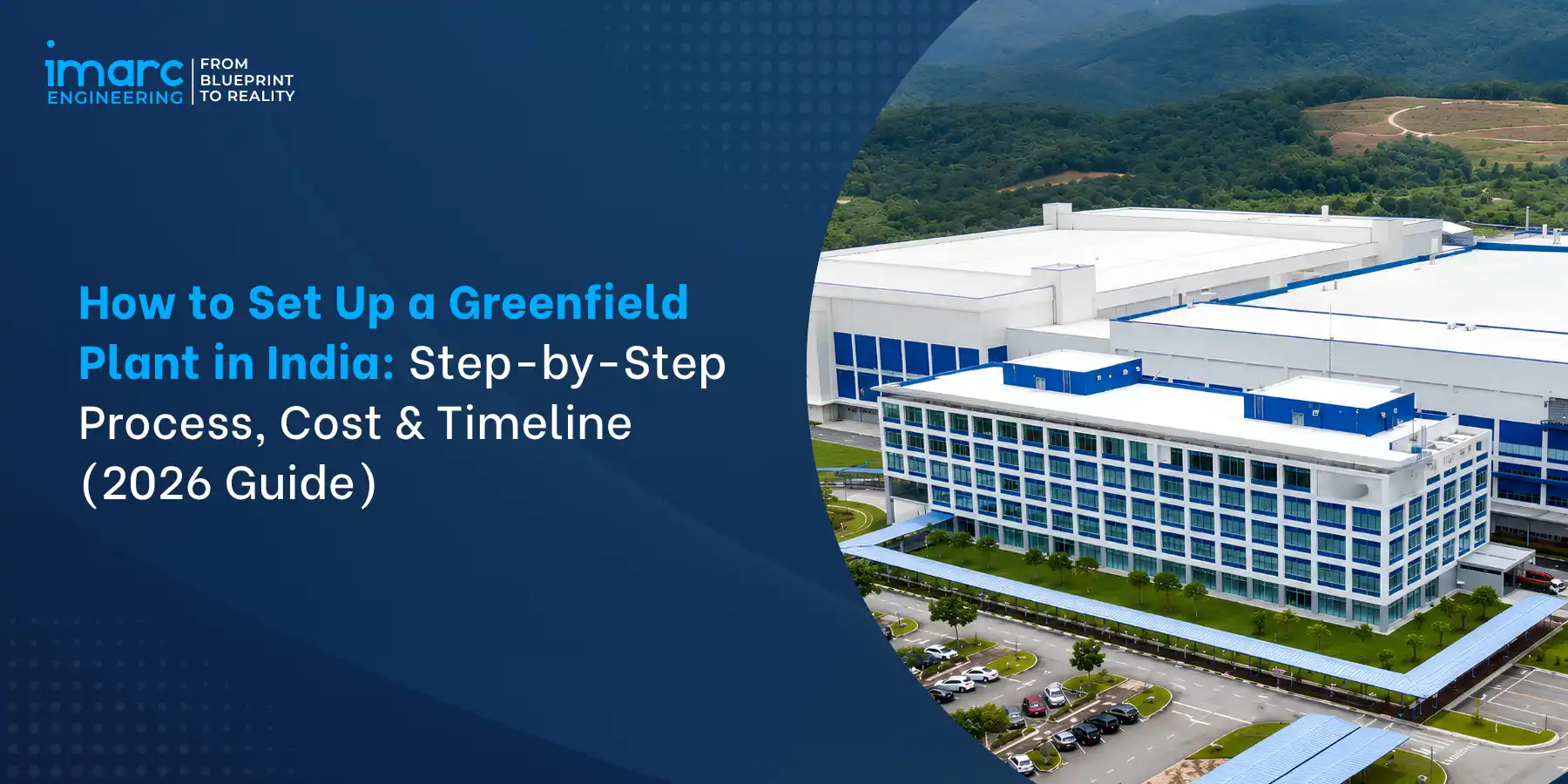
How to Set Up a Greenfield Plant in India: Step-by-Step Process, Cost & Timeline (2026 Guide)
Introduction
For Indian and international manufacturers planning to expand industrial capacity in 2026, greenfield plant setup in India has emerged as one of the most strategically consequential capital decisions of the decade. A combination of structural factors has created the strongest environment for setting up a greenfield plant in India since economic liberalisation. Key drivers include the INR 1.97 lakh crore PLI programme, over INR 2.16 lakh crore of committed investments, the National Industrial Corridor Development Programme (NICDP), sustained manufacturing FDI exceeding USD 165 billion over the past decade, and the ongoing China-Plus-One supply-chain shift.
Manufacturing GVA growth above 7% in FY 2025-26 and the national goal of increasing manufacturing's share of GDP from around 17% to 25% further strengthen the opportunity. Companies that execute a greenfield project in India effectively can capture incentives, secure customer mandates, and scale rapidly, while execution failures can result in lasting competitive disadvantages.
Yet a greenfield project in India remains a uniquely complex undertaking. A single INR 500 crore to INR 5,000 crore greenfield project typically spans 30+ statutory clearances across central, state, sectoral, and municipal authorities; engages 50-150+ engineering, construction, and equipment vendors; involves capital deployment from sponsor equity, commercial lenders, NaBFID, multilateral financiers, and, where applicable, PLI / NICDP / state-level incentive programmes; and runs across 24-48 months from project FID to commercial operations for typical mid-to-large manufacturing facilities.
Each of these dimensions has its own discipline, its own risk profile, and its own contribution to the integrated outcome. Strong execution requires not the brilliance of any one workstream but the coherent integration of all of them under structured programme governance, which is what an effective manufacturing plant setup in India framework delivers.
The institutional support architecture is materially stronger than even five years ago. The National Single Window System (NSWS), launched in September 2021, integrates approvals across 32 ministries and 29 states / UTs into a unified online portal. The PM Gati Shakti National Master Plan (October 2021) brings 44 ministries onto a common integrated planning platform.
NICDC has approved 20 major NICDP projects across 13 states, with 430 industrial plots covering 4,552 acres allotted across four operational greenfield industrial nodes, Dholera (Gujarat), AURIC (Maharashtra), Greater Noida (Uttar Pradesh), and Vikram Udyogpuri (Madhya Pradesh), which together attracted over USD 20.6 billion in investment and generated approximately 100,000 jobs in their first phase.
The Prime Minister laid foundation stones for the Krishnapatnam Industrial Area (January 2025) and Karnataka's Kopparthy and Orvakal Industrial Areas (October 2025), continuing the pipeline of plug-and-play industrial infrastructure. For manufacturers planning new capacity, the question is increasingly not whether to locate in India but where in India, how to structure the project, and how to execute through the 24-48 month cycle without losing time or capital.
Scope of This Guide
Drawing on IMARC Engineering's experience supporting greenfield plant feasibility studies, EPCM project management, equipment selection, statutory clearance coordination, and integrated programme governance for Indian and international manufacturers across pharmaceuticals, EV battery, electronics, specialty chemicals, food processing, automotive, and engineering goods sectors, this guide lays out a structured, step-by-step approach to the factory setup process in India in 2026.
You will find a clear view on why greenfield setup has become strategic; the seven-phase lifecycle; site selection and industrial-corridor strategy; design engineering and EPCM; statutory clearance sequencing; construction and commissioning; cost drivers and indicative capex breakdown; common pitfalls; an integrated checklist; and a frequently-asked-questions section. The objective is to make industrial project execution in India practical and predictable for project sponsors, EPCM teams, lenders, and operational leaders.
Table of Contents
- Introduction
- Why Greenfield Plant Setup Has Become Strategic in 2026
- The Seven-Phase Greenfield Setup Lifecycle
- Site Selection, Land Acquisition, and Industrial Corridor Strategy
- Design Engineering and EPCM Strategy
- Statutory Clearances and Regulatory Sequencing
- Construction, Equipment Installation, and Commissioning
- Cost Drivers and Indicative Capex Breakdown
- Common Mistakes and How to Avoid Them
- Greenfield Plant Setup Checklist
- Conclusion
1. Why Greenfield Plant Setup Has Become Strategic in 2026
Understanding why new factory setup in India has become a board-level capital allocation priority starts with five structural drivers that have raised the strategic stakes materially over the past 3-5 years.
1.1 PLI Has Created the Largest Manufacturing-Incentive Window in Indian History
The Production Linked Incentive (PLI) framework, with INR 1.97 lakh crore outlay across 14 strategic sectors (mobile and electronics, pharmaceuticals, medical devices, automobiles and auto components, advanced chemistry cells, telecom and networking, food processing, white goods, textiles, specialty steel, drone, IT hardware, solar PV modules, and high-efficiency solar manufacturing), has by early 2026 already attracted over INR 2.16 lakh crore of committed investment and produced over INR 20 lakh crore of cumulative output.
The scheme rewards committed capacity additions on phased disbursement against investment, capacity, and sales milestones - making the greenfield project the natural vehicle for capturing PLI economics. Companies that integrate greenfield planning with PLI eligibility design from Day 1 capture the disbursement; companies that build first and seek PLI alignment later routinely miss the windows. The PLI architecture has made the greenfield decision a strategic, scheme-aligned decision rather than a routine operational expansion.
1.2 Industrial Corridor and Smart City Infrastructure Has Matured
The NICDP architecture has shifted greenfield economics materially. Four operational greenfield smart cities (Dholera, AURIC, Greater Noida, Vikram Udyogpuri) - spanning approximately 3,124 hectares - have already attracted over USD 20.6 billion in investment with plug-and-play infrastructure, single-window clearances, multimodal connectivity, and 'walk to work' planning.
With 12 additional greenfield industrial smart city projects approved by Government in 2024 - covering 10 states and 6 major corridors - the institutional infrastructure for greenfield site selection has expanded substantially. Locating in an operational NICDP node materially de-risks the early-phase greenfield setup; locating outside one shifts more execution risk onto the sponsor. Either choice can work but the trade-offs are explicit, and the framework for evaluating them is now well-established.
1.3 The National Single Window System Has Compressed Approval Friction
The National Single Window System (NSWS), launched in September 2021, integrates approvals across 32 ministries and 29 states / UTs into a unified online portal - reducing the historical friction of multi-agency, multi-state regulatory navigation that previously consumed 12-24 months of greenfield project schedule. While NSWS does not eliminate the underlying statutory clearances, it materially reduces transaction cost and improves visibility into the approval pipeline.
PM Gati Shakti National Master Plan layered on top of NSWS provides integrated infrastructure planning across 44 ministries. The combined effect: a well-prepared greenfield project can navigate the central, state, and sectoral approval architecture faster than at any prior point in Indian manufacturing history.
1.4 Foreign Direct Investment Inflows Validate the Investment Case
Cumulative manufacturing FDI inflows into India have crossed USD 165 billion over the past decade per DPIIT data, with manufacturing consistently among the top three sectors for FDI equity inflows. The Index of Industrial Production grew by 3% during April-September 2025-26; manufacturing Gross Value Added grew over 7% during FY 2025-26.
The Reserve Bank of India and Government data point to continued FDI strength into 2026. The sustained inflow validates that international manufacturers are voting with capital - which in turn signals to domestic sponsors that the competitive bar has risen, and that capacity expansion through greenfield setup is no longer optional for many sectors but a competitive necessity.
1.5 The Cost of Delay Has Become Strategic
Beyond the direct economics of any single project, the strategic cost of late greenfield delivery has risen sharply. PLI scheme windows are finite; customer mandates from global OEM principals are time-bound; partners-of-choice in international supply chains commit to capacity sequences that move past tardy entrants. A greenfield project delayed by 18 months may miss an entire PLI milestone window, loses customer-mandate priority, and pays the opportunity cost of foregone capacity utilisation in a high-demand market.
Conversely, a greenfield project delivered to schedule and quality captures the PLI disbursement, the customer commitments, and the early-mover advantage in a sector that may not see comparable opportunity again for a decade. The asymmetric value of on-time delivery has made greenfield execution discipline a board-level priority.
2. The Seven-Phase Greenfield Setup Lifecycle
A structured greenfield setup unfolds across seven distinct phases, each with defined deliverables, owners, and acceptance criteria. The framework below — the practical step by step greenfield plant setup process in India that disciplined sponsors and EPCM teams apply — works across sectors (pharma, EV battery, electronics, chemicals, food, automotive, engineering goods) and across scales (from INR 100 crore mid-size facilities to INR 5,000+ crore mega-projects).
| Phase | Activity | Typical Duration |
|---|---|---|
| 1. Strategy and Pre-Feasibility | Investment thesis, scoping, indicative siting, pre-FID approval | 3-6 months |
| 2. Feasibility, Site Selection & Land Acquisition | Multi-criteria site selection, DPR, land acquisition, FID | 4-9 months |
| 3. Design Engineering & EPCM Mobilisation | Basic and detailed engineering, EPCM contracting, equipment specs | 4-8 months |
| 4. Statutory Clearances | EC, factory licence, fire NOC, PCB, water, power, sectoral, building approvals | 9-18 months (overlapping with Phase 5) |
| 5. Construction & Equipment Procurement | Civil, structural, MEP, equipment manufacturing, delivery, erection | 12-24 months |
| 6. Commissioning & Validation | Pre-commissioning, commissioning, validation, regulatory inspections | 3-6 months |
| 7. Ramp-Up & Steady-State | Trial production, ramp-up to nameplate capacity, optimisation | 6-12 months |
2.1 Total Timeline and Critical Path
Total elapsed time from project FID to commercial operations typically runs 24-36 months for mid-size manufacturing facilities (INR 100-500 crore) in established industrial nodes, 30-48 months for larger INR 500-2,000 crore facilities, and 36-60+ months for mega-projects involving complex multi-process technology, large land parcels, or extensive regulatory complexity.
The timeline for greenfield project execution in India is most commonly dictated not by construction itself but by statutory clearances — environmental clearance under EIA Notification 2006 typically running 12-24 months for Category A projects; forest clearance (if applicable) typically 12-24 months; land acquisition (if private land involved) typically 18-36 months. Critical path management requires explicit mapping of these clearance pathways alongside the construction schedule.
2.2 Overlapping vs Sequential Execution
Mature greenfield programmes overlap phases aggressively to compress total timeline. Engineering design begins during feasibility; statutory clearance applications begin during engineering; long-lead equipment procurement begins during basic engineering; site works begin under conditional approvals where regulations permit. The risk of overlap is that early-phase changes (technology selection, capacity, site layout) cascade into changes in already-procured equipment or already-executed civil works - producing expensive rework.
The discipline that makes overlap work is mature change-control - rigorous design freezes at the end of each engineering stage, with formal change orders required for subsequent modifications. Projects that overlap activities without formal change-control mechanisms often experience schedule delays and cost overruns; projects with disciplined overlap deliver early.
2.3 Programme Governance Structure
Effective greenfield programmes operate under formal governance with three tiers. Tier 1 - Programme Steering Committee, typically chaired by a Board member or senior executive sponsor, meeting monthly to review strategic decisions, schedule, budget, and risks. Tier 2 - Project Management Office (PMO), typically led by a Programme Director with cross-functional reports (engineering, EPCM, regulatory, procurement, finance, HR, operations), meeting weekly to manage execution and resolve issues.
Tier 3 - Workstream teams (engineering, civil construction, MEP, equipment, regulatory, finance, HR, commissioning) meeting daily during high-tempo phases. The governance structure provides clear escalation pathways, named accountabilities, and the cadence needed to keep complex multi-vendor execution coherent.
3. Site Selection, Land Acquisition, and Industrial Corridor Strategy
Site selection is one of the most consequential single decisions in any greenfield project - shaping logistics economics, talent access, regulatory complexity, incentive eligibility, and lifetime operational cost. A disciplined site selection methodology evaluates 20-40 candidate locations across multiple criteria; produces a shortlist of 3-5 sites for detailed evaluation; recommends a preferred site after multi-criteria scoring with sensitivity testing on weights.
3.1 The Macro-Screening Criteria
Site selection for a greenfield plant setup in India typically begins with evaluating key factors such as market access, raw material availability, skilled labour, logistics connectivity, utility reliability, land cost and availability, state investment climate, and incentive support.
Additional considerations include environmental risks, proximity to industrial corridors, supplier ecosystems, regulatory complexity, and long-term operational stability. Weighting these criteria against project requirements helps create a quantitative shortlist and supports a more effective factory setup process in India.
3.2 The Industrial Corridor Choice
For most modern greenfield manufacturers, the choice between locating in an operational NICDP node versus a non-NICDP site is a foundational decision. NICDP nodes (Dholera, AURIC, Greater Noida, Vikram Udyogpuri operational; Krishnapatnam, Kopparthy, Orvakal in development pipeline) offer plug-and-play infrastructure (roads, water, power, sewage, common utilities), single-window clearances, integrated planning, and 'walk to work' urban design.
The 430 industrial plots already allotted across 4,552 acres of operational NICDP land demonstrate the scale of capacity available. The trade-off: NICDP nodes may charge premium land rates compared to non-NICDP industrial areas; certain sector-specific clusters (textile in Tirupur, gems and jewellery in Surat, leather in Kanpur) are outside NICDP and may offer ecosystem advantages that compensate. The right choice depends on sector, scale, and supply-chain integration requirements.
3.3 Major Industrial Corridors
| Industrial Corridor | States Covered | Anchor Nodes |
|---|---|---|
| Delhi-Mumbai Industrial Corridor (DMIC) | Delhi, Haryana, Rajasthan, MP, Gujarat, Maharashtra | Dholera (Gujarat); AURIC (Maharashtra); Greater Noida (UP); Vikram Udyogpuri (MP) |
| Chennai-Bengaluru Industrial Corridor (CBIC) | Tamil Nadu, Andhra Pradesh, Karnataka | Krishnapatnam (AP); Tumakuru (Karnataka) |
| Amritsar-Kolkata Industrial Corridor (AKIC) | Punjab, Haryana, UP, Bihar, Jharkhand, WB | Multiple nodes |
| Bengaluru-Mumbai Economic Corridor (BMEC) | Karnataka, Maharashtra | Multiple nodes |
| Vizag-Chennai Industrial Corridor (VCIC) | Andhra Pradesh, Tamil Nadu | Multiple nodes |
| Hyderabad-Bengaluru Industrial Corridor | Telangana, Andhra Pradesh, Karnataka | Kopparthy (AP); Orvakal (AP) |
3.4 Land Acquisition Pathways
Three principal land acquisition pathways apply. (1) NICDP allotment - applying directly to NICDC for an industrial plot at an operational greenfield node; typically the fastest and most de-risked pathway. (2) State Industrial Development Corporation (SIDC) allotment - applying to the respective state's industrial promotion authority (MIDC in Maharashtra, GIDC in Gujarat, KIADB in Karnataka, TIIC in Tamil Nadu, etc.) for plots in state-developed industrial areas.
(3) Private land acquisition - purchasing private land directly from owners, or through state acquisition under the RFCTLARR Act 2013 where the project qualifies. Pathways 1 and 2 are materially faster and lower-risk than pathway 3; pathway 3 may be necessary for site-specific requirements (proximity to particular resources, large contiguous parcels, or specific geological characteristics).
3.5 Due Diligence on the Selected Site
Once a preferred site is identified, detailed due diligence covers: legal title verification and litigation search; topographical survey and detailed geotechnical investigation (typically 1 borehole per 5,000-10,000 sqm with adequate depth); hydrology and drainage analysis; environmental baseline (air, water, noise, biodiversity); access road and utility availability verification; tax and incentive validation with state authorities; encumbrance certification; statutory zoning verification.
Due diligence findings can disqualify a site even after macro-selection - issues like ground contamination, title defects, or zoning misalignment are routinely surfaced only at this depth. The discipline of running thorough due diligence before signing land purchase / lease agreements protects the project from late-stage surprises that are typically very costly.
4. Design Engineering and EPCM Strategy
Design engineering and EPCM strategy are the technical backbone of the greenfield project, translating the business case into buildable, equipment-specified, schedule-coordinated execution plans. The choices made at this stage cascade into capex, schedule, operational performance, and lifecycle cost. EPCM services for greenfield projects in particular have become a standardised commercial framework for managing the complexity of integrated multi-vendor greenfield delivery.
4.1 The Three Engineering Stages
Design engineering progresses through three distinct stages with increasing accuracy. Basic Engineering (typically 8-16 weeks, ±15-20% cost accuracy) establishes the process design basis, equipment list, plant layout, P&ID development, utility loads, and major civil and structural concepts. Detailed Engineering (typically 16-32 weeks, ±5-10% cost accuracy) produces tender-grade BOQ, civil and structural drawings, MEP design, equipment specifications and procurement packages, automation and instrumentation design, and construction sequence.
Construction Engineering (typically 8-24 weeks, ongoing through construction) handles shop drawings, vendor data integration, field design queries, and as-built documentation. The progression from Basic to Detailed locks in the design freeze that disciplined construction depends on.
4.2 EPCM vs EPC vs Turnkey vs multi-contract
| Contracting Model | Sponsor Role | Best For |
|---|---|---|
| EPCM (Engineering, Procurement & Construction Management) | Sponsor holds risk; EPCM manages on sponsor's behalf | Complex projects where sponsor wants control, flexibility, and transparency |
| EPC (Engineering, Procurement & Construction) | Sponsor transfers risk to EPC contractor | Standardised projects with proven technology and clear scope |
| Turnkey / Lump-sum | Single contractor delivers complete operational plant | Smaller standardised projects; technology-package suppliers |
| Multi-Contract | Sponsor manages many separate contracts directly | Sponsors with strong internal project management; rare for greenfield |
4.3 Why EPCM Has Become the Default for Mid-to-Large Greenfield Projects
For mid-to-large greenfield manufacturing projects (INR 500 crore to INR 5,000 crore), EPCM has become the preferred contracting model. The reasons: EPCM provides the sponsor with full transparency on cost build-up and decision flexibility on technology, equipment vendors, and contracting partners; EPCM scales naturally as the project evolves through engineering definition; EPCM avoids the contingency loading typical of lump-sum EPC bids on technology-uncertain projects; EPCM allows the sponsor to retain optionality on PLI alignment, customer specifications, and design changes through the engineering stages. The trade-off: the sponsor retains delivery risk and must have robust project governance to manage the EPCM contractor effectively. An EPCM consultant for greenfield manufacturing plant in India with strong sector and geography experience materially reduces this risk.
4.4 Equipment Procurement Strategy
Equipment typically represents 35-50% of total greenfield capex for typical manufacturing projects and is the longest-lead procurement category - critical equipment can have 18-36 month delivery from order. Effective procurement strategy: long-lead equipment specifications frozen during Basic Engineering with conditional orders placed before Detailed Engineering completes; equipment from validated, reputable suppliers (international Tier-1 OEMs for critical process equipment; domestic Tier-1 manufacturers under Make in India and import-substitution alignment for non-critical balance-of-plant); structured factory acceptance testing (FAT) before shipment; site acceptance testing (SAT) post-installation; comprehensive spares and consumables strategy from Day 1.
4.5 Sustainability and Industry 4.0 Integration
Modern greenfield plant setup in India projects increasingly incorporate sustainability features from the design stage rather than through later retrofits. Common measures include rooftop solar installations, rainwater harvesting, zero-liquid-discharge systems where required, energy-efficient HVAC systems, LED lighting, and low-carbon construction materials.
Industry 4.0 capabilities are also becoming standard in a greenfield project in India, including MES-ready network infrastructure, IoT-enabled sensors, predictive maintenance systems, SCADA/DCS integration, and digital-twin foundations. While these features may add 3–8% to project CAPEX, they can reduce operating costs by 15–30% over the asset life and support future smart manufacturing requirements.
5. Statutory Clearances and Regulatory Sequencing
Statutory clearances are most commonly the critical path of a greenfield project - the workstream that determines whether construction can start on time, whether commissioning can be authorised, and whether commercial operations can lawfully commence. A typical mid-to-large greenfield project requires 25-35 distinct clearances across central, state, sectoral, and municipal authorities. Sequencing these correctly is the single highest-leverage discipline in regulatory execution.
5.1 The Major Clearance Categories
| Clearance Category | Issuing Authority | Typical Timeline |
|---|---|---|
| Environmental Clearance (Category A / B) | MoEFCC / SEIAA under EIA Notification 2006 | 12-24 months (longer for Category A) |
| Forest Clearance (if applicable) | MoEFCC, Forest Advisory Committee | 12-24 months |
| Consent to Establish / Operate (CTE / CTO) | State Pollution Control Board | 60-90 days each |
| Factory Licence | State Directorate of Industrial Safety & Health | 60-120 days |
| Fire NOC (Provisional + Final) | State Fire Service under state Fire Services Act and NBC 2016 Part 4 | 30-60 days each stage |
| Building Plan Approval & Occupancy Certificate | Local Municipal Corporation / Development Authority | 60-180 days |
| Water Supply and Sewerage Connection | State Public Health Engineering Department | 60-120 days |
| Electricity Connection (HT) | State Electricity Distribution Company | 90-180 days |
| Boiler / PESO / AERB / Sectoral | Sectoral regulators per applicability | Variable (60-360 days) |
| GST / Shops & Establishments / Labour | Central / State revenue and labour departments | 30-60 days |
5.2 The Critical Path of Clearances
For most greenfield projects, the critical path is dominated by Environmental Clearance (especially for Category A projects requiring MoEFCC appraisal with Expert Appraisal Committee review and public hearing), Forest Clearance where forest land is involved, and Land Acquisition (under RFCTLARR 2013) where private land must be acquired.
Construction-stage clearances (CTE, factory licence, fire NOC, building plan, water and power connections) are typically obtainable within 6-12 months in parallel with construction. Operational-stage clearances (CTO, final fire NOC, occupancy certificate, sectoral operational permissions) are obtainable just before commissioning. Mapping the critical path explicitly during feasibility and sequencing applications to start each clearance at the earliest viable date is the discipline that prevents schedule slippage.
5.3 NSWS and the Single-Window Approach
The National Single Window System (NSWS), launched in 2021, has significantly simplified the regulatory side of greenfield plant setup in India. By integrating multiple ministries and states into a single platform, NSWS allows project developers to submit applications, track approvals, and receive clearances through a unified digital interface.
While NSWS does not replace underlying statutory approvals, it reduces administrative friction and improves project predictability. For a greenfield project in India, locating within a NICDP node can provide an additional layer of single-window support, further streamlining the approval and factory setup process in India.
5.4 Sector-Specific Clearance Overlays
Beyond general approvals, most greenfield plant setup in India projects require sector-specific clearances. Examples include CDSCO approvals for pharmaceuticals and medical devices, FSSAI licences for food processing, PESO approvals for chemicals and petroleum products, BIS certification for electronics and EV batteries, telecom equipment approvals, and automotive homologation through ARAI or ICAT.
Identifying these requirements during the feasibility stage is critical. A greenfield project in India can secure all major land, environmental, and construction approvals yet still face commissioning delays if sector-specific licences are not planned and sequenced correctly.
5.5 The Adjacent ESG and Compliance Layer
Modern greenfield projects must integrate ESG and compliance considerations from the design stage. SEBI's BRSR framework affects listed sponsors immediately and unlisted suppliers through customer audits and value-chain disclosure references project ESG profile during appraisal. EU Carbon Border Adjustment Mechanism (CBAM) affects projects with export exposure to the EU.
Battery Waste Management Rules 2022 EPR obligations apply to EV battery operations. These overlays are not statutory clearances in the traditional sense but materially shape project design, equipment specifications, and operational design - and are most efficiently integrated at the engineering stage rather than retrofitted later.
6. Construction, Equipment Installation, and Commissioning
The construction, installation, and commissioning phases consume the largest share of project cost and schedule and are where execution discipline most visibly translates into outcomes. For industrial plant construction in India, the critical capabilities are integrated scheduling across civil, structural, MEP, and equipment workstreams; quality assurance discipline across hundreds of vendors; safety leadership across what is often a 1,000+ person construction workforce; and disciplined transition from construction to commissioning to operations. Independent site supervision and execution oversight help maintain construction quality, safety compliance, and schedule adherence.
6.1 Construction Sequence
A typical greenfield plant setup in India follows a phased construction sequence: site preparation, foundations, structural works, roofing, internal finishing, and utility infrastructure. MEP systems, equipment foundations, and major process installations are often executed in parallel to accelerate the schedule.
The later stages include equipment installation, piping, instrumentation, electrical integration, HVAC, fire protection, and utility commissioning. For most mid-to-large manufacturing plant setup in India projects, the factory construction process in India typically takes 12–24 months from site mobilisation to mechanical completion.
6.2 Equipment Installation and Erection
Equipment installation is often the most technically demanding phase and the most schedule-critical. Sequencing: foundations completed and surveyed to tolerance before equipment delivery; equipment delivered to site per the construction sequence (not earlier - to avoid storage damage and double-handling); rigging and erection per OEM specifications with qualified rigging contractors; alignment, levelling, and grouting per OEM tolerances; mechanical interconnection (piping, ducting, electrical, instrumentation); functional verification at each stage.
Site Acceptance Testing (SAT) certifies that the installed equipment meets the agreed performance specifications. For high-value process equipment (specialty reactors, large-capacity machines), SAT is typically witnessed by OEM engineers and may include performance guarantees that flow into commissioning.
6.3 Pre-Commissioning, Commissioning, and Validation
The transition from construction to operations runs through three distinct stages. Pre-commissioning verifies that all utilities, instrumentation, control systems, and safety systems are functional - water, electricity, compressed air, steam, nitrogen, vacuum, instrument air, HVAC, fire detection and suppression, emergency power. Commissioning brings the production equipment into operation under controlled conditions - first with water or inert fluids for hydraulic testing, then with process fluids for functional verification, then with full process load for performance validation.
Validation (especially for pharmaceutical, food, and other regulated sectors) demonstrates that the process consistently produces product meeting specifications - typically Installation Qualification (IQ), Operational Qualification (OQ), and Performance Qualification (PQ) protocols. Validation for pharmaceutical manufacturing under Schedule M can run 3-6 months and is typically on the critical path for regulatory clearance.
6.4 Regulatory Inspections at Commissioning
Multiple regulatory inspections occur at the commissioning stage and are prerequisites for commercial operations. State Pollution Control Board verifies operational compliance for the Consent to Operate (CTO). State Fire Service conducts inspection for the Final Fire NOC. DISH conducts factory licence verification. Sectoral regulators (CDSCO for pharma, FSSAI for food, etc.) conduct sectoral inspections. PESO inspects facilities handling petroleum or explosives.
AERB inspects facilities with radiation sources. Each inspection has its own focus areas, document requirements, and corrective-action protocols. Mature commissioning planning sequences these inspections in a logical order with adequate preparation time, and pre-inspection internal audits to identify and close gaps. Inspections that surface major findings can delay commercial operations by 2-6 months.
6.5 Ramp-Up and Stabilisation
Commercial operations rarely commence at full nameplate capacity. Typical ramp-up curves: 20-40% capacity in Month 1-3; 50-70% in Month 3-9; 80-100% by Month 9-18. The ramp-up duration depends on process complexity, customer qualification requirements (especially in pharma, automotive, and electronics where customer audit and product approval can take 6-12 months), workforce training, supplier qualification, and quality stabilisation.
PLI scheme disbursements typically link to capacity-utilisation milestones - so ramp-up performance directly affects PLI economics. Mature greenfield programmes plan ramp-up explicitly with named owners, ramp-up curves, customer qualification calendars, and stabilisation KPIs - rather than treating ramp-up as a soft phase after commissioning.
7. Cost Drivers and Indicative Capex Breakdown
Total cost of setting up a greenfield plant in India varies materially by sector, scale, technology, location, and integration depth from INR 50-200 crore for small-to-mid manufacturing facilities to INR 5,000+ crore for large pharmaceutical, EV battery, or specialty chemical complexes. Understanding the capex breakdown by category enables informed budgeting, contingency sizing, and procurement strategy.
7.1 Indicative Capex Breakdown by Category
| Cost Category | Typical % of Total Capex | Notes |
|---|---|---|
| Land and site development | 5-15% | Wide variation; lower in NICDP nodes with allotted plots; higher for private land in metros |
| Civil and structural construction | 15-25% | Foundations, structural shell, roof, partitions, finishes |
| MEP (Mechanical, Electrical, Plumbing) | 10-20% | HVAC, electrical distribution, plumbing, fire protection, utilities |
| Process equipment | 30-50% | Largest category for most projects; varies by sector |
| Process piping, instrumentation, automation | 5-12% | Higher for process industries (chemicals, pharma) |
| Utility infrastructure (water, power, compressed air, steam) | 3-8% | Higher for energy-intensive industries |
| EPCM / project management fees | 4-8% | Typically a fixed-fee or percentage-of-capex basis |
| Statutory fees, clearances, and legal | 1-3% | Application fees, consents, statutory levies |
| Pre-operating expenses (training, validation) | 2-5% | Especially significant for pharma, food, regulated sectors |
| Contingency | 8-15% | Depending on project complexity and design maturity at FID |
7.2 Key Cost Drivers
Several factors drive total capex materially. Sector and technology - pharmaceutical and biotech facilities (with cleanrooms, HVAC, water systems, validation) typically run 2-3x the per-square-metre cost of general manufacturing; semiconductor fabs run 5-10x; EV battery cell manufacturing falls in between. Location - tier-1 metropolitan locations cost 30-50% more than tier-2/3 industrial parks due to land cost, labour rates, and logistics; NICDP nodes typically balance lower land cost with higher quality infrastructure.
Capacity scale - economies of scale apply but with diminishing returns; doubling capacity typically increases capex by 60-80% rather than 100%. Technology maturity - well-proven technology with mature vendor base typically costs less and risks less than emerging technology. Specification depth - over-specification (over-redundancy, premium materials, gold-plated automation) routinely adds 10-25% to capex without commensurate operational benefit.
7.3 Contingency Sizing
Contingency provisioning is one of the most consistently under-sized capex items in Indian greenfield projects. International project-finance practice typically applies 10-15% contingency at feasibility-stage capex estimates (which carry ±10-15% accuracy bands). Indian projects historically have applied lower contingency on the assumption that contractual lump-sum EPC pricing transfers cost risk - but the cost overruns observed across MoSPI's Central Sector project monitoring history suggest that this transfer is often theoretical rather than effective.
Mature sponsors size contingency conservatively, hold it under strict change-control governance, and release it only against specifically documented scope changes - producing transparent reconciliation of actual final cost against feasibility estimate.
7.4 Funding Structure
Typical greenfield funding structures for INR 500 crore-plus projects: equity 30-40% (from sponsor; in larger projects, also strategic investors, infrastructure funds, sovereign wealth funds, or for PLI-aligned projects, central government incentive disbursements); senior debt 50-60% (from commercial banks, NaBFID, IIFCL, ECAs for imported equipment); subordinated debt or mezzanine financing 5-10% (where applicable); multilateral financing (World Bank, ADB, AIIB) for large projects with development bank fit.
Project finance non-recourse structures are common for larger projects; balance-sheet financing is more common for mid-size projects with strong sponsor credit. PLI scheme disbursements - paid against milestones - effectively reduce sponsor capex contribution over the build cycle but do not reduce upfront funding needs.
7.5 PLI Economics and Capex
PLI economics interact with capex in nuanced ways. The PLI scheme rewards committed capacity additions and value-addition milestones with phased disbursement over typically 5-6 years of operations - meaning the sponsor must fund full upfront capex, with PLI disbursements arriving against operational milestones in years 2-6. PLI disbursement can recover 4-8% of total capex over the scheme window for committed performers - meaningful but not project-defining.
The strategic value of PLI is the credibility and partner-of-choice positioning in customer supply chains, not the disbursement itself. Designing the project for PLI eligibility from Day 1 - through committed capacity, qualifying value-addition trajectory, and ESG / sustainability features - converts the scheme into a strategic positioning lever beyond its direct financial value.
8. Common Mistakes and How to Avoid Them
The mistakes below are the recurring patterns we see across greenfield project engagements - and the ones most likely to produce schedule delays, cost overruns, regulatory friction, or post-commissioning performance issues. Each is paired with the discipline that prevents it.
8.1 Compressing Feasibility and Engineering to Save Calendar
The most consequential failure mode is rushing through feasibility and Basic Engineering to start construction earlier - producing engineering assumptions that crystallise into expensive rework during Detailed Engineering or construction. The pattern: feasibility study is compressed to 4-6 weeks rather than 12-16; Basic Engineering is collapsed into Detailed Engineering rather than completed as a separate stage with formal design freeze; equipment is ordered before specifications are firm; construction starts before drawings are complete.
Discipline: invest the full feasibility cycle (12-24 weeks for mid-to-large projects); complete Basic Engineering as a distinct stage with formal design freeze; rigorous change control thereafter; resist pressure to compress upfront work in pursuit of accelerated construction start.
8.2 Treating Statutory Clearances as Routine Paperwork
Projects that under-scope statutory clearances - assuming standard timelines, ignoring sector-specific overlays, sequencing applications late - routinely find that clearance delays become the critical path. The pattern: Environmental Clearance assumed at 6-9 months when realistic is 12-24; Forest Clearance not identified until forest land is encountered; sectoral clearances (CDSCO, FSSAI, BIS, PESO) not sequenced into the master schedule; building plan approval delayed by inadequate municipal coordination.
Discipline: map all 25-35 clearances at feasibility stage; engage statutory advisory specialists with sector and state experience; sequence applications to start each clearance at the earliest viable date; build realistic timeline assumptions into the master schedule; treat statutory clearances as a dedicated workstream with named programme accountability.
8.3 Wrong Contracting Model for Project Complexity
Choosing the wrong contracting model produces structural execution friction. Lump-sum EPC for technology-uncertain projects produces heavy contingency loading or scope renegotiation under change orders; EPCM for simple replicable projects produces unnecessary management overhead; multi-contract for sponsors without strong internal project management capability produces coordination failures.
Discipline: select the contracting model based on technology maturity, scope clarity, sponsor capability, and risk-appetite considerations; EPCM is typically right for mid-to-large complex projects; EPC for standardised replication; turnkey for technology-package suppliers; multi-contract rarely appropriate for greenfield unless sponsor has very mature internal capability.
8.4 Under-Sized or Mis-Allocated Contingency
Contingency at 5% or less of project cost is too low for typical greenfield complexity and design maturity at FID; contingency without governance is consumed wastefully through routine change orders.
Discipline: size contingency at 8-15% of project capex at FID, calibrated to project complexity, technology maturity, and engineering definition depth; hold contingency under strict change-control governance with documented release triggers; report contingency consumption monthly in the steering committee; preserve adequate contingency through to commissioning rather than depleting it during construction.
8.5 Equipment Procurement Without Vendor Diligence
Equipment procured purely on lowest price or based on inadequate vendor diligence produces installation issues, FAT failures, performance shortfalls, and post-commissioning warranty disputes.
Discipline: equipment vendor selection on technical, commercial, and reference-based scoring with structured shortlist evaluation; factory inspection prior to manufacturing release for critical items; structured FAT before shipment with sponsor / EPCM witness; comprehensive SAT post-installation; explicit performance guarantees with clear measurement methodology; long-term service and spares commitments from selected vendor.
8.6 Inadequate Construction Quality Assurance
Construction quality issues that surface during commissioning or post-handover are typically 5-10x more expensive to remediate than the same issues caught during construction.
Discipline: structured Quality Assurance Plan covering inspection and test plans for civil, structural, MEP, and equipment installation; qualified third-party Quality Surveillance Engineer (QSE) representing the sponsor's interest distinct from the EPCM contractor; weekly quality walkdowns; documented Non-Conformance Reports (NCRs) with disposition tracking; pre-commissioning quality verification covering all major work packages.
8.7 Treating Ramp-Up as a Soft Phase After Commissioning
Greenfield projects sometimes treat commercial operations as a clean handover from EPCM to operations team - underestimating the 6-18 month ramp-up phase where production is at sub-capacity, quality is stabilising, customers are qualifying, suppliers are settling, and operations team is learning.
Discipline: explicit ramp-up plan documented during commissioning with named owners, target ramp-up curve, customer qualification calendar, supplier stabilisation plan, workforce training calendar, and stabilisation KPIs; phased EPCM presence during ramp-up rather than abrupt demobilisation; PLI milestone alignment integrated into ramp-up planning.
8.8 Fragmented Programme Governance
Greenfield projects with engineering, EPCM, regulatory, procurement, finance, HR, and operations workstreams managed by separate teams with separate calendars and separate reporting structures consistently deliver late at higher cost than integrated programmes.
Discipline: formal three-tier governance (Programme Steering Committee monthly; PMO weekly; workstream teams daily); single integrated master schedule with cross-workstream dependencies explicit; unified risk register; weekly cross-workstream coordination; named Programme Director with cross-functional accountability; consistent reporting cadence to sponsor leadership.
9. Greenfield Plant Setup Checklist
The checklist below consolidates the operational decision points across the greenfield lifecycle into a structured framework that project sponsors, EPCM teams, regulatory advisors, and operational leaders can apply directly to their next INR 500 crore-plus engagement. It covers project management consultancy for greenfield manufacturing across the seven phases and the question of how to set up a manufacturing plant in India from scratch.
9.1 Phase 1 - Strategy and Pre-Feasibility
- Investment thesis documented with strategic rationale, target sector, scale, and timeline
- PLI scheme eligibility assessed against the product / sector portfolio
- NICDP node options evaluated against target geography
- Pre-feasibility study completed with indicative siting, capacity, capex, and financial returns
- Pre-FID approval from board / investment committee secured
- Programme Director and PMO mobilisation planned
9.2 Phase 2 - Feasibility, Site Selection, and Land Acquisition
- Full feasibility study completed (12-24 weeks) with technical, financial, environmental, regulatory pillars
- Multi-criteria site selection with shortlist evaluation
- Detailed site due diligence (title, geotechnical, hydrology, environmental, zoning)
- Land acquisition pathway selected (NICDP allotment / SIDC allotment / private acquisition)
- DPR prepared in standard 12-15 chapter format
- FID secured with financial structure, timeline, and resource plan documented
9.3 Phase 3 - Design Engineering and EPCM Mobilisation
- Basic Engineering completed with formal design freeze (8-16 weeks)
- EPCM contracting model selected and contractor engaged
- Detailed Engineering commenced (16-32 weeks)
- Long-lead equipment specifications finalised and conditional orders placed
- Construction strategy documented (sequence, durations, milestones)
- Quality Assurance Plan and Health-Safety-Environment Plan finalised
- Sustainability and Industry 4.0 features integrated into design
9.4 Phase 4 - Statutory Clearances
- Complete 25-35 clearance roadmap documented with timelines and dependencies
- Environmental Clearance application filed (with ToR scoping in hand)
- Forest Clearance application filed (where applicable)
- Consent to Establish from State PCB obtained
- Factory Licence applied through DISH
- Fire NOC Provisional applied
- Building plan approval applied through local Municipal Corporation
- Water and power connection applications filed
- Sector-specific clearances (CDSCO, FSSAI, BIS, PESO, AERB, ARAI) sequenced
- NSWS portal coordination for inter-agency tracking
9.5 Phase 5 - Construction and Equipment Procurement
- Site mobilisation with site office, security, safety, and amenities
- Earthworks, piling, and foundation works
- Structural construction (steel-frame or RCC-frame)
- Roof, cladding, weatherproofing, and external works
- MEP installation (HVAC, electrical, plumbing, fire protection)
- Equipment delivery, installation, alignment, and grouting
- Piping, instrumentation, automation, and electrical interconnection
- FAT for critical equipment with sponsor / EPCM witness
- SAT post-installation with documented performance verification
- Quality assurance discipline with weekly walkdowns and NCR tracking
9.6 Phase 6 - Commissioning and Validation
- Pre-commissioning of all utilities (water, power, steam, compressed air, nitrogen, HVAC, fire protection)
- Commissioning of process equipment progressively (water-batch, then process fluid)
- Validation protocols executed (IQ, OQ, PQ for regulated sectors)
- State Pollution Control Board CTO inspection
- State Fire Service Final NOC inspection
- DISH factory licence verification
- Sector-specific regulator inspection (CDSCO, FSSAI, PESO, AERB as applicable)
- Operations team training completed and qualified
- First commercial production batch successfully completed
9.7 Phase 7 - Ramp-Up and Steady-State
- Ramp-up plan documented with named owners and ramp-up curve
- Customer qualification calendar (where customer audit / product approval required)
- Supplier stabilisation plan with key supplier engagement
- Workforce training and skill development through to nameplate capacity
- PLI milestone tracking with quarterly reporting to Ministry of Heavy Industries / Project Management Agency
- Quality stabilisation with continuous improvement discipline
- Phased EPCM demobilisation aligned with stabilisation milestones
- Lessons-learned captured for the next greenfield project
Conclusion
India's manufacturing landscape in 2026 presents one of the strongest opportunities for greenfield plant setup in India. Growth is being driven by the INR 1.97 lakh crore PLI programme, expanding industrial corridors, over USD 165 billion in manufacturing FDI over the past decade, and a streamlined approvals framework through the National Single Window System.
At the same time, operational industrial corridor nodes are already attracting significant investment and job creation, while manufacturing output and GVA continue to grow. For investors and manufacturers, a greenfield project in India is increasingly a strategic decision that shapes long-term competitiveness, customer access, and market position.
Three factors remain critical for success: invest in rigorous feasibility and engineering upfront, manage statutory approvals as a dedicated workstream, and establish strong programme governance. In most manufacturing plant setup in India projects, disciplined planning and execution matter more to outcomes than the speed of construction itself.
HAVE A QUESTION NOT ANSWERED HERE?
IMARC Engineering's greenfield plant setup specialists are ready to help. Whether you are evaluating a new sector entry; scaling capacity through a greenfield expansion; navigating NICDP node selection; pursuing PLI scheme alignment; or managing an existing greenfield project that requires turnaround intervention, our team can support you with end-to-end advisory and execution.
Frequently Asked Questions
A typical greenfield plant setup takes 24–36 months for mid-sized projects and 36–60+ months for large facilities. Regulatory approvals and long-lead equipment are usually the biggest drivers of the overall factory setup process in India.
The cost of a greenfield project in India can range from INR 50 crore for smaller facilities to INR 5,000+ crore for large pharmaceutical, EV battery, or semiconductor projects. Process equipment, civil works, utilities, and compliance infrastructure account for the majority of project CAPEX.
NICDP nodes offer plug-and-play infrastructure, faster approvals, and integrated planning, while state industrial parks often provide established supply chains and sector-specific ecosystems. The right location for a manufacturing plant setup in India depends on industry, scale, logistics, and incentives.
PLI eligibility should be built into the new factory setup in India from the planning stage. Capacity, investment levels, value addition targets, and product categories must align with scheme requirements to maximize incentives and long-term competitiveness.
Yes. Private industrial plant construction in India projects can access multilateral-backed funding through institutions such as IFC, ADB, AIIB, NaBFID, and partner banks, provided they meet environmental, social, and governance standards.
IMARC Engineering provides end-to-end support for greenfield plant setup in India, including feasibility studies, DPR preparation, site selection, engineering design, approvals, procurement, construction management, commissioning, and EPCM services for greenfield projects.
IMARC supports industrial project execution in India across pharmaceuticals, EV batteries, electronics, chemicals, food processing, automotive, textiles, renewable energy, and engineering goods, from INR 100 crore facilities to multi-thousand-crore manufacturing projects.
Recent Post


Trusted by Industry Leaders
We partner with global enterprises and ambitious businesses across sectors to deliver operational excellence, strategic insights, and sustainable growth through integrated solutions.









Success in Their Words
Real feedback from clients across industries. Discover how our solutions delivered measurable impact and operational excellence.

I wanted to express my sincere appreciation for your efforts in handling this matter. Your dedication and commitment have been truly commendable, and it is evident that you have put in tremendous hard work and expertise into resolving the issues at hand. We are greatly interested in continuing our collaboration with you in the future, as your professionalism and reliability have made you a trusted partner. Thank you once again for your invaluable contribution. We look forward to strengthening our partnership ahead.

It has been a pleasure working with the IMARC team. The insights provided were structured, clear, and highly valuable, helping us strengthen both our technical and financial planning with confidence. We deeply appreciate the team’s professionalism, responsiveness, and attention to detail throughout the engagement. Every requirement was well understood and effectively incorporated, resulting in a comprehensive and actionable output. Overall, our experience has been excellent, and I would gladly recommend IMARC to organizations seeking a reliable research partner.

Your service is truly exceptional. Working with the IMARC team has been a seamless and professional experience. The clarity of communication, responsiveness to queries, and consistent support at every stage made the entire engagement highly efficient. The insights shared were well-structured, practical, and perfectly aligned with our requirements, helping us make informed decisions with confidence. Overall, the dedication and professionalism demonstrated by your team stand out, and I would be glad to recommend IMARC as a reliable and trustworthy research partner.

IMARC did an outstanding job in preparing our study. They were punctual, precise, and consistently responsive throughout the entire process. The team delivered all the data we required in a clear, well-organized, and highly professional format. Their strong attention to detail, combined with their ability to meet every deadline without compromising quality, truly set them apart. Overall, their reliability and commitment made them an exceptional partner for our project, and we would gladly work with them again in the future.

IMARC made the whole process incredibly easy from start to finish. Everyone I interacted with via email was polite, professional, and straightforward to deal with, always keeping their promises regarding delivery timelines and remaining consistently solutions-focused. From my very first contact, I appreciated the professionalism and support shown by the entire IMARC team. I highly recommend IMARC to anyone seeking timely, affordable, and reliable information or advice. My experience with IMARC was excellent, and I truly cannot fault any aspect of it.

I’d like to express my sincere gratitude for the excellent work you accomplished with the study. Your ability to quickly understand our requirements and deliver high-quality results under tight timelines truly reflects your expertise, exceptional work ethic, and unwavering commitment to your customer’s success. The professionalism and responsiveness you demonstrated throughout the process made a significant difference. Our entire team and company are incredibly thankful for your dedication, reliability, and support. Once again, thank you for your outstanding contribution.