Manufacturing
July 14 2026
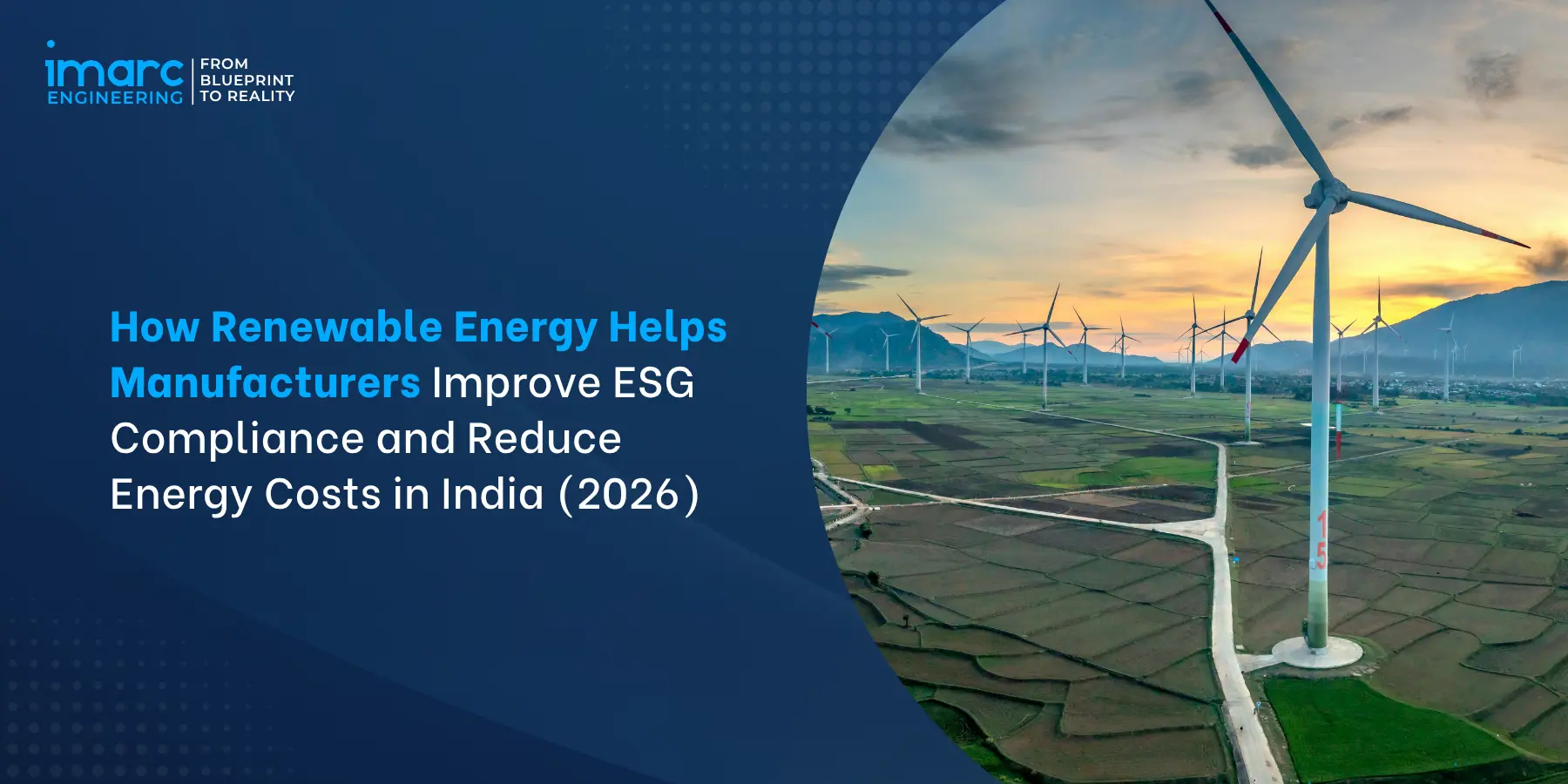
How Renewable Energy Helps Manufacturers Improve ESG Compliance and Reduce Energy Costs in India (2026)
Introduction
For manufacturers operating in India in 2026, energy is both a rising cost line and a strategic differentiator. Grid tariffs for industrial consumers have progressively increased. Sustainability disclosure obligations under SEBI's BRSR Core framework, buyer procurement mandates from global OEMs, and export-market carbon pricing under EU CBAM collectively raise the ESG bar. Renewable energy for manufacturers in India has evolved from a sustainability initiative into a practical business strategy that helps reduce electricity costs, strengthen ESG performance, and improve long-term competitiveness.
Scope of this Guide
This guide answers the manufacturer's strategic question directly. If I adopt renewable energy for my facility in India, how does it improve ESG compliance, reduce energy costs, and support long-term operational sustainability? It explains the major renewable energy options available to manufacturers, compares their commercial benefits, outlines ESG and regulatory considerations, and highlights implementation practices that improve long-term returns.
Table of Contents
- Introduction
- Why Renewable Energy for Manufacturers in India Matters in 2026
- Renewable Energy Options for Manufacturing Plants in India
- How Renewable Energy Helps Manufacturers Reduce Energy Costs in India
- Rooftop Solar for Manufacturing Plants in India
- Open Access Renewable Power for Manufacturers in India
- How Renewable Energy Improves ESG Scores
- Renewable Energy Incentives for Industries in India
- Common Mistakes and Best Practices
- Conclusion
1. Why Renewable Energy for Manufacturers in India Matters in 2026
Four structural drivers make renewable energy adoption a strategic priority for Indian manufacturers in 2026.
1.1 Industrial Grid Tariffs Continue to Rise
Grid tariffs for industrial consumers across most Indian states now sit in the INR 6-10 per kWh range depending on state, voltage level, and time of use. Peak-hour surcharges, cross-subsidy surcharges, and additional surcharges further increase effective landed cost.
Structured industrial energy cost reduction through renewable procurement typically delivers 20-40 percent savings on the renewable-served portion of consumption over long-term contracts, materially improving manufacturing cost competitiveness.
1.2 SEBI BRSR Core Disclosure Mandate
SEBI's Business Responsibility and Sustainability Report (BRSR) Core framework applies to the top 1,000 listed companies by market capitalisation with progressive expansion. BRSR Core requires disclosure of nine key ESG parameters with limited assurance, including greenhouse gas emissions, energy consumption, water usage, waste generation, and social metrics.
Non-listed manufacturers supplying to listed customers face equivalent disclosure demand through the buyer's Scope 3 emission accounting. Structured ESG data infrastructure aligned with renewable procurement supports both disclosure and buyer engagement.
1.3 Global Buyer Procurement Mandates
Global OEMs and major buyers progressively incorporate renewable energy commitments into supplier selection criteria. RE100 signatories, Science Based Targets initiative (SBTi) commitments, and net-zero pledges from Apple, Microsoft, Walmart, and other large buyers cascade into supplier expectations.
Automotive OEMs, apparel brands, electronics assemblers, and food companies increasingly require renewable-energy-served operations from qualifying suppliers. Manufacturers without structured renewable procurement face progressive exclusion from premium buyer engagements.
1.4 EU CBAM and Trade-Linked Carbon Pricing
The European Union Carbon Border Adjustment Mechanism (CBAM) applies to imports of steel, aluminium, cement, fertiliser, hydrogen, and electricity with progressive expansion to other sectors. Reporting has commenced with financial obligations from January 2026.
Manufacturers exporting to EU markets face embedded carbon accounting and financial obligations proportional to product carbon intensity. Renewable-energy-served operations materially reduce embedded carbon and CBAM exposure. Similar trade-linked carbon mechanisms are being evaluated in other markets.
2. Renewable Energy Options for Manufacturing Plants in India
Industrial manufacturers can adopt renewable energy through several procurement and ownership models depending on their energy demand, investment strategy, and operational requirements. Deployment of renewable energy for manufacturing plants typically involves choice among rooftop solar, captive generation, open access, group captive, corporate PPAs, and Renewable Energy Certificates depending on facility characteristics, consumption profile, capital availability, and long-term strategy.
2.1 The Options Comparison
| Option | Deployment Model | Typical Fit |
|---|---|---|
| Rooftop Solar | Behind-the-meter on facility roof | 10-40% consumption coverage |
| Ground-Mount Captive | On-site or adjacent land | 40-100% coverage if land available |
| Open Access Solar/Wind | Third-party plant + grid wheeling | Any scale, tariff-linked |
| Group Captive | 26% equity + 51% consumption | Long-term commitment |
| Corporate PPA | 10-25 year purchase agreement | Large stable consumers |
| RECs (Renewable Energy Certificates) | Offset mechanism | Reporting and voluntary claims |
| Hybrid Solar-Wind-BESS | Combined resources + storage | High-reliability requirements |
2.2 Behind-the-Meter Rooftop Solar
Rooftop solar is the most accessible entry point for most manufacturers. Advantages include direct offset against grid tariff, no wheeling charges, no cross-subsidy surcharge, tax benefits under accelerated depreciation, and relatively short implementation timeline of 6-12 months. Constraints include roof area limits (typically covers 10-40 percent of consumption depending on roof-to-consumption ratio), structural roof suitability, and shading considerations. Typical capital cost ranges INR 3-5 crore per MW for utility-scale rooftop installations.
2.3 Open Access and Corporate PPA
Open access enables procurement from third-party renewable plants through grid wheeling. Corporate Power Purchase Agreements (PPAs) with independent power producers provide long-term price certainty. Advantages include scalability beyond rooftop constraints, competitive tariffs (INR 2.5-4 per kWh for solar; INR 3-4 per kWh for wind), and structured commercial arrangements. Constraints include state-specific open access regulations, wheeling charges, cross-subsidy surcharge, and banking rules. Structured corporate PPA for industrial buyers design typically delivers 25-45 percent savings on served consumption over the contract period.
2.4 Group Captive and Hybrid Systems
Group captive arrangements require the consumer to hold at least 26 percent equity in the generating plant and consume at least 51 percent of the generation. Group captive exempts cross-subsidy surcharge under most state frameworks, materially improving landed cost. Hybrid solar wind and BESS for manufacturing combine complementary resources with battery storage to improve capacity utilisation and reliability. Hybrid systems particularly suit facilities with critical loads or high renewable procurement targets.
3. How Renewable Energy Helps Manufacturers Reduce Energy Costs in India
Understanding how renewable energy helps manufacturers reduce energy costs in India helps sponsors quantify the return on renewable procurement investment. Cost impact operates through tariff differential, tax benefits, hedge value, and long-term price stability.
3.1 The Cost Reduction Mechanism
| Cost Element | Grid Baseline | Renewable Alternative |
|---|---|---|
| Energy Tariff | INR 6-10 per kWh | INR 2.5-4.5 per kWh |
| Fixed Charges | Recurring monthly | Contract-based structure |
| Tariff Escalation Risk | 3-6% annual typical | Hedged over contract |
| Cross-Subsidy Surcharge | Applied on all consumption | Waived on group captive |
| Peak-Hour Premium | Additional 20-40% | Time-shifted with BESS |
| Accelerated Depreciation | Not applicable | Tax benefit on renewable capex |
3.2 Levelised Cost Comparison
Levelised cost of renewable energy (LCoE) for commercial-scale solar in India ranges INR 2.5-3.5 per kWh; wind LCoE ranges INR 3-4 per kWh; hybrid solar-wind-BESS ranges INR 4-5 per kWh depending on storage sizing. Grid tariffs for industrial consumers typically range INR 6-10 per kWh.
The differential creates 25-50 percent savings on the renewable-served portion of consumption over long-term contracts. Actual savings depend on state open-access charges, wheeling costs, banking terms, and renewable capacity utilisation.
3.3 Tax and Financial Benefits
Accelerated depreciation on renewable capital equipment provides material tax benefits under Income Tax Act provisions. Interest deductibility on green financing loans, priority sector lending status, concessional rates through Indian Renewable.
Energy Development Agency (IREDA), and multilateral climate financing including from World Bank, ADB, and IFC support attractive project economics. Structured financial modelling should capture both operational savings and tax benefits.
3.4 Hedge Value Against Tariff Escalation
Long-term renewable contracts fix or index energy costs over 10-25 year horizons. Grid tariffs have typically escalated 3-6 percent annually in most states. Contracted renewable prices with fixed escalation caps materially reduce forward tariff risk. For energy-intensive sectors, the hedge value can rival the direct cost savings. Structured procurement blends different contract structures to balance certainty against optionality.
4. Rooftop Solar for Manufacturing Plants in India
Rooftop solar for manufacturing plants is typically the first structured renewable initiative for most facilities. Understanding the technical, commercial, and regulatory dimensions supports informed decisions.
4.1 Technical Feasibility
Rooftop solar feasibility depends on available roof area, structural roof-load capacity, orientation, shading, and integration with existing electrical systems. A typical manufacturing facility with 10,000 square metres of usable roof area supports approximately 1-1.2 MWp of solar installation generating around 1.5-1.8 million kWh annually. Structural assessment of existing roofs (particularly older factory sheds) is essential before installation. Structured shade analysis, tilt optimisation, and monitoring system integration influence long-term generation.
4.2 Commercial Models
Solar power for manufacturers deploys through several commercial models. CAPEX purchase involves upfront investment by the manufacturer with full ownership and depreciation benefits. RESCO (Renewable Energy Service Company) or OPEX models involve zero upfront investment by the manufacturer who purchases power at a discounted tariff from the developer. Hybrid models combine elements of both. Model choice depends on balance sheet appetite, tax position, cash flow preferences, and operations preferences.
4.3 Regulatory Framework
Rooftop solar operates under net metering, net billing, or gross metering frameworks depending on state policy. Distribution licensee approval, safety clearance from Chief Electrical Inspector, and grid synchronisation approvals are typically required. State-specific policies from MERC (Maharashtra), TNERC (Tamil Nadu), KERC (Karnataka), GERC (Gujarat), and other State Electricity Regulatory Commissions govern net metering caps, tariff structures, and export provisions. Structured regulatory navigation is particularly important for facilities exceeding threshold capacities.
4.4 Financial and Payback Considerations
Rooftop solar CAPEX typically ranges INR 3-5 crore per MWp depending on scale, location, and installation complexity. Simple payback typically runs 4-7 years for CAPEX models and immediate cash flow benefit for OPEX models. IRR for CAPEX installations typically ranges 15-25 percent depending on grid tariff replaced and utilisation. Structured monitoring, cleaning schedules, and inverter maintenance protect long-term generation.
5. Open Access Renewable Power for Manufacturers in India
Open access renewable power for manufacturers enables scale beyond rooftop constraints. Third-party renewable procurement through grid wheeling has emerged as the highest-volume renewable procurement mechanism for large industrial consumers.
5.1 The Open Access Framework
The Electricity Act 2003 provides the parent framework for open access. State Electricity Regulatory Commissions notify state-specific open access regulations covering procedural applications, wheeling charges, cross-subsidy surcharge, additional surcharge, banking rules, and reactive energy charges.
Open access enables large consumers (typically above 1 MW connected load) to procure electricity from third-party generators. Renewable open access typically enjoys some concessions on cross-subsidy surcharge and wheeling charges depending on state policy.
5.2 Cost Structure and Effective Landed Cost
Open access renewable landed cost combines the contracted energy tariff, transmission charges (STU and CTU), wheeling charges, cross-subsidy surcharge, additional surcharge, and other applicable charges. Effective landed cost typically runs 25-45 percent below grid tariffs for eligible consumers in states with supportive policies. State-by-state analysis is essential given significant variation in charge structure. Some states have progressively liberalised open access while others retain higher charges.
5.3 Group Captive Structure
Captive renewable power plant setup through group captive structures requires the industrial consumer to hold at least 26 percent equity in the generating plant and consume at least 51 percent of the generated electricity. Group captive exempts cross-subsidy surcharge in most states, further improving landed cost.
Group captive structures suit long-term stable consumers with capacity to make equity commitments. Structured governance, offtake reconciliation, and equity administration are integral to group captive execution.
5.4 Contracting and Banking Terms
Open access contracts typically run 10-25 years for long-term arrangements. Shorter-term arrangements support optionality but with less price certainty. Banking terms allow consumers to draw generated energy during peak-demand periods against surplus generation banked during low-demand periods, subject to banking charges and time limits per state regulations. Deemed generation clauses, curtailment provisions, and force majeure terms require careful contract review. Structured contract design materially affects long-term value.
6. How Renewable Energy Improves ESG Scores
ESG reporting for Indian manufacturers is the disclosure layer that translates renewable procurement into stakeholder credibility. Structured reporting supports listed obligations, buyer disclosures, and voluntary sustainability claims.
6.1 Reporting Frameworks
- BRSR Core (SEBI) — mandatory disclosure of 9 ESG parameters with limited assurance for top 1,000 listed
- GRI Standards — global reporting framework widely adopted voluntarily
- SASB Standards — sector-specific materiality-focused
- ISSB IFRS S1 and S2 — international sustainability disclosure standards
- TCFD — climate-related financial disclosures framework
- CDP (Carbon Disclosure Project) — investor and buyer-driven disclosure platform
- Science Based Targets initiative (SBTi) — target-setting framework
6.2 GHG Accounting and Scope Coverage
Greenhouse gas accounting per the GHG Protocol covers Scope 1 (direct emissions), Scope 2 (purchased electricity and heat), and Scope 3 (value chain emissions). Renewable energy procurement primarily reduces Scope 2 emissions through both physical delivery (open access, captive) and instrument-based accounting (Renewable Energy Certificates). Scope 3 emission reductions require supplier engagement and product carbon footprint work. ISO 14064 (GHG accounting) and ISO 14067 (product carbon footprint) provide the international methodology reference.
6.3 Renewable Procurement in ESG Narraative
Structured carbon reduction strategies for manufacturers integrate renewable procurement into a broader ESG narrative. Documentation should cover procurement volumes and additionality, contract structures and terms, emission factors used, and verification protocols. RE100 signatories additionally track percentage of renewable electricity toward 100 percent commitment. Structured claims aligned with GHG Protocol and RE100 technical criteria avoid greenwashing concerns and support credible buyer engagement.
6.4 Assurance and Verification
BRSR Core requires limited assurance from independent assurers. Voluntary GHG inventories increasingly seek reasonable assurance from bodies including BSI, Bureau Veritas, DNV, SGS, TUV, and Intertek. Verification bodies review data collection, calculation methodologies, boundary definitions, and consistency across reporting periods. Structured data infrastructure with defined controls, evidence documentation, and internal audit prepares organisations for external assurance without disruptive last-minute remediation.
7. Renewable Energy Incentives for Industries in India
Renewable energy incentives for industries stack Central, state, and financing benefits that materially improve project economics. Sponsors should map the full incentive landscape rather than pursuing renewable procurement without policy stacking.
7.1 Central Incentives and Support
- Accelerated Depreciation on renewable equipment under Income Tax Act
- Green Term Ahead Market (GTAM) for structured procurement flexibility
- Renewable Energy Certificate (REC) mechanism for reporting and offsets
- Perform Achieve Trade (PAT) scheme trading benefits
- Carbon Credit Trading Scheme (CCTS) notified under Energy Conservation Act 2001 (amended 2022)
- Priority sector lending status for renewable projects
- Custom duty exemptions on specified renewable equipment
7.2 State-Level Support
State-level renewable policies vary significantly. Progressive states including Gujarat, Karnataka, Tamil Nadu, Maharashtra, Andhra Pradesh, Rajasthan, and Madhya Pradesh offer capital subsidies, electricity duty exemption, wheeling charge concessions, cross-subsidy surcharge waivers, and simplified approvals for industrial renewable procurement. State-by-state analysis is essential at planning stage. Structured location-and-model matching against state policies materially improves project returns.
7.3 Green Financing
Renewable energy investment for industries benefits from expanding green financing options. Green bonds, sustainability-linked loans, IREDA financing at concessional rates, priority sector lending from banks, and multilateral climate finance from World Bank, Asian Development Bank, and International Finance Corporation collectively provide competitive financing.
Sustainability-linked loans with interest step-down provisions tied to renewable procurement targets create additional incentive alignment. Structured financing significantly improves project IRR.
7.4 Carbon Credit Trading Scheme (CCTS)
The Carbon Credit Trading Scheme (CCTS) notified under the Energy Conservation Act 2001 as amended in 2022 establishes India's domestic carbon market. The scheme operates through compliance and offset mechanisms. Manufacturers with structured emission reduction programmes can potentially generate tradeable carbon credits.
CCTS interacts with the existing PAT scheme for energy-intensive sectors. As the scheme matures, sponsors should monitor implementation notifications and evaluate carbon credit opportunities alongside renewable procurement.
8. Common Mistakes and Best Practices
8.1 Under-Scoped Baseline Assessment
Renewable procurement decisions taken without structured energy baseline analysis produce sub-optimal choices. Best practice: 12-month consumption profile with time-of-use analysis; load factor assessment; peak demand mapping; tariff category and structure review; state open-access policy review before selecting model.
8.2 Single-Model Bias
Choosing rooftop, open access, or group captive without evaluating alternatives forgoes optimisation opportunity. Best practice: portfolio approach combining rooftop (base coverage), open access (scale), and RECs (reporting completeness); structured evaluation of state policies affecting each model; hybrid solutions matching specific consumption patterns.
8.3 Weak Contract Structuring
Open access and PPA contracts locked without careful review of deemed generation, curtailment, banking, and force majeure provisions produce disputes and value leakage. Best practice: legal and commercial review of every material contract clause; benchmark against peer contracts; structured governance for contract lifecycle management; regular contract performance reviews.
8.4 Fragmented ESG Data Infrastructure
ESG data scattered across finance, operations, HR, and utilities functions produces gaps that surface during assurance and buyer audits. Best practice: integrated ESG data infrastructure with defined ownership; digital platforms for data collection and quality assurance; internal audit programme aligned with BRSR Core and voluntary framework requirements; structured evidence retention.
8.5 Deferring Implementation
Waiting for perfect policy clarity or ideal cost curves postpones benefits materially. Best practice: staged implementation starting with rooftop or REC coverage; progressive scaling as experience builds; portfolio optimisation over 3-5 year horizon; continuous monitoring of policy and market developments to refine approach.
Conclusion
Renewable energy for manufacturers in India in 2026 is a structural strategic priority combining cost reduction, ESG credibility, buyer engagement, and long-term operational sustainability. Rising grid tariffs, SEBI BRSR Core disclosure mandates, global buyer procurement expectations, and EU CBAM trade-linked carbon pricing collectively make renewable procurement a competitive necessity rather than a discretionary initiative.
Manufacturers that combine structured baseline assessment, portfolio-model design, disciplined contract structuring, integrated ESG data infrastructure, and staged implementation consistently deliver both cost savings and credible sustainability outcomes across the operational lifecycle.
Three closing reminders for manufacturing leaders. First, treat renewable procurement as a portfolio design decision, not a single-model choice. Rooftop solar addresses base coverage: open access enables scale; group captive supports long-term structures; RECs support reporting completeness. Each has role in a well-designed portfolio.
Second, integrate ESG data infrastructure from the outset rather than as post-facto reporting exercise. BRSR Core assurance, buyer disclosures, and voluntary framework participation requires structured data foundations that cannot be assembled at the last minute.
Third, execute in stages rather than waiting for ideal conditions. Progressive implementation building experience and internal capability delivers better long-term outcomes than delayed comprehensive deployment.
PLANNING YOUR RENEWABLE ENERGY AND ESG PROGRAMME?
IMARC Engineering's renewable energy and ESG advisory team supports manufacturers, sustainability leads, and energy managers across baseline assessment, portfolio design, technology selection, contract structuring, project execution, ESG data infrastructure, BRSR Core reporting, buyer engagement, and CBAM readiness across rooftop, open access, group captive, PPA, and hybrid renewable procurement models.
→ Schedule a free renewable energy and ESG scoping consultation with an IMARC specialist
Frequently Asked Questions
Depends on state grid tariffs, renewable procurement model, and consumption profile. Industrial energy cost reduction through renewable procurement typically ranges 20-45 percent on the renewable-served portion of consumption over long-term contracts. Actual savings depend on state open-access charges, wheeling costs, and portfolio design.
Depends on facility profile and consumption. Rooftop solar covers 10-40 percent of typical consumption. Open access enables scale beyond rooftop constraints. Group captive suits long-term structures with equity commitment. Corporate PPAs support large stable consumers. Most manufacturers benefit from portfolio combinations rather than single-model deployment.
BRSR Core is SEBI's Business Responsibility and Sustainability Report Core framework mandating disclosure of 9 key ESG parameters with limited assurance for the top 1,000 listed companies by market capitalisation with progressive expansion. Non-listed manufacturers supplying to listed customers face equivalent demand through the buyer's Scope 3 accounting. ESG compliance for manufacturers should align with BRSR Core disclosure requirements.
Rooftop solar CAPEX typically ranges INR 3-5 crore per MWp with simple payback of 4-7 years for CAPEX purchase models. OPEX or RESCO models provide immediate cash flow benefits without upfront investment. Actual payback depends on grid tariff replaced, capacity utilisation, and installation quality.
Open access enables large industrial consumers (typically above 1 MW connected load) to procure electricity from third-party generators through grid wheeling. The mechanism is governed by state open-access regulations covering procedural applications, wheeling charges, cross-subsidy surcharge, and banking rules. Effective landed cost typically runs 25-45 percent below grid tariffs in supportive states.
A captive renewable power plant setup through group captive structure requires the industrial consumer to hold at least 26 percent equity in the generating plant and consume at least 51 percent of generation. Group captive exempts cross-subsidy surcharge in most states, materially improving landed cost. Suits long-term stable consumers with equity commitment capacity.
The EU Carbon Border Adjustment Mechanism applies to imports of steel, aluminium, cement, fertiliser, hydrogen, and electricity with progressive expansion. CBAM imposes financial obligations proportional to embedded carbon. Renewable-energy-served operations materially reduce embedded carbon accounting and financial obligations. Structured renewable procurement supports CBAM readiness alongside other decarbonisation measures.
The Carbon Credit Trading Scheme (CCTS) notified under the Energy Conservation Act 2001 (amended 2022) establishes India's domestic carbon market with compliance and offset mechanisms. Manufacturers with structured emission reduction programmes can potentially generate tradeable carbon credits as the scheme matures. CCTS interacts with the existing PAT scheme for energy-intensive sectors.
Structured renewable energy consulting in India engagements support baseline assessment, portfolio design, technology selection, contract structuring, financing arrangement, project execution, and ongoing ESG data infrastructure. Specialised consulting bridges the gap between technical, commercial, regulatory, and disclosure dimensions that individually may not surface the optimal solution.
Recent Post





Trusted by Industry Leaders
We partner with global enterprises and ambitious businesses across sectors to deliver operational excellence, strategic insights, and sustainable growth through integrated solutions.











Success in Their Words
Real feedback from clients across industries. Discover how our solutions delivered measurable impact and operational excellence.

I wanted to express my sincere appreciation for your efforts in handling this matter. Your dedication and commitment have been truly commendable, and it is evident that you have put in tremendous hard work and expertise into resolving the issues at hand. We are greatly interested in continuing our collaboration with you in the future, as your professionalism and reliability have made you a trusted partner. Thank you once again for your invaluable contribution. We look forward to strengthening our partnership ahead.

It has been a pleasure working with the IMARC team. The insights provided were structured, clear, and highly valuable, helping us strengthen both our technical and financial planning with confidence. We deeply appreciate the team’s professionalism, responsiveness, and attention to detail throughout the engagement. Every requirement was well understood and effectively incorporated, resulting in a comprehensive and actionable output. Overall, our experience has been excellent, and I would gladly recommend IMARC to organizations seeking a reliable research partner.

Your service is truly exceptional. Working with the IMARC team has been a seamless and professional experience. The clarity of communication, responsiveness to queries, and consistent support at every stage made the entire engagement highly efficient. The insights shared were well-structured, practical, and perfectly aligned with our requirements, helping us make informed decisions with confidence. Overall, the dedication and professionalism demonstrated by your team stand out, and I would be glad to recommend IMARC as a reliable and trustworthy research partner.

IMARC did an outstanding job in preparing our study. They were punctual, precise, and consistently responsive throughout the entire process. The team delivered all the data we required in a clear, well-organized, and highly professional format. Their strong attention to detail, combined with their ability to meet every deadline without compromising quality, truly set them apart. Overall, their reliability and commitment made them an exceptional partner for our project, and we would gladly work with them again in the future.

IMARC made the whole process incredibly easy from start to finish. Everyone I interacted with via email was polite, professional, and straightforward to deal with, always keeping their promises regarding delivery timelines and remaining consistently solutions-focused. From my very first contact, I appreciated the professionalism and support shown by the entire IMARC team. I highly recommend IMARC to anyone seeking timely, affordable, and reliable information or advice. My experience with IMARC was excellent, and I truly cannot fault any aspect of it.

I’d like to express my sincere gratitude for the excellent work you accomplished with the study. Your ability to quickly understand our requirements and deliver high-quality results under tight timelines truly reflects your expertise, exceptional work ethic, and unwavering commitment to your customer’s success. The professionalism and responsiveness you demonstrated throughout the process made a significant difference. Our entire team and company are incredibly thankful for your dedication, reliability, and support. Once again, thank you for your outstanding contribution.