Manufacturing
April 06 2026
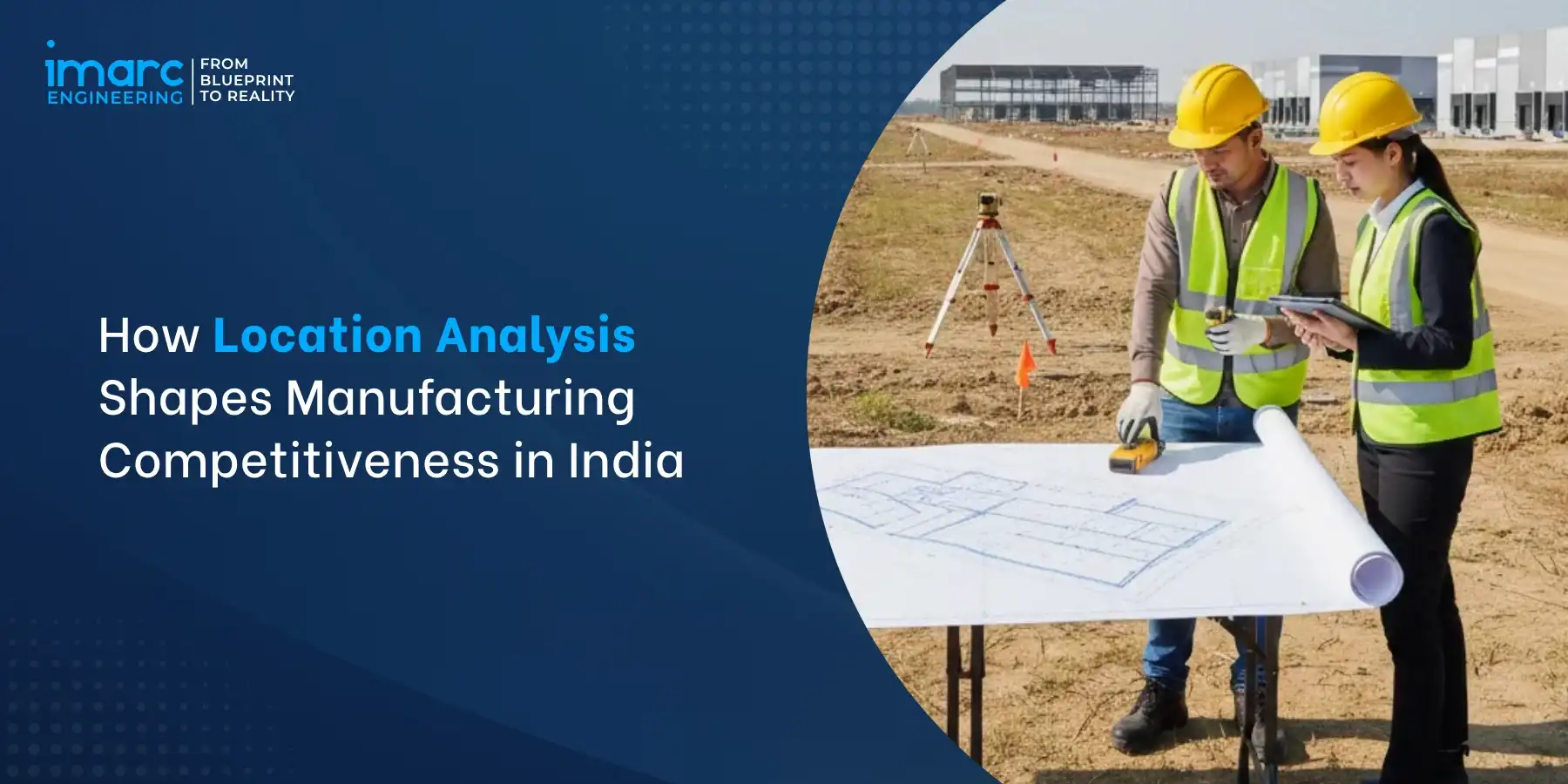
How Location Analysis Shapes Manufacturing Competitiveness in India
Introduction
India is undergoing the most significant manufacturing transformation in its economic history. With over USD 21 billion attracted through Production Linked Incentive (PLI) schemes, a 1.4-billion-strong domestic market, and a demographic dividend that rivals no other economy, India has firmly positioned itself as the world's next major manufacturing powerhouse. Yet, despite these structural tailwinds, a significant proportion of manufacturing investments in India fail to achieve their expected ROI, not because of flawed strategy at the global level, but because of inadequate location analysis at the India level.
For manufacturing executives, a location decision in India is not merely a question of which state offers the lowest land cost. It is a 15–25-year strategic commitment that will shape labour accessibility, logistics economics, regulatory compliance burden, supply chain resilience, and market responsiveness. An incorrect India location choice locks companies into cost structures that cannot be remedied by operational improvements alone.
India's manufacturing competitiveness is no longer simply about lower wages relative to China or other Asian markets. It is about the degree to which a specific location within India fits the investor's business model, supply chain architecture, and growth trajectory. Location analysis has become the most critical strategic tool for unlocking the India manufacturing opportunity.
This guide covers:
- Why India-specific location analysis is the foundation of manufacturing competitiveness.
- Cost structure analysis and total cost of ownership frameworks for Indian locations.
- Workforce evaluation across India's diverse state-level labour markets.
- Infrastructure and supply chain integration assessment in India.
- Regulatory environment and government incentive landscape by state.
- Risk mitigation and resilience planning for Indian operations.
- IMARC Engineering's multi-phase India location analysis methodology.
Section 1: Why India Location Analysis Is the Foundation of Manufacturing Competitiveness
1.1 India's Strategic Shift: From Wage Arbitrage to Integrated Location Strategy
India location analysis used to have only one key variable: significantly lower labor costs compared to Western nations. That is clearly not the case today in the manufacturing location decision for India. The modern-day manufacturing investor in India must now analyze total cost of ownership across 28 states and 8 Union Territories, each with their own set of regulations, infrastructure development, labor force, and incentives.
The structural changes in India are apparent in various sectors, which have resulted in location advantages through the allocation of PLI schemes in 14 sectors ranging from semiconductors and mobile electronics to pharmaceuticals, advanced chemistry cells, and textiles.
Maharashtra’s Auric City, Gujarat’s Dholera SIR, Tamil Nadu’s SIPCOT Industrial clusters, Telangana’s Genome Valley, Uttar Pradesh’s Defence Industrial Corridor, etc., are now emerging as new forms of location advantages, which need to be analyzed using sophisticated tools to evaluate. Companies that simply choose Tier 1 Industrial hubs as their location in India without doing a proper multi-factor analysis of their India location analysis are rapidly discovering that they are at a disadvantage in terms of cost, land costs, and competing for a scarce labor force with dozens of other manufacturers who have made the same undifferentiated decision.
1.2 The Financial Impact of Location Decisions Within India
Even within a single country, location typically accounts for 25–40% of differences in manufacturing operating cost. Within India's highly heterogeneous state-level environment, the variation is even more pronounced. The difference in effective power cost between a well-located facility in Gujarat (with dedicated power supply and state subsidy) and an equivalent facility in a power-stressed northern state can have a significant difference that compounds significantly over a facility's operating life.
Location analysis, when executed with rigour, directly improves manufacturing competitiveness in India by maximising incentive capture, minimising logistics cost, accessing the right talent pool, and ensuring regulatory timelines do not compress return on invested capital. When executed incorrectly or based on generalist India market knowledge without state-level depth, it traps manufacturers in disadvantages that operational efficiency cannot fully overcome.
1.3 Who Needs Structured India Location Analysis?
- Multinational manufacturers evaluating India entry for the first time, choosing between state-level locations.
- Existing India operators evaluating greenfield expansion, brownfield upgrades, or satellite facility additions.
- Companies implementing China+1 or global supply chain diversification strategies with India as a primary destination.
- Private equity and corporate investors conducting manufacturing asset due diligence in India.
- Government agencies and industrial development authorities benchmarking the competitiveness of their regions.
- Supply chain leaders redesigning India production and distribution networks.
Section 2: Cost Structure Analysis- The Quantitative Foundation for India
Cost structure analysis is arguably the most important result of India location analysis. It is also arguably the most frequently executed with insufficient detail. The most common error is to compare cost structure metrics, land costs, statutory minimum labor rates, or published electrical tariff rates, without regard to the actual cost of all-in labor, or all-in electrical cost, which is required to ensure that the return on investment is achieved from this location.
2.1 Total Cost of Ownership Framework for India
IMARC Engineering's India TCO framework considers all cost factors that impact the economics of a manufacturing facility, broken down at a state or microlocation level. These are: land costs, construction costs, effective labor cost, energy cost, logistics/freight costs, regulatory compliance costs, tax costs, net value of capital incentives over the life of the facility.
2.2 Hidden Cost Factors Specific to India
India's published cost indicators frequently conceal substantial hidden expenses that distort location comparisons when not rigorously accounted for:
- Power reliability gaps: In states with DISCOM-related grid instability, effective energy costs can be higher than the published tariff rate due to backup generation requirements and production losses from unplanned outages.
- Labour attrition and retraining: In high-competition industrial zones, annual attrition in semi-skilled manufacturing roles can significantly. The fully loaded cost of replacement, recruitment, onboarding, productivity ramp-up, and quality losses can exceed the apparent wage savings of selecting a low-cost labour market.
- Compliance and permitting delays: Environmental and construction clearance timelines in India vary dramatically between states. A 6-month permitting delay relative to a comparable location in a better-performing state translates directly into increased CapEx carrying costs and delayed revenue generation.
- Logistics infrastructure gaps: Locations that appear cost-attractive on a headline basis frequently carry higher effective logistics costs due to poor last-mile road connectivity, congested port access, or limited rail freight access, requiring higher safety stock levels and increasing working capital requirements significantly.
- Water availability and treatment costs: Manufacturing processes with significant water requirements face materially higher costs in water-stressed regions, including procurement cost, treatment CapEx, and regulatory compliance burden under state pollution control board requirements.
Section 3: Workforce Analysis- Navigating India's Diverse Labour Markets
India's workforce landscape is among the most diverse and complex in global manufacturing. With over 500 million workers in the labour force, significant variation in educational attainment, technical skill levels, wage structures, attrition patterns, and labour law environments across states, workforce analysis in India demands a structured multi-dimensional approach that goes far beyond simple wage comparison.
3.1 Multi-Dimensional Workforce Evaluation Framework for India
The Multi-Dimensional Workforce Evaluation Framework structures workforce assessment across six dimensions, each of which independently influences manufacturing competitiveness in India:
- Wage cost and total compensation: Statutory minimum wages, industry-level actual wages, and benefit costs vary significantly between states, from INR 400–500/day for semi-skilled manufacturing in low-cost states to INR 700–900/day and above in mature industrial hubs.
- Workforce stability and attrition: Regions with concentrated industrial activity and high employer competition (NCR industrial belt, Pune-PCMC corridor) often exhibit higher attrition rates than emerging industrial zones, despite lower absolute wages.
- Technical skill availability: Proximity to ITIs, polytechnics, engineering colleges, and sector-specific training institutions determines the available skill pool for technical manufacturing roles.
- Workforce scalability: The ability to ramp headcount rapidly to match production expansion plans, including the availability of contractual and gig-format labour supply chains.
- Labour law environment: State-level labour law complexity, inspection frequency, and dispute resolution mechanisms vary significantly and must be modelled as operational variables, not compliance checkboxes.
- Industry 4.0 readiness: Locations with access to engineering graduates, automation technicians, and digital manufacturing skill pools provide a long-term competitive advantage as manufacturing becomes more technology-intensive.
3.2 Workforce Quality vs. Cost Trade-offs in India
The Indian manufacturing workforce has a quality-cost trade-off that is different from other low-cost manufacturing locations worldwide. Tamil Nadu and Karnataka have a better workforce quality, particularly for precise manufacturing, electronics, and automotive industries; however, this comes at a cost. For locations like Rajasthan and UP, the workforce cost is lower, but if the industry is precise or requires process discipline, the impact of higher workforce attrition and productivity can outweigh the cost advantage.
Manufacturing industries using Industry 4.0 technology, CNC manufacturing, robotic assembly, quality control systems need to consider workforce quality, accessibility of engineering colleges, and trainability of the workforce over cost. Suzuki Motor Corporation has implemented AI-based work analysis systems on the factory floor in India; this is a demonstration of how technology multiplies the benefits of a skilled workforce, thus making the choice of a technically qualified workforce a multiplier of the return on capital investments.
3.3 Future Workforce Considerations in India
- India's STEM pipeline is among the largest globally, with over 1.5 million engineering graduates annually, but geographic distribution is uneven, making proximity to technical institutions a differentiating location factor.
- Workforce age demographics are highly favourable in India overall, but urbanisation patterns and migration flows to established industrial centres must be factored into long-term labour supply projections.
- State government vocational training programmes, particularly in Gujarat (ITI network), Tamil Nadu (TASMAC industrial training), and Telangana (TASK programme), provide structured workforce pipeline support for new manufacturing investors.
Section 4: Infrastructure & Supply Chain Integration in India
4.1 India Infrastructure Readiness Assessment
The quality of India's infrastructure is one of the most variable factors of manufacturing competitiveness and is often one of the most underestimated factors of location analysis. The difference between the best and worst manufacturing locations in India on infrastructure parameters is greater than in most developed manufacturing economies, and this is a critical differentiator of infrastructure evaluation.
The key parameters of infrastructure evaluated by IMARC Engineering's framework of location analysis for India are power supply reliability and tariff; road connectivity to ports and distribution centers; rail freight accessibility and terminal proximity; port accessibility and Inland Container Depot (ICD) connectivity; adequacy and reliability of water supply; availability of natural gas for process manufacturing; and digital/telecom connectivity.
4.2 India's Industrial Corridor and Infrastructure Development Programme
India's infrastructure development program for the manufacturing industry is one of the most ambitious in the country's history. The PM Gati Shakti National Master Plan, the Delhi-Mumbai Industrial Corridor (DMIC), the Chennai-Bengaluru Industrial Corridor (CBIC), the Amritsar-Kolkata Industrial Corridor, and the development of Dedicated Freight Corridors (DFCs) are collectively making the cost competitiveness of the areas that could have been logistically marginal a decade ago. The selection of Reliance MET City by BEUMER Group for its Indian facility is a prime example of the advantages provided by plug-and-play industrial infrastructure, where power, water, road, rail connectivity, and customs infrastructure are provided under a single zone.
Key supply chain integration factors evaluated in IMARC Engineering's India location analysis framework include:
- Proximity to raw material sources and established tier-2 and tier-3 supplier clusters.
- Inbound material flow logistics costs and lead time modelling at the state and district level.
- Outbound distribution costs to domestic demand centres and export ports.
- JNPT, Mundra, Chennai, Vizag, and Kolkata port turnaround times and customs clearance efficiency.
- Special Economic Zone (SEZ) access for export-oriented manufacturing.
- Dedicated Freight Corridor access — the EDFC and WDFC together enable significantly lower rail logistics costs for locations along these corridors.
4.3 Future Infrastructure: 10-Year Planning Horizon in India
The location analysis for India undertaken by IMARC Engineering includes a forward-looking infrastructure development plan for the next 10 years in its location scoring criteria. Ineffective industrial locations from a logistics point of view, including new industrial locations emerging along the DMIC route, the Amritsar-Kolkata industrial axis, and Andhra Pradesh's industrial locations along its coastline, represent substantial location advantages for plants scheduled for commissioning in 2025-2035, since these will benefit from the enhanced infrastructure as committed in the development plans.
Section 5: Regulatory Environment & Government Incentives in India
India's regulatory environment for manufacturing has undergone a structural improvement over the past decade. The introduction of the National Single Window System (NSWS), state-level ease of doing business reforms, and the rapid expansion of incentive programmes at both central and state level have meaningfully improved India's attractiveness for manufacturing investment. However, regulatory complexity remains a significant variable that differentiates India locations, and a key dimension of IMARC Engineering's location analysis framework.
5.1 State-by-State Regulatory Comparison
| Regulatory Factor | Maharashtra | Gujarat | Tamil Nadu | Telangana | Uttar Pradesh |
|---|---|---|---|---|---|
| Ease of Doing Business State Rank | 13 | 10 | 14 | 3 | 2 |
| Single Window Clearance Effectiveness | High | Very High | High | Very High | Moderate |
Gujarat and Telangana consistently rank among the most investor-friendly regulatory environments in India, combining strong single-window systems, competitive timelines, and proactive government liaison for large manufacturing investments. Uttar Pradesh has made rapid progress on ease of doing business rankings but operational execution on the ground still lags behind more established manufacturing states.
5.2 India Government Incentive Landscape (2026)
India's incentive landscape in 2026 represents one of the most comprehensive manufacturing investment support frameworks in Asia. Understanding the full incentive stack, central, state, and scheme-specific, is a core component of India location analysis and materially impacts the financial viability of location options.
- PLI Scheme: Capital subsidies of 4–18% of incremental sales across 14 sectors including mobile electronics, pharmaceuticals, automotive components, advanced chemistry cells, textiles, food processing, and specialty steel. PLI eligibility, application timelines, and compliance obligations differ by sector and must be carefully modelled.
- State capital subsidies: Maharashtra, Gujarat, Tamil Nadu, Telangana, and UP each offer significant capital subsidy of eligible fixed assets for qualifying investments, with higher slabs for investments in aspirational districts and backward areas.
- Power subsidies: Multiple states offer power tariff concessions, representing material operating cost reduction. For instance, while Andhra Pradesh and Haryana give discounts on the fixed cost component of electricity rates ranging from INR 1 to INR 3 per kWh for up to 5 years, Telangana offers a 25% reduction on the electricity tariff for five years, capped at INR 5 crores (US$1 million). Additionally, industrial water tariffs in Andhra Pradesh and Haryana are discounted by 50% for a maximum of three years.
- Land concessions: Industrial development corporations in major states offer land at concessional rates, typically 30–60% below market value, for anchor manufacturing investments.
- SEZ and FTWZ benefits: Export-oriented manufacturers can access duty-free import of capital goods, components, and raw materials within SEZs and Free Trade Warehousing Zones, significantly improving landed cost economics.
- RoDTEP: The Remission of Duties and Taxes on Exported Products scheme provides export incentives for manufactured goods, improving the economics of export-oriented India manufacturing facilities.
IMARC Engineering provides PLI scheme eligibility assessment, incentive negotiation support, and compliance management as part of our India market entry service offering.
➤ Schedule a Free India Location Consultation with Us
5.3 Compliance Risk Assessment for India
- Environmental compliance under MoEFCC and State Pollution Control Board requirements can add 8–18 months to project timelines if not proactively managed from the pre-feasibility stage.
- Labour law complexity: India's four labour codes like Industrial Relations Code, Code on Wages, Occupational Safety Code, and Code on Social Security, are being implemented at the state level on varying schedules, creating transition risk that must be modelled in multi-year cost projections.
- Policy stability: IMARC Engineering evaluates policy consistency over 10+ year horizons, not just current incentive schedules, to ensure location recommendations are robust to government transitions and policy revision cycles.
Section 6: Risk Mitigation & Resilience Planning for India Manufacturing
The operating environment in India has a unique risk profile that needs to be factored in during the location analysis. The geopolitical risks are relatively low compared to the other competing nations for the manufacturing industry. However, the risks that are unique to the Indian environment, including infrastructure reliability risks, labor market stability risks, regulatory change risks, and climate risks, differ across the country.
6.1 India Manufacturing Location Risk Assessment Matrix
| Risk Factor (1–10, higher = riskier) | Maharashtra | Gujarat | Tamil Nadu | Telangana | UP / North India |
|---|---|---|---|---|---|
| Labour Unrest Risk | 4.5 | 3.5 | 4.0 | 3.5 | 5.5 |
| Power Reliability Risk | 3.5 | 3.0 | 3.5 | 3.5 | 5.5 |
| Logistics Disruption Risk | 3.0 | 3.0 | 3.5 | 3.5 | 5.0 |
| Regulatory Change Risk | 4.0 | 3.5 | 4.0 | 4.0 | 5.0 |
| Climate / Flood Risk | 5.5 | 4.5 | 5.0 | 4.0 | 5.5 |
Gujarat and Telangana consistently demonstrate the most favourable risk profiles among major Indian manufacturing states, combining strong infrastructure reliability, constructive industrial relations environments, and proactive governance. States in the northern manufacturing belt offer cost advantages but carry higher risk ratings across infrastructure reliability, logistics, and workforce stability dimensions.
6.2 Resilience Strategies Within India
- Regional diversification: Multi-site India strategies, combining a western hub (Gujarat or Maharashtra) with a southern hub (Tamil Nadu or Telangana) and a northern cost-optimisation facility, provide resilience against regional infrastructure disruptions, climate events, and labour market shocks.
- India as a China+1 destination: India's structural advantages, scale, demographic workforce profile, English-language competency, legal system compatibility with global business norms, and improving logistics infrastructure, make it the primary destination for supply chain diversification away from China. IMARC Engineering's India location analysis models the cost-resilience trade-off of India versus alternative China+1 geographies to validate the India investment case.
- Coastal vs. inland trade-offs: Coastal manufacturing locations in India offer superior export logistics economics but higher exposure to cyclone and monsoon flood risk. IMARC's framework explicitly models the cost-risk trade-off between coastal competitiveness and climate exposure.
6.3 Business Continuity & Location Design in India
- Integrating disaster preparedness criteria including flood zone mapping under IMD projections, cyclone exposure for coastal facilities, and seismic risk for facilities in high-seismicity zones, directly into site scoring.
- Power resilience planning: specifying redundant grid connection points, captive power provisions (solar, captive thermal, or backup DG sets), and documenting DISCOM track record on outage frequency and restoration time.
- Water security planning: assessing groundwater availability, MIDC/GIDC water supply reliability, and alternative water source optionality for the full 25-year facility operating horizon.
Section 7: The India Location Analysis Process- IMARC Engineering's Methodology
IMARC Engineering's India location analysis methodology is designed to eliminate bias from the state selection process, validate data through on-ground due diligence, and deliver location recommendations that can withstand boardroom scrutiny and sustain long-term operational outcomes. The five-phase process is calibrated to the specific complexity of India's federal, multi-state manufacturing environment.
7.1 IMARC's Five-Phase India Location Analysis Framework
Phase 1- Strategic Criteria Definition: Align India location requirements with the investor's global supply chain strategy, product type, target markets (domestic vs. export), and growth plan. Define the relative weighting of cost, workforce, infrastructure, regulatory, and risk factors based on the specific manufacturing context and sector. For PLI-eligible investments, incorporate scheme eligibility criteria as a hard filter at this stage.
Phase 2- India Long-List Screening: Apply macro-level filters, state-level infrastructure quality, political stability, logistics connectivity, available industrial land, and PLI/SEZ access, to create a long-list of 8–12 candidate regions across India. Eliminate states and zones that fail minimum threshold criteria before conducting detailed analysis.
Phase 3- Short-List Evaluation: Conduct detailed multi-factor scoring of long-listed locations across cost, workforce, infrastructure, regulatory, and risk dimensions to narrow to 3–4 shortlisted locations. Produce preliminary TCO models for each shortlisted location incorporating the full incentive stack.
Phase 4- On-Ground Due Diligence: Conduct physical site visits, utility verification (DISCOM reliability records, water supply capacity confirmation, gas network availability), supplier interviews, state government and industrial development authority liaison meetings, and ground-truth validation of published data. In India, this phase routinely changes the ranking of shortlisted locations, the divergence between published data and on-ground conditions is among the highest in Asia.
Phase 5- Financial Modelling & Recommendation: Develop scenario-based TCO modelling incorporating the full incentive package, sensitivity analysis under energy price movement, labour cost inflation, and logistics cost scenarios, and a final location recommendation supported by a regulatory implementation roadmap and incentive capture plan.
7.2 Common Mistakes in India Location Analysis
- Defaulting to established Tier 1 industrial zones without evaluating emerging industrial corridors that offer superior long-term cost and infrastructure profiles.
- Relying on state-level promotional data from investment promotion agencies without independent on-ground verification of infrastructure quality, utility reliability, and permitting timelines.
- Underweighting the compounding impact of PLI scheme incentive capture on 10-year NPV, in PLI-eligible sectors, the scheme's financial benefit can represent significant part of the facility's total investment value.
- Ignoring labour market saturation risk in over-industrialised zones, where competition for skilled workers from existing manufacturers creates structural attrition pressure that is invisible in published wage data.
- Failing to model scenario-based outcomes, in India's policy environment, a single-point TCO estimate that does not account for labour code implementation changes, energy tariff movements, or incentive revision cycles significantly overstates the precision of the analysis.
Section 8: Latest Trends in India Manufacturing Location Strategy (2025–2026)
PLI Scheme Maturation and Incentive Capture Urgency
With the investment timelines under the PLI scheme progressing and many schemes entering the production-linked disbursement stages, the criticality for the location decisions for investors eligible for the PLI scheme in India has increased. If investors delay their entry into the Indian market, they will miss the first-mover advantage for the allocation of the PLI scheme in highly competitive industries like electronics, electric vehicles, and advanced chemistry cells. IMARC Engineering's India location study includes the eligibility assessment for the investors under the PLI scheme from Phase 1 itself.
PM Gati Shakti and the Logistics Cost Inflection
The India PM Gati Shakti National Master Plan, which unifies the 16 central ministries and state government infrastructure development schemes on a geospatial platform, is reportedly yielding quantified improvements in the logistical connectivity of manufacturing clusters along the Dedicated Freight Corridor backbone. Facilities within the DFC catchment area are reportedly benefiting from a significant reduction in rail versus road costs, which is expected to increase with the expansion of the corridor network. Location analysis carried out for India without factoring in the 5-year infrastructure development trajectory along the DFC-adjacent zones is likely to miss the cost competitiveness of the locations.
Sustainability and Renewable Energy as Location Criteria
India's rapid renewable energy capacity expansion, targeting 500 GW of non-fossil power by 2030, is creating new location differentiation based on access to solar and wind energy for manufacturers with Scope 2 emissions reduction commitments. Rajasthan's solar resource, Tamil Nadu's and Gujarat's wind resource, and emerging green hydrogen production zones are becoming primary location criteria for energy-intensive manufacturers. IMARC Engineering incorporates renewable energy access, Green Energy Open Access regulations at the state level, and captive RE project feasibility into our India infrastructure assessment.
India+1 Emerges as a Complement to China+1
The India+1 strategy, with China capacities maintained and a new India manufacturing base created, rather than a full relocation, is becoming increasingly popular with global manufacturers looking for supply chain diversification without the binary risks of a single-country strategy. India domestic market size makes it a relatively rare characteristic of China+1 locations, where a single facility can meet both export and domestic markets, thus creating better utilization cost benefits. IMARC Engineering models domestic access and export logistics economics with its India location analysis.
Semiconductor and Electronics Ecosystem Buildout
The development of India's semiconductor ecosystem, with its anchor being the India Semiconductor Mission and Tata Electronics' Dholera semiconductor fab, is expected to unlock a new downstream location for electronic assembly and semiconductor manufacturing in Gujarat. The gravitational pull of a home-grown silicon supply, combined with the quality of infrastructure in Gujarat, is expected to shift the optimal location for electronic manufacturing in India over a 5–7-year period. The India location analysis for electronic investors as a first-mover country needs to take cognizance of the semiconductor ecosystem as a 10-year location factor.
Conclusion
India's manufacturing opportunity is significant, substantial, and underpinned by structural drivers. However, the India opportunity is not uniform; rather, its distribution is only evident when undertaking rigorous India location analysis. The margin between the best location for a facility in India versus a good location is significant, measured in percentage points, years, and decades.
The highest-performing manufacturers who invest in India share a common characteristic: they apply the same level of rigor to India location analysis as they do to product engineering and efficiency optimization. They evaluate the cost environment, labor pool, infrastructure, regulatory environment, and risks in a holistic and fact-based approach, tailored to the state-level heterogeneity of the Indian market, rather than relying on commonly cited state-level promotional charts and general state-level intuition.
A systematic and fact-based India location analysis provides a four-fold compounding advantage: the capture of the maximum possible PLI and incentives, the structural advantage of lower costs, supply chain robustness, and scalability in line with India’s long-term infrastructure development roadmap. This four-fold advantage compounds over the 15–25-year lifespan of a manufacturing asset, creating a cost advantage in India that is virtually impossible for a competitor to achieve in the future.
Our India manufacturing location analysis specialists are ready to answer your specific questions, whether on cost benchmarking, PLI eligibility, state shortlisting, or full site selection. No generic advice; only expert, project-specific guidance.
➤ Get Expert Advice - Schedule a Free Consultation at sales@imarcengineering.com
Frequently Asked Questions
There is no single answer; this highlights the limitation of simplistic India location analysis. States with low headline costs such as Uttar Pradesh, Bihar, and Rajasthan often result in higher effective costs when power reliability, logistics, compliance timelines, and workforce attrition are factored in. Conversely, higher-cost states like Gujarat and Tamil Nadu can offer lower total cost of ownership due to stronger infrastructure, incentives, and workforce stability. IMARC Engineering’s TCO framework delivers a sector-specific, data-driven location decision aligned to investor requirements.
The most underweighted India-specific costs include: workforce attrition and retraining; power reliability premiums (DG backup CapEx and operating cost in states with unreliable grid supply); permitting delay carrying costs; water supply infrastructure gaps (borewell drilling, treatment plant CapEx, State Pollution Control Board compliance); and logistics infrastructure gap mitigation costs for locations without direct highway or rail connectivity.
A full India location analysis engagement, from strategic criteria definition through state-level screening, multi-location evaluation, on-ground due diligence, and financial modelling, typically takes 10–14 weeks for a single-state or single-region study and 16–22 weeks for a multi-state comparative analysis. Compressed timelines are feasible for shortlisted evaluations where strategic criteria and state-level preferences have already been defined.
IMARC Engineering's India methodology draws on DPIIT and state government investment portal data, DISCOM reliability records, state-level ease of doing business assessment data, ILO and NSSO labour market data, port and logistics authority publications, and critically on-ground interviews with industrial zone developers, state government officials, DISCOM representatives, logistics service providers, and local labour contractors. In India, published data diverges from on-ground conditions more than in most comparable manufacturing geographies, making primary research a non-negotiable component of rigorous location analysis.
India's incentive landscape in 2026 includes: PLI scheme capital subsidies of 4–18% of incremental sales across 14 sectors; state-level capital subsidies of eligible fixed assets in Maharashtra, Gujarat, Tamil Nadu, Telangana, and UP; power tariff concessions of INR 1–3/kWh for qualifying investments; significant land concessions; SEZ duty-free benefits for export-oriented units; and RoDTEP export incentives. The specific incentive package available depends on sector, investment scale, employment commitment, PLI eligibility, and the chosen state. IMARC Engineering provides full incentive landscape mapping and negotiation support as part of our India market entry service.
Key regulatory requirements include: Environmental Impact Assessment (EIA) and environmental clearance from MoEFCC (for projects above threshold investment or located in notified areas); Factory Licence under the Factories Act; Consent to Establish and Consent to Operate from the State Pollution Control Board; building plan approval from local authority or MIDC/GIDC; fire NOC; and sector-specific licences (FSSAI for food, CDSCO for pharmaceuticals, BIS certification for electronics).
IMARC Engineering delivers end-to-end India location analysis, from criteria definition and multi-state screening to due diligence, financial modelling, PLI assessment, and implementation support. Our cross-functional expertise ensures analytically robust, operationally grounded, and commercially actionable location decisions.
IMARC Engineering supports manufacturing clients across automotive, electronics, pharmaceuticals, food processing, chemicals, logistics, and capital goods sectors across India—from Gujarat and Maharashtra to Tamil Nadu, Telangana, Andhra Pradesh, and other key industrial regions. Contact us to discuss your project requirements.
Recent Post



Trusted by Industry Leaders
We partner with global enterprises and ambitious businesses across sectors to deliver operational excellence, strategic insights, and sustainable growth through integrated solutions.












Success in Their Words
Real feedback from clients across industries. Discover how our solutions delivered measurable impact and operational excellence.

I wanted to express my sincere appreciation for your efforts in handling this matter. Your dedication and commitment have been truly commendable, and it is evident that you have put in tremendous hard work and expertise into resolving the issues at hand. We are greatly interested in continuing our collaboration with you in the future, as your professionalism and reliability have made you a trusted partner. Thank you once again for your invaluable contribution. We look forward to strengthening our partnership ahead.

It has been a pleasure working with the IMARC team. The insights provided were structured, clear, and highly valuable, helping us strengthen both our technical and financial planning with confidence. We deeply appreciate the team’s professionalism, responsiveness, and attention to detail throughout the engagement. Every requirement was well understood and effectively incorporated, resulting in a comprehensive and actionable output. Overall, our experience has been excellent, and I would gladly recommend IMARC to organizations seeking a reliable research partner.

Your service is truly exceptional. Working with the IMARC team has been a seamless and professional experience. The clarity of communication, responsiveness to queries, and consistent support at every stage made the entire engagement highly efficient. The insights shared were well-structured, practical, and perfectly aligned with our requirements, helping us make informed decisions with confidence. Overall, the dedication and professionalism demonstrated by your team stand out, and I would be glad to recommend IMARC as a reliable and trustworthy research partner.

IMARC did an outstanding job in preparing our study. They were punctual, precise, and consistently responsive throughout the entire process. The team delivered all the data we required in a clear, well-organized, and highly professional format. Their strong attention to detail, combined with their ability to meet every deadline without compromising quality, truly set them apart. Overall, their reliability and commitment made them an exceptional partner for our project, and we would gladly work with them again in the future.

IMARC made the whole process incredibly easy from start to finish. Everyone I interacted with via email was polite, professional, and straightforward to deal with, always keeping their promises regarding delivery timelines and remaining consistently solutions-focused. From my very first contact, I appreciated the professionalism and support shown by the entire IMARC team. I highly recommend IMARC to anyone seeking timely, affordable, and reliable information or advice. My experience with IMARC was excellent, and I truly cannot fault any aspect of it.

I’d like to express my sincere gratitude for the excellent work you accomplished with the study. Your ability to quickly understand our requirements and deliver high-quality results under tight timelines truly reflects your expertise, exceptional work ethic, and unwavering commitment to your customer’s success. The professionalism and responsiveness you demonstrated throughout the process made a significant difference. Our entire team and company are incredibly thankful for your dedication, reliability, and support. Once again, thank you for your outstanding contribution.