Automotive
June 08 2026
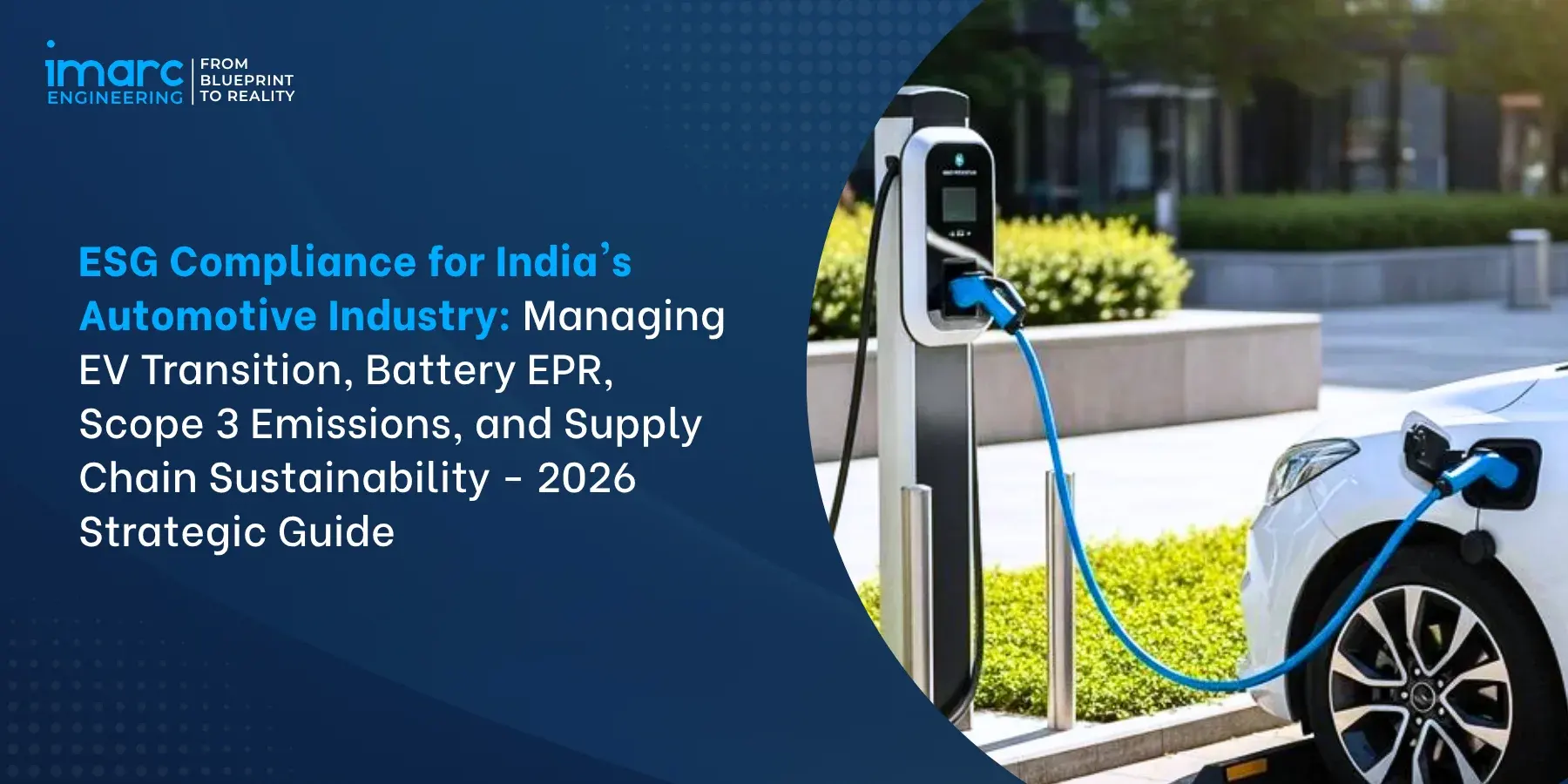
ESG Compliance for India's Automotive Industry: Managing EV Transition, Battery EPR, Scope 3 Emissions, and Supply Chain Sustainability - 2026 Strategic Guide
Introduction
India's automotive industry is in the middle of the most consequential structural transition in its history, simultaneously moving from internal combustion engines toward electric mobility, from linear production toward circular battery and component lifecycles, from intra-factory emissions focus toward value-chain decarbonisation, and from voluntary sustainability disclosure toward assured ESG reporting under SEBI's BRSR Core framework. ESG compliance automotive industry in India has, in this environment, shifted from a periodic disclosure exercise into a strategic capability that materially shapes capital allocation, supplier relationships, customer mandates, and competitive positioning.
Several regulatory and market pressure points are converging on the Indian automotive industry: SEBI's BRSR framework anchored in the 12 July 2023 circular, the Battery Waste Management Rules 2022 mandating EPR for batteries, the PM E-DRIVE Scheme and FAME II ecosystem, PLI Auto (INR 25,938 crore) and PLI ACC (INR 18,100 crore targeting 50 GWh of ACC manufacturing), the EU Carbon Border Adjustment Mechanism requiring embedded-emissions disclosure on steel exports, and global OEM principals demanding supplier-level ESG transparency. These converging requirements leave automotive manufacturers with no option but to build structured ESG programmes.
The scale of what is at stake is reflected in industry research. According to a recent CEEW (Council on Energy, Environment and Water) analysis, indirect emissions, predominantly Scope 3, account for more than 83% of the Indian automotive sector's total emissions footprint, while vehicle production in India is projected to potentially quadruple by 2050 with emissions doubling to around 64 million tonnes of CO2 in a business-as-usual trajectory. The CEEW analysis indicates that the Indian auto industry could cut emissions by up to 87% by 2050 through green energy and low-carbon steel, but only if automotive sustainability in India is reframed as a value-chain transformation rather than as a factory-level efficiency programme.
The companies that are getting this transition right, several major automakers including Mahindra & Mahindra, Tata Motors, and Toyota have committed to net-zero targets under the Science Based Targets initiative (SBTi) are already moving up the maturity curve; those still treating ESG as a reporting exercise risk being structurally outcompeted.
Drawing on IMARC Engineering's experience supporting ESG advisory, BRSR Core readiness, battery EPR compliance, EV transition project work, environmental clearance, and supply-chain decarbonisation engagements across pharmaceutical, EV battery, electronics, specialty chemicals, food, and automotive manufacturers, this guide lays out a structured strategic framework for ESG reporting automotive sector in 2026 India.
You will find a clear view on why automotive ESG has become strategic, the regulatory framework, EV transition compliance, Battery EPR mechanics under the BWMR 2022, Scope 3 emissions strategy, supply-chain sustainability and tier-N engagement, BRSR Core for automotive, common pitfalls, an integrated checklist, and a frequently-asked-questions section. The objective is to make sustainable automotive manufacturing practical and defensible for OEM, Tier-1, Tier-2, and EV-platform leadership teams.
Table of Contents
- Introduction
- Why ESG Has Become Strategic for Indian Automotive in 2026
- The ESG Regulatory Framework for Indian Auto
- Managing the EV Transition - Policy, Scheme, and Compliance
- Battery EPR Compliance Under the BWMR 2022
- Scope 3 Emissions and the Decarbonisation Strategy
- Supply Chain Sustainability and Tier-N Engagement
- BRSR Core for Auto - The Nine Attributes and Value-Chain Disclosure
- Common Mistakes and How to Avoid Them
- Automotive ESG Programme Checklist
- Conclusion
1. Why ESG Has Become Strategic for Indian Automotive in 2026
Understanding why ESG regulations in India have become a board-level priority for automotive manufacturers starts with five structural drivers that have raised the regulatory, financial, commercial, and reputational stakes over the past 3-5 years.
1.1 Regulatory Mandates Are Closing In on the Whole Value Chain
The regulatory perimeter has expanded sharply. SEBI's BRSR is mandatory for the top 1,000 listed companies by market capitalisation since FY 2022-23 - which captures every major Indian automotive OEM, several large Tier-1 suppliers, and the listed parents of EV start-ups. The BRSR Core framework, with its nine attributes requiring reasonable assurance, has been phased in on a glide path covering the top 150 from FY 2023-24, top 250 from FY 2024-25, top 500 from FY 2025-26, and top 1,000 from FY 2026-27.
Value Chain Disclosures - originally targeted at FY 2024-25, now deferred by SEBI to FY 2025-26 - require listed companies to disclose ESG data covering upstream and downstream partners representing at least 2% of purchases or sales, with up to 75% of total value chain activities in scope. This means BRSR effectively reaches deep into the Tier-2 and Tier-3 supplier base whether those suppliers are themselves listed or not.
1.2 The EV Transition Is Reshaping Every Workstream
The shift from ICE to electric mobility - underpinned by the PM E-DRIVE Scheme, PLI Auto and PLI ACC, the March 2024 EV Policy attracting global investors with the USD 500 million minimum-investment / 15% customs-duty pathway, and FAME II's predecessor framework - is reshaping product design, factory configuration, supply chain composition, regulatory engagement, and ESG profile simultaneously.
Companies executing the transition cleanly capture the policy benefits; those that under-invest find themselves locked into legacy ICE economics with declining commercial viability. The transition itself has substantial ESG implications - battery raw materials, mining impacts, cell manufacturing energy intensity, end-of-life battery management - all of which feed directly into the automotive ESG narrative.
1.3 Customer and Capital Markets Pressure Has Intensified
Global OEM principals (European, Japanese, Korean, and US automotive groups) routinely audit their Indian Tier-1 and Tier-2 suppliers on environmental, social, and governance dimensions - emissions intensity, water, waste, labour practices, supply-chain due diligence, anti-corruption controls. International capital - ESG-mandated funds, sustainability-linked debt providers, green-finance specialists - increasingly references ESG performance in pricing and qualification decisions.
The Indian EV finance market alone is projected to reach approximately INR 3.7 lakh crore (USD 50 billion) by 2030 (industry projections), much of it ESG-aligned. Auto companies with robust ESG performance routinely access better pricing on debt and equity than peers with weak performance; the cost-of-capital differential has become material.
1.4 Scope 3 Has Emerged as the Central Decarbonisation Challenge
Industry analyses indicate that Scope 3 emissions automotive industry in India account for more than 83% of the sector's total carbon footprint, the value-chain emissions from raw material extraction (steel, aluminium, plastics, rubber, copper, lithium), upstream component manufacturing, and downstream use-phase emissions over the vehicle's operational life.
Tackling Scope 3 requires coordinated action with hundreds of suppliers, raw material producers (steel, aluminium), logistics providers, and ultimately, the energy grid powering both production and downstream EV use. A manufacturer with a clean Scope 1 and Scope 2 profile but unaddressed Scope 3 is solving roughly 17% of the actual carbon problem; the strategic decarbonisation conversation has shifted decisively to Scope 3.
1.5 The Cost of Non-Compliance Has Risen Sharply
BRSR assurance qualifications create direct cost-of-capital and reputational damage. Battery EPR non-compliance under the BWMR 2022 triggers CPCB enforcement, scheme-portal restrictions, and operational disruption. Customer ESG audit failures result in supplier-list de-rating with global OEMs.
EU CBAM exposure on steel and aluminium content in exported vehicles imposes embedded-carbon-pricing penalties on uncompliant supply chains. Cumulatively, the cost of weak automotive ESG is no longer hypothetical - it manifests in capital cost, customer access, scheme disbursement, and market valuation. The cost of compliant ESG is modest relative to the financial impact of falling behind.
2. The ESG Regulatory Framework for Indian Auto
Indian automotive ESG operates within a multi-layered framework - SEBI's BRSR for capital-markets disclosure, sectoral environmental regulations under the EP Act and Rules, scheme-specific compliance under PLI / FAME / PM E-DRIVE, waste management rules with EPR obligations, EU CBAM for export-oriented manufacturers, and customer audit standards from OEM principals. Mapping these correctly at the strategic level is the foundation of any credible automotive ESG programme.
2.1 The Core Regulatory Instruments
| Instrument | Issuing Authority | Scope |
|---|---|---|
| BRSR / BRSR Core | SEBI | Top 1,000 listed companies; phased BRSR Core assurance |
| Battery Waste Management Rules, 2022 | MoEFCC / CPCB | EPR for all battery producers, importers, and brand owners |
| E-Waste Management Rules, 2022 | MoEFCC / CPCB | EPR for vehicle electronics and EEE |
| Plastic Waste Management Rules (with amendments) | MoEFCC / CPCB | EPR for plastic packaging used in auto distribution |
| Hazardous and Other Wastes Rules, 2016 | MoEFCC / SPCBs | Manufacturing-site hazardous waste authorisation |
| EIA Notification, 2006 | MoEFCC / SEIAAs | Prior Environmental Clearance for vehicle and component plants |
| EU CBAM | European Commission | Embedded-carbon disclosure for steel and aluminium in exports to EU |
| PM E-DRIVE / FAME framework | Ministry of Heavy Industries | EV demand-side incentives and OEM eligibility conditions |
| PLI Auto / PLI ACC | Ministry of Heavy Industries | Manufacturing-incentive schemes with localisation and ESG conditions |
2.2 The BRSR Architecture - Quick Recap for Auto
BRSR is anchored in the National Guidelines on Responsible Business Conduct (NGRBC) and organised around nine principles covering ethics, product responsibility, employees, stakeholders, human rights, environment, public policy advocacy, inclusive growth, and consumer engagement. Within each principle, essential indicators and leadership indicators form a comprehensive disclosure architecture - in total approximately 140 indicators (around 98 essential and around 42 leadership).
For automotive, the most demanding disclosures cluster around: emissions and energy (Principle 6), water and waste (Principle 6), supply chain and human rights (Principles 5 and 8), product responsibility and consumer impact (Principle 9), and governance (Principles 1, 7). BRSR Core then condenses the most material indicators across these principles into a smaller standardised set requiring reasonable assurance.
2.3 The BRSR Glide Path
| FY | Coverage | BRSR Core Assurance |
|---|---|---|
| 2022-23 | Top 1,000 listed (BRSR mandatory) | Voluntary |
| 2023-24 | Top 150 listed | Reasonable assurance on BRSR Core |
| 2024-25 | Top 250 listed | Reasonable assurance on BRSR Core |
| 2025-26 | Top 500 listed | Reasonable assurance + Value Chain Disclosures begin |
| 2026-27 | Top 1,000 listed | Reasonable assurance on BRSR Core (full mandate) |
2.4 Value Chain Disclosures - The Tier-N Reach
SEBI's Value Chain Disclosure requirement extends the BRSR perimeter beyond the listed parent into upstream and downstream partners representing at least 2% of purchases or sales, with up to 75% of total value chain activities in scope. Originally targeted for FY 2024-25, the requirement has been deferred to FY 2025-26 in recognition of the complexity of collecting tier-N data.
For automotive, where supply chains run 3-5 tiers deep and Scope 3 dominates the carbon footprint, value-chain disclosure is the most operationally demanding workstream in the entire BRSR architecture - and the workstream where the gap between mature and immature programmes is most visible.
2.5 The Adjacent Sectoral Layer
Beyond BRSR, automotive ESG must integrate with adjacent sectoral compliance: pollution control consents (CTE/CTO) under the Water Act 1974 and Air Act 1981; hazardous waste authorisations under HOWM Rules 2016; EPR registrations on CPCB portals for batteries (BWMR 2022), plastic packaging, and e-waste; environmental clearance under EIA Notification 2006 for new and expanding plants; factory licensing under the Factories Act 1948; Bharat Stage VI emission compliance and CAFE norms for vehicle products; and increasingly, supplier ESG audits driven by global OEM principals. Treating these as a coordinated programme rather than disconnected workstreams is the operational discipline that distinguishes mature automotive ESG.
3. Managing the EV Transition - Policy, Scheme, and Compliance
The shift to electric mobility is the single most consequential strategic transition for Indian automotive in 2026, affecting product, manufacturing, supply chain, and ESG profile simultaneously. The EV transition in India is being actively shaped by an interconnected policy architecture covering manufacturing incentives, demand-side support, regulatory framework, and ESG expectations.
3.1 The Policy Architecture
| Scheme / Policy | Outlay / Scope | Coverage |
|---|---|---|
| PLI for Auto and Auto Components | INR 25,938 crore | Advanced automotive technology products including EVs and components |
| PLI for Advanced Chemistry Cells (ACC) | INR 18,100 crore | 50 GWh of domestic ACC battery manufacturing capacity |
| PM E-DRIVE Scheme | Replacing FAME II framework | EV demand-side incentives, charging infrastructure, e-buses |
| EV Policy (March 2024) | Global investor pathway | USD 500 million minimum investment with 15% customs duty |
| Battery Waste Management Rules, 2022 | EPR regime | Mandatory EPR for battery producers, importers, brand owners |
| NITI Aayog Circular Economy Action Plan | Strategy document | Circular economy framework for lithium-ion batteries |
3.2 PLI Auto - What It Rewards
The PLI Auto scheme, with a total outlay of INR 25,938 crore, incentivises production of high-value, high-tech automotive components and EV systems through phased disbursement against committed investment and sales milestones. The scheme covers two broad categories — Advanced Automotive Technology (AAT) Products (including EV powertrains, charging components, lithium-ion battery systems, sensors and electronics) and Champion Original Equipment Manufacturer (Champion OEM) Incentive for EVs.
EV transition advisory for automotive OEMs in India typically focuses on aligning product roadmap, manufacturing capacity, and supply chain to the AAT product list and the value-addition trajectories the scheme requires. The structural commitments — investment, capacity, value addition, ESG performance — require integrated project management to capture full disbursement.
3.3 PLI ACC - The Battery Manufacturing Pillar
The PLI ACC scheme, with INR 18,100 crore outlay, targets 50 GWh of domestic Advanced Chemistry Cell manufacturing capacity - the foundational supply-side investment to reduce India's dependence on battery imports for its EV ambitions. The scheme was awarded to selected bidders with detailed milestones for investment, capacity commissioning, and domestic value addition.
Implementation has been mixed: industry reports indicate that as of early 2025, none of the beneficiaries had met the December 2024 milestones, prompting the budget allocation for FY 2024-25 disbursements to be reduced from INR 250 crore to INR 15.42 crore; beneficiary companies subsequently sought milestone extensions in 2025. The mixed performance underscores the complexity of building gigawatt-scale battery manufacturing - and the importance of disciplined execution for any company pursuing PLI economics.
3.4 The March 2024 EV Policy
The March 2024 EV Policy is designed to attract major global EV manufacturers into Indian manufacturing. It allows qualifying foreign EV makers to import a limited number of vehicles at a reduced customs duty of 15% (versus the standard higher rate) in exchange for committing to a minimum investment of USD 500 million and establishing local manufacturing within a defined timeline.
The policy is conditional on phased domestic value-addition milestones. For global EV majors evaluating India entry, this policy provides a structured commercial pathway; for Indian companies, it raises the competitive bar by accelerating the arrival of global capacity into the domestic market.
3.5 Industry Performance Markers
Practical performance markers from 2025 illustrate the maturity of the framework: in March 2025, Ola Electric became the first 2-wheeler maker to receive PLI-Auto disbursement of INR 73.7 crore - a meaningful milestone showing that the scheme architecture is delivering for committed performers. Conversely, battery PLI disbursements stalled in early 2025 with no beneficiaries having met December 2024 milestones, demonstrating that scheme economics are only available to companies executing the underlying capacity build cleanly.
The Indian EV finance market is projected to reach approximately INR 3.7 lakh crore (around USD 50 billion) by 2030, reflecting the scale of capital expected to flow into the transition over the next 5-7 years.
4. Battery EPR Compliance Under the BWMR 2022
The Battery Waste Management Rules, 2022 (BWMR), notified under the Environment (Protection) Act 1986, created India's first comprehensive Extended Producer Responsibility regime for batteries — lead-acid, lithium-ion, and other categories. Battery EPR compliance in India is now a mandatory obligation for all battery producers, importers, and brand owners; for automotive companies, it directly affects EV strategy, vehicle design, and supplier relationships.
4.1 Scope and Obligated Entities
BWMR 2022 obligates Producers (those who manufacture batteries in India), Importers (those who import batteries or battery-containing products into India), and Brand Owners (those who put batteries on the market under their brand). Automotive OEMs typically fall under multiple categories - producers of vehicle-integrated batteries (especially for EVs), brand owners of the vehicle itself (with embedded batteries), and importers (for batteries or battery components sourced internationally).
Battery categories under the rules include: Portable Batteries (used in consumer electronics, power tools); Automotive Batteries (used in conventional ICE vehicles, primarily lead-acid); Electric Vehicle Batteries (high-voltage Li-ion for EVs and hybrids); and Industrial Batteries (used in industrial applications, UPS, energy storage).
4.2 EPR Targets and Performance Commitments
Producers must achieve increasing collection and recycling targets over time, expressed as a percentage of the battery weight placed on the market in prior years (with sliding-scale calculations based on average battery life by category). The targets escalate annually, requiring producers to build collection infrastructure (collection centres, take-back points, reverse logistics), engage authorised recyclers, and obtain EPR Certificates corresponding to actual recycling performed. Failure to achieve targets attracts environmental compensation penalties under CPCB enforcement.
4.3 The EPR Portal and Certificate Workflow
CPCB operates a centralised EPR portal for batteries (parallel to the e-waste and plastic-waste portals) where producers register, declare quantities placed on market, contract with authorised recyclers, obtain EPR Certificates, and file periodic returns.
The certificate workflow links recycler-side processing to producer-side obligation - the producer obtains certificates from authorised recyclers corresponding to verified recycling and uses them to demonstrate compliance with annual targets. Audit-readiness of this workflow is increasingly important; CPCB has tightened oversight of certificate trading and verification over 2024-2025.
4.4 Operational Compliance Requirements
- Registration on the CPCB centralised battery EPR portal at the producer level
- Quarterly and annual returns declaring batteries placed on market
- Annual EPR target compliance with documented certificate evidence
- Tie-up with CPCB-authorised battery recyclers / refurbishers
- Reverse logistics infrastructure for collected end-of-life batteries
- Labelling on batteries indicating EPR producer responsibility
- Record-keeping for sales, collection, and recycling tonnages
- Coordination with dealer and service-centre network for collection
4.5 The Circular Economy Imperative
Beyond statutory compliance, battery EPR is strategically important because lithium-ion battery raw materials (lithium, cobalt, nickel, manganese, graphite) are concentrated in a small number of countries and represent a significant supply-chain risk for the Indian EV value chain. Recovering these materials from end-of-life batteries - urban mining - is essential to reducing import dependence and de-risking long-term supply.
NITI Aayog's Circular Economy Action Plan for lithium-ion batteries provides the strategic framework; the BWMR 2022 provides the operational mandate. Automotive companies that treat battery EPR as a circular-economy enabler rather than a compliance overhead routinely capture additional value through secondary materials access and supply-chain resilience.
5. Scope 3 Emissions and the Decarbonisation Strategy
Scope 3 is where the strategic centre of automotive decarbonisation lies. Industry research consistently shows that Scope 3 emissions automotive industry contributions exceed 83% of the sector's total footprint in India, dominated by raw material extraction and processing, upstream component manufacturing, logistics, and downstream vehicle use-phase emissions. Scope 3 emissions accounting for automotive companies in India has therefore become the most operationally demanding and strategically consequential workstream in the entire automotive ESG architecture.
5.1 The 15 Scope 3 Categories Under the GHG Protocol
The GHG Protocol Corporate Value Chain (Scope 3) Standard defines 15 distinct Scope 3 categories - 8 upstream (purchased goods and services, capital goods, fuel- and energy-related activities, upstream transportation and distribution, waste generated in operations, business travel, employee commuting, upstream leased assets) and 7 downstream (downstream transportation and distribution, processing of sold products, use of sold products, end-of-life treatment of sold products, downstream leased assets, franchises, investments).
For automotive, the dominant categories are typically: Category 1 (Purchased Goods and Services - steel, aluminium, components); Category 11 (Use of Sold Products - vehicle operational emissions over lifetime); Category 4 (Upstream Transportation and Distribution); and Category 12 (End-of-Life Treatment of Sold Products - vehicle and battery end-of-life). Categories 1 and 11 together typically account for 70-80% of total automotive Scope 3.
5.2 Material Pathway - The Steel and Aluminium Question
Steel and aluminium together represent the largest single contributor to vehicle production-stage Scope 3 emissions. The CEEW analysis indicates that switching to green steel (DRI-EAF with green hydrogen, or scrap-based EAF) and low-carbon aluminium (using renewable electricity-powered smelting) can deliver substantial emission reductions in the automotive value chain.
The challenge: green steel and low-carbon aluminium are currently produced at modest commercial volumes globally and at price premiums that automotive customers must accept. Indian automotive OEMs increasingly engage upstream with steel and aluminium suppliers - long-term green-steel offtake agreements, joint decarbonisation projects, technology partnerships - as the practical pathway to material-side Scope 3 reduction.
5.3 Use-Phase Decarbonisation - The EV Transition Connection
Vehicle use-phase emissions (Category 11) are determined by powertrain choice (ICE vs hybrid vs full EV), driving behaviour, vehicle efficiency, and - for EVs - the carbon intensity of the electricity grid powering them. The EV transition reduces use-phase Scope 3 directly; the magnitude of reduction depends on grid decarbonisation pace.
India's 500 GW non-fossil capacity target by 2030 directly affects how clean the EV value proposition becomes from a Scope 3 perspective - cleaner grid translates to cleaner EV use-phase emissions. Companies modelling Scope 3 use-phase reductions typically use scenario analysis covering current grid mix, 2030 grid mix, and 2040 grid mix to demonstrate the trajectory.
5.4 Scope 3 Measurement - The Practical Methodology
Scope 3 measurement uses two main methodologies under the GHG Protocol: spend-based (multiplying procurement spend by emission factors from databases like DEFRA, EPA, India-specific GHG Platform) and activity-based (using physical activity data - tonnes of steel purchased, kWh of electricity, kilometres of logistics - with material-specific emission factors).
Spend-based is faster to deploy but less precise; activity-based is more demanding but produces more defensible numbers. Most mature programmes start with spend-based across all 15 categories, then progressively transition to activity-based for the highest-impact categories. ISO 14064 family standards (GHG quantification and verification) and the GHG Protocol provide the methodological backbone.
5.5 Supplier Engagement - The Critical Lever
Because Scope 3 originates in the supply chain, supplier engagement is the operational lever that determines whether reduction targets are achievable. Mature programmes structure engagement on a 80/20 principle - the top 20% of suppliers (by spend or by emissions intensity) typically account for 80% of Category 1 Scope 3.
Engagement progresses through onboarding (ESG questionnaire integrated into supplier qualification), baseline measurement (annual emissions disclosure), target setting (alignment with the buyer's SBTi commitments), and joint reduction projects (energy efficiency, renewable energy procurement, material substitution). Several major Indian automakers - Mahindra & Mahindra, Tata Motors, Toyota - have publicly committed to SBTi pathways and engage suppliers under their decarbonisation programmes accordingly.
5.6 EU CBAM and Cross-Border Implications
The EU Carbon Border Adjustment Mechanism (CBAM) imposes carbon-pricing on imported goods with high embedded emissions - currently covering steel, aluminium, cement, fertiliser, hydrogen, and electricity. For Indian automotive component exporters and vehicle exporters to the EU, CBAM disclosure obligations apply (with full financial liability from January 2026 in the EU's transitional schedule) - making embedded-emission tracking of steel and aluminium content in exported products mandatory.
CBAM essentially extends supplier-engagement and Scope 3 disclosure requirements globally for any Indian automotive operator with EU export exposure, and is a strong external driver for tighter supply-chain emissions data.
6. Supply Chain Sustainability and Tier-N Engagement
Automotive supply chains run 3-5 tiers deep, with thousands of suppliers across raw material producers, component manufacturers, sub-assembly providers, and logistics operators. Supply chain sustainability automotive is therefore one of the most operationally demanding ESG workstreams — and the workstream that BRSR value-chain disclosures, customer ESG audits, and EU CBAM are most aggressively pushing.
6.1 The Tier Structure - Why Depth Matters
In a typical automotive supply chain, Tier-1 suppliers deliver complete sub-systems (engine, transmission, electronics, body panels) directly to the OEM; Tier-2 suppliers deliver components to Tier-1 (castings, machined parts, electronics components); Tier-3 suppliers deliver raw materials and basic components to Tier-2 (steel, aluminium, plastics, rubber, glass); Tier-4 covers raw material producers (iron ore, bauxite, polymer feedstocks).
Most automotive Scope 3 emissions originate at Tier-2, Tier-3, and Tier-4 - well outside the OEM's direct contractual relationship. Effective supply chain sustainability programmes therefore require cascading engagement - the OEM engages Tier-1; Tier-1 engages Tier-2; and so on - with consistent methodology, data formats, and improvement expectations across tiers.
6.2 The Six Pillars of Automotive Supplier ESG
| Pillar | Coverage | Typical Indicators |
|---|---|---|
| Climate | GHG emissions, energy, renewable share | Scope 1, 2, 3; energy intensity; RE100 progress |
| Water and waste | Water consumption, effluent, waste | Water intensity; ZLD compliance; hazardous waste |
| Materials | Raw material origin, traceability, circularity | Recycled content; conflict minerals; supplier sourcing |
| Labour and human rights | Working conditions, wages, freedom of association | Living wage; freedom of association; modern-slavery audit |
| Health and safety | OHS performance, training, incidents | LTIFR; fatality rate; safety training hours |
| Governance and ethics | Anti-corruption, data privacy, supplier code | Code of conduct sign-off; audit attestation |
6.3 The Supplier-Engagement Model
Mature sustainable supply chain consulting for the auto industry in India structures supplier engagement across five stages: (1) Onboarding- ESG questionnaire integrated into supplier qualification and contracting; (2) Baseline- annual ESG performance disclosure with audit-ready evidence; (3) Target setting- reduction commitments aligned to the buyer's SBTi targets and BRSR Core trajectory; (4) Joint projects- specific initiatives on energy efficiency, renewable energy procurement, material substitution, ergonomics, and labour standards; (5) Performance management- ESG performance reflected in supplier scorecards alongside quality, cost, and delivery.
Suppliers that improve receive preferential consideration in future business; suppliers that fail to progress face de-rating or exit. This transformation of supplier management from a sourcing function into a sustainability lever represents one of the defining shifts in modern automotive procurement.
6.4 Supplier Capacity Building
A practical reality: many Tier-2 and Tier-3 suppliers are small and medium enterprises without dedicated ESG teams, robust data systems, or familiarity with disclosure standards. Effective programmes invest in capacity building, structured training on emissions calculation, basic energy management, waste management, and labour standards; tool support for data collection; phased disclosure expectations matched to supplier maturity; and joint problem-solving on capex barriers.
The MSME Sustainable (ZED) Certification scheme under the Ministry of MSME provides a complementary infrastructure layer, embedding sustainability practices among Indian SMEs that often serve as automotive Tier-2 and Tier-3 suppliers. This makes ZED a valuable enabler for automotive companies building upstream supply chain ESG capability.
6.5 Audit and Verification
Supplier ESG data must be audit-ready to support BRSR Core assurance and customer audit defensibility. Mature supply chain decarbonization services for automotive manufacturers use verification approaches that include: supplier self-declarations with on-site sample verification; third-party assurance on key supplier data; EcoVadis or similar industry rating systems for routine credentials; and specific audits for high-risk areas such as modern slavery, conflict minerals, and hazardous chemicals.
The verification effort scales with supplier criticality and disclosed risk. Low-risk routine suppliers may be verified once every 2-3 years, while high-impact suppliers face annual verification. This risk-based approach balances assurance quality with administrative burden on both the buyer and the supplier base.
6.6 Logistics and Downstream
Beyond manufacturing supply chain, automotive ESG covers logistics and downstream operations. Logistics decarbonisation involves modal shift, fleet electrification, carrier engagement, and route optimisation. Dealer and service-centre ESG covers energy efficiency, water and waste management, labour practices, and battery-take-back infrastructure for end-of-life management. Mature programmes integrate dealer ESG performance into network management criteria alongside sales performance and customer satisfaction.
7. BRSR Core for Auto - The Nine Attributes and Value-Chain Disclosure
BRSR Core is the assured subset of BRSR that condenses the most material indicators into nine attributes requiring reasonable assurance. Understanding BRSR compliance requirements for automotive companies is the foundation of any credible automotive ESG programme, the framework that auditor, regulator, and customer assurance ultimately converge on.
7.1 The Nine BRSR Core Attributes
BRSR Core covers nine attributes drawn from the broader BRSR framework: (1) GHG Footprint- Scope 1, Scope 2, and Scope 3 emissions and intensity metrics; (2) Water Footprint- water withdrawal, consumption, and discharge by source; (3) Energy Footprint- total energy consumption and renewable energy share; (4) Embracing Circularity- waste generation, recycling, and reuse; and (5) Enhancing Employee Wellbeing and Safety- LTIFR, employee health spending, and training metrics.
The remaining attributes are: (6) Enabling Gender Diversity in Business- women representation, gender pay gap, and leadership diversity; (7) Enabling Inclusive Development- local community representation and MSME procurement; (8) Fairness in Engaging with Customers and Suppliers- complaint resolution and fair trade practices; and (9) Open-ness of Business- whistleblower mechanisms, anti-corruption training, and regulatory action history. Each attribute includes specific KPIs that require reasonable assurance from an independent assurance provider.
7.2 What Auto Companies Disclose Under Each Attribute
- GHG Footprint: Total Scope 1, 2 absolute emissions and intensity; Scope 3 reporting (mandatory for BRSR Core attribute disclosure; mandatory across Categories 1, 4, 11 for most auto companies)
- Water Footprint: Plant-level water consumption, intensity per vehicle produced; ZLD compliance status; sources (municipal, ground, surface)
- Energy Footprint: Total energy from grid; on-site renewable; off-site renewable through PPAs; intensity per vehicle
- Embracing Circularity: Hazardous waste generated and disposed; non-hazardous waste recycled; battery EPR target compliance; end-of-life vehicle handling
- Employee Wellbeing and Safety: LTIFR; medical and life insurance coverage; safety training hours; fatality count; occupational illness
- Gender Diversity: % women in workforce; % women in leadership; gender pay gap; women on board
- Inclusive Development: Local community employment; MSME procurement spend; supplier-located representation
- Customer and Supplier Fairness: Complaint resolution time; supplier ESG audit coverage; fair-trade certifications
- Open-ness: Whistleblower complaints received and resolved; anti-corruption training coverage; regulatory action history
7.3 Value-Chain Disclosure Implementation
Value-chain disclosure, deferred from FY 2024-25 to FY 2025-26, requires listed automotive companies to extend BRSR Core disclosures into the value chain covering upstream and downstream partners representing at least 2% of purchases or sales, with up to 75% of total value chain activities in scope. For OEMs, this typically covers the top 20-30 Tier-1 suppliers and the top 10-20 dealer/distribution partners; for Tier-1 suppliers, it cascades into their own top 20-30 Tier-2 suppliers.
The operational mechanics require: (a) supplier ESG questionnaire aligned to BRSR Core attributes; (b) annual data collection cycle; (c) data validation and aggregation tooling; (d) assurance-ready evidence storage; (e) consolidated value-chain disclosure in the annual BRSR. Implementing the value-chain disclosure capability is the single most operationally demanding workstream in current automotive ESG programmes. The question of how to implement BRSR Core in automotive companies in practice converges on getting this value-chain data architecture right.
7.4 Assurance Readiness
Reasonable assurance on BRSR Core requires evidence beyond self-declaration. Audit-ready documentation includes: source documents (utility bills, payroll records, manifest copies, EPR certificates, financial accounts); documented calculation methodologies and assumptions; emission factor sources with provenance; control evidence (sign-offs, approvals, change logs); third-party validation evidence where available.
The assurance provider (an independent assurance firm) tests the disclosed numbers against this evidence and issues a reasonable assurance report. Companies preparing for first-year assurance routinely face material qualifications when documentation discipline has been weak; preparation time of 6-9 months is typical for clean first-year assurance.
8. Common Mistakes and How to Avoid Them
The mistakes below are the recurring patterns we see across automotive ESG engagements - and the ones most likely to produce assurance qualifications, customer audit findings, missed scheme disbursements, or strategic competitive disadvantage. Each is paired with the discipline that prevents it.
8.1 Treating ESG as a Reporting Exercise Rather Than a Strategic Capability
The most consequential failure mode is treating ESG as a year-end disclosure exercise - the sustainability team produces the BRSR document; the rest of the organisation continues as before. The pattern: impressive disclosures with stable underlying performance; assurance qualifications when the auditors trace the numbers back to operational reality; customer audit findings as global OEM principals probe behind the disclosure.
Discipline: position ESG as a strategic capability integrated into product strategy, capital allocation, procurement, manufacturing, and human capital - with the BRSR document being the by-product of strategic action, not the primary deliverable.
8.2 Underestimating Scope 3 Data Complexity
Scope 3 emissions data covers 15 categories, originates outside the company's direct control, and depends on supplier engagement, methodology choices, and emission factor sources. Companies that attempt to deliver Scope 3 reporting without a structured measurement methodology, supplier engagement framework, and validated emission factor library routinely produce numbers that are inconsistent year-over-year, contestable under assurance, and not credible to customer auditors.
Discipline: design the Scope 3 architecture systematically - GHG Protocol-aligned methodology, structured supplier engagement, validated emission factors, audit-ready evidence trail; expect 12-24 months to build a credible Scope 3 capability from scratch.
8.3 Battery EPR Compliance as Tail-Risk Rather Than Strategic Lever
Many automotive companies treat battery EPR as a routine compliance line item managed by environmental teams in isolation. The pattern: certificate trading is treated as a transactional buy of EPR certificates rather than as part of a circular-economy strategy; producer collection infrastructure is underbuilt; supplier and dealer-network coordination on take-back is weak; the EPR investment delivers compliance but no strategic value.
Discipline: position battery EPR as part of the circular-economy and supply-chain resilience strategy - building genuine collection and recycling infrastructure that simultaneously delivers compliance and reduces dependence on imported raw materials over time.
8.4 Weak Tier-N Supplier Engagement
Companies that limit supplier ESG engagement to Tier-1 self-declarations - without verification, target-setting, or cascading to Tier-2 and below - find their Scope 3 disclosures challenged when auditors and customer auditors trace data back through the chain.
Discipline: structured five-stage supplier engagement (onboarding, baseline, target setting, joint projects, performance management); verification proportionate to supplier criticality; supplier capacity building for Tier-2/3 SMEs that often lack independent ESG capability; cascading expectations through the supply chain via Tier-1 partners.
8.5 Fragmenting BRSR Core, Battery EPR, EV Compliance, and Sectoral Approvals
ESG, EPR, EV scheme compliance, environmental approvals, factory licensing, fire safety, and labour compliance all overlap - and yet are commonly managed by separate teams with separate calendars and separate reporting structures. The pattern: inconsistencies surface during audit; data points conflict across filings; integration of insight is lost.
Discipline: build an integrated compliance and ESG operating model with one data backbone feeding BRSR, EPR returns, environmental disclosures, scheme reporting, and customer ESG audits from validated source data; coordinate across regulatory, sustainability, environmental, and operational teams under unified governance.
8.6 Misjudging the EV Transition Capital Requirements
Companies that under-invest in the EV transition - holding too long to ICE platforms, deferring EV-specific manufacturing capacity, treating EV as an adjacent business rather than a strategic platform - find themselves losing PLI economics, customer relevance, and ESG narrative simultaneously.
Discipline: align EV transition strategy with PLI Auto and PLI ACC scheme economics; commit capacity build-up early; integrate EV into core operations rather than running it as a separate division; align ESG, financial, and operational reporting around the transition.
8.7 Inadequate Assurance Readiness for BRSR Core
Reasonable assurance on BRSR Core requires source documentation, calculation methodology transparency, and evidence trails - levels of rigour that exceed traditional internal sustainability reporting practice. Companies preparing for first-year assurance routinely face material qualifications because documentation discipline has been weak.
Discipline: 6-9 months pre-assurance preparation; structured documentation backbone; calculation methodologies and assumptions documented; emission factor sources with provenance; control evidence; pre-assurance internal audit to identify and close gaps.
8.8 Ignoring EU CBAM and Other External Drivers
Indian automotive exporters with EU exposure face CBAM obligations from January 2026 in the EU's transitional schedule. Companies that have not built embedded-emission data on steel, aluminium, and other CBAM-covered inputs to their exported products will face commercial and disclosure consequences. Beyond CBAM, customer ESG audits from European, Japanese, Korean, and US OEM principals impose their own data and performance expectations.
Discipline: map all external ESG drivers (CBAM, customer audits, SBTi, ESG-linked financing) alongside Indian statutory frameworks (BRSR, EPR, environmental) and build a consolidated programme that addresses all of them with one data backbone.
9. Automotive ESG Programme Checklist
The checklist below consolidates the operational decision points into a structured framework that operations, sustainability, regulatory, and project teams can apply directly to their automotive ESG programme. It covers the practical mechanics of ESG due diligence for automotive suppliers in India, BRSR Core readiness, and integrated value-chain compliance.
9.1 Governance and Strategy Phase
- Board-level ESG governance with named accountabilities for BRSR, EPR, climate, supply chain
- Five-year ESG strategy aligned with corporate strategy and PLI / EV transition commitments
- SBTi or equivalent decarbonisation target validated; net-zero pathway documented
- Materiality assessment refreshed with stakeholder input
- ESG performance integrated into executive incentive structure
- Integrated programme office linking regulatory, sustainability, operations, procurement, and EV transition teams
9.2 BRSR Core Readiness Phase
- BRSR mandate applicability confirmed against listing status and market-cap glide path
- Nine BRSR Core attributes mapped to plant and entity data sources
- Source documentation backbone built (utility bills, payroll, EPR certificates, financial accounts)
- Calculation methodologies documented for each attribute
- Internal pre-assurance audit conducted 4-6 months before official assurance
- Independent assurance provider engaged with clear scope
- Audit-ready evidence storage and retrieval system in place
9.3 Battery EPR Phase
- CPCB centralised battery EPR portal registration completed for all obligated entities
- Battery quantities placed on market tracked with audit trail
- Tie-ups with CPCB-authorised battery recyclers in place
- Reverse logistics infrastructure for end-of-life collection through dealers/service centres
- EPR certificate procurement aligned to annual target compliance
- Quarterly and annual returns filed on time
- Labelling on batteries indicating EPR producer responsibility
9.4 EV Transition Phase
- EV product roadmap aligned with PLI Auto AAT product list
- Manufacturing capacity build-up calendar aligned with PLI commitments
- Domestic value-addition trajectory documented and on track
- Quarterly PLI reporting to Ministry of Heavy Industries / Project Management Agency
- Battery cell sourcing strategy (PLI ACC participation or supplier engagement)
- Charging infrastructure partnerships and PM E-DRIVE eligibility
9.5 Scope 3 and Supply Chain Phase
- 15-category GHG Protocol Scope 3 inventory developed
- Dominant categories identified (typically Category 1 purchased goods and Category 11 use-phase)
- Activity-based methodology in place for top 5-6 categories
- Top 20% suppliers (by spend / emissions) engaged structurally
- Annual supplier ESG questionnaire with audit-ready responses
- Supplier capacity-building programme for SME Tier-2/3 partners
- Joint decarbonisation projects with key suppliers (energy efficiency, RE, materials)
- EU CBAM exposure assessed for EU-exposed export streams
9.6 Operational Compliance Phase
- CTE / CTO under Water Act 1974 and Air Act 1981 current at all plants
- Hazardous waste authorisation under HOWM Rules 2016
- Form V Annual Environment Statement filed by 30 September
- Plastic Waste EPR registration and target compliance
- E-Waste EPR registration and target compliance
- Bharat Stage VI and CAFE compliance for ICE products
- Fire NOC, factory licence, environmental clearances renewed as required
9.7 Continuous Improvement Phase
- Quarterly tracking against ESG KPIs at plant and entity level
- Annual materiality reassessment with stakeholder consultation
- Post-assurance lessons-learned captured for next cycle
- Customer ESG audit responses tracked and learnings fed forward
- Capacity-building investments in internal ESG team
Conclusion
India's automotive industry is navigating one of the most consequential strategic transitions of any global automotive market simultaneously decarbonising production, transitioning to electric mobility, building circular battery infrastructure, and reporting transparently against assured ESG frameworks. ESG compliance automotive industry in India is, in this environment, no longer a periodic disclosure exercise but a strategic capability that materially shapes capital allocation, customer relationships, supplier engagement, and competitive position.
Three closing reminders. First, treat ESG as a strategic capability integrated into product, manufacturing, and supply chain rather than as a year-end reporting exercise - the value differential between strategic and tactical framing is measured in customer mandates, capital cost, and scheme disbursement.
Second, build the value-chain capability deliberately - Scope 3 measurement, supplier engagement, tier-N cascading, and supplier capacity-building together form the most operationally demanding ESG workstream and the area where competitive advantage is decided.
Third, align EV transition, PLI execution, battery EPR, BRSR Core, and adjacent sectoral compliance under one integrated programme - the scheme economics, regulatory compliance, and ESG narrative reinforce each other when coordinated, and undermine each other when fragmented.
BUILDING AN AUTOMOTIVE ESG PROGRAMME?
Get end-to-end ESG advisory and execution from IMARC Engineering. Our team supports OEMs, Tier-1, Tier-2, and EV platform companies across BRSR Core preparation and assurance readiness; battery EPR registration and target compliance; Scope 3 measurement and decarbonisation strategy; supplier engagement and capacity building; EV transition advisory and PLI alignment; EU CBAM exposure management. Integrated execution with verifiable expertise across the automotive ESG perimeter.
→ Schedule a free automotive ESG scoping consultation with an IMARC specialist
Frequently Asked Questions
No—BRSR compliance automotive companies applies only to top 1,000 listed firms, covering major automotive OEMs and large Tier-1 suppliers. However, non-listed suppliers face indirect pressure as listed OEM customers demand value-chain disclosure and lenders increasingly reference ESG performance. For most material suppliers, ESG reporting in automotive sector has become a commercial necessity even without direct obligation.
Building from scratch takes 18-30 months: governance (3-6 months), data architecture (6-12 months), Scope 3 emissions automotive industry methodology with supplier engagement (12-18 months), BRSR Core readiness (12-18 months), and EV transition integration. Existing automotive sustainability capability compresses timelines; starting from zero requires the full duration.
Practically, no. Global OEM principals and listed OEM customers now contractually require supplier ESG participation as a business condition. Resisting suppliers face de-ration, restricted allocation, and eventual exit. Mature programmes provide capacity-building support to Tier-2/3 SMEs, recognising that supply chain sustainability in automotive requires help, not just enforcement.
A mid-size automotive OEM with multiple plants spends multi-crore annually on ESG programme delivery—a small fraction of value at stake. Assurance qualification risk, customer mandate loss, and PLI disbursement risk individually can exceed annual cost. ESG compliance in automotive industry in India investment is strategic risk management, not a mere cost line item.
PLI Auto and PLI ACC scheme disbursements increasingly reference ESG performance through associated requirements. Companies meeting milestones capture disbursements; those missing them lose substantial value. Aligning ESG infrastructure with PLI project execution, same data backbone and governance maximises both compliance and scheme economics. Treating them separately routinely creates gaps.
IMARC provides end-to-end automotive ESG advisory, BRSR Core readiness and assurance, value-chain disclosure, battery EPR compliance under BWMR 2022, Scope 3 emissions automotive industry measurement, supplier capacity-building, EV transition and PLI Auto/PLI ACC alignment, EU CBAM exposure management, and integrated governance. Our team combines ESG regulations in India expertise with experience across OEMs, Tier-1/2 suppliers, and EV platforms.
IMARC supports automotive sustainability in India across passenger/ commercial vehicle OEMs, two/three-wheeler manufacturers, EV pure-play platforms, battery and ACC manufacturers, auto component suppliers (Tier-1/2), automotive electronics, and adjacent segments (logistics, end-of-life management).
Recent Post
Trusted by Industry Leaders
We partner with global enterprises and ambitious businesses across sectors to deliver operational excellence, strategic insights, and sustainable growth through integrated solutions.












Success in Their Words
Real feedback from clients across industries. Discover how our solutions delivered measurable impact and operational excellence.

I wanted to express my sincere appreciation for your efforts in handling this matter. Your dedication and commitment have been truly commendable, and it is evident that you have put in tremendous hard work and expertise into resolving the issues at hand. We are greatly interested in continuing our collaboration with you in the future, as your professionalism and reliability have made you a trusted partner. Thank you once again for your invaluable contribution. We look forward to strengthening our partnership ahead.

It has been a pleasure working with the IMARC team. The insights provided were structured, clear, and highly valuable, helping us strengthen both our technical and financial planning with confidence. We deeply appreciate the team’s professionalism, responsiveness, and attention to detail throughout the engagement. Every requirement was well understood and effectively incorporated, resulting in a comprehensive and actionable output. Overall, our experience has been excellent, and I would gladly recommend IMARC to organizations seeking a reliable research partner.

Your service is truly exceptional. Working with the IMARC team has been a seamless and professional experience. The clarity of communication, responsiveness to queries, and consistent support at every stage made the entire engagement highly efficient. The insights shared were well-structured, practical, and perfectly aligned with our requirements, helping us make informed decisions with confidence. Overall, the dedication and professionalism demonstrated by your team stand out, and I would be glad to recommend IMARC as a reliable and trustworthy research partner.

IMARC did an outstanding job in preparing our study. They were punctual, precise, and consistently responsive throughout the entire process. The team delivered all the data we required in a clear, well-organized, and highly professional format. Their strong attention to detail, combined with their ability to meet every deadline without compromising quality, truly set them apart. Overall, their reliability and commitment made them an exceptional partner for our project, and we would gladly work with them again in the future.

IMARC made the whole process incredibly easy from start to finish. Everyone I interacted with via email was polite, professional, and straightforward to deal with, always keeping their promises regarding delivery timelines and remaining consistently solutions-focused. From my very first contact, I appreciated the professionalism and support shown by the entire IMARC team. I highly recommend IMARC to anyone seeking timely, affordable, and reliable information or advice. My experience with IMARC was excellent, and I truly cannot fault any aspect of it.

I’d like to express my sincere gratitude for the excellent work you accomplished with the study. Your ability to quickly understand our requirements and deliver high-quality results under tight timelines truly reflects your expertise, exceptional work ethic, and unwavering commitment to your customer’s success. The professionalism and responsiveness you demonstrated throughout the process made a significant difference. Our entire team and company are incredibly thankful for your dedication, reliability, and support. Once again, thank you for your outstanding contribution.