Manufacturing
June 10 2026
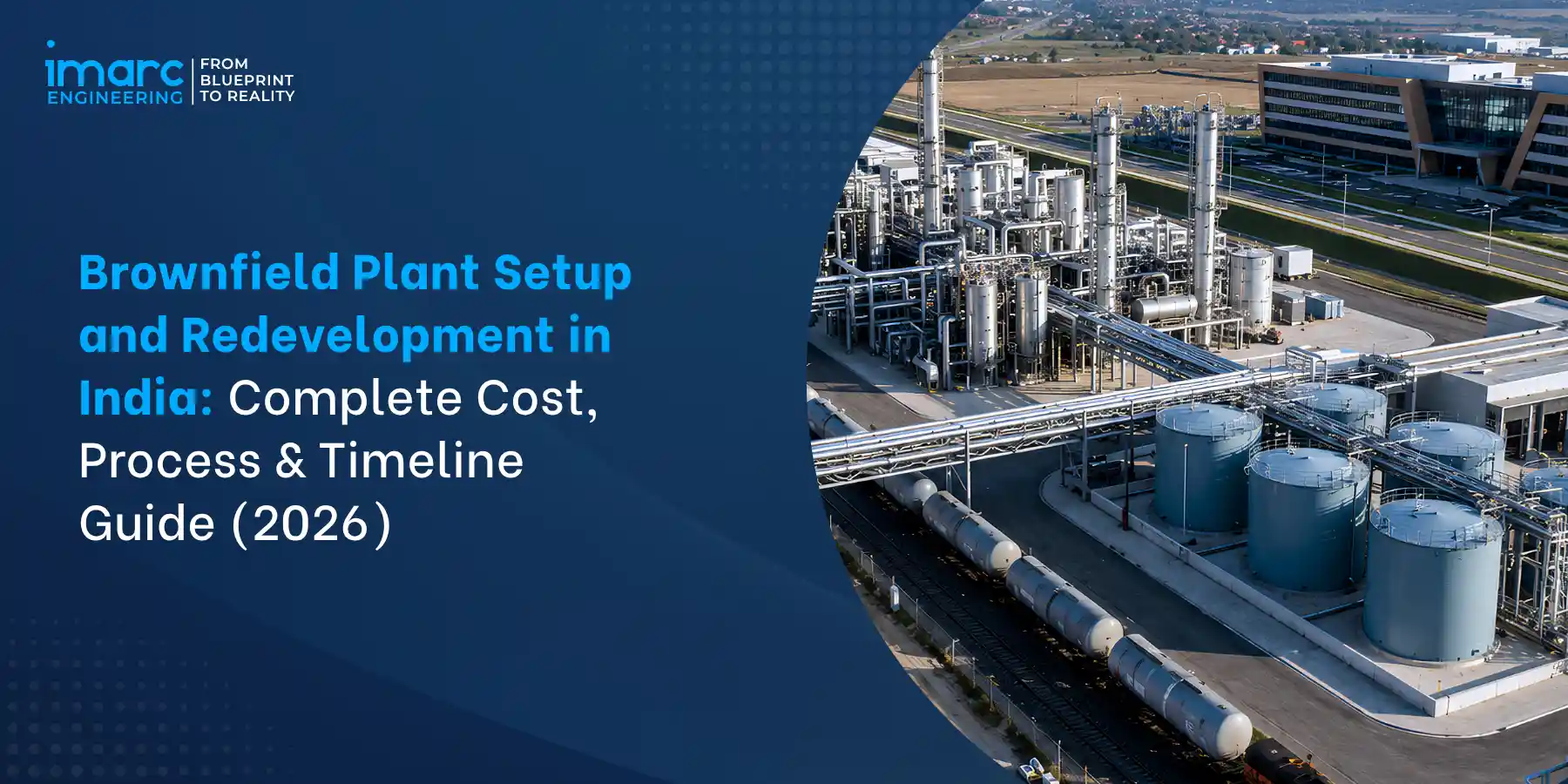
Brownfield Plant Setup and Redevelopment in India: Complete Cost, Process & Timeline Guide (2026)
Introduction
For Indian manufacturers in 2026, the key decision is often not whether to invest, but whether to pursue a greenfield project or expand and modernise existing facilities. Across pharmaceuticals adapting to revised Schedule M requirements, EV battery and automotive manufacturers scaling under the PLI programme, electronics and chemical companies meeting BIS QCO requirements, and food businesses responding to evolving FSSAI standards, brownfield project management in India has become a preferred investment route.
Brownfield projects are also being driven by ESG initiatives, energy-efficiency upgrades, and Industry 4.0 adoption across sectors such as textiles, engineering, automotive, and food processing. By leveraging existing infrastructure, companies can expand capacity and improve operational performance with lower capital intensity. Compared with greenfield projects, brownfield developments typically deliver 40–60% lower CAPEX per unit of additional capacity and reduce project timelines by 30–50%. They also face fewer land acquisition and regulatory challenges, making them attractive for faster growth.
However, these advantages come with greater execution complexity. The biggest challenge in facility expansion project management is delivering construction, upgrades, and commissioning while maintaining ongoing production, safety, quality, and customer commitments.
The scale of brownfield activity across Indian manufacturing is significant. Cumulative manufacturing FDI inflows exceeded USD 165 billion over the past decade per DPIIT data, with manufacturing GVA growth above 7% during FY 2025-26 and Index of Industrial Production growth of 3% during April-September 2025-26. A substantial share of this growth is delivered through brownfield plant setup in India rather than greenfield additions — because existing operators leveraging existing land, utility, and workforce footprints can commission new capacity faster and cheaper than starting from scratch.
Industrial brownfield expansion in India has become particularly active in pharma (Schedule M-driven facility upgrades), EV and battery (capacity additions at existing automotive plants), electronics (PLI-aligned capacity expansion), and specialty chemicals (downstream value-addition retrofits).
A brownfield project, however, is operationally more complex than greenfield. It involves working within existing site constraints (utility capacity, layout, structural envelopes, regulatory permits); managing construction adjacent to or interfaced with running production (production preservation and contamination control); navigating regulatory amendments rather than fresh approvals (changes to Environmental Clearance, factory licence amendment, CTE / CTO modification, sectoral licence variations); and integrating new equipment, technology, or process changes with legacy systems.
Plant modernization in India through brownfield investment requires disciplined programme governance, structured shutdown / outage planning, rigorous interface management, and — perhaps most importantly — honest assessment of what the existing infrastructure can support versus where new infrastructure is unavoidable. Underweight planning produces brownfield projects that overrun by 25-50% on schedule and 20-40% on cost; disciplined planning produces brownfield projects that deliver on time at materially lower capex than equivalent greenfield additions.
Scope of This Guide
Drawing on IMARC Engineering's experience supporting feasibility studies, EPCM execution, equipment selection, regulatory amendment coordination, and integrated programme governance for brownfield expansion, modernisation, and retrofit projects across pharmaceuticals, EV battery, electronics, specialty chemicals, food, automotive, and engineering sectors, this guide lays out a structured, practical approach to expansion project management in India in 2026.
You will find a clear view on why brownfield development has become strategically important; the six-phase brownfield lifecycle; the practical methodology for upgrading an existing facility; indicative cost and timeline frameworks; PLI alignment for expansion projects; when external advisory support adds value; common pitfalls; an integrated checklist; and a frequently asked questions section. The objective is to make factory expansion in India more structured and predictable, provide a practical roadmap for a manufacturing plant upgrade in India, and support successful industrial redevelopment in India for project sponsors, plant leaders, EPCM teams, and the lenders financing them.
Table of Contents
- Introduction
- Why Brownfield Project Management India Has Become Strategic in 2026
- The Six-Phase Brownfield Lifecycle Framework
- How to Upgrade an Existing Manufacturing Plant in India
- Step by Step Brownfield Plant Upgrade Process India
- Cost of Brownfield Plant Modernization in India
- Timeline for Brownfield Plant Redevelopment in India
- PLI Scheme Alignment for Brownfield Expansion Projects India
- Industrial Plant Retrofit Consultant in India - When to Engage External Support
- Common Mistakes and How to Avoid Them
- Brownfield Project Checklist
- Conclusion
1. Why Brownfield Project Management India Has Become Strategic in 2026
Brownfield investment has moved from being the budget-constrained alternative to greenfield, to being the strategic default for capacity expansion and capability upgrade across most Indian manufacturing sectors. Five structural drivers explain this shift.
1.1 Capital Efficiency Has Become a Boardroom Priority
With sustained interest rate environments globally, manufacturers are under intensified pressure to extract more capacity from each unit of invested capital. Brownfield projects routinely deliver 40-60% lower capex per unit of incremental capacity compared to equivalent greenfield projects - because land, utility connections, structural envelopes, ancillary infrastructure, workforce facilities, and management overhead can be leveraged from existing footprint.
For mid-size manufacturers (especially MSMEs), this capital efficiency is often the difference between feasibility and infeasibility of capacity expansion. For large manufacturers, it is the difference between a single new line and three brownfield-added lines for the same capex budget.
1.2 Schedule M and Regulatory Upgrade Mandates Drive Forced Modernisation
Multiple regulatory programmes have created direct upgrade mandates for existing facilities. The revised Schedule M of the Drugs and Cosmetics Rules - effective 1 July 2024 for large pharmaceutical manufacturers, with SMEs given extension through 31 December 2025 - introduced Pharmaceutical Quality System (PQS), Quality Risk Management (QRM), and substantial qualification and validation upgrades aligned with WHO GMP. Most existing Indian pharmaceutical facilities have been undertaking brownfield modernisation programmes to meet the revised standards.
BIS Quality Control Orders (187 QCOs covering 679+ products as of March 2025) similarly drive equipment retrofit at electronics, electricals, and chemicals plants. ZED Certification under the Ministry of MSME drives SME plant upgrades for quality, productivity, and sustainability. Battery Waste Management Rules 2022, E-Waste Rules 2022, and revised Plastic Waste Management Rules drive EPR-related infrastructure additions across multiple sectors.
1.3 ESG and Decarbonisation Investment Has Become Mandatory
SEBI's BRSR Core framework with phased reasonable assurance requirements, the value chain disclosure deferred to FY 2025-26 covering at least 2% of purchases or sales up to 75% of total value chain activities, and the EU Carbon Border Adjustment Mechanism (CBAM) with transitional liability for steel and aluminium-content exports from January 2026 have all created direct pressure for emissions-reduction investment in existing facilities.
Brownfield decarbonisation projects (renewable energy on existing rooftops, energy-efficient HVAC retrofits, ZLD effluent treatment additions, hazardous waste storage upgrades, EV charging infrastructure for site fleets) deliver compliance and competitive advantage with relatively rapid payback - typically 3-7 years for energy efficiency and 5-10 years for renewable energy investments.
1.4 PLI and Scheme Economics Often Favour Brownfield
Although PLI schemes were initially perceived as greenfield-focused, the operational reality is that PLI alignment is achievable through brownfield capacity additions in many sectors. With INR 2.16 lakh crore of committed PLI investment and over INR 20 lakh crore of cumulative output by early 2026 across 14 PLI sectors, a substantial share of the committed capacity is being delivered through brownfield expansion at existing manufacturer sites.
The PLI framework rewards committed capacity and value-addition milestones - which are equally achievable through brownfield additions. Brownfield economics typically favour PLI participation because the capex efficiency translates directly into faster payback and higher return on PLI-disbursed capital.
1.5 Talent, Supplier Ecosystem, and Customer Relationships Are Already in Place
A material but often-underappreciated advantage of brownfield expansion is that the operational ecosystem already exists - trained workforce, qualified suppliers, validated logistics partners, established customer relationships, regulatory familiarity, and institutional learning curves are all in place. Greenfield projects must build these from zero over the 12-24 month ramp-up phase; brownfield projects can deploy new capacity into an existing ecosystem with substantially shorter qualification and stabilisation timelines.
For sectors where customer qualification (pharma, automotive, electronics) is itself a multi-quarter process, the brownfield advantage can be measured in lost revenue avoided. Faster time-to-market is increasingly the strategic argument that tips the greenfield-versus-brownfield decision.
2. The Six-Phase Brownfield Lifecycle Framework
A disciplined brownfield project unfolds across six distinct phases. The framework differs from the seven-phase greenfield lifecycle in compression (land acquisition typically not required), but adds material complexity in interface management between new capex and existing production. Factory retrofit projects in India and industrial plant expansion in India both follow this same broad framework, calibrated to the specific scope and risk profile.
| Phase | Activity | Typical Duration |
|---|---|---|
| 1. Strategic Assessment & Feasibility | Business case, scope definition, infrastructure capability assessment, regulatory pathway mapping | 2-5 months |
| 2. Design Engineering & EPCM Mobilisation | Basic and Detailed Engineering, EPCM contracting, equipment specifications, interface design | 3-7 months |
| 3. Regulatory Amendments & Approvals | EC amendment, factory licence amendment, CTE / CTO amendment, sectoral variations | 3-9 months (overlapping with Phase 4) |
| 4. Construction & Equipment Installation | Site mobilisation, equipment delivery, installation per shutdown windows, interconnection | 6-18 months |
| 5. Commissioning, Validation & Integration | Pre-commissioning, commissioning, validation, regulator inspections, integration with existing operations | 2-5 months |
| 6. Ramp-Up & Stabilisation | Trial production, ramp-up to nameplate, optimisation, supplier and customer qualification | 3-9 months |
2.1 Total Timeline and Critical Path
Total elapsed time from project FID to commercial commissioning typically runs 12-24 months for moderate brownfield expansion (INR 50-300 crore scope), 18-30 months for larger brownfield expansion or modernisation (INR 300-1,500 crore scope), and 24-36 months for major redevelopment (INR 1,500+ crore scope or significant production-running constraints). The critical path is typically driven not by any single workstream but by interface management - the production-running constraints that dictate when shutdown windows are available for equipment installation, electrical interconnection, utility tie-ins, and process integration.
2.2 Why Brownfield Phases Cannot Be Sequenced Like Greenfield
Three structural differences shape brownfield execution. First, regulatory amendments are typically faster than fresh approvals - but they must be sequenced carefully against existing licence cycles to avoid creating coverage gaps. Second, equipment installation must respect production-running constraints - shutdowns of 4-12 weeks during scheduled maintenance windows or annual plant turnarounds are typical; longer outages are rare and expensive.
Third, the workforce is already committed to running operations - dedicating internal teams to brownfield project execution while sustaining production levels requires either dual-staffing or careful sequencing of project tasks against operational cycles. These constraints together mean brownfield project schedules must be built around production calendar realities, not abstract project-management ideal cases.
2.3 Programme Governance Calibrated for Brownfield
Effective brownfield programmes operate under formal three-tier governance similar to greenfield - Steering Committee, PMO, and workstream teams - but with explicit interface management protocols added. Plant Manager and operational leadership must be represented at every governance level because shutdown decisions, safety isolation, and operational disruption authority sit with them.
Workstream interfaces between project team and operations team must be mapped explicitly: who owns the production cell during installation; who provides safety isolation; who controls process change authority; who approves return-to-service. These interface ownership decisions, when explicit at programme initiation, prevent the operational friction that consumes calendar in poorly-governed brownfield projects.
3. How to Upgrade an Existing Manufacturing Plant in India
This section addresses the practical methodology for upgrading an existing manufacturing plant in India - the question that every operational leader and project sponsor faces at the start of a brownfield initiative.
3.1 The Pre-Project Infrastructure Assessment
Before any expansion or modernisation project begins, a detailed assessment of existing infrastructure is essential. This typically covers electrical systems, water supply, steam and compressed air utilities, HVAC capacity, effluent treatment facilities, structural load-bearing capability, available space, and fire-safety systems.
The objective is to determine which assets can support the proposed expansion and which require upgrades. A thorough assessment helps optimise brownfield project management in India, reducing execution risk, avoiding infrastructure bottlenecks, and ensuring that new capacity can be integrated efficiently into existing operations.
3.2 Production-Continuity Strategy
The single most consequential strategic question in any brownfield project is whether production must continue during construction. Three patterns: (1) Full production continuity required - construction must occur in dedicated annexes, mezzanines, or rooftops with minimal interfering work; interconnection during scheduled outage windows. (2) Partial production reduction acceptable - construction can occur in cleared areas with cycled production through remaining lines; coordinated capacity scheduling required.
(3) Extended outage acceptable - production stopped for 4-16 weeks during construction; permits aggressive execution but requires careful customer commitment management. Each pattern has materially different EPCM strategy implications and cost implications - producing 15-30% capex differential between maximum-disruption and minimum-disruption approaches.
3.3 The Equipment Decision - Replace, Augment, or Coexist
Brownfield equipment decisions cluster around three options:
Replace: existing equipment is removed and replaced with new (typical for end-of-life equipment, technology obsolescence, or capacity expansion that doubles or triples existing).
Augment: existing equipment is retained and supplemented with new parallel capacity (typical for capacity expansion of 30-100% where existing assets remain efficient).
Coexist: existing equipment is retained and new product / process equipment is added separately with shared utilities (typical for product portfolio expansion).
The choice depends on existing equipment condition, technology maturity, business case economics, and execution risk - and is one of the foundational decisions that shape the entire brownfield programme.
3.4 Regulatory Amendment Pathway
In brownfield project management in India, expansions usually require amendments to existing approvals rather than entirely new licences. Common amendments include Environmental Clearance modifications, SPCB Consent amendments, Factory Licence updates, Fire NOC revisions, and sector-specific approvals such as CDSCO, FSSAI, or BIS scope expansions.
These amendment processes are generally faster than obtaining fresh approvals, often reducing regulatory timelines significantly. However, authorities typically require proof of compliance with existing licence conditions before approving any expansion, capacity increase, or product-line addition.
4. Step by Step Brownfield Plant Upgrade Process India
Beyond the six-phase framework, the practical step-by-step execution of a brownfield project unfolds across structured workstreams that proceed in coordinated parallel rather than strict sequence.
4.1 Step 1 - Strategic Assessment
Begin with a structured business case capturing the strategic objective (capacity expansion, technology upgrade, regulatory compliance, ESG retrofit, M&A integration); the target investment range; the timeline expectations; and the success criteria. Validate the business case against alternatives - greenfield versus brownfield versus capacity buyback / partnership versus deferred investment.
Pre-project assessment should test the assumed advantages of brownfield against the actual constraints of the existing site - in some cases, greenfield turns out to be the better economic answer when site constraints are fully assessed.
4.2 Step 2 - Infrastructure Capability Assessment
Engage technical specialists to assess the existing infrastructure across electrical, mechanical, civil/structural, utility, environmental, and safety dimensions. Produce a quantitative gap analysis between current capability and projected requirement. Identify capability gaps that must be addressed through additions, upgrades, or replacements - and capability headroom that can be leveraged unchanged. This assessment shapes capex estimates and execution planning materially.
4.3 Step 3 - Concept Engineering and Layout Studies
Develop concept layouts showing the proposed expansion / upgrade in the context of existing facility. Material flow, personnel flow, utility flow, emergency egress, and waste handling must all integrate cleanly with existing operations. Multi-iteration layout studies are typical - the first iteration almost never works without modification when existing constraints are honestly assessed. Concept engineering also identifies the production continuity strategy required during construction.
4.4 Step 4 - Detailed Engineering and Equipment Specification
Once concept layout is approved, detailed engineering progresses to tender-grade BOQ. Equipment specifications are finalised against the validated capacity and product requirements. Long-lead equipment orders are placed under conditional release pending board approval. Construction sequence is mapped against production calendar to identify shutdown window requirements.
4.5 Step 5 - Regulatory Amendment Filings
File regulatory amendments in parallel with detailed engineering. EC amendment notification, CTE amendment, factory licence amendment, fire NOC amendment for the modified scope, sectoral amendments. Each amendment has its own timeline and document requirements; mapping them at this stage prevents downstream surprises.
4.6 Step 6 - Construction Execution
Construction proceeds under EPCM management with explicit interface protocols for production interface. Civil and structural work in cleared areas; equipment foundations during accessible windows; equipment installation during scheduled shutdowns; electrical interconnection during isolation windows; piping interconnection during process outages. The cadence of construction work is dictated by the production calendar to a much greater degree than greenfield.
4.7 Step 7 - Commissioning, Validation, and Integration
Commission new equipment in isolation first - verify functionality with existing systems isolated. Then progressively integrate with existing operations under controlled conditions. Validate new processes for regulated sectors (IQ/OQ/PQ for pharma). Conduct regulator inspections for amendment approvals. Train operations team on new equipment, controls, and process changes.
4.8 Step 8 - Ramp-Up and Stabilisation
Ramp-up follows the same logic as greenfield but can typically be compressed - existing workforce already trained on adjacent operations; customer qualification often faster because of pre-existing relationships; supplier ecosystem already in place. Typical brownfield ramp-up to nameplate runs 3-9 months versus the 6-18 months typical of greenfield.
5. Cost of Brownfield Plant Modernization in India
Total cost varies materially by sector, scope, and execution complexity. Understanding the capex breakdown by category enables informed budgeting, contingency sizing, and procurement strategy for any EPCM brownfield projects in India engagement.
5.1 Indicative Capex Breakdown by Category
| Cost Category | Typical % of Brownfield Capex | Notes vs Greenfield |
|---|---|---|
| Site preparation and demolition | 2-8% | Brownfield-specific; often higher than greenfield ground preparation |
| Civil and structural additions | 8-18% | Lower than greenfield (no foundation, shell from scratch) |
| MEP modifications and additions | 12-22% | Higher proportion than greenfield - interface complexity |
| New process equipment | 30-45% | Similar to greenfield |
| Equipment relocation, refurbishment, modification | 3-10% | Brownfield-specific category |
| Process piping, instrumentation, automation | 8-15% | Higher than greenfield - tie-ins to existing systems |
| Utility upgrades (transformers, water, steam, ETP) | 5-12% | Brownfield-specific based on assessed gaps |
| EPCM / project management fees | 5-9% | Higher than greenfield due to interface complexity |
| Statutory amendments and clearances | 1-3% | Lower than greenfield - amendments faster |
| Pre-operating and validation | 2-6% | Sector-dependent - higher for regulated sectors |
| Contingency | 10-18% | Higher than greenfield due to discovery risk in existing infrastructure |
5.2 Why Brownfield Contingency Should Be Higher
Brownfield projects typically require higher contingency provisions than greenfield projects because of discovery risks associated with existing infrastructure. Common issues include outdated electrical systems, corroded piping, hidden structural weaknesses, legacy hazardous materials, and discrepancies between original drawings and actual site conditions.
To reduce these risks, effective brownfield project management in India includes detailed pre-construction surveys and infrastructure assessments before execution begins. While early investigations can identify many issues, some uncertainty remains, making contingency planning a critical component of project budgeting and risk management.
5.3 Total Project Cost Ranges by Scope
Brownfield project costs vary widely by scope. Simple capacity expansions may require INR 20–100 crore, while facility modernisation and regulatory upgrades often range from INR 100–500 crore. Larger redevelopment programmes involving major capacity additions, new utilities, and technology upgrades can range from INR 500 crore to over INR 2,500 crore.
Cost is driven not only by the scale of expansion but also by execution complexity. Factors such as operating-plant constraints, regulatory requirements, equipment density, and brownfield discovery risks can significantly increase project costs, making brownfield project management in India more complex than a simple capacity-based calculation would suggest.
5.4 Cost Drivers That Differ from Greenfield
Three cost drivers materially distinguish brownfield from greenfield economics.
Production preservation cost - working around running production typically adds 10-25% to construction-stage costs because of restricted access, shutdown coordination, and lost-production allowances.
Interface complexity cost - tying new equipment into existing electrical, instrumentation, piping, and process systems requires engineering precision that greenfield clean-sheet design avoids.
Discovery cost - the residual capex consumed by issues surfacing during construction that no amount of upfront investigation eliminates. Honest budgeting for all three avoids the budget overruns that brownfield projects commonly encounter.
5.5 Financing Brownfield Capex
Financing for brownfield expansion is generally easier than greenfield because existing operations provide cash flow, asset cover, and lender relationships. Typical structure: 30-45% sponsor equity (often from operating cash flow); 50-65% debt (commercial banks, NaBFID for large projects, IIFCL for infrastructure-adjacent projects, ECAs for imported equipment); 5-10% subordinated debt or mezzanine where applicable.
PLI scheme disbursements arrive against operational milestones - effectively reducing equity contribution over years 2-6 of operations. For listed sponsors, sustainability-linked loans (SLLs) and ESG-linked financing offer pricing benefits when project ESG profile is strong - particularly relevant for decarbonisation and energy efficiency brownfield investments.
6. Timeline for Brownfield Plant Redevelopment in India
Total elapsed time from project FID to commercial commissioning varies materially with scope and production-running constraints. The framework below provides indicative ranges across project complexity tiers — useful for setting realistic schedule expectations early in manufacturing facility modernization services in India engagements.
6.1 Indicative Timeline by Scope
| Brownfield Scope | FID to Mechanical Completion | Mechanical Completion to Commercial Operations |
|---|---|---|
| Simple capacity addition (INR 20-100 cr) | 8-14 months | 1-2 months |
| Moderate modernisation (INR 100-500 cr) | 14-24 months | 2-4 months |
| Major redevelopment (INR 500-1,500 cr) | 20-32 months | 3-6 months |
| Complex campus transformation (INR 1,500+ cr) | 30-48 months | 4-9 months |
6.2 The Production Calendar as Critical Path
Brownfield project schedules are dictated by production calendar to a greater degree than greenfield projects. Annual plant turnaround windows provide the primary opportunity for major interconnection work. Monthly maintenance shutdown windows support smaller tie-in activities.
Process-cycle pauses support short-duration interventions. Mapping the production calendar at project initiation and scheduling construction activities against available windows is foundational - projects that ignore production-calendar realities consistently slip schedule.
6.3 Compressing Brownfield Timelines
Several disciplines compress brownfield timelines effectively. Modular and skid-mounted equipment - delivered to site pre-assembled and pre-tested, requiring only positioning, hooking-up, and interconnection during shutdown windows - reduce on-site installation time by 40-60% versus stick-built construction. Pre-fabricated piping and electrical assemblies - manufactured offsite during construction phase, installed during shutdowns - similarly compress shutdown durations.
Parallel work streams - civil work in cleared areas while existing production continues; equipment installation during planned shutdowns; commissioning of new equipment in isolation - parallelise the schedule beyond what sequential greenfield execution supports. These compression techniques, well-executed, can deliver 25-40% timeline compression versus naive sequential execution.
6.4 Regulatory Amendment Timeline
Regulatory amendments typically run faster than fresh approvals. EC amendments for capacity expansion or product addition typically run 4-8 months versus 12-24 months for fresh Category A EC. Factory licence amendments typically run 60-90 days. Fire NOC amendments typically 30-60 days. Sectoral amendments (CDSCO, FSSAI, BIS, PESO) vary by sector but generally 60-180 days.
The aggregate amendment workload can typically be completed within the construction window of a moderate brownfield project but requires explicit programme management to ensure no amendment falls outside the construction-stage critical path.
7. PLI Scheme Alignment for Brownfield Expansion Projects India
The PLI framework, with INR 1.97 lakh crore outlay across 14 strategic sectors, has substantial relevance to brownfield expansion - despite the common perception that PLI is greenfield-only. Many committed PLI investments are being delivered through brownfield expansion at existing manufacturer sites.
7.1 Which PLI Sectors Support Brownfield Investment
Several PLI schemes support brownfield project management in India, including Auto & Auto Components, Pharmaceuticals, Electronics, Food Processing, Specialty Steel, White Goods, and Textiles. In many cases, existing facilities can qualify for incentives through capacity expansion, technology upgrades, or new product-line investments.
However, eligibility depends on sector-specific requirements such as minimum incremental investment, capacity creation, and value-addition targets. Evaluating a brownfield expansion against the relevant PLI guidelines during the feasibility stage is essential to confirm incentive eligibility and optimize project economics.
7.2 Brownfield Investment Commitment and Milestones
PLI scheme commitments for brownfield expansion typically cover: minimum incremental investment commitment (typically INR 100-500 crore depending on sector and tier); minimum incremental capacity commitment (sector-specific units); domestic value-addition trajectory over 5-6 years; sales / revenue commitments matched against incremental capacity.
The commitments must be specifically tied to the new brownfield capacity - existing capacity does not qualify for PLI benefits, only the incremental addition. Tracking and demonstrating that the PLI-eligible incremental capacity is properly metered separately from existing capacity is an operational requirement throughout the scheme window.
7.3 Practical PLI Alignment for Brownfield
Mature PLI-aligned brownfield projects integrate scheme requirements into project design from Day 1. Capacity sizing aligns with PLI minimum thresholds. Product portfolio aligns with eligible AAT product lists (sector-specific). Equipment selection considers PLI-aligned domestic supplier preferences where applicable. Quality and ESG features align with emerging PLI 2.0 expectations (BIS quality, ZED, Industry 4.0, sustainability).
Reporting infrastructure supports the quarterly PLI compliance reporting to the Ministry of Heavy Industries / Project Management Agency. The disciplined sponsor that builds these features into the project design captures the PLI economics cleanly; the sponsor that retrofits PLI alignment after FID routinely captures lower disbursement than the headline scheme economics suggest.
7.4 Beyond PLI - State Incentives for Brownfield
State-level incentive schemes complement central PLI for brownfield expansion. Most major manufacturing states (Maharashtra, Gujarat, Tamil Nadu, Karnataka, Telangana, Andhra Pradesh, Uttar Pradesh, Madhya Pradesh, West Bengal) operate industrial promotion schemes offering capital subsidies (typically 5-25% of investment), interest subsidies on term loans, stamp duty exemptions, electricity duty rebates, and SGST refunds for committed investments. State incentives are typically additive to central PLI - a well-structured brownfield investment can capture both. Mapping state incentive eligibility at feasibility, alongside PLI eligibility, optimises the total subsidy capture.
8. Industrial Plant Retrofit Consultant in India - When to Engage External Support
Not every brownfield project benefits from external advisory support; some are handled efficiently by internal engineering and project teams. The decision of when to engage external support is a strategic capital-deployment choice that materially shapes brownfield project outcomes.
8.1 Internal Capability vs External Specialist - The Decision Framework
Three factors typically drive the decision between internal execution and external support. First, project complexity: moderate brownfield expansions can often be managed by experienced internal teams, while major redevelopments, technology transitions, and regulatory-driven upgrades usually benefit from specialist expertise.
Second, internal team bandwidth: large projects can divert resources from day-to-day operations, making external EPCM support valuable for maintaining execution momentum. Third, sector specialization: industries such as pharmaceuticals, EV batteries, and semiconductors often require technical and regulatory expertise that may not exist within the organization on a permanent basis.
8.2 The EPCM Consultant Engagement Model
An EPCM consultant for brownfield manufacturing plant in India engagement is typically structured as: dedicated Project Director and PMO team with full-time presence at site; engineering team (process, civil, mechanical, electrical, instrumentation) sized to the project scope; procurement specialists managing vendor engagement and ordering; construction management specialists overseeing site execution; regulatory and statutory specialists handling amendments and approvals; commissioning specialists managing the transition to operations.
Engagement runs from feasibility through commercial operations stabilisation, with team size scaling phase-by-phase. The EPCM contractor's responsibility is to deliver the project to schedule, budget, and quality criteria; the sponsor retains risk but gains transparency and control through the EPCM relationship.
8.3 Selecting the Right Consultant Partner
Selecting an external partner requires structured diligence. Track record - verifiable case history with brownfield projects of comparable scale, sector, and complexity; reference checks from prior sponsors. Sector specialisation - depth in the specific sector (pharma, EV battery, electronics, chemicals, food); familiarity with sector-specific regulatory frameworks and quality standards. Capability bench - engineering disciplines covered in-house, partner-supported, or sub-contracted; the deeper the in-house bench, the more responsive the execution.
Project management discipline - documented programme governance, risk management, schedule control, change control, and quality assurance methodologies. Cultural fit - cooperative working style with operations teams; production-friendly mindset; safety leadership; transparent communication. Cost competitiveness - benchmarked against comparable engagements with disciplined scope definition.
9. Common Mistakes and How to Avoid Them
The mistakes below are the recurring patterns we see across brownfield project engagements - the ones most likely to produce production disruption, schedule overrun, cost overrun, or post-commissioning integration issues. Each is paired with the discipline that prevents it.
9.1 Overstating Existing Infrastructure Capability
The most consequential failure mode is treating existing infrastructure as 'good enough' without rigorous capability assessment - and discovering capacity gaps during construction or commissioning.
The pattern: electrical capacity assumed adequate for new equipment turns out to require transformer upgrade; existing chilled water capacity insufficient for additional HVAC load; existing effluent treatment plant cannot handle additional flow; structural floor cannot support new equipment weight. The downstream consequence: scope expansion mid-project, capex overrun, schedule slip.
Discipline: rigorous pre-project infrastructure assessment with quantitative capability mapping across electrical, mechanical, utility, structural, and environmental dimensions; explicit identification of upgrade requirements before FID.
9.2 Underestimating Production Disruption
Brownfield projects often underestimate the operational cost of production disruption during construction - lost production during outages, reduced efficiency during cycled operation, additional inventory buildup before construction, customer commitment management cost.
The pattern: aggressive shutdown windows committed at FID; reality of construction sequence requires longer shutdowns or more frequent ones; production targets miss; customer commitments at risk.
Discipline: honest assessment of available shutdown windows at FID; collaborative planning with operations team on construction sequence; explicit budgeting for production-disruption opportunity cost; contingency planning for shutdown extension scenarios.
9.3 Inadequate Pre-Construction Investigation
Brownfield discovery risk is real - issues that surface only when existing structures are opened for connection, demolition, or modification.
The pattern: legacy hazardous materials discovered in walls or insulation; outdated drawings don't match as-built; corroded piping requires replacement; foundation conditions are different from records. Each discovery triggers scope expansion.
Discipline: structured pre-construction investigation phase including intrusive surveys where safely possible; updated as-built documentation as Day 1 deliverable; geotechnical re-investigation for any new equipment foundation; environmental survey for legacy contamination; structural verification of load-bearing capacity. Pre-construction investment in investigation pays back multiple-times during execution.
9.4 Treating Regulatory Amendments as Routine Paperwork
Amendments to existing approvals can be material in scope - EC amendments for capacity expansion may require updated EIA and supplementary public hearing; factory licence amendments may require fresh inspection; CTO amendments may trigger CPCB visit. Projects that treat these as administrative routine routinely face amendment delays that affect project schedule.
Discipline: map every required amendment at feasibility; engage statutory advisory specialists with sector and state experience; sequence amendment filings against the construction calendar; build realistic amendment-timeline assumptions into the master schedule.
9.5 Weak Interface Management Between Project and Operations Teams
The single largest source of avoidable friction in brownfield execution is poor interface management between project teams and operations teams.
The pattern: project team makes design or construction decisions without operations consultation; operations team objects mid-execution; rework or schedule delay results; relationship friction makes subsequent coordination harder.
Discipline: explicit interface protocol at project initiation - named project lead, named plant operations representative, weekly interface coordination meeting, formal authority matrix for production isolation and return-to-service decisions; integrated planning with operations input at each stage gate; shared visibility into project schedule and production calendar.
9.6 Under-Specifying Contingency
Brownfield contingency under-specified at 5-8% (typical for greenfield) is insufficient for brownfield discovery risk.
The pattern: project budget built on greenfield contingency norms; discovery items consume contingency early; mid-project funding requests put pressure on board approvals and timing.
Discipline: size contingency at 10-18% of brownfield capex (higher than greenfield); hold contingency under strict change control with documented release triggers; report contingency consumption monthly; preserve adequate contingency through to commissioning rather than depleting during construction.
9.7 Inadequate Equipment Refurbishment Decisions
Decisions to retain existing equipment vs replace are often made informally without rigorous lifecycle cost analysis.
The pattern: existing equipment retained on capex grounds; subsequent reliability issues, parts obsolescence, or performance shortfalls during ramp-up; expensive late-stage replacement under pressure.
Discipline: formal lifecycle assessment of each equipment retention decision (remaining useful life, condition, technology relevance, parts availability, energy efficiency, integration cost); decision framework comparing 'replace now' vs 'replace later'; documented basis-of-decision for future reference.
9.8 Fragmented Programme Governance
Brownfield projects with engineering, EPCM, regulatory, procurement, finance, HR, and operations workstreams managed by separate teams with separate calendars consistently underperform integrated programmes. Brownfield's interface intensity makes this worse than for greenfield.
Discipline: formal three-tier governance with explicit operations representation; single integrated master schedule with production calendar overlaid; unified risk register including operational disruption risks; weekly cross-workstream coordination including plant operations; named Programme Director with cross-functional accountability.
10. Brownfield Project Checklist
10.1 Pre-Project Phase Checklist
- Strategic business case documented with brownfield vs greenfield comparison
- Infrastructure capability assessment completed across electrical, mechanical, utility, structural, environmental dimensions
- Production-continuity strategy decided (full continuity / partial reduction / extended outage)
- Equipment decision framework applied (replace / augment / coexist) with lifecycle assessment
- Regulatory amendment pathway mapped
- PLI scheme eligibility assessed for incremental capacity
- State incentive eligibility assessed
- Programme governance structure designed including operations representation
10.2 Design and Engineering Phase Checklist
- Concept layout developed with material, personnel, utility, and emergency flow integration
- Multi-iteration layout refinement against existing site constraints
- Detailed engineering completed with tender-grade BOQ
- Equipment specifications finalised; long-lead orders placed under conditional release
- Interface engineering for new-old systems detailed (electrical, instrumentation, piping, process)
- Pre-construction investigation completed (intrusive surveys, updated as-builts)
- Construction sequence mapped against production calendar
10.3 Regulatory and Approvals Phase Checklist
- Environmental Clearance amendment filed (where applicable)
- Consent to Establish / Operate amendment filed with State PCB
- Factory licence amendment filed under Factories Act 1948
- Fire NOC amendment filed for structural / occupancy changes
- Sectoral amendments filed (CDSCO, FSSAI, BIS, PESO, AERB as applicable)
- Building plan modification approval secured
- Power / utility connection upgrades coordinated
10.4 Execution and Commissioning Phase Checklist
- Site mobilisation with safety induction for project workforce
- Production-running construction protocols (segregation, contamination control, noise / vibration management)
- Equipment installation per shutdown windows with contingency for shutdown extension
- Interface tie-ins (electrical, instrumentation, piping) under controlled isolation
- Quality assurance discipline with weekly walkdowns and NCR tracking
- Pre-commissioning verification of all new utilities and systems in isolation
- Progressive integration commissioning with existing operations
- Validation protocols executed (IQ / OQ / PQ for regulated sectors)
- Regulator inspections coordinated and closed
Conclusion
Brownfield project management in India has become the preferred growth strategy for manufacturers in 2026, driven by 40–60% lower CAPEX than greenfield projects, faster execution timelines, PLI-linked expansion opportunities, and the ability to leverage existing infrastructure, workforce, and supply-chain networks. Regulatory upgrades, ESG requirements, and Industry 4.0 adoption are further accelerating brownfield investments across sectors.
Successful brownfield project management depends on disciplined execution. The most critical steps are conducting a realistic infrastructure assessment, aligning the project schedule with ongoing production requirements, and establishing strong coordination between project and operations teams. These factors often have a greater impact on project success than the engineering scope itself.
HAVE A QUESTION NOT ANSWERED HERE?
IMARC Engineering's brownfield project specialists are ready to help. Whether you are planning a Schedule M modernisation; scaling capacity through PLI-aligned expansion; pursuing ESG and energy-efficiency retrofit; navigating a complex multi-line redevelopment; or addressing post-acquisition integration of a brownfield asset, our team can support you with end-to-end advisory and execution.
Frequently Asked Questions
Brownfield project management in India typically delivers 40–60% lower CAPEX per unit of new capacity than greenfield projects by leveraging existing land, utilities, buildings, and workforce. The advantage reduces for large-scale redevelopments where substantial new infrastructure is required.
Most brownfield projects take 12–24 months, while larger expansions and redevelopments can require 18–36 months. Project timelines are often driven by production-continuity requirements, shutdown windows, and commissioning schedules.
Yes. Many PLI schemes support brownfield expansions, provided projects meet the prescribed investment, capacity, and value-addition criteria. Eligibility should be assessed during the feasibility stage against sector-specific guidelines.
Yes. Most brownfield project management programmes are designed to maintain full or partial production during construction. The chosen approach depends on operational requirements, shutdown constraints, and the project's business case.
IMARC Engineering provides end-to-end brownfield project management in India, including feasibility studies, infrastructure assessment, engineering design, EPCM execution, regulatory amendments, procurement, commissioning, and production-aligned project delivery.
IMARC supports brownfield projects across pharmaceuticals, medical devices, EV batteries, electronics, specialty chemicals, food processing, automotive, engineering goods, textiles, and renewable energy manufacturing, including capacity expansion, modernization, and compliance-driven upgrades.
Recent Post





Trusted by Industry Leaders
We partner with global enterprises and ambitious businesses across sectors to deliver operational excellence, strategic insights, and sustainable growth through integrated solutions.











Success in Their Words
Real feedback from clients across industries. Discover how our solutions delivered measurable impact and operational excellence.

I wanted to express my sincere appreciation for your efforts in handling this matter. Your dedication and commitment have been truly commendable, and it is evident that you have put in tremendous hard work and expertise into resolving the issues at hand. We are greatly interested in continuing our collaboration with you in the future, as your professionalism and reliability have made you a trusted partner. Thank you once again for your invaluable contribution. We look forward to strengthening our partnership ahead.

It has been a pleasure working with the IMARC team. The insights provided were structured, clear, and highly valuable, helping us strengthen both our technical and financial planning with confidence. We deeply appreciate the team’s professionalism, responsiveness, and attention to detail throughout the engagement. Every requirement was well understood and effectively incorporated, resulting in a comprehensive and actionable output. Overall, our experience has been excellent, and I would gladly recommend IMARC to organizations seeking a reliable research partner.

Your service is truly exceptional. Working with the IMARC team has been a seamless and professional experience. The clarity of communication, responsiveness to queries, and consistent support at every stage made the entire engagement highly efficient. The insights shared were well-structured, practical, and perfectly aligned with our requirements, helping us make informed decisions with confidence. Overall, the dedication and professionalism demonstrated by your team stand out, and I would be glad to recommend IMARC as a reliable and trustworthy research partner.

IMARC did an outstanding job in preparing our study. They were punctual, precise, and consistently responsive throughout the entire process. The team delivered all the data we required in a clear, well-organized, and highly professional format. Their strong attention to detail, combined with their ability to meet every deadline without compromising quality, truly set them apart. Overall, their reliability and commitment made them an exceptional partner for our project, and we would gladly work with them again in the future.

IMARC made the whole process incredibly easy from start to finish. Everyone I interacted with via email was polite, professional, and straightforward to deal with, always keeping their promises regarding delivery timelines and remaining consistently solutions-focused. From my very first contact, I appreciated the professionalism and support shown by the entire IMARC team. I highly recommend IMARC to anyone seeking timely, affordable, and reliable information or advice. My experience with IMARC was excellent, and I truly cannot fault any aspect of it.

I’d like to express my sincere gratitude for the excellent work you accomplished with the study. Your ability to quickly understand our requirements and deliver high-quality results under tight timelines truly reflects your expertise, exceptional work ethic, and unwavering commitment to your customer’s success. The professionalism and responsiveness you demonstrated throughout the process made a significant difference. Our entire team and company are incredibly thankful for your dedication, reliability, and support. Once again, thank you for your outstanding contribution.