Factory License Reforms Under Labour Codes May Accelerate Industrial Project Development in India
June 30, 2026
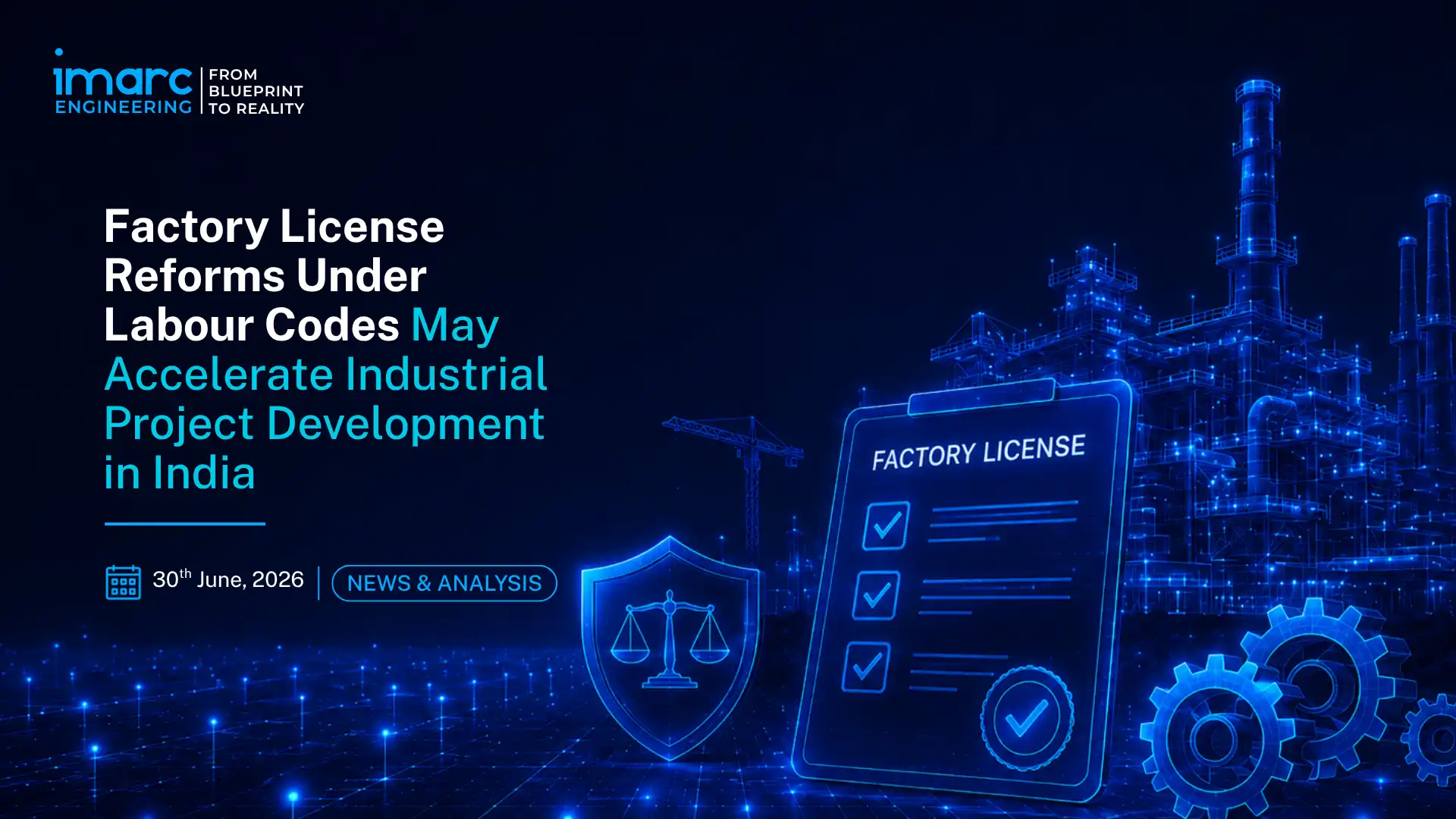
India's four Labour Codes came into force on November 21, 2025, the most consequential factory license reform of the country's labour regulatory framework since Independence. As of April 2026, all states except West Bengal and Nagaland have notified their state-level rules under the Occupational Safety, Health and Working Conditions Code, the code most directly relevant to factory license in India and industrial compliance.
For manufacturers, industrial developers, and investors planning manufacturing projects in India, the reforms carry specific and practical implications for factory licensing, approvals, and compliance timelines. Understanding what has changed, and what it means for project development, is now part of industrial investment planning.
What Changed: The New Factory Licensing Framework
India's previous factory licensing framework was governed by the Factories Act, 1948, a law nearly 80 years old. It was one of 13 separate laws that governed occupational safety, health, and working conditions across different worker categories. The result was a fragmented, inconsistently enforced, and administratively burdensome compliance landscape.
The Occupational Safety, Health and Working Conditions Code consolidates all 13 of these laws into a single framework. The most significant change for factory licensing is the replacement of multiple registrations, licenses, and returns with a single registration, single license, and single return system.
This is not just administrative simplification. It is the elimination of a category of regulatory friction that previously required manufacturers to interact with multiple authorities, file multiple returns on different schedules, and manage overlapping compliance obligations across the same physical facility.
Three specific changes are particularly relevant to industrial project development. First, the factory threshold has been raised. Under the old Factories Act, a unit employing 10 or more workers with power, or 20 or more without power, was classified as a factory and attracted the full compliance burden of the Act.
Under the OSHWC Code, those thresholds are 20 workers with power and 40 workers without power. This means that thousands of small and mid-size manufacturing units are no longer classified as factories under the Code, reducing their regulatory obligation and freeing management bandwidth for operations rather than paperwork.
Second, the contract labour licensing framework has been upgraded. The old Contract Labour (Regulation and Abolition) Act set a threshold of 20 contract workers for mandatory registration. The new Code raises this to 50 workers. More importantly, it introduces auto-generated, all-India licenses valid for five years. Previously, a contractor working across multiple states needed separate state-wise licenses.
Now, a single all-India auto-generated license covers the same scope. For construction contractors, EPCM firms, and project execution companies deploying labour across multiple sites and states, which describes virtually every major industrial project, this is a significant administrative simplification.
Third, the enforcement model has been fundamentally reoriented. The old framework used inspectors whose primary role was identifying violations and initiating prosecution. The new Code replaces the inspector role with inspector-cum-facilitators. The emphasis shifts from punitive enforcement to compliance support.
First-time violations that were previously criminal offences now attract monetary fines rather than imprisonment for most categories of non-compliance. This change removes a source of uncertainty that deterred manufacturing investment in India, particularly from foreign companies unfamiliar with India's enforcement culture.
The Factory License Process: What It Looks Like in 2026
Under the new framework, factory licensing and registration flows through a centralised digital system rather than through state-level physical visits and paper applications. The Shram Suvidha Portal is the central platform for labour compliance filings under the Labour Codes. Single-window registration covers the factory license, contract labour compliance, building and construction worker registration, and interstate migrant worker compliance, all from a single digital interface.
For greenfield manufacturing projects, this has a direct bearing on the project timeline. In the previous system, factory license applications required physical inspections by state labour department officers, paper-based submissions, and approval timelines that varied significantly by state and were often unpredictable. The new digital framework is designed to produce time-bound responses, bringing factory licensing closer to the predictable approval cycle that infrastructure clearances have moved toward under the PM GatiShakti single-window portal.
Manufacturing project approvals in India now benefit from a cleaner regulatory sequence. An investor setting up a new plant needs: an environment consent (from the State Pollution Control Board, under MoEF's EIA framework), a factory license (under OSHWC Code, via Shram Suvidha Portal), a fire NOC (from state fire department), a building completion certificate, and utility connections.
The labour code reforms address the factory license stage, historically one of the most variable and least predictable in the approval sequence. Making it digital, time-bound, and single-window removes a bottleneck that has historically added weeks to months to project commissioning timelines.
The Compliance Transition: What Manufacturers Must Do Now
The reforms create both simplification and new obligations. Manufacturers who had previously maintained basic pay below 50% of total CTC to minimise PF and gratuity contributions must now restructure salary to meet the 50% wage rule under the Code on Wages.
This increases statutory contribution costs for some employers. Companies employing more than 500 workers must set up safety committees with worker and employer representation. Annual health check-ups for all workers become mandatory. The appointment letter requirement, documenting the job role, wage, and social security benefits, must be issued to all workers including contract and gig workers.
For industrial compliance in India, the transition period from November 2025 to April 2026 was when companies should have updated payroll systems, revised contract templates, registered under the new unified portal, and trained HR and compliance teams on the new requirements.
Companies that have not completed this transition face increasing compliance risk as enforcement under the new framework scales up through 2026. State-level variations in rule notification mean that the specific timelines and requirements vary by geography, adding a layer of compliance complexity for manufacturers operating across multiple states.
What This Means for Industrial Project Development
For manufacturers evaluating new plant investments or brownfield expansions, the factory license reforms improve the predictability of the approval timeline. A single-window digital system with time-bound responses is more manageable in project scheduling than the previous multi-authority, physically dependent process.
For foreign companies entering India under the China+1 strategy, the combination of digital licensing, auto-generated contract labour permits, and inspector-cum-facilitator enforcement reduces the regulatory opacity that has historically made industrial compliance in India difficult to plan for. The labour code reforms form part of India's broader ease of doing business agenda. By simplifying factory licensing, digitising approvals, and reducing administrative complexity, the reforms aim to improve the business environment for both domestic manufacturers and global investors evaluating manufacturing investment in India.
The reforms do not eliminate compliance complexity. State-level variations, transition-period uncertainties, and the new obligations on wage structure, safety committees, and worker documentation require active management. But the direction is right. For manufacturers planning greenfield or brownfield projects in India, integrating the new labour code compliance timeline into project schedules, from factory license application to first production, is now a standard planning requirement.
India consolidated 29 labour laws into 4. The factory license now runs through a single portal. The inspector is now a facilitator. These are not small changes, they are the administrative infrastructure of a country that wants to manufacture at scale.
IMARC Engineering's Perspective
At IMARC Engineering, we see the practical impact of factory licensing delays every time we manage a plant setup or brownfield expansion project. A client commissions a DPR, finalises site selection, and starts civil construction, and then waits weeks or months for a factory license that should take days.
The labour code reforms address this directly: a single registration system, auto-generated licenses for contract labour, and inspector-cum-facilitators replacing inspector-policing models. When fully enforced, these changes will shorten the pre-commissioning compliance window materially. For manufacturers executing under PLI scheme timelines, where a delay of even one financial year means missing an incentive tranche, that reduction in compliance time has direct commercial value.
IMARC Engineering integrates factory licensing, labour compliance planning, environment consents, fire NOCs, and other manufacturing project approvals into every project schedule we build. The labour code reforms do not eliminate this work. But they do make it more predictable. And in industrial project development in India, predictability is worth its weight in capital.
Latest News
-
India Pushes Domestic Shipping Container Manufacturing with INR 10,000 Crore Assistance Scheme
September 25, 2026
-
India’s Growing GCC Sector Brings Greenfield Setup and Regulatory Compliance into Focus
September 24, 2026
-
Uttar Pradesh Approves INR 200+ Crore Ethanol Plant at Chhata Sugar Mill in Mathura
September 23, 2026
-
Escorts Kubota Breaks Ground on INR 2,000 Crore Greenfield Manufacturing Plant in Uttar Pradesh
September 22, 2026
-
SEMICON India 2026 Highlights Expansion of India’s Semiconductor Manufacturing Ecosystem
September 21, 2026
Trusted by Industry Leaders
We partner with global enterprises and ambitious businesses across sectors to deliver operational excellence, strategic insights, and sustainable growth through integrated solutions.









Success in Their Words
Real feedback from clients across industries. Discover how our solutions delivered measurable impact and operational excellence.

I wanted to express my sincere appreciation for your efforts in handling this matter. Your dedication and commitment have been truly commendable, and it is evident that you have put in tremendous hard work and expertise into resolving the issues at hand. We are greatly interested in continuing our collaboration with you in the future, as your professionalism and reliability have made you a trusted partner. Thank you once again for your invaluable contribution. We look forward to strengthening our partnership ahead.

It has been a pleasure working with the IMARC team. The insights provided were structured, clear, and highly valuable, helping us strengthen both our technical and financial planning with confidence. We deeply appreciate the team’s professionalism, responsiveness, and attention to detail throughout the engagement. Every requirement was well understood and effectively incorporated, resulting in a comprehensive and actionable output. Overall, our experience has been excellent, and I would gladly recommend IMARC to organizations seeking a reliable research partner.

Your service is truly exceptional. Working with the IMARC team has been a seamless and professional experience. The clarity of communication, responsiveness to queries, and consistent support at every stage made the entire engagement highly efficient. The insights shared were well-structured, practical, and perfectly aligned with our requirements, helping us make informed decisions with confidence. Overall, the dedication and professionalism demonstrated by your team stand out, and I would be glad to recommend IMARC as a reliable and trustworthy research partner.

IMARC did an outstanding job in preparing our study. They were punctual, precise, and consistently responsive throughout the entire process. The team delivered all the data we required in a clear, well-organized, and highly professional format. Their strong attention to detail, combined with their ability to meet every deadline without compromising quality, truly set them apart. Overall, their reliability and commitment made them an exceptional partner for our project, and we would gladly work with them again in the future.

IMARC made the whole process incredibly easy from start to finish. Everyone I interacted with via email was polite, professional, and straightforward to deal with, always keeping their promises regarding delivery timelines and remaining consistently solutions-focused. From my very first contact, I appreciated the professionalism and support shown by the entire IMARC team. I highly recommend IMARC to anyone seeking timely, affordable, and reliable information or advice. My experience with IMARC was excellent, and I truly cannot fault any aspect of it.

I’d like to express my sincere gratitude for the excellent work you accomplished with the study. Your ability to quickly understand our requirements and deliver high-quality results under tight timelines truly reflects your expertise, exceptional work ethic, and unwavering commitment to your customer’s success. The professionalism and responsiveness you demonstrated throughout the process made a significant difference. Our entire team and company are incredibly thankful for your dedication, reliability, and support. Once again, thank you for your outstanding contribution.
Ready to Experience the IMARC Advantage?
Whether you're planning a new facility, expanding operations, optimizing performance, or facing complex challenges—IMARC Engineering brings the expertise, experience, and commitment needed for success.