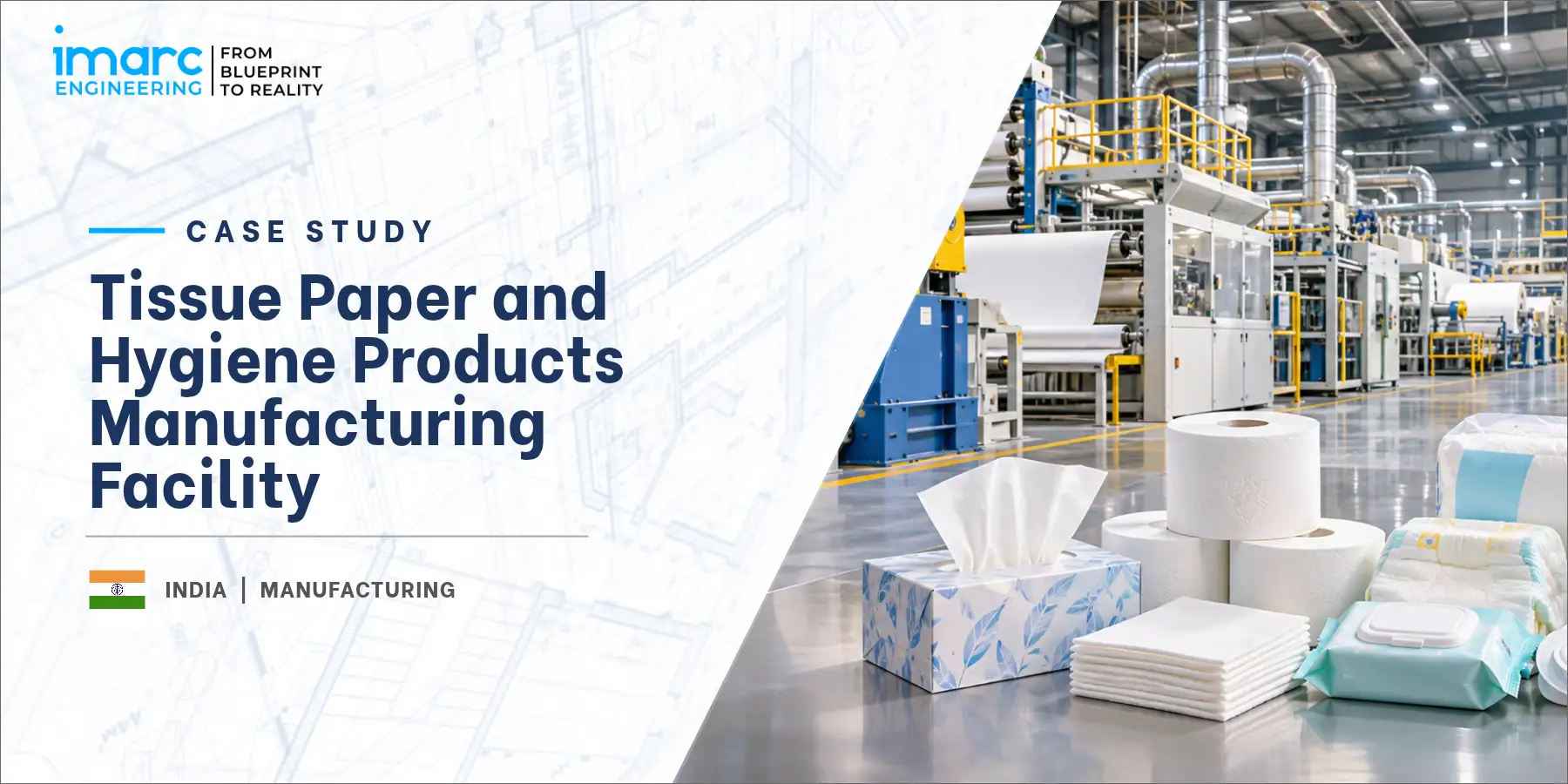
Tissue Paper and Hygiene Products Manufacturing Facility
Case Study Details
Industry
Manufacturing – Tissue Paper Products (Toilet Rolls, Kitchen Towels, Facial Tissues, Napkins)
Location
Shillong, Meghalaya, India (serving Indian retail hygiene brand aggregators, modern trade and quick-commerce distribution, institutional buyers across the hospitality and food-service channels, and the growing Northeast Asian regional export markets covering Bangladesh, Bhutan, Myanmar, and select Southeast Asian destinations)
Project Type
Greenfield tissue paper manufacturing facility (Phase 1, expandable with specialty absorbent hygiene products (SAHP) line covering sanitary napkins, adult incontinence pads, and premium facial tissue variants)
Project Capacity
36,000 MTPA tissue paper production across 20,000 MTPA toilet rolls, 10,000 MTPA kitchen towels, and 6,000 MTPA facial tissues and napkins, covering standard, premium, and private-label specifications under relevant BIS standards and allied product standards
Investment
INR 280 Crore (final CapEx)
Challenge
18 months to commissioning
Impact
Swachh Bharat Mission aligned Northeast tissue paper manufacturing anchor; and FSSAI food-contact-paper compliance completed for the kitchen towel and food-contact facial tissue product families; Forest Stewardship Council (FSC) Chain-of-Custody and PEFC certifications secured; supply commitments signed with three Indian retail hygiene brand aggregators, two modern trade distributors, one quick-commerce aggregator, two hospitality chain institutional buyers, and two cross-border export distributors covering Bangladesh and Myanmar
IMARC's Solution Highlights
End-to-end EPCM advisory across feasibility, tissue machine and converting line engineering, recovered fibre and virgin pulp supply chain design, multi-OEM equipment procurement, and integrated Swachh Bharat Mission, MoEFCC Pulp and Paper mill environmental guidelines, BIS, FSC, PM-DevINE, North East Industrial Development Scheme, and Meghalaya State Pollution Control Board compliance readiness
Project Overview
An Indian paper and hygiene products engineering major and a European tissue machine and converting technology partner engaged IMARC Engineering to establish a greenfield tissue paper manufacturing facility at Shillong, Meghalaya. The project was structured against the Government of India's structural hygiene product demand transformation driven by the Swachh Bharat Mission, launched on 2 October 2014 and continued through Swachh Bharat Mission 2.0 (SBM-Urban 2.0 administered by the Ministry of Housing and Urban Affairs and SBM-Gramin 2.0 administered by the Ministry of Jal Shakti), which has structurally reshaped Indian household and institutional hygiene consumption behaviour and created a sustained multi-decade growth runway for the organised tissue paper and hygiene products category.
The project is further anchored on the Northeast-specific industrial development framework comprising the North East Industrial Development Scheme (NEIDS) and UNNATI 2024 (Uttar Poorva Transformative Industrialization Scheme, 2024) providing capital investment incentive, interest subvention, and GST-linked manufacturing incentive support, the PM Development Initiative for Northeast Region (PM-DevINE), the INR 6,600 Crore Ministry of Development of North Eastern Region scheme providing capital support and logistics enablement for Northeast industrial capacity development, alongside the Meghalaya Industrial and Investment Promotion Policy incentive framework.
Regulatory compliance is structured against the Ministry of Environment, Forest and Climate Change Pulp and Paper mill environmental guidelines (including the specific requirements for small and medium paper mills on effluent, chemical oxygen demand, biological oxygen demand, and absorbable organic halogen limits), relevant BIS compliance, FSSAI food-contact-paper regulations for the kitchen towel and food-contact facial tissue product families, Forest Stewardship Council (FSC) Chain-of-Custody certification, and Programme for the Endorsement of Forest Certification (PEFC) framework for sustainable fibre sourcing.
The project involved establishing 36,000 MTPA of tissue paper manufacturing capacity across three product families 20,000 MTPA of toilet rolls (across standard-ply, double-ply, triple-ply, and specialty variants), 10,000 MTPA of kitchen towels (across standard and premium-absorbency variants), and 6,000 MTPA of facial tissues and dinner napkins (across standard retail, premium-ply, and institutional variants). Site infrastructure was designed for Phase 2 expansion adding a specialty absorbent hygiene products (SAHP) line covering sanitary napkins, adult incontinence pads, and premium facial tissue variants aligned with the emerging Indian middle-class hygiene product consumption expansion.
Client's Challenges
The client faced several specific challenges in establishing greenfield tissue paper manufacturing in Northeast India:
- Pulp supply chain strategy: Structuring a resilient fibre supply chain across a diversified pulp input base, comprising imported virgin bleached kraft pulp (sourced from established Southeast Asian, Latin American, and North American pulp producers given the structural domestic virgin pulp capacity constraint), domestic recycled fibre from the surrounding Northeast and East Indian paper recovery ecosystem, and specialty bamboo pulp leveraging the Northeast bamboo cultivation base, with associated quality grading and blending infrastructure for the diversified fibre input mix.
- Tissue machine and converting engineering: Engineering the integrated tissue machine (crescent-former Yankee cylinder tissue machine) and converting line infrastructure capable of delivering the characteristic tissue paper properties (bulk, softness, absorbency, wet strength) across the toilet roll, kitchen towel, and facial tissue product families, with the associated process air system, Yankee hood operation, creping blade system, and converting line (rewinding, log sawing, embossing, and packaging) specifications required for the three-product-family portfolio.
- Northeast logistics complexity: Managing the logistics constraints of Northeast tissue product dispatch across the Siliguri corridor to Eastern and Central Indian markets alongside cross-border logistics for the emerging Bangladesh, Bhutan, Myanmar, and Southeast Asian export opportunity with associated distribution network design, buffer storage infrastructure, and specialty cross-border customs documentation and quality certification requirements.
- FSC and sustainability certification pathway: Securing Forest Stewardship Council (FSC) Chain-of-Custody certification and PEFC framework alignment for the sustainable fibre sourcing credentials, critical credentials for premium retail brand aggregator supply, institutional hospitality customer qualification, and export market participation where ESG-aligned sustainable fibre sourcing has become structurally non-negotiable.
- MoEFCC pulp and paper environmental compliance: Meeting the Ministry of Environment, Forest and Climate Change Pulp and Paper mill environmental guidelines, covering effluent treatment, chemical oxygen demand (COD), biological oxygen demand (BOD), total suspended solids (TSS), and absorbable organic halogen (AOX) limits, alongside the stringent Meghalaya State Pollution Control Board compliance covering the state's historically rigorous environmental enforcement for the Khasi and Jaintia Hills ecological zone.
- Workforce build-up: Recruiting 500 personnel including paper machine superintendents, converting line specialists, quality technicians, and skilled process operators in the Shillong regional labour market, supported by structured technology-transfer partnerships with the European tissue machine technology licensor and by targeted recruitment from adjacent Indian paper industry clusters including the Andhra Pradesh, Gujarat, and Tamil Nadu paper manufacturing ecosystems.
What We Did
-
Pre-Investment and Strategic Advisory
Our feasibility study evaluated four candidate Indian locations Shillong (Meghalaya), Byrnihat industrial belt (Meghalaya-Assam border), Guwahati (Assam), and Siliguri (West Bengal) with Shillong selected on the strength of the surrounding Meghalaya bamboo cultivation base providing supplementary specialty bamboo pulp fibre supply, Northeast strategic positioning for cross-border export logistics to Bangladesh, Bhutan, Myanmar, and select Southeast Asian destinations where Indian hygiene product supply is positioned to displace historical Chinese and Southeast Asian imports, PM-DevINE capital support and logistics enablement eligibility, the Meghalaya Industrial and Investment Promotion Policy framework, and access to engineering talent from NIT Meghalaya, and IIT Guwahati and the surrounding technical education base.
CapEx planning of INR 296 Crore covered the pulp preparation and stock preparation area, the tissue machine with Yankee cylinder dryer and process air system, the parent reel storage area, the converting lines (rewinding, log sawing, embossing, and packaging), the warehouse, the effluent treatment plant, and central utilities. Financial modelling demonstrated post-tax IRR of 15.4 percent at full ramp with a 6.6-year payback inclusive of NEIDS capital investment incentive and Meghalaya state incentive benefit.
-
Engineering and Design Services
IMARC designed a 42,000 sq.m built-up facility on a 24-acre plot comprising the pulp receiving and bale storage area with dedicated staging for virgin bleached kraft pulp, recycled fibre, and specialty bamboo pulp input streams, the pulp preparation and deinking area for the recycled fibre fraction, the stock preparation area with refining, screening, and cleaning infrastructure delivering the controlled fibre furnish to the tissue machine, the tissue machine featuring crescent-former Yankee cylinder dryer configuration with high-velocity hood system engineered for the characteristic bulk and softness properties required across the product families, the parent reel storage and buffer area, the converting line hall housing dedicated rewinding machines, log saws, embossing stations, packaging infrastructure, and bulk-pack palletising for each of the toilet roll, kitchen towel, and facial tissue product families, the quality laboratory covering basis weight testing, softness testing, absorbency testing, wet strength testing, and BIS specification verification infrastructure, the raw material and finished goods warehouse, the effluent treatment plant with primary clarification, biological treatment, and tertiary polishing infrastructure meeting MoEFCC Pulp and Paper mill guidelines and Meghalaya State Pollution Control Board specifications, and central utilities.
Process utility design covered 6 MW grid demand supplemented by a 1.5 MW captive rooftop solar array, dedicated steam boiler infrastructure (with provision for biomass-fuel co-firing using agricultural residues from the surrounding Northeast agricultural ecosystem reducing fossil fuel dependence), zero-liquid-discharge (ZLD) orientation for the effluent management, dedicated dust and volatile organic compound extraction across the converting operations, integrated MES for lot-level traceability aligned with BIS, FSC Chain-of-Custody, and ESG reporting documentation requirements, and heavy-haul outbound logistics infrastructure engineered for the characteristic high-volume low-weight tissue product despatch pattern.
-
Procurement and Supply Chain Support
We executed a multi-geography procurement programme across 46 critical vendors. The tissue machine (crescent-former Yankee cylinder configuration) was sourced from an established European tissue machinery specialist with proven multi-decade references across global tissue industry deployments. Converting line equipment including rewinding machines, log saws, embossing stations, and packaging infrastructure was sourced from a combination of European tissue converting equipment specialists (reflecting the deep European engineering heritage in tissue converting machinery) and Indian packaging equipment specialists.
Pulp preparation, deinking, and stock preparation equipment was sourced from established European and Indian specialists with proven paper industry references. Quality laboratory equipment covering basis weight, softness, absorbency, and wet strength testing was sourced from established European and US paper industry analytical equipment specialists. Effluent treatment plant infrastructure was sourced from Indian water technology specialists with pulp and paper industry track record.
Fibre feedstock sourcing was structured through diversified supply arrangements: imported virgin bleached kraft pulp from established Southeast Asian, Latin American, and North American pulp producers under structured long-term arrangements; domestic recycled fibre through the surrounding Northeast and East Indian paper recovery ecosystem; and specialty bamboo pulp through structured arrangements with Meghalaya and adjacent Northeast bamboo cultivation suppliers. Documented Domestic Content reached 78 percent in Year-1 operations and 86 percent in Year-2 as the Indian recycled fibre and specialty bamboo pulp supply ecosystem developed alongside progressive localisation of chemicals and consumables.
-
Project Execution and Site Management
Our turnkey project management delivered 18 months from groundbreaking to first commercial tissue product despatch, coordinating civil construction, mechanical and electrical erection, tissue machine installation and commissioning (the critical-path activity requiring approximately 10 months of installation and commissioning from first civil hand-over), effluent treatment plant installation, equipment integration, and phased commissioning across the pulp preparation, tissue machine, converting, and quality laboratory zones.
Phased commissioning ran the pulp receiving and stock preparation area first, followed by the tissue machine installation and progressive commissioning with first parent reel production in month 15 and sustained parent reel quality acceptance in month 16, then the converting lines with first commercial toilet roll batch completed in month 17, first commercial kitchen towel and facial tissue batches in month 18, and finally the specialty variants ramp through month 19.
Multi-vendor coordination across European, Indian, and US contractors required a 22-strong owner's engineering team supplemented by 6 European resident engineers from the tissue machine technology partner during the critical tissue machine commissioning and first-production ramp-up phases.
-
Compliance, Quality and Sustainability
IMARC led certification readiness across BIS product standard, verified across the toilet roll product family in Year-1 of operations, BIS compliance verification, FSSAI food-contact-paper regulations compliance for the kitchen towel and food-contact facial tissue product families (particularly critical for the hospitality and food-service institutional channel), Forest Stewardship Council (FSC) Chain-of-Custody certification covering the full fibre supply chain traceability, Programme for the Endorsement of Forest Certification (PEFC) framework alignment for the broader sustainable fibre sourcing documentation, Public Procurement (Preference to Make in India) local content certification, and ISO 9001:2015, ISO 14001:2015, ISO 45001:2018, and ISO 50001:2018 management system certifications.
Environmental compliance covered Meghalaya State Pollution Control Board Consent to Establish and Operate (recognising the state's historically rigorous environmental enforcement framework for the ecologically sensitive Khasi and Jaintia Hills zone), MoEFCC Pulp and Paper mill environmental guidelines compliance covering effluent treatment plant performance against COD, BOD, TSS, and AOX limits, Hazardous Waste Authorisation for effluent treatment plant sludge, and the Plastic Waste Management Rules, 2016 (as amended) and the EPR Guidelines for Plastic Packaging, 2022.
The facility achieved IGBC Gold certification through 1.5 MW captive rooftop solar covering approximately 20 percent of facility daytime energy demand, biomass fuel co-firing in the steam boiler covering approximately 24 percent of thermal energy demand, zero-liquid-discharge (ZLD) effluent management, heat recovery from the Yankee hood and converting operations, variable-frequency drives across HVAC and process pump systems, and 22 percent lower facility energy intensity versus the Southeast Asian tissue paper manufacturing industry benchmark.
Final Results

Operational Performance
The facility achieved mechanical completion in 18 months with first commercial tissue product despatch in month 19. Full 36,000 MTPA nameplate capacity was reached at 76 percent utilisation (equivalent to 27,360 MTPA in Year-2, comprising approximately 15,200 MTPA toilet rolls, 7,600 MTPA kitchen towels, and 4,560 MTPA facial tissues and napkins) by month 15 of operations, with applicable BIS specification compliance across the product portfolio.
FSSAI food-contact-paper regulations compliance was completed for the kitchen towel and facial tissue product families, FSC Chain-of-Custody certification was secured, PEFC framework alignment was documented, and successful supplier qualification audits were passed with three Indian retail hygiene brand aggregators, two modern trade distributors, one quick-commerce aggregator, two hospitality chain institutional buyers, and two cross-border export distributors covering Bangladesh and Myanmar across the first operational year.
Financial Outcomes
Final CapEx of INR 280 Crore delivered 5.4 percent savings against the INR 296 Crore budget through optimised civil packaging, disciplined Indian-fabrication leverage across the structural and process infrastructure scope, coordinated multi-vendor procurement, PM-DevINE capital support, North East Industrial Development Scheme capital investment incentive and interest subvention benefit, and Meghalaya Industrial and Investment Promotion Policy incentive framework support.
Year-2 revenue of INR 230 Crore was generated at an EBITDA margin of 12 percent, consistent with established Indian tissue paper sector reporting where commodity-nature toilet roll pricing combined with imported virgin pulp cost structure delivers a characteristic moderate-margin profile, offset by stronger value-addition margins on the premium kitchen towel and facial tissue variants and supported by the growing Indian middle-class hygiene product consumption expansion and the Northeast-specific state incentive framework.
Market Access
Long-term supply commitments were signed with three Indian retail hygiene brand aggregators covering committed annual toilet roll, kitchen towel, and facial tissue offtake for the pan-India modern trade and traditional trade distribution network, two modern trade distributors covering committed offtake for premium retail distribution across the Delhi-NCR, Mumbai, Bengaluru, and Kolkata urban belts, one quick-commerce aggregator covering committed offtake for the rapidly growing 10-to-30-minute hygiene product delivery segment across the top Indian urban markets, two hospitality chain institutional buyers covering kitchen towel, facial tissue, and napkin offtake for the Indian premium hotel and food-service institutional channel, and two cross-border export distributors.
Export share reached 15 percent of revenue by Year-2 through the emerging Northeast-anchored cross-border opportunity across Bangladesh, Bhutan, Myanmar, and select Southeast Asian destinations, with structural positioning benefits from the facility's proximity to the Northeast cross-border logistics corridor.
Sustainability Impact
Our integrated design, combining 1.5 MW captive rooftop solar covering approximately 20 percent of facility daytime energy demand, biomass fuel co-firing in the steam boiler covering approximately 24 percent of thermal energy demand (sourced from the surrounding Northeast agricultural residue base), zero-liquid-discharge (ZLD) effluent management with closed-loop water reclamation, heat recovery from the Yankee hood and converting operations, variable-frequency drives across HVAC and process pump systems, and LED lighting throughout, achieves 22 percent lower facility energy intensity versus the Southeast Asian tissue paper manufacturing industry benchmark.
The fibre supply strategy structurally prioritises recycled fibre and specialty bamboo pulp (both renewable and fast-growing) over the imported virgin bleached kraft pulp fraction, with FSC Chain-of-Custody certification providing full traceability for the sustainable fibre sourcing credentials. The ZLD effluent management infrastructure eliminates discharge to the ecologically sensitive Khasi and Jaintia Hills waterway network. End-of-life packaging material recovery partnerships are established under the Plastic Waste Management Rules 2022 framework, with the tissue product itself being structurally biodegradable and compostable at consumer end-of-life.
Strategic Impact
The project established a meaningful greenfield tissue paper manufacturing capability within the Northeast industrial development framework, positioning the client at the intersection of multiple reinforcing demand drivers, the Swachh Bharat Mission-driven structural shift in Indian household and institutional hygiene consumption behaviour, the growing Indian middle-class per-capita tissue consumption trajectory, the Northeast cross-border export opportunity to Bangladesh, Bhutan, Myanmar, and Southeast Asian markets, and the PM-DevINE plus NEIDS Northeast industrial development framework providing structural policy support.
Year-2 revenue of INR 230 Crore, BIS and FSC certifications across the product portfolio, three retail brand aggregator supply commitments, and the two-market cross-border export entry led the client to approve Phase 2 expansion comprising a specialty absorbent hygiene products (SAHP) line covering sanitary napkins, adult incontinence pads, and premium facial tissue variants.
IMARC Engineering's end-to-end EPCM advisory, combining tissue machine and converting line engineering, diversified fibre supply chain design, Swachh Bharat Mission demand pipeline positioning, BIS and FSC certification pathway support, PM-DevINE and NEIDS Northeast policy framework navigation, and disciplined multi-vendor execution, enabled the client to anchor a strategically important Indian industrial asset in a sector positioned at the intersection of India's long-term hygiene product consumption transition and the Northeast cross-border export opportunity.
Case Study Details
Industry
Manufacturing – Tissue Paper Products (Toilet Rolls, Kitchen Towels, Facial Tissues, Napkins)
Location
Shillong, Meghalaya, India (serving Indian retail hygiene brand aggregators, modern trade and quick-commerce distribution, institutional buyers across the hospitality and food-service channels, and the growing Northeast Asian regional export markets covering Bangladesh, Bhutan, Myanmar, and select Southeast Asian destinations)
Project Type
Greenfield tissue paper manufacturing facility (Phase 1, expandable with specialty absorbent hygiene products (SAHP) line covering sanitary napkins, adult incontinence pads, and premium facial tissue variants)
Project Capacity
36,000 MTPA tissue paper production across 20,000 MTPA toilet rolls, 10,000 MTPA kitchen towels, and 6,000 MTPA facial tissues and napkins, covering standard, premium, and private-label specifications under relevant BIS standards and allied product standards
Investment
INR 280 Crore (final CapEx)
Challenge
18 months to commissioning
Impact
Swachh Bharat Mission aligned Northeast tissue paper manufacturing anchor; and FSSAI food-contact-paper compliance completed for the kitchen towel and food-contact facial tissue product families; Forest Stewardship Council (FSC) Chain-of-Custody and PEFC certifications secured; supply commitments signed with three Indian retail hygiene brand aggregators, two modern trade distributors, one quick-commerce aggregator, two hospitality chain institutional buyers, and two cross-border export distributors covering Bangladesh and Myanmar
IMARC's Solution Highlights
End-to-end EPCM advisory across feasibility, tissue machine and converting line engineering, recovered fibre and virgin pulp supply chain design, multi-OEM equipment procurement, and integrated Swachh Bharat Mission, MoEFCC Pulp and Paper mill environmental guidelines, BIS, FSC, PM-DevINE, North East Industrial Development Scheme, and Meghalaya State Pollution Control Board compliance readiness
Have a similar project in mind?
Our engineering consultants can help you plan, design, and execute your next facility — from feasibility to commissioning.
Schedule a consultationTrusted by Industry Leaders
We partner with global enterprises and ambitious businesses across sectors to deliver operational excellence, strategic insights, and sustainable growth through integrated solutions.






Success in Their Words
Real feedback from clients across industries. Discover how our solutions delivered measurable impact and operational excellence.

I wanted to express my sincere appreciation for your efforts in handling this matter. Your dedication and commitment have been truly commendable, and it is evident that you have put in tremendous hard work and expertise into resolving the issues at hand. We are greatly interested in continuing our collaboration with you in the future, as your professionalism and reliability have made you a trusted partner. Thank you once again for your invaluable contribution. We look forward to strengthening our partnership ahead.

It has been a pleasure working with the IMARC team. The insights provided were structured, clear, and highly valuable, helping us strengthen both our technical and financial planning with confidence. We deeply appreciate the team’s professionalism, responsiveness, and attention to detail throughout the engagement. Every requirement was well understood and effectively incorporated, resulting in a comprehensive and actionable output. Overall, our experience has been excellent, and I would gladly recommend IMARC to organizations seeking a reliable research partner.
Your service is truly exceptional. Working with the IMARC team has been a seamless and professional experience. The clarity of communication, responsiveness to queries, and consistent support at every stage made the entire engagement highly efficient. The insights shared were well-structured, practical, and perfectly aligned with our requirements, helping us make informed decisions with confidence. Overall, the dedication and professionalism demonstrated by your team stand out, and I would be glad to recommend IMARC as a reliable and trustworthy research partner.

IMARC did an outstanding job in preparing our study. They were punctual, precise, and consistently responsive throughout the entire process. The team delivered all the data we required in a clear, well-organized, and highly professional format. Their strong attention to detail, combined with their ability to meet every deadline without compromising quality, truly set them apart. Overall, their reliability and commitment made them an exceptional partner for our project, and we would gladly work with them again in the future.

IMARC made the whole process incredibly easy from start to finish. Everyone I interacted with via email was polite, professional, and straightforward to deal with, always keeping their promises regarding delivery timelines and remaining consistently solutions-focused. From my very first contact, I appreciated the professionalism and support shown by the entire IMARC team. I highly recommend IMARC to anyone seeking timely, affordable, and reliable information or advice. My experience with IMARC was excellent, and I truly cannot fault any aspect of it.

I’d like to express my sincere gratitude for the excellent work you accomplished with the study. Your ability to quickly understand our requirements and deliver high-quality results under tight timelines truly reflects your expertise, exceptional work ethic, and unwavering commitment to your customer’s success. The professionalism and responsiveness you demonstrated throughout the process made a significant difference. Our entire team and company are incredibly thankful for your dedication, reliability, and support. Once again, thank you for your outstanding contribution.
Ready to Experience the IMARC Advantage?
Whether you're planning a new facility, expanding operations, optimizing performance, or facing complex challenges—IMARC Engineering brings the expertise, experience, and commitment needed for success.