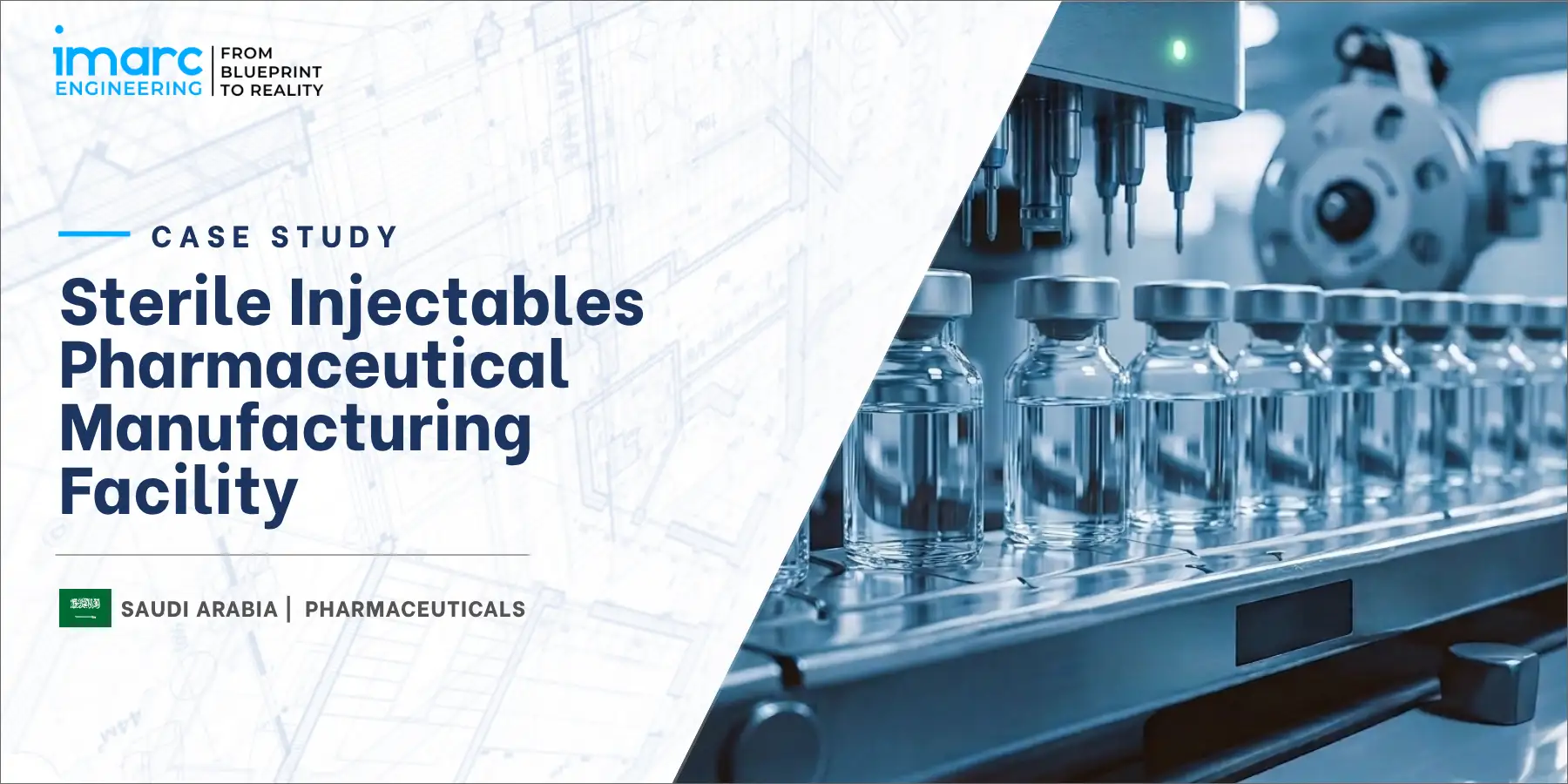
Sterile Injectables Pharmaceutical Manufacturing Facility
Case Study Details
Industry
Pharmaceuticals- Sterile Injectables
Location
Sudair Industrial City, Saudi Arabia (serving GCC, MENA and African export markets)
Project Type
Greenfield manufacturing facility (Phase 1, expandable with biologics fill-finish)
Project Capacity
80 million vials per annum (45 M liquid + 35 M lyophilised)
Investment
SAR 568 Million (final CapEx after Execution)
Challenge
30 months to commissioning
Impact
Saudi Arabia's first WHO-PQ certified central-region sterile injectables facility; simultaneous SFDA, USFDA cGMP and EU EMA Annex 1 approvals; SIDF Tranche 2 disbursement secured
IMARC's Solution Highlights
End-to-end EPCM advisory across feasibility, Grade A/B aseptic cleanroom design, multi-OEM equipment procurement, triple-regulatory compliance readiness, and integrated digital quality systems
Project Overview
A Saudi Arabian pharmaceutical group, in partnership with a European technology and dossier licensor, engaged IMARC Engineering to establish a greenfield sterile injectables manufacturing facility in Sudair Industrial City. Aligned with Saudi Vision 2030's pharmaceutical localisation strategy, which targets 40% domestic value addition against current levels of approximately 20%, the project addresses persistent supply security gaps in critical injectable categories (oncology, anti-infectives, anaesthetics, and emergency-use therapeutics) where the GCC region currently imports over 85% of demand.
The project involved establishing an 80 million vial per annum facility producing both liquid and lyophilised injectables across 24 product variants for hospital, government tender, and export markets, meeting EU EMA Annex 1, USFDA cGMP, and WHO Prequalification standards from day one.
Client's Challenges
The client faced several specific challenges in establishing greenfield sterile manufacturing in central Saudi Arabia:
- Multiple regulatory readiness: Achieving simultaneous compliance with SFDA, USFDA cGMP, EU EMA Annex 1 (2023 revision), and WHO-PQ standards with non-overlapping nuances across contamination control strategy, data integrity, and supplier qualification.
- Aseptic process design: Engineering Grade A cleanroom envelopes within Grade B backgrounds for high-risk operations (vial filling, lyophiliser loading) with revised Annex 1 compliance for environmental monitoring, smoke study evidence, barrier technologies, and contamination control strategy documentation.
- Local talent shortage: Saudi Arabia's nascent sterile injectable sector required expatriate-led commissioning while meeting Saudization (Nitaqat) targets of 40% Saudi nationals in technical roles within three years.
- Climate-driven utility load: Sudair's summer ambient temperatures reaching 48°C required oversized chiller capacity and resilient HVAC engineering for 24x7 cleanroom stability of 22 ± 1°C and 45 ± 5% RH across 14,200 sq.m of classified areas.
- Halal certification across the range: Securing GSO 2055-1 Halal certification for all 24 variants required verification of all excipients, capsule and stopper materials, and any animal-derived API impurities through a single coordinated audit cycle.
- Validation programme scale: Executing process validation, cleaning validation, sterility assurance qualification, and aseptic process simulation (media fills) across two filling lines and three lyophilisers within an aggressive commissioning timeline.
What We Did
-
Pre-Investment and Strategic Advisory
Our feasibility study assessed three candidate locations, Sudair Industrial City, King Salman Industrial City (KSIC), and the second Modon zone in Riyadh, against 16 weighted criteria including utility reliability, GCC tender logistics, Saudi Industrial Development Fund (SIDF) eligibility, port and air-cargo connectivity (King Khalid International for cold chain), and access to King Saud University and KAUST graduate pipelines. Sudair was selected on the strength of SIDF's 75% co-financing eligibility for pharmaceutical projects, dedicated 132 kV grid availability, and proximity to the planned Riyadh-King Khalid logistics corridor.
CapEx planning of SAR 600 Million covered cleanroom shells, HVAC and water systems, two filling lines, three lyophilisers, QC laboratories, and central utilities. Our team led SIDF application preparation that secured SAR 174 Million in long-tenure financing, alongside SFDA establishment licence and Ministry of Investment industrial licence advisory. Financial modelling demonstrated post-tax IRR of 19.4% at full ramp with a payback of 6.8 years inclusive of SIDF benefits.
-
Engineering and Design Services
IMARC designed a 28,000 sq.m built-up facility on a 184,000 sq.m site with strict zoning across Grade A/B/C/D classifications. The aseptic core covered 14,200 sq.m of classified space, with two filling lines housed in Restricted Access Barrier Systems (RABS) and three pharmaceutical lyophilisers (35 sq.m shelf area each) integrated through automated loading and unloading systems. HVAC design comprised 16 air-handling units delivering 1.2 million m³/hr of HEPA H14-filtered air with N+1 redundancy and full pressure cascade integrity.
Water and steam systems included a Water for Injection (WFI) loop generating 6,000 L/hr to USP/EP standards via multi-effect distillation, pure steam generators rated to 1,800 kg/hr, and Purified Water systems with continuous TOC and conductivity monitoring. Climate engineering accounted for 48°C ambient design temperature with 6,500 TR of chilled water capacity, dual-redundant chiller plants, and a 14 MW captive substation supplied by a dedicated 132 kV feeder. The design embedded EU EMA Annex 1 (2023) requirements upfront — including a documented Contamination Control Strategy, single-pass airflow visualisation studies, and barrier technology selection rationale.
-
Procurement and Supply Chain Support
We executed a tightly orchestrated procurement programme across 92 critical vendors. Vial washing and depyrogenation tunnels, filling lines with RABS, and capping equipment were sourced from European OEMs with proven sterile installations (Bausch+Stroebel, Optima, IMA, Syntegon). Lyophilisation systems were sourced from a single Italian OEM to standardise the cycle development library. WFI and pure steam generators were procured from German specialists with documented references to USFDA-approved facilities.
Vendor qualification protocols included on-site supplier audits, FAT and SAT validation packages, and incoming material specifications with Certificate of Analysis review across all primary packaging (Type 1 borosilicate vials, FluroTec coated stoppers, aluminium seals). Cold-chain qualified logistics partners were pre-contracted for both excipient inflows and finished goods outflows, with mapped temperature corridors validated to ±2°C across the GCC distribution network.
-
Project Execution and Site Management
Our turnkey project management delivered 30 months from groundbreaking to first commercial batch, coordinating civil construction, cleanroom panel installation, equipment integration, and concurrent qualification across all utility and process systems. We managed construction of the aseptic production block (16,400 sq.m), QC and microbiology laboratories (3,200 sq.m), warehouse with cold storage (2°–8°C, 15°–25°C zones), and central utility block.
Installation supervision ensured pharmaceutical-grade specifications: 316L electropolished stainless steel for product contact (Ra ≤ 0.4 µm), orbital-welded WFI distribution loops with full passivation records, dead-leg ratios under 3D, validated environmental monitoring with 248 fixed sampling points, and SCADA integration logging 850,000 critical parameter readings per shift. Multi-vendor coordination across European, Saudi, Indian, and Lebanese contractors required a dedicated 31-strong owner's engineering team and weekly integration steering reviews under a single contamination-control-led execution plan.
-
Compliance, Quality and Sustainability
IMARC led parallel-track regulatory readiness across SFDA, USFDA cGMP, EU EMA Annex 1, and WHO Prequalification, alongside ISO 9001, ISO 14001, ISO 45001, and GSO 2055-1 Halal certification. We executed three rounds of mock inspections, internal, third-party gap audit, and a pre-PAI consultant review, closing 86 cumulative observations before the regulatory submissions. Aseptic process simulations covered three consecutive successful media fills per line, with environmental monitoring data integrity validated under 21 CFR Part 11 and EU Annex 11.
Environmental compliance covered Saudi Ministry of Environment, Water and Agriculture clearance, Royal Commission Hazardous Waste Authorisation for solvent and cytotoxic streams (handled via dedicated segregated suite), and Extended Producer Responsibility commitments under the Saudi Green Initiative framework. The facility achieved LEED Gold certification through a 21% renewable energy share via 3.8 MW captive solar, water recycling recovering 78% of cooling and CIP intake, and 32% lower embedded carbon versus the imported product LCA benchmark.
-
Digital, Documentation and Training
We implemented an integrated digital quality and operations stack: an Electronic Quality Management System (eQMS) covering deviation, CAPA, change control, and supplier quality; a Laboratory Information Management System (LIMS) with bidirectional instrument integration across 47 QC instruments; a Manufacturing Execution System (MES) with electronic batch records compliant with 21 CFR Part 11 and EU Annex 11; and ERP integration through SAP S/4HANA covering supply chain, finance, and warehouse management.
Documentation and technical file preparation produced a Validation Master Plan with 1,150 protocols, 312 SOPs, and complete site master file packages tailored separately for SFDA, USFDA, EMA, and WHO-PQ submissions. EHS and GMP training was delivered to 1,800 personnel — including 240 senior staff rotated through the European licensor's facility for hands-on operational training and 64 engineers placed on six-month embedded technology-transfer assignments. Saudization-focused training partnerships with two Saudi pharma vocational institutes pre-qualified 380 Saudi national candidates ahead of commissioning.
Final Results
.webp)
Operational Performance
The facility achieved commissioning in 30 months, with the first commercial batch released in month 32. SFDA approval was granted in month 4 of operations; USFDA pre-approval inspection passed in month 14 with six minor observations and zero Form 483 critical findings; EU EMA inspection followed in month 18 with no critical observations; and WHO-PQ certification was secured in month 22. Full 80 million vial nameplate capacity was reached at 87% utilisation in month 16, with overall yield of 96.8%, sterility assurance level (SAL) of 10⁻⁶, and zero batch recalls in the first operational year across 1,420 batches released.
Financial Outcomes
Final CapEx of SAR 568 Million delivered 5.3% savings against budget through optimised civil packaging, multi-source equipment procurement leverage, and efficient parallel execution of qualification activities. SIDF Tranche 2 disbursement of SAR 78 Million was secured against year-1 production milestones, with cumulative SIDF benefit of SAR 174 Million across the financing tenure. Year-1 revenue of SAR 720 Million was generated at 38% gross margin, against the imported-competitor benchmark of approximately 22% post-duty in equivalent product baskets.
Market Access
The facility secured supply contracts with Saudi Arabia's Ministry of Health, the UAE Ministry of Health and Prevention, and the Kuwait Ministry of Health (cumulative SAR 280 Million annual value), with active tender wins in Egypt, Iraq, Algeria, and Jordan. WHO-PQ status enabled access to UN agency procurement programmes including UNICEF and the Global Fund. Twelve product registrations are advancing in EU member states under decentralised procedure, and four oncology dossiers are under USFDA ANDA review.
Sustainability Impact
Our energy-efficient design, combining 3.8 MW captive solar (12,400 panels), heat recovery from compressed-air systems, variable-frequency drives across HVAC, and high-efficiency chillers, achieves 32% lower energy consumption versus regional pharmaceutical benchmarks, saving SAR 14.6 Million annually. Water recycling from cooling systems and CIP operations recovers 78% of intake, saving 142,000 m³ annually in a water-scarce region. Solvent recovery systems achieve 94% recovery across all organic solvents used in QC and small-scale process applications.
Strategic Impact
The project established Saudi Arabia's first WHO-PQ certified sterile injectables facility in the central region and demonstrated the operational viability of Vision 2030's pharmaceutical localisation thesis. Saudization reached 28% of the technical workforce in year 1, ahead of the regulatory glide path. The client has approved Phase 2 expansion comprising a dedicated oncology suite and a biologics fill-finish facility, alongside a parallel API pilot facility under the planned Saudi Pharmaceutical Industrial Cluster. IMARC Engineering's end-to-end EPCM advisory enabled the client to enter regulated export markets with a globally compliant, sustainable, and commercially competitive operation in a sector previously closed to GCC manufacturers.
Case Study Details
Industry
Pharmaceuticals- Sterile Injectables
Location
Sudair Industrial City, Saudi Arabia (serving GCC, MENA and African export markets)
Project Type
Greenfield manufacturing facility (Phase 1, expandable with biologics fill-finish)
Project Capacity
80 million vials per annum (45 M liquid + 35 M lyophilised)
Investment
SAR 568 Million (final CapEx after Execution)
Challenge
30 months to commissioning
Impact
Saudi Arabia's first WHO-PQ certified central-region sterile injectables facility; simultaneous SFDA, USFDA cGMP and EU EMA Annex 1 approvals; SIDF Tranche 2 disbursement secured
IMARC's Solution Highlights
End-to-end EPCM advisory across feasibility, Grade A/B aseptic cleanroom design, multi-OEM equipment procurement, triple-regulatory compliance readiness, and integrated digital quality systems
Have a similar project in mind?
Our engineering consultants can help you plan, design, and execute your next facility — from feasibility to commissioning.
Schedule a consultationTrusted by Industry Leaders
We partner with global enterprises and ambitious businesses across sectors to deliver operational excellence, strategic insights, and sustainable growth through integrated solutions.




Success in Their Words
Real feedback from clients across industries. Discover how our solutions delivered measurable impact and operational excellence.
I wanted to express my sincere appreciation for your efforts in handling this matter. Your dedication and commitment have been truly commendable, and it is evident that you have put in tremendous hard work and expertise into resolving the issues at hand. We are greatly interested in continuing our collaboration with you in the future, as your professionalism and reliability have made you a trusted partner. Thank you once again for your invaluable contribution. We look forward to strengthening our partnership ahead.

It has been a pleasure working with the IMARC team. The insights provided were structured, clear, and highly valuable, helping us strengthen both our technical and financial planning with confidence. We deeply appreciate the team’s professionalism, responsiveness, and attention to detail throughout the engagement. Every requirement was well understood and effectively incorporated, resulting in a comprehensive and actionable output. Overall, our experience has been excellent, and I would gladly recommend IMARC to organizations seeking a reliable research partner.
Your service is truly exceptional. Working with the IMARC team has been a seamless and professional experience. The clarity of communication, responsiveness to queries, and consistent support at every stage made the entire engagement highly efficient. The insights shared were well-structured, practical, and perfectly aligned with our requirements, helping us make informed decisions with confidence. Overall, the dedication and professionalism demonstrated by your team stand out, and I would be glad to recommend IMARC as a reliable and trustworthy research partner.
IMARC did an outstanding job in preparing our study. They were punctual, precise, and consistently responsive throughout the entire process. The team delivered all the data we required in a clear, well-organized, and highly professional format. Their strong attention to detail, combined with their ability to meet every deadline without compromising quality, truly set them apart. Overall, their reliability and commitment made them an exceptional partner for our project, and we would gladly work with them again in the future.

IMARC made the whole process incredibly easy from start to finish. Everyone I interacted with via email was polite, professional, and straightforward to deal with, always keeping their promises regarding delivery timelines and remaining consistently solutions-focused. From my very first contact, I appreciated the professionalism and support shown by the entire IMARC team. I highly recommend IMARC to anyone seeking timely, affordable, and reliable information or advice. My experience with IMARC was excellent, and I truly cannot fault any aspect of it.
I’d like to express my sincere gratitude for the excellent work you accomplished with the study. Your ability to quickly understand our requirements and deliver high-quality results under tight timelines truly reflects your expertise, exceptional work ethic, and unwavering commitment to your customer’s success. The professionalism and responsiveness you demonstrated throughout the process made a significant difference. Our entire team and company are incredibly thankful for your dedication, reliability, and support. Once again, thank you for your outstanding contribution.
Ready to Experience the IMARC Advantage?
Whether you're planning a new facility, expanding operations, optimizing performance, or facing complex challenges—IMARC Engineering brings the expertise, experience, and commitment needed for success.