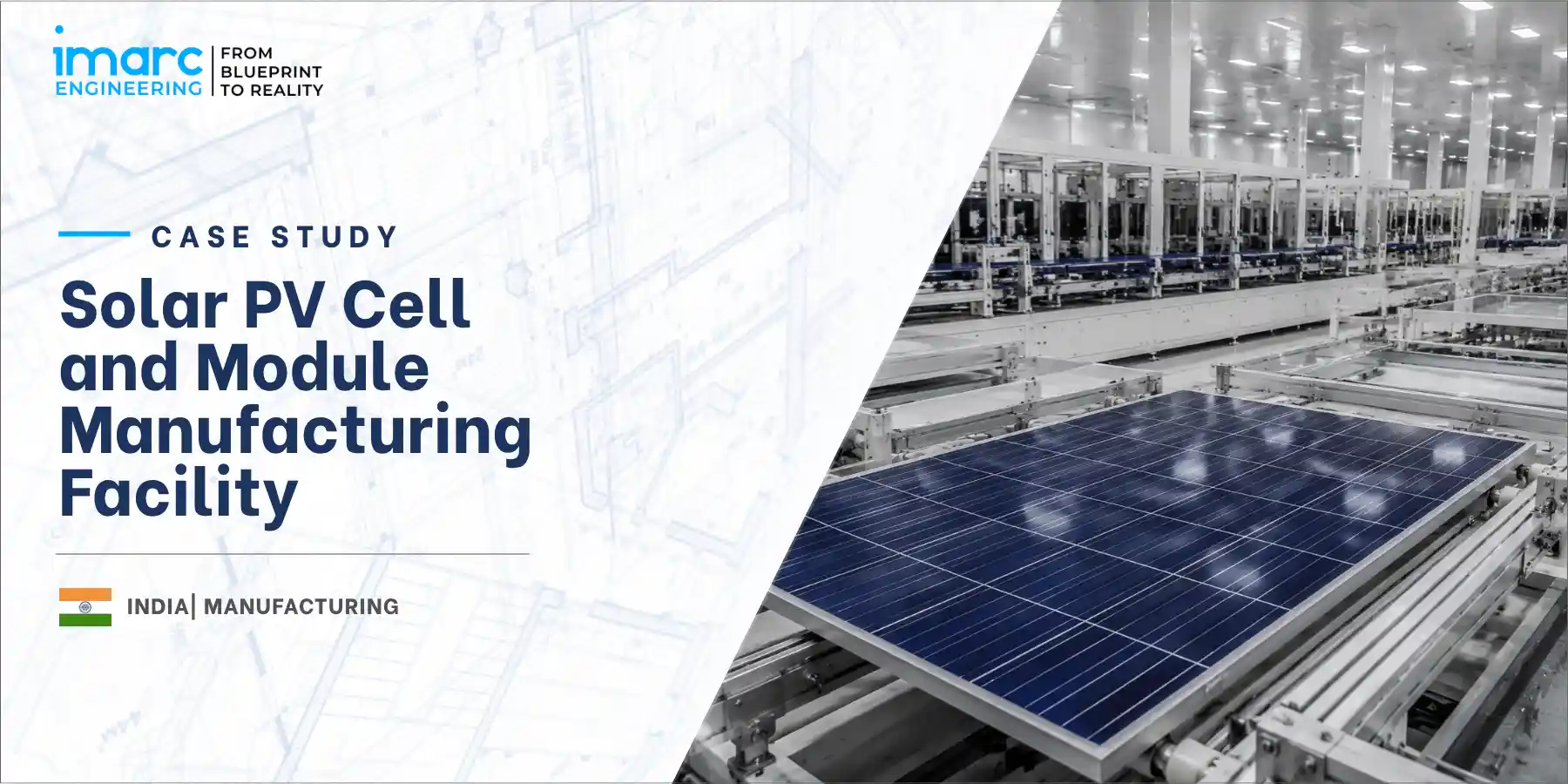
Solar PV Cell and Module Manufacturing Facility
Case Study Details
Industry
Manufacturing – Solar Photovoltaic Cells and Modules
Location
Sri City Special Economic Zone, Tirupati District, Andhra Pradesh, India (serving Indian utility-scale, commercial and rooftop solar developers)
Project Type
Greenfield integrated solar cell and module manufacturing facility (Phase 1, expandable with upstream wafer line)
Project Capacity
4 GW per annum monocrystalline TOPCon cells and 4 GW per annum bifacial modules (M10 wafer format)
Investment
INR 2,840 Crore (final CapEx after execution)
Challenge
22 months to commissioning
Impact
PLI ALMM Tranche II allocation executed against milestone schedule; ALMM listing secured under MNRE for both cells and modules; BIS, IEC 61215, and IEC 61730 certifications completed; long-term supply commitments signed across five Indian utility-scale solar developers
IMARC's Solution Highlights
End-to-end EPCM advisory across feasibility, TOPCon process engineering, multi-OEM equipment procurement, PLI ALMM Domestic Value Addition planning, and integrated MNRE/BIS/IEC compliance readiness
Project Overview
An Indian renewable energy developer-manufacturer consortium engaged IMARC Engineering to establish a greenfield 4 GW solar photovoltaic cell and 4 GW bifacial module manufacturing facility at the Sri City Special Economic Zone in Tirupati District, Andhra Pradesh. The project was structured against an allocation secured under the Government of India's Production Linked Incentive scheme for High Efficiency Solar PV Modules (PLI ALMM Tranche II, an INR 19,500 Crore corpus awarded across 39.6 GW of cumulative integrated capacity in 2024), and within the broader policy framework of the Approved List of Models and Manufacturers (ALMM) order, the Basic Customs Duty regime on imported cells and modules, and Domestic Content Requirement provisions in central and state government solar tenders.
The project involved establishing 4 GW per annum of monocrystalline TOPCon (Tunnel Oxide Passivated Contact) cell production using M10 wafer format (182.2 mm) and 4 GW per annum of matched bifacial module assembly, with site infrastructure designed for Phase 2 expansion adding an upstream wafer slicing line and additional cell capacity.
Client's Challenges
The client faced several specific challenges in establishing greenfield TOPCon-generation solar PV manufacturing in India:
- TOPCon technology transition: Establishing first-time-in-organisation TOPCon cell manufacturing capability — including tunnel oxide deposition, in-situ doped polysilicon layer growth, boron diffusion, and hydrogenation steps — as the industry transitions from PERC (passivated emitter rear contact) to TOPCon, with associated equipment, process, and operator skill changes.
- PLI ALMM Domestic Value Addition: Achieving the scheme's Domestic Value Addition milestones progressively across the five-year scheme tenure, in a sector where polysilicon and wafer feedstock remains substantially imported and where DVA must be built through downstream component localisation (glass, encapsulant, backsheet, frames, junction boxes, ribbons).
- Wafer supply security: Securing reliable upstream wafer supply during Phase 1 operations, with concentrated global wafer production creating both commercial and strategic exposure, and developing a credible Phase 2 wafer-line investment pathway.
- Cell efficiency consistency at scale: Sustaining cell efficiency at or above 24.5 percent across multiple parallel production lines, with tight control of in-line process parameters across diffusion, etching, deposition, and metallisation steps.
- ALMM and DCR market access: Achieving ALMM listing across the cell and module models within scheme-required timelines and DCR-compliant cell sourcing certification, both prerequisites for participation in central and state government solar tenders that constitute the largest share of Indian utility-scale demand.
- Workforce build-up: Recruiting and training 1,420 manufacturing, quality, and engineering personnel — including TOPCon-specific process specialists — in a regional location, supported by a structured technology-transfer programme with the European cell-line equipment licensor.
What We Did
-
Pre-Investment and Strategic Advisory
Our feasibility study evaluated four candidate Indian locations, Sri City SEZ (Andhra Pradesh), Sricity-adjacent Naidupeta (Andhra Pradesh), an established Tamil Nadu solar manufacturing cluster, and a Gujarat coastal industrial estate, against 15 weighted criteria including SEZ benefits and customs duty treatment, port proximity for wafer and polysilicon imports, 220 kV grid availability and reliability, state-level renewable manufacturing incentives, water entitlements, and skilled engineering workforce availability from the surrounding Chennai metropolitan engineering pipeline. Sri City SEZ was selected on the strength of its established multinational manufacturing ecosystem, dual-feed 220 kV grid through APSPDCL with documented reliability, proximity to Krishnapatnam and Chennai ports (approximately 70 and 120 kilometres respectively), Andhra Pradesh Industrial Development Policy capital subsidy eligibility, and the SEZ's customs duty exemption on imported polysilicon and wafer feedstock during Phase 1 operations.
CapEx planning of INR 2,960 Crore covered the four TOPCon cell production lines, four matched module assembly lines, common process utilities (compressed air, nitrogen, chilled water, deionised water), the test and quality laboratory, the warehouse and packaging area, and the dedicated 220 kV substation upgrade. Our team led the PLI ALMM Tranche II bid preparation that secured the 4 GW integrated cell-and-module allocation, alongside Andhra Pradesh single-window investment approval, SEZ unit registration, and ALMM listing application preparation under the MNRE Approved List of Models and Manufacturers order. Financial modelling demonstrated post-tax IRR of 17.4 percent at full ramp with a 6.6-year payback inclusive of PLI accruals and the Andhra Pradesh capital subsidy.
-
Engineering and Design Services
IMARC designed a 38,000 sq.m built-up facility on a 26-acre plot across cell production, module assembly, test laboratory, warehouse, and central utility areas. The cell manufacturing hall housed four parallel TOPCon production lines, each rated at 1 GW per annum nameplate capacity and configured for monocrystalline M10 wafer processing. The process sequence comprised alkaline texturing, boron diffusion for front-emitter formation, tunnel oxide growth, LPCVD polysilicon deposition and phosphorus doping of the passivating contact, etching and edge isolation, PECVD deposition of passivation and anti-reflective silicon nitride layers, screen-printed metallisation, and final firing for contact formation and hydrogenation. The module hall accommodated four matched M10 78-cell bifacial module assembly lines producing modules at the 605 to 625 Wp range with a measured bifaciality factor of 80 to 90 percent.
Process utility design covered electrical demand of 38 MW supplied through the upgraded 220 kV substation, a 6 MW rooftop solar array delivering approximately 18 percent of facility daytime energy demand, deionised water at 18.2 MΩ·cm resistivity (180 m³/hr design capacity) for cell processing, captive 99.999 percent purity nitrogen (1,200 Nm³/hr) for diffusion and PECVD atmospheres, captive Class A compressed dry air, and dedicated cooling water systems for the diffusion furnaces and process chillers. Cell line tolerances were specified for in-line junction box and metallisation steps to ±15 micrometres alignment accuracy, with closed-loop process control across 32 critical-to-quality parameters and statistical process control reporting at each in-line measurement point.
-
Procurement and Supply Chain Support
We executed a multi-geography procurement programme across 68 critical vendors. TOPCon cell-line core equipment — including diffusion furnaces, PECVD systems for hydrogenation, LPCVD systems for the polysilicon layer, screen printers, and in-line metrology — was sourced from a combination of European turnkey cell-line specialists and qualified Asian process-equipment OEMs with documented TOPCon installations. Module assembly equipment including stringers, layup, lamination, framing, and electroluminescence and current-voltage testers was sourced from European and Asian OEMs with reference installations at Indian ALMM-listed manufacturers. Civil, MEP, and process utility packages were awarded to qualified Indian contractors with documented solar manufacturing project track records.
Feedstock and bill-of-materials sourcing was deliberately structured to optimise PLI ALMM Domestic Value Addition. Polysilicon and wafer feedstock continued to be imported from established global suppliers during Phase 1 operations under structured long-term agreements. Downstream module bill-of-materials was substantially localised: solar glass from Indian patterned-glass manufacturers, EVA and POE encapsulants from Indian polymer specialists, backsheet from Indian and Korean qualified sources, aluminium frames and mounting hardware from Indian extruders, junction boxes from Indian electrical-component manufacturers, and copper ribbons from established Indian metal-fabrication suppliers. Vendor qualification protocols included supplier audits, factory acceptance testing, site acceptance validation, and full incoming material certification under IEC 61215 and IEC 61730 component traceability requirements. PLI DVA Year-1 achievement of 41 percent rose to 46 percent in Year-2 as the local supplier ramp progressed.
-
Project Execution and Site Management
Our turnkey project management delivered 22 months from groundbreaking to first commercial module output, coordinating civil construction, mechanical and electrical erection, equipment integration, and integrated commissioning of the cell and module lines in sequenced phases. We managed construction of the cell production hall (16,800 sq.m), the module assembly hall (12,400 sq.m), the test laboratory and electroluminescence inspection area (2,800 sq.m), the warehouse and outbound logistics block, and the central utility yard including the upgraded substation, deionised water plant, and gas yard.
Phased commissioning ran cell line 1 first, with the matched module line 1 commencing operations approximately 6 weeks after cell line 1 reached qualification, followed by parallel ramp-up of the remaining three cell and module lines. Installation supervision ensured solar-manufacturing-grade specifications: precision-controlled diffusion furnace temperature uniformity within ±2°C across the boat span, in-line wafer-handling vacuum systems verified to maintain breakage rates below 0.2 percent, and HEPA-filtered ISO Class 8 environmental control across cell lines critical to maintaining defect-free deposition. Multi-vendor coordination across European, Asian, and Indian contractors required a 22-strong owner's engineering team supplemented by 14 European resident engineers from the cell-line equipment licensor during the first two cell lines' commissioning. Cell efficiency progression tracked from 23.8 percent at first qualified output (month 23) to 24.8 percent by month 30, sustained against target across all four lines from month 32 onwards.
-
Compliance, Quality and Sustainability
IMARC led certification readiness across the MNRE Approved List of Models and Manufacturers (ALMM) order for both cell and module models, BIS IS 14286 (the Indian standard incorporating IEC 61215 and IEC 61730), IEC 61215 module qualification testing, IEC 61730 module safety testing, IEC 61701 salt-mist corrosion testing for coastal deployment qualification, and IEC TS 62804 PID (Potential Induced Degradation) testing. We implemented an integrated quality system with electroluminescence inspection on 100 percent of cells and modules, current-voltage flash testing at standard test conditions, dimensional verification, and full lot-level traceability from incoming wafer to outgoing module.
Environmental compliance covered Andhra Pradesh Pollution Control Board Consent to Establish and Operate, Central Ground Water Authority clearance for groundwater abstraction, Hazardous Waste Authorisation for spent solvents and process by-products, and Extended Producer Responsibility commitments for end-of-life module take-back. The facility achieved IGBC Gold certification through 6 MW captive rooftop solar (covering approximately 18 percent of daytime energy demand), water reclamation at 76 percent of process intake through closed-loop DI water polishing and cooling-water reuse, heat recovery from diffusion furnace exhaust and module laminator presses, and 24 percent lower process energy intensity versus the Chinese industry benchmark per third-party LCA. Forward sustainability commitments include progressive electrification of process heating, additional rooftop and ground-mounted captive solar, and an end-of-life module recycling partnership.
Final Results

Operational Performance
The facility achieved mechanical completion in 22 months with first commercial module dispatch in month 23. Full 4 GW per annum nameplate capacity was reached at 85 percent utilisation by month 18 of operations, with sustained TOPCon cell efficiency of 24.8 percent across all four cell lines (exceeding the target 24.5%) and module power output in the 605 to 625 Wp range for the M10 78-cell bifacial format. First-pass quality acceptance reached 98.2 percent at module level and 97.6 percent at cell level, with cumulative wafer breakage rate sustained below 0.2 percent across the operational year. ALMM listing was secured for all four module models and three cell models within 11 months of first commercial output.
Financial Outcomes
Final CapEx of INR 2,840 Crore delivered nearly 4.0 percent savings against the INR 2,960 Crore budget through optimised civil packaging, multi-source equipment procurement leverage, and disciplined commissioning sequencing across the four parallel lines. The Andhra Pradesh capital subsidy and electricity duty exemption benefits were disbursed against construction and ramp-up milestones, and PLI ALMM Tranche II milestone disbursements commenced from Year-1 commercial production with cumulative scheme eligibility of approximately INR 332 Crore over the scheme tenure. Year-2 revenue of INR 4,820 Crore was generated at an EBITDA margin of 18 percent — consistent with cell-and-module integrated solar manufacturing economics in the ALMM-protected Indian market, and supported by the BCD-driven domestic price premium over imported competition.
Market Access
ALMM listing was secured for all four module models within 11 months of first commercial output, with subsequent DCR certification unlocking access to central government and state government solar tender pipelines. Long-term supply commitments were signed with five Indian utility-scale solar developers covering aggregate offtake of approximately 12 GW cumulatively through 2032, with selective regulated-market export agreements signed for the European Union and the United States covering modules eligible under the respective domestic content frameworks. The facility was qualified as a Tier 1 module supplier under independent bankability rating frameworks within 14 months of commercial operations.
Sustainability Impact
Our integrated design — combining 6 MW rooftop captive solar covering approximately 18 percent of daytime energy demand, heat recovery from diffusion furnace exhaust and laminator presses delivering 18 GJ per hour of useful thermal energy, variable-frequency drives across cooling, compressed air, and DI water systems, and LED lighting throughout — achieves 24 percent lower process energy intensity versus the Chinese solar manufacturing industry benchmark, saving approximately INR 64 Crore annually in energy operating costs. Process water reclamation reaches 76 percent through closed-loop deionised water polishing and cooling water reuse, saving approximately 380,000 m³ annually. The facility holds IGBC Gold certification and operates an end-of-life module take-back partnership covering Andhra Pradesh and neighbouring states.
Strategic Impact
The project established a meaningful greenfield contribution to India's solar manufacturing capacity build-out under the PLI ALMM framework and demonstrated the operational viability of first-time TOPCon-generation cell manufacturing at scale for an Indian renewable energy developer-manufacturer consortium. Year-2 revenue of INR 4,820 Crore, sustained 24.8 percent TOPCon cell efficiency, Tier 1 bankability rating, and the secured PLI ALMM and DCR market access framework led the client to approve Phase 2 expansion comprising an upstream M10 wafer slicing line and an additional 2 GW of TOPCon cell capacity, targeting deeper vertical integration and higher PLI Domestic Value Addition over the scheme tenure.
IMARC Engineering's end-to-end EPCM advisory — combining TOPCon process engineering, PLI ALMM scheme navigation, MNRE/BIS/IEC compliance readiness, and disciplined multi-vendor execution — enabled the client to anchor a strategically important Indian industrial asset in a sector where technology transition risk, scheme-compliance complexity, and ramp-up execution had previously raised the entry barrier for first-time solar manufacturers.
Case Study Details
Industry
Manufacturing – Solar Photovoltaic Cells and Modules
Location
Sri City Special Economic Zone, Tirupati District, Andhra Pradesh, India (serving Indian utility-scale, commercial and rooftop solar developers)
Project Type
Greenfield integrated solar cell and module manufacturing facility (Phase 1, expandable with upstream wafer line)
Project Capacity
4 GW per annum monocrystalline TOPCon cells and 4 GW per annum bifacial modules (M10 wafer format)
Investment
INR 2,840 Crore (final CapEx after execution)
Challenge
22 months to commissioning
Impact
PLI ALMM Tranche II allocation executed against milestone schedule; ALMM listing secured under MNRE for both cells and modules; BIS, IEC 61215, and IEC 61730 certifications completed; long-term supply commitments signed across five Indian utility-scale solar developers
IMARC's Solution Highlights
End-to-end EPCM advisory across feasibility, TOPCon process engineering, multi-OEM equipment procurement, PLI ALMM Domestic Value Addition planning, and integrated MNRE/BIS/IEC compliance readiness
Have a similar project in mind?
Our engineering consultants can help you plan, design, and execute your next facility — from feasibility to commissioning.
Schedule a consultationTrusted by Industry Leaders
We partner with global enterprises and ambitious businesses across sectors to deliver operational excellence, strategic insights, and sustainable growth through integrated solutions.












Success in Their Words
Real feedback from clients across industries. Discover how our solutions delivered measurable impact and operational excellence.

I wanted to express my sincere appreciation for your efforts in handling this matter. Your dedication and commitment have been truly commendable, and it is evident that you have put in tremendous hard work and expertise into resolving the issues at hand. We are greatly interested in continuing our collaboration with you in the future, as your professionalism and reliability have made you a trusted partner. Thank you once again for your invaluable contribution. We look forward to strengthening our partnership ahead.

It has been a pleasure working with the IMARC team. The insights provided were structured, clear, and highly valuable, helping us strengthen both our technical and financial planning with confidence. We deeply appreciate the team’s professionalism, responsiveness, and attention to detail throughout the engagement. Every requirement was well understood and effectively incorporated, resulting in a comprehensive and actionable output. Overall, our experience has been excellent, and I would gladly recommend IMARC to organizations seeking a reliable research partner.

Your service is truly exceptional. Working with the IMARC team has been a seamless and professional experience. The clarity of communication, responsiveness to queries, and consistent support at every stage made the entire engagement highly efficient. The insights shared were well-structured, practical, and perfectly aligned with our requirements, helping us make informed decisions with confidence. Overall, the dedication and professionalism demonstrated by your team stand out, and I would be glad to recommend IMARC as a reliable and trustworthy research partner.

IMARC did an outstanding job in preparing our study. They were punctual, precise, and consistently responsive throughout the entire process. The team delivered all the data we required in a clear, well-organized, and highly professional format. Their strong attention to detail, combined with their ability to meet every deadline without compromising quality, truly set them apart. Overall, their reliability and commitment made them an exceptional partner for our project, and we would gladly work with them again in the future.

IMARC made the whole process incredibly easy from start to finish. Everyone I interacted with via email was polite, professional, and straightforward to deal with, always keeping their promises regarding delivery timelines and remaining consistently solutions-focused. From my very first contact, I appreciated the professionalism and support shown by the entire IMARC team. I highly recommend IMARC to anyone seeking timely, affordable, and reliable information or advice. My experience with IMARC was excellent, and I truly cannot fault any aspect of it.

I’d like to express my sincere gratitude for the excellent work you accomplished with the study. Your ability to quickly understand our requirements and deliver high-quality results under tight timelines truly reflects your expertise, exceptional work ethic, and unwavering commitment to your customer’s success. The professionalism and responsiveness you demonstrated throughout the process made a significant difference. Our entire team and company are incredibly thankful for your dedication, reliability, and support. Once again, thank you for your outstanding contribution.
Ready to Experience the IMARC Advantage?
Whether you're planning a new facility, expanding operations, optimizing performance, or facing complex challenges—IMARC Engineering brings the expertise, experience, and commitment needed for success.