Orthopaedic Implants Manufacturing Facility
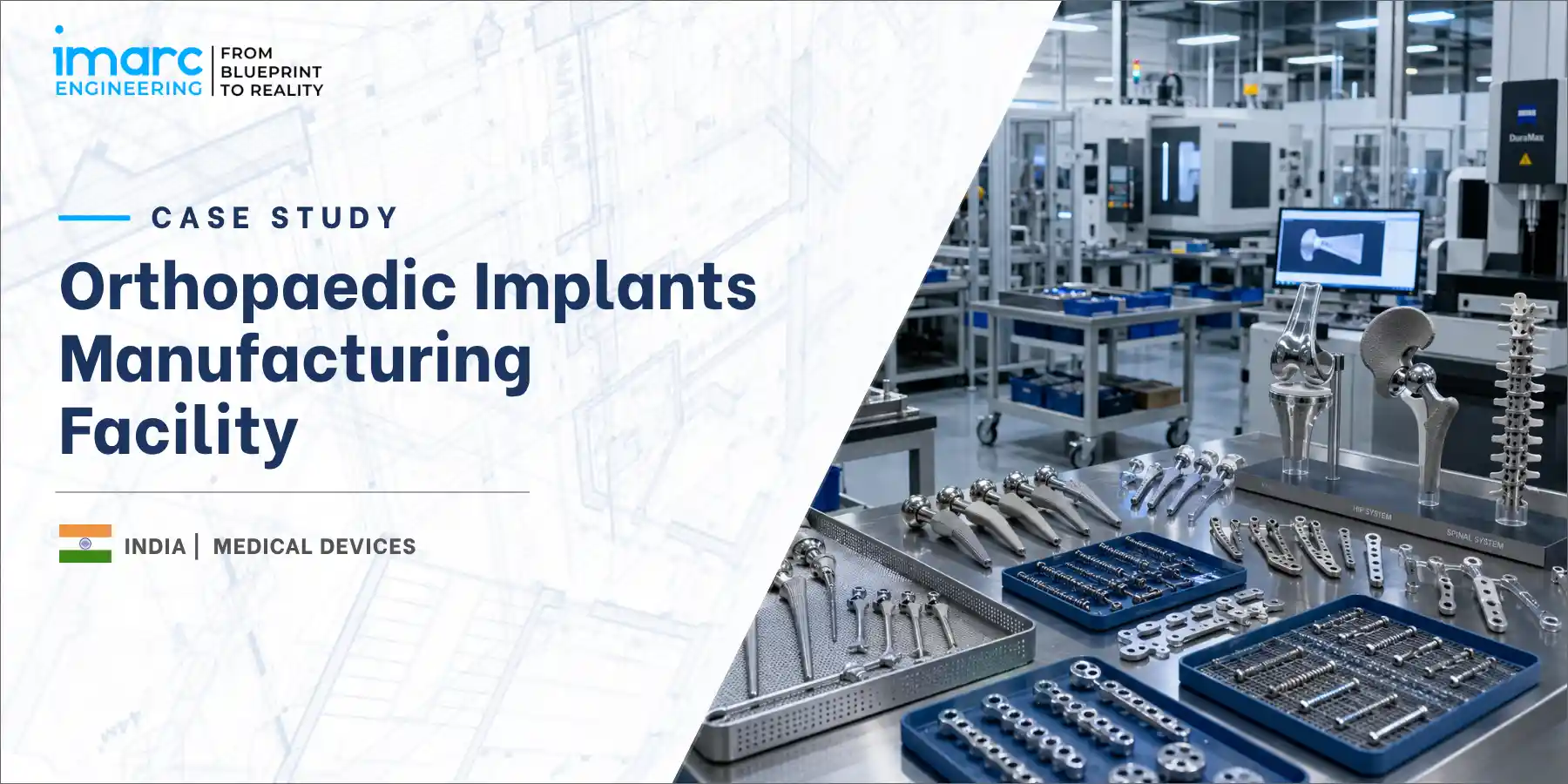
Case Study Details
Industry
Medical Devices – Orthopaedic Implants
Location
Telangana Medical Devices Park, Sultanpur, Medak District, Telangana, India (serving Indian hospital networks and regulated export markets)
Project Type
Greenfield orthopaedic implants manufacturing facility (Phase 1, expandable with spinal and dental implant lines)
Project Capacity
240,000 implants per annum across knee, hip, and trauma categories in cobalt-chrome and titanium alloy platforms
Investment
INR 420 Crore (final CapEx)
Challenge
24 months to commissioning
Impact
PLI Medical Devices Category 3 allocation executed against milestone schedule; 4 USFDA 510(k) clearances in Year-1 with 14 cumulative by Year-2; 8 EU MDR 2017/745 certifications; ISO 13485:2016 quality system certified; supply commitments signed with eight Indian hospital networks and entries into US, EU, Australia, and ASEAN export markets
IMARC's Solution Highlights
End-to-end EPCM advisory across feasibility, precision implant manufacturing engineering, HIP and surface-treatment integration, multi-OEM specialty equipment procurement, and integrated PLI/USFDA/EU MDR/CDSCO compliance readiness
Project Overview
A consortium led by an Indian medical devices manufacturer and a European orthopaedic implant technology licensor engaged IMARC Engineering to establish a greenfield orthopaedic implants manufacturing facility within the Telangana Medical Devices Park at Sultanpur in Medak District, approximately 50 kilometres from Hyderabad. The project was structured against an allocation secured under the Government of India's Production Linked Incentive scheme for Medical Devices (an INR 3,420 Crore corpus across four scheme categories, with 28 manufacturers selected across the 2021 and 2022 application windows), and within the broader policy framework of the Promotion of Medical Devices Parks Scheme (under which four parks have been approved with central financial assistance of up to INR 100 Crore each), the Medical Device Rules 2017 administered by CDSCO, and the National Pharmaceutical Pricing Authority's orthopaedic implant price ceilings in force since 2017.
Driven by India's documented 75 to 80 percent import dependence on medical devices — concentrated in the premium orthopaedic implant segments where European and US imports dominate — and a domestic demand profile of approximately 270,000 knee replacement surgeries and 85,000 hip replacement surgeries per annum growing at the high end of the medical-device segment, the client identified a strategic opportunity to localise production of premium orthopaedic implants for the Indian hospital network and to enter regulated export markets in the United States, European Union, Australia, and ASEAN under credible quality and regulatory credentials.
The project involved establishing a 240,000-implant per annum facility producing a portfolio across knee replacement implants (cementless and cemented variants, including femoral, tibial, insert, and patellar components), hip replacement implants (cementless femoral stem, acetabular cup, polyethylene liner, femoral head), and trauma implants (locking plates, cortical and cancellous screws, intramedullary nails) across cobalt-chromium-molybdenum (CoCrMo, ASTM F1537) and titanium alloy (Ti-6Al-4V ELI, ASTM F136) platforms, with site infrastructure designed for Phase 2 expansion adding spinal implants and dental implant lines.
Client's Challenges
The client faced several specific challenges in establishing greenfield premium-segment orthopaedic implant manufacturing in India:
- Precision metalworking on biomedical alloys: Engineering 5-axis CNC precision machining of cobalt-chromium-molybdenum and Ti-6Al-4V ELI alloys to surgical-implant tolerances — typically ±25 micrometres on critical articulating surfaces and ±10 micrometres on stem geometries critical to bone interface — with associated tooling, in-process metrology, and operator skill development on materials substantially harder and more demanding than commodity steel or aluminium.
- Hot Isostatic Pressing and surface treatments: Establishing in-house Hot Isostatic Pressing (HIP) for porosity closure and density homogenisation, plasma spray coating for hydroxyapatite (HA) bone-ingrowth surfaces, micro-blasting for textured stems, electropolishing for articulating surfaces, and cleanroom passivation — each unfamiliar to general engineering manufacturing in India and each requiring dedicated process validation.
- Triple regulatory readiness: Simultaneous compliance with USFDA 510(k) requirements, EU Medical Device Regulation 2017/745 (with associated Notified Body engagement and clinical evidence dossier preparation), and Indian CDSCO Medical Device Rules 2017 — with non-overlapping documentation rigour across design history files, technical files, and clinical evidence.
- PLI Medical Devices scheme compliance: Meeting the scheme's investment, production volume, and Domestic Value Addition milestones across the five-year scheme tenure under PLI Medical Devices Category 3 (implants and orthopaedic devices), alongside the Telangana Medical Devices Park's specific tenant performance commitments and NPPA pricing-compliance reporting obligations.
- Talent build-up for surgical implant operations: Recruiting 540 personnel including 84 precision CNC machinists, 22 metallurgists, 36 quality and regulatory affairs specialists, and 18 clinical and regulatory documentation officers in a regional location with limited prior surgical implant manufacturing experience, supported by structured technology-transfer partnerships with the European licensor and recruitment relationships with Indian engineering and medical-device-engineering programmes.
- Sterilisation, packaging integrity, and clinical evidence: Engineering sterilisation by ethylene oxide (in-house) and gamma irradiation (via dedicated outsourced partnership) with associated process validation across ISO 11135 and ISO 11137, sterile barrier packaging integrity validation under ISO 11607, and supporting clinical evidence preparation under MEDDEV 2.7/1 Rev 4 for EU MDR compliance.
What We Did
-
Pre-Investment and Strategic Advisory
Our feasibility study evaluated the four Government-approved Medical Devices Parks — Telangana (Sultanpur, Medak District), Andhra Pradesh (HCMD, Visakhapatnam), Tamil Nadu (Oragadam), and Himachal Pradesh (Nalagarh) — against 15 weighted criteria including park infrastructure readiness, surrounding medical and hospital ecosystem maturity, engineering and medical-device-engineering talent pipelines, port and air-cargo connectivity for sterile-barrier product export, state-level medical-device industrial policies, and water and grid reliability. Telangana Medical Devices Park was selected on the strength of its established Hyderabad medtech and hospital ecosystem (with major corporate hospital networks operating in the city alongside NIPER Hyderabad and IIT Hyderabad providing engineering talent), proximity to the Rajiv Gandhi International Airport for time-sensitive sterile product exports, and the Telangana Industrial Policy 2014 designation of medical devices as a thrust sector.
CapEx planning of INR 440 Crore covered the precision machining hall, the Hot Isostatic Pressing and surface-treatment block, the ISO Class 7 cleanroom assembly area, the in-house ethylene oxide sterilisation block, the metrology and mechanical-testing laboratory complex, and the warehouse and packaging facilities. Our team led the PLI Medical Devices Category 3 bid preparation that secured a scheme allocation, alongside Telangana State Industries Department investment approval, Telangana Medical Devices Park land allotment, and CDSCO Manufacturing Licence pre-application engagement. The PLI scheme's performance-linked incentive structure was modelled to deliver a cumulative benefit of approximately INR 38 Crore across the five-year scheme window against achieved production and DVA milestones. Financial modelling demonstrated post-tax IRR of 22.4 percent at full ramp with a 5.2-year payback inclusive of PLI accruals and the Telangana state subsidy structure.
-
Engineering and Design Services
IMARC designed an 18,000 sq.m built-up facility comprising the precision machining hall (5,800 sq.m housing 24 five-axis CNC centres alongside Swiss-type lathes and wire-EDM stations), the HIP and surface-treatment block (3,200 sq.m housing the Hot Isostatic Pressing chamber rated 1,200°C and 150 MPa, plasma spray coating booths, micro-blasting stations, electropolishing tanks, and passivation chemistry), the ISO Class 7 cleanroom assembly hall (4,800 sq.m), the in-house ethylene oxide sterilisation block, the metrology and mechanical-testing laboratory complex (1,400 sq.m), and warehouse, packaging, and administrative areas. The cleanroom envelope was specified for ISO 14644-1 Class 7 (Class 10,000 by the legacy nomenclature) for final implant assembly, with positive-pressure cascade airlocks between high-care and lower-classification zones.
Mechanical testing was designed to support full regulatory dossier evidence: hip implant fatigue testing per ISO 7206 (covering ISO 7206-4 stem fatigue and ISO 7206-6 femoral neck fatigue), knee implant testing per ISO 14243, bone screw and plate testing per ASTM F543 and ASTM F382, and component-level dimensional verification through coordinate measuring machines, surface roughness measurement, and optical comparators. Process utility design covered 6 MW grid demand supplemented by a 1.2 MW captive solar array, deionised water at 0.1 µS/cm conductivity for final cleaning steps, medical-grade compressed air at oil and particulate specifications meeting ISO 8573 Class 0, HVAC engineered for cleanroom pressure cascade with HEPA H14 filtration, and dedicated ethylene oxide exhaust scrubbing with continuous emission monitoring.
-
Procurement and Supply Chain Support
We executed a multi-geography procurement programme across 52 critical vendors. Five-axis CNC precision machining centres were sourced from established Japanese and German specialists with documented orthopaedic implant manufacturing references; the Hot Isostatic Pressing chamber from a European HIP equipment specialist; plasma spray coating equipment from a European medical-grade coating systems supplier; ethylene oxide sterilisation chambers from European medical-device sterilisation OEMs; and the metrology suite (CMM, surface roughness, optical measurement) from Japanese, German, and US precision-metrology specialists. Cleanroom panel systems and HVAC packages were awarded to qualified Indian and European specialty contractors with documented medical-device cleanroom track records.
Raw material sourcing combined qualified international suppliers for medical-grade CoCrMo bar stock (ASTM F1537) and Ti-6Al-4V ELI bar stock (ASTM F136) with progressive qualification of Indian specialty alloy suppliers for selected sizes and grades. Hydroxyapatite coating powder was sourced from a European medical-grade specialty supplier under the technology licensor's preferred supplier network. Sterile barrier packaging materials including Tyvek pouches and sealable lid stock were sourced from European packaging specialists with documented ISO 11607 references. Gamma irradiation sterilisation was structured under a dedicated long-term contract with an established Indian gamma irradiation facility, complementing the in-house ethylene oxide capability. Vendor qualification protocols included on-site supplier audits, full Certificate of Analysis verification, biocompatibility testing per ISO 10993 series, and PLI DVA documentation linking every procurement decision to the scheme's annual DVA milestones. PLI DVA reached 52 percent by Year-2.
-
Project Execution and Site Management
Our turnkey project management delivered 24 months from groundbreaking to first commercial implant release, coordinating civil construction, mechanical and electrical erection, cleanroom installation, equipment integration, and integrated commissioning of the precision machining, HIP and surface treatment, cleanroom assembly, sterilisation, and packaging zones. We managed construction of the precision machining hall, the HIP and surface-treatment block (engineered for the heavy and thermally-cycled foundations required for the HIP chamber), the cleanroom envelope, the sterilisation block (designed to manage ethylene oxide handling and emission control), the metrology and mechanical testing laboratory, the warehouse and packaging area, and the dedicated substation and utility yards.
Phased commissioning ran precision machining first (with progressive five-axis CNC qualification across the 24 machining centres), followed by HIP and surface-treatment commissioning, then cleanroom assembly hall commissioning, sterilisation block commissioning, and finally end-to-end Process Validation (PV) campaigns covering Operational Qualification (OQ) and Performance Qualification (PQ) for each product family. Installation supervision ensured surgical-implant-grade specifications: machined-surface roughness verification within ±0.1 µm Ra on articulating geometries, dimensional verification by CMM on every batch with statistical sampling on every implant, ethylene oxide cycle validation per ISO 11135 with biological indicator and dosimetric verification, and continuous environmental monitoring with 124 fixed sensors logging particle count, temperature, humidity, and pressure differential across all classified spaces. Multi-vendor coordination across European, Japanese, German, US, and Indian contractors required an 18-strong owner's engineering team supplemented by 8 European resident engineers from the technology licensor during the precision machining and HIP/surface-treatment commissioning phases.
-
Compliance, Quality and Sustainability
IMARC led certification readiness across ISO 13485:2016 (medical-device quality management system, certified in month 11), ISO 14971 (medical-device risk management), ISO 11135 and ISO 11137 (sterilisation validation for ethylene oxide and gamma irradiation respectively), ISO 11607 (sterile barrier packaging), the ISO 10993 series (biocompatibility evaluation), the device-specific testing standards (ISO 7206, ISO 14243, ASTM F543, ASTM F382), and ISO 9001, ISO 14001, and ISO 45001 management systems. We led the regulatory dossier preparation that secured 4 USFDA 510(k) clearances across major implant types in Year-1 of commercial operations with 14 cumulative clearances by Year-2, 8 EU MDR 2017/745 certifications across the product portfolio through a designated Notified Body, 6 BIS product approvals, and CDSCO Manufacturing Licence and Loan Licence registration.
Environmental compliance covered Telangana State Pollution Control Board Consent to Establish and Operate, Hazardous Waste Authorisation for ethylene oxide residues, spent passivation chemistry, and machining coolant (managed through dedicated treatment and licensed offsite disposal), and Extended Producer Responsibility commitments for end-of-life implant material recovery. Specialty alloy swarf from precision machining is recovered and recycled through a structured arrangement with the upstream specialty alloy supplier, achieving an overall swarf recovery rate of 96 percent.
The facility achieved IGBC Gold certification through 1.2 MW captive solar (covering approximately 16 percent of facility energy demand), 78 percent process water reclamation through closed-loop cooling and ultrapure water polishing, heat recovery from the HIP chamber and ethylene oxide cycle exhaust, and 18 percent lower process energy intensity versus the European orthopaedic implant manufacturing industry benchmark per third-party comparative assessment.
Final Results
.webp)
Operational Performance
The facility achieved mechanical completion in 24 months with first commercial implant release in month 25. Full 240,000-implant per annum nameplate capacity was reached at 82 percent utilisation by month 18 of operations, with first-pass yield of 97.4 percent across the qualified product portfolio. ISO 13485:2016 certification was secured in month 11, the first 4 USFDA 510(k) clearances were obtained by month 14, cumulative USFDA 510(k) clearances reached 14 by month 22, and 8 EU MDR 2017/745 certifications were secured by month 24 through the designated Notified Body. Cumulative quality performance across the first operational year recorded zero CAPA-escalated complaints, zero regulatory observations from CDSCO inspection, and full lot-genealogy traceability across all 612 commercial batches released.
Financial Outcomes
Final CapEx of INR 420 Crore delivered 4.5 percent savings against the INR 440 Crore budget through optimised civil packaging, deliberate Indian-fabrication leverage for the structural and clean-utility scope, and disciplined multi-vendor procurement under the PLI Medical Devices Domestic Value Addition framework. PLI Medical Devices Tranche disbursements commenced from Year-1 commercial production against the scheme's milestone structure, with cumulative scheme benefit of approximately INR 38 Crore across the five-year window. Year-2 revenue of INR 520 Crore was generated at an EBITDA margin of 22 percent — consistent with established Indian premium orthopaedic implant manufacturer reporting and supported by the regulated export-market premium pricing relative to NPPA-capped domestic pricing.
Market Access
ISO 13485 certification was secured in month 11 of operations, the first USFDA 510(k) clearance in month 14, and EU MDR 2017/745 first product certification by month 18 — with cumulative 14 USFDA 510(k) clearances, 8 EU MDR certifications, 6 BIS product approvals, and CDSCO licensing, all by month 24. Supply commitments were signed with eight Indian corporate hospital networks (including national pan-India networks and regional super-specialty chains). Export entries were established across regulated markets — the United States, European Union member states, Australia (TGA), and ASEAN markets (Singapore, Malaysia, Thailand) — with export share reaching 32 percent of revenue by Year-2 and forming the strategic premium-pricing channel for the manufacturer.
Sustainability Impact
Our integrated design — combining 1.2 MW captive rooftop solar covering approximately 16 percent of facility energy demand, heat recovery from the Hot Isostatic Pressing chamber and ethylene oxide sterilisation cycle exhaust, variable-frequency drives across HVAC and process pump systems, and LED lighting throughout — achieves 18 percent lower process energy intensity versus the European orthopaedic implant manufacturing industry benchmark, saving approximately INR 4.2 Crore annually in energy operating costs. Process water reclamation reaches 78 percent through closed-loop machining-coolant recovery and ultrapure water polishing recycling. Specialty alloy swarf recovery at 96 percent (cobalt-chromium and titanium reclaimed through structured arrangements with upstream alloy suppliers) substantially reduces the facility's raw-material environmental footprint. The facility holds IGBC Gold certification and operates an end-of-life implant material recovery partnership across the eight hospital network supply commitments.
Strategic Impact
The project established a fully-integrated cobalt-chrome and titanium orthopaedic implant manufacturing capability under the PLI Medical Devices Category 3 framework, with simultaneous regulated-market access across the United States, the European Union under MDR 2017/745, Australia, and ASEAN — a regulatory and quality footprint historically confined to European and US incumbent manufacturers. Year-2 revenue of INR 520 Crore, 22 percent EBITDA margin, sustained 97.4 percent first-pass yield, and the secured regulated-market export-channel access led the client to approve Phase 2 expansion comprising spinal implant manufacturing and dental implant lines, leveraging the existing precision machining, HIP, and cleanroom infrastructure. IMARC Engineering's end-to-end EPCM advisory — combining precision implant manufacturing engineering, HIP and surface-treatment integration, USFDA and EU MDR regulatory dossier readiness, and PLI scheme navigation — enabled the client to anchor a strategically important Indian medical device asset in a sector where regulatory rigour, metallurgical precision, and clinical-evidence requirements had previously confined Indian manufacturers to commodity disposables and trauma hardware.
Case Study Details
Industry
Medical Devices – Orthopaedic Implants
Location
Telangana Medical Devices Park, Sultanpur, Medak District, Telangana, India (serving Indian hospital networks and regulated export markets)
Project Type
Greenfield orthopaedic implants manufacturing facility (Phase 1, expandable with spinal and dental implant lines)
Project Capacity
240,000 implants per annum across knee, hip, and trauma categories in cobalt-chrome and titanium alloy platforms
Investment
INR 420 Crore (final CapEx)
Challenge
24 months to commissioning
Impact
PLI Medical Devices Category 3 allocation executed against milestone schedule; 4 USFDA 510(k) clearances in Year-1 with 14 cumulative by Year-2; 8 EU MDR 2017/745 certifications; ISO 13485:2016 quality system certified; supply commitments signed with eight Indian hospital networks and entries into US, EU, Australia, and ASEAN export markets
IMARC's Solution Highlights
End-to-end EPCM advisory across feasibility, precision implant manufacturing engineering, HIP and surface-treatment integration, multi-OEM specialty equipment procurement, and integrated PLI/USFDA/EU MDR/CDSCO compliance readiness
Have a similar project in mind?
Our engineering consultants can help you plan, design, and execute your next facility — from feasibility to commissioning.
Schedule a consultationTrusted by Industry Leaders
We partner with global enterprises and ambitious businesses across sectors to deliver operational excellence, strategic insights, and sustainable growth through integrated solutions.












Success in Their Words
Real feedback from clients across industries. Discover how our solutions delivered measurable impact and operational excellence.

I wanted to express my sincere appreciation for your efforts in handling this matter. Your dedication and commitment have been truly commendable, and it is evident that you have put in tremendous hard work and expertise into resolving the issues at hand. We are greatly interested in continuing our collaboration with you in the future, as your professionalism and reliability have made you a trusted partner. Thank you once again for your invaluable contribution. We look forward to strengthening our partnership ahead.

It has been a pleasure working with the IMARC team. The insights provided were structured, clear, and highly valuable, helping us strengthen both our technical and financial planning with confidence. We deeply appreciate the team’s professionalism, responsiveness, and attention to detail throughout the engagement. Every requirement was well understood and effectively incorporated, resulting in a comprehensive and actionable output. Overall, our experience has been excellent, and I would gladly recommend IMARC to organizations seeking a reliable research partner.

Your service is truly exceptional. Working with the IMARC team has been a seamless and professional experience. The clarity of communication, responsiveness to queries, and consistent support at every stage made the entire engagement highly efficient. The insights shared were well-structured, practical, and perfectly aligned with our requirements, helping us make informed decisions with confidence. Overall, the dedication and professionalism demonstrated by your team stand out, and I would be glad to recommend IMARC as a reliable and trustworthy research partner.

IMARC did an outstanding job in preparing our study. They were punctual, precise, and consistently responsive throughout the entire process. The team delivered all the data we required in a clear, well-organized, and highly professional format. Their strong attention to detail, combined with their ability to meet every deadline without compromising quality, truly set them apart. Overall, their reliability and commitment made them an exceptional partner for our project, and we would gladly work with them again in the future.

IMARC made the whole process incredibly easy from start to finish. Everyone I interacted with via email was polite, professional, and straightforward to deal with, always keeping their promises regarding delivery timelines and remaining consistently solutions-focused. From my very first contact, I appreciated the professionalism and support shown by the entire IMARC team. I highly recommend IMARC to anyone seeking timely, affordable, and reliable information or advice. My experience with IMARC was excellent, and I truly cannot fault any aspect of it.

I’d like to express my sincere gratitude for the excellent work you accomplished with the study. Your ability to quickly understand our requirements and deliver high-quality results under tight timelines truly reflects your expertise, exceptional work ethic, and unwavering commitment to your customer’s success. The professionalism and responsiveness you demonstrated throughout the process made a significant difference. Our entire team and company are incredibly thankful for your dedication, reliability, and support. Once again, thank you for your outstanding contribution.
Ready to Experience the IMARC Advantage?
Whether you're planning a new facility, expanding operations, optimizing performance, or facing complex challenges—IMARC Engineering brings the expertise, experience, and commitment needed for success.