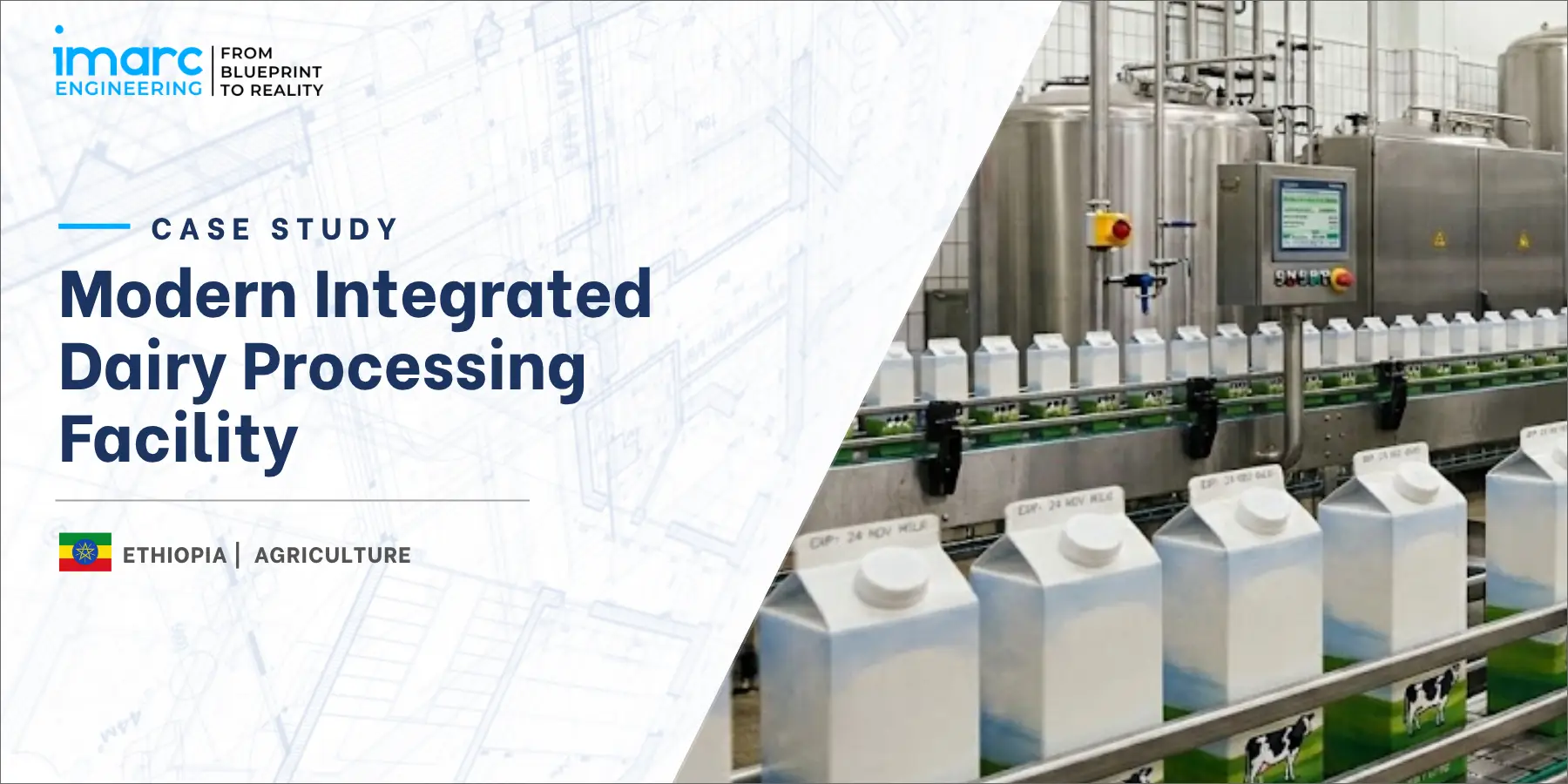
Modern Integrated Dairy Processing Facility
Case Study Details
Industry
Agriculture – Dairy Processing and Smallholder Integration
Location
Holeta, Oromia Region, Ethiopia (serving Ethiopian, COMESA and Middle East markets)
Project Type
Greenfield integrated dairy processing facility (Phase 1, expandable with feta cheese and infant formula lines)
Project Capacity
400,000 litres per day (146 million litres per annum across UHT milk, yogurt, butter, mozzarella, and milk powder)
Investment
USD 88 Million (final CapEx after execution)
Challenge
22 months to commissioning
Impact
Ethiopia's largest smallholder-linked modern dairy plant; 12,400 farmers integrated; ISO 22000, FSSC 22000, and Halal certifications secured; IFC and AfDB ESG safeguards demonstrated
IMARC's Solution Highlights
End-to-end EPCM advisory across feasibility, integrated processing-and-collection engineering, multi-product line execution, operational readiness across food safety certifications, and smallholder farmer integration programme design
Project Overview
An Ethiopian-European joint venture, in partnership with a European dairy processing technology integrator, engaged IMARC Engineering to establish a greenfield integrated dairy processing facility in Holeta, Oromia Region, more than 37 km west of Addis Ababa. Driven by Ethiopia's Agricultural Growth Programme II priorities, the African Development Bank and International Finance Corporation's structured agribusiness investment frameworks, and the structural demand-supply gap in modern dairy products across East Africa, Ethiopian per-capita dairy consumption sits at 20 litres against the African Union target of 50 litres and the global average of 87 litres, the client identified a strategic opportunity to anchor a smallholder-linked, vertically-integrated dairy processing operation with COMESA and Middle East export upside.
The project involved establishing a 400,000 litres per day facility processing UHT milk, set yogurt, butter, mozzarella cheese, and full-cream milk powder across five integrated production lines, supported by a regional milk collection network spanning 12,400 smallholder farmers across the Oromia, Amhara, and Sidama regions, with site infrastructure designed for Phase 2 expansion adding feta cheese and infant formula capabilities.
Client's Challenges
The client faced several specific challenges in establishing greenfield modern dairy manufacturing in Ethiopia:
- Smallholder-anchored supply chain: Building a reliable, daily 400,000-litre raw milk supply from 12,400 smallholder farmers (typical herd size 2 to 5 cows) across three regions, requiring an integrated cold-chain collection network with 48 milk collection centres operating to documented quality standards.
- Power reliability: Operating in Ethiopia's grid-constrained environment requiring 6 MW captive diesel backup, hybrid solar-grid architecture, and 24-hour redundancy for refrigerated storage to protect against EEP load-shedding and voltage instability.
- Cold chain at scale: Maintaining 4°C across 12,400 farm-level chilling assets, 48 regional collection centres, intermediate bulking stations, and 220 km of refrigerated transport, a multi-tier cold chain at a scale previously unprecedented for Ethiopian dairy.
- Multi-certification readiness: Simultaneous ISO 22000, FSSC 22000, Halal, EFDA registration, and COMESA dairy export protocol compliance, layered onto IFC and AfDB Environmental and Social Performance Standards safeguard requirements under the DFI-backed financing structure.
- Workforce scarcity: Recruiting and training 280 operations, quality, and engineering personnel in a country with limited modern dairy processing experience, plus embedding 140 field extension officers across the smallholder collection network.
- Forex and import scheduling: Operating under Ethiopia's structural forex constraints requiring careful import sequencing, local content optimisation through Ethiopian fabrication partners, and forex hedging across the 22-month construction window.
What We Did
-
Pre-Investment and Strategic Advisory
Our feasibility study evaluated four candidate sites in Ethiopia's dairy belt — Holeta (Oromia), Bishoftu (East Shewa), Adama, and Hawassa (Sidama) — against 15 weighted criteria including milkshed density and quality, road infrastructure for collection logistics, electricity availability, water supply, proximity to Addis Ababa for finished-goods distribution, and Ethiopian Investment Commission incentive packages. Holeta was selected on the strength of its established small-scale dairy ecosystem in the surrounding Sululta Plains and Walmara districts, paved road access along the Addis-Ambo corridor, dual EEP grid feed availability, and an Oromia Regional Investment Commission package including reduced lease premium on the 14-hectare site.
CapEx planning of USD 92 Million covered the integrated processing facility, milk collection infrastructure, and farmer integration programme launch. Our team led the joint financing application that secured USD 38 Million from the International Finance Corporation under its Agribusiness Investment programme, USD 22 Million from the African Development Bank's Agriculture Fast Track Fund, USD 18 Million of client’s equity, and USD 14 Million in equity from a European dairy industrial partner, alongside Ethiopian Investment Commission incentives, Ethiopian Revenues and Customs Authority duty-deferral structures, and Oromia regional land lease advisory. Smallholder economics modelling demonstrated a sustainable farmgate price uplift of approximately 180% versus the informal-trader baseline, and project-level financial modelling confirmed post-tax IRR of 19.8% at full ramp with a 6.1-year payback inclusive of DFI concessional terms.
-
Engineering and Design Services
IMARC designed a 12,800 sq.m built-up facility on a 14-hectare site comprising five integrated processing lines: a 200,000 LPH milk reception and standardisation hall with four unloading bays, a 120,000 LPH ultra-high-temperature (UHT) line with Tetra Pak A3/Flex aseptic packaging in 1L, 500ml, and 200ml formats, a 60,000 LPH set yogurt line with cup and pouch filling, a 4 MT/day butter line with churning and packaging, a 6 MT/day mozzarella cheese line, and a 12 MT/day spray-dryer milk powder train. Plant layout was developed under HACCP-by-design principles with strict zoning between raw, intermediate, and finished-product areas, and full pressure cascade segregation between low-, medium-, and high-care zones.
Utility design covered 4.8 MW of contracted EEP demand supplemented by 2 MW dedicated rooftop solar with battery firming, 6 MW diesel backup generation with N+1 redundancy for critical refrigerated and aseptic loads, ammonia (R717) refrigeration across all chilled storage with zero global-warming-potential exposure, 4.8 MLD gross water intake with target reclamation exceeding 35%, and methane biogas recovery from whey and condensate treatment delivering 180 Nm³/hr of useful gas back into boiler fuel. The 48 milk collection centres were standard-designed on a single replicable footprint of 280 sq.m each, with 8,000 to 15,000-litre chilled bulk milk tanks, weighing platforms, milk quality testing benches (fat, SNF, freezing point, antibiotic screening), and farmer payment kiosks.
-
Project Execution and Site Management
Our turnkey project management delivered 22 months from groundbreaking to first commercial product, coordinating civil construction, mechanical and electrical erection, and integrated commissioning of all five process lines and the 48-centre collection network in parallel. Equipment integration spanned 84 vendors across European turnkey technology partners (Tetra Pak, GEA, SPX Flow, Alfa Laval) for the core processing islands, Indian, Turkish, and South African fabrication partners for tanks and stainless steel utilities, and East African construction firms for civil works, leveraging Ethiopian Engineering Group and Sur Construction for site-wide civil and MEP.
Installation supervision ensured dairy-grade specifications: 316L stainless steel and EPDM elastomers across all milk-contact surfaces, sanitary clamp connections to 3-A and EHEDG standards, orbital-welded high-purity product piping with full passivation records, CIP-by-design with validated cleaning programmes for each product changeover, and continuous environmental monitoring with 142 fixed sensors for temperature, humidity, and door-status across the cold chain.
Multi-vendor coordination across European, Asian, and East African contractors required an 18-strong owner's engineering team with embedded resident commissioning engineers from the European technology partner, weekly steering reviews under a single food-safety-led execution plan, and parallel-track construction of the 48 collection centres with a dedicated regional construction supervisor for each of the three target regions.
-
Operations Readiness and Ramp-Up
We developed a structured operational readiness programme comprising 184 SOPs covering process operations, hygiene and sanitation, raw milk testing protocols, finished-product release, and emergency response. The HACCP team, 18 cross-functional senior personnel, was certified to ISO 22000 lead auditor level and trained over six months at the European partner facility.
Operator training included a 12-week residential immersion programme for 280 personnel covering food-safety culture, hygienic operating practice, equipment-specific operating skills, and quality decision-making, with 32 senior staff additionally placed on a 6-week residential rotation at the European technology partner's reference facility.
Production ramp-up tracked utilisation from 60% (month 1) to 88% (month 12), with first-pass quality acceptance evolving from 91% to 98.6%. Yogurt fermentation profile tuning, mozzarella stretch-and-mould parameter optimisation, and milk powder agglomeration uniformity were addressed through weekly steering reviews driving root-cause closure on 86 process anomalies.
Post-commissioning performance validation confirmed achievement of design throughput within 11 months and customer-side acceptance across modern trade quality audits from three major Ethiopian retail chains and an initial COMESA export buyer based in Djibouti.
-
Compliance, Quality and Sustainability
IMARC led certification readiness across ISO 22000 (food safety management), FSSC 22000 (Global Food Safety Initiative recognised scheme), Halal certification across all five product lines, EFDA (Ethiopian Food and Drug Authority) facility and product registration, and COMESA dairy export protocol compliance covering veterinary, sanitary, and phytosanitary documentation.
We implemented an integrated quality system with raw milk acceptance testing at the farm gate, at collection centres, and at plant reception (covering fat, SNF, freezing point, somatic cell count, antibiotic residues, and aflatoxin M1), 100% online product testing across UHT and aseptic packaging integrity, and full lot traceability from individual farmer to retail shelf through QR-coded primary packaging.
Environmental and social compliance was structured around the International Finance Corporation's Environmental and Social Performance Standards 1 through 8, with documented Environmental and Social Impact Assessment, stakeholder engagement plans across the three target regions, gender-balanced employment commitments (currently 38% female workforce), occupational health and safety frameworks, and resource efficiency commitments.
Sustainability outcomes include 2 MW captive solar covering 19% of facility energy demand, 38% water reclamation across cooling and CIP circuits, methane biogas recovery offsetting 22% of process steam demand, ammonia refrigeration with zero global-warming-potential exposure, and a 28% lower process energy intensity versus the regional African dairy industry benchmark.
-
Business Support Services
Beyond core EPCM, IMARC delivered the ecosystem-building programme that anchors the project's commercial sustainability. We designed and rolled out a 12,400-farmer integration programme across the Oromia, Amhara, and Sidama regions, comprising 48 milk collection centres with farmer-level chilling and quality testing, a structured farmer training curriculum covering improved animal husbandry, hygienic milking practice, balanced feeding regimes, and pre-dispatch quality discipline, six mobile veterinary outreach teams providing free animal health services across the milkshed, and a microfinance partnership with two Ethiopian rural banks enabling 2,800 farmers to access cow herd expansion credit in the project's first year of operations.
Recruitment delivered 280 operations and quality hires plus 140 field extension officers, with structured partnerships with Holeta Agricultural Research Centre, Hawassa University, and Bahir Dar University for technical placement. Sales and marketing development covered consumer brand architecture, packaging and labelling design, distributor network establishment across Addis Ababa, Adama, Bahir Dar, Hawassa, and Mekelle, modern trade onboarding with four major Ethiopian retail chains, and COMESA export channel development with identified buyers and distributors in Djibouti, Somaliland, the United Arab Emirates, and Saudi Arabia — converting six export prospects into qualified commercial customers within the first nine months of operations.
Final Results
.webp)
Operational Performance
The facility achieved commissioning in 22 months, with the first commercial UHT milk shipment dispatched in month 23. Full 400,000 litres per day nameplate capacity was reached at 88% utilisation by month 12 of operations, with first-pass quality acceptance of 98.6% across all five product lines, zero major product recalls, and zero IFC ESG safeguard non-compliance findings across the first 12 months. The 48 milk collection centres reached full operating cadence by month 8 of operations, with average daily volume per centre stabilising at 8,400 litres against a design target of 8,000 litres.
Financial Outcomes
Final CapEx of USD 88 Million delivered 4.3% savings against the USD 92 Million budget through optimised civil packaging, local fabrication leverage for tanks and stainless-steel utilities, and disciplined construction sequencing across the 48 collection centres. IFC and AfDB disbursements were completed against construction and ramp-up milestones. Year-1 revenue of USD 148 Million was generated at an EBITDA margin of 17%, five points above the African dairy industry benchmark of 12%, supported by domestic premium pricing in the UHT segment and COMESA export margin uplift.
Market Access
Halal certification across all five product lines was secured by month 4, ISO 22000 in month 7, and FSSC 22000 in month 11. Domestic Ethiopian market share in the UHT segment reached 28% within 18 months of commissioning, with listings in all four major Ethiopian modern trade chains and an active distributor network across nine regional cities. Export share reached 32%: Djibouti (14% of revenue), Somaliland (8%), United Arab Emirates (6%), and Saudi Arabia (4%), with COMESA dairy export licence secured and active sanitary and veterinary documentation chains validated by importing-country authorities.
Sustainability Impact
Our integrated design, combining 2 MW captive solar (6,400 panels) with battery firming, methane biogas recovery from whey and condensate processing (180 Nm³/hr useful gas offsetting 22% of process steam demand), ammonia refrigeration with zero global-warming-potential exposure, heat recovery from compressed-air and refrigeration systems, and variable-frequency drives across all motor loads, achieves 28% lower process energy intensity versus the regional African dairy industry benchmark, saving USD 1.4 Million annually.
Water reclamation across CIP and cooling circuits reaches 38%, saving 480,000 m³ annually in a water-stressed catchment. The smallholder farmer integration programme has delivered an average 180% farmgate price uplift versus the informal-trader baseline across the 12,400-farmer network, equivalent to USD 18 Million per year of incremental rural income.
Strategic Impact
The project established Ethiopia's largest modern smallholder-linked dairy processing facility and demonstrated the operational viability of the DFI-backed, ecosystem-integrated agribusiness model for Sub-Saharan Africa. Year-2 revenue projections of USD 178 Million and the steady expansion of the smallholder network toward a year-3 target of 18,000 integrated farmers led the client to approve Phase 2 expansion comprising a feta cheese line and an infant formula facility leveraging the existing milk powder dryer.
IMARC Engineering's end-to-end EPCM advisory, uniquely combined with smallholder ecosystem design, multi-DFI safeguard navigation, and route-to-market development, enabled the client to anchor a commercially viable, socially impactful agribusiness platform in a market where execution complexity and supply-chain risk had previously confined modern dairy investment to small-scale, import-dependent operations.
Case Study Details
Industry
Agriculture – Dairy Processing and Smallholder Integration
Location
Holeta, Oromia Region, Ethiopia (serving Ethiopian, COMESA and Middle East markets)
Project Type
Greenfield integrated dairy processing facility (Phase 1, expandable with feta cheese and infant formula lines)
Project Capacity
400,000 litres per day (146 million litres per annum across UHT milk, yogurt, butter, mozzarella, and milk powder)
Investment
USD 88 Million (final CapEx after execution)
Challenge
22 months to commissioning
Impact
Ethiopia's largest smallholder-linked modern dairy plant; 12,400 farmers integrated; ISO 22000, FSSC 22000, and Halal certifications secured; IFC and AfDB ESG safeguards demonstrated
IMARC's Solution Highlights
End-to-end EPCM advisory across feasibility, integrated processing-and-collection engineering, multi-product line execution, operational readiness across food safety certifications, and smallholder farmer integration programme design
Have a similar project in mind?
Our engineering consultants can help you plan, design, and execute your next facility — from feasibility to commissioning.
Schedule a consultationTrusted by Industry Leaders
We partner with global enterprises and ambitious businesses across sectors to deliver operational excellence, strategic insights, and sustainable growth through integrated solutions.






Success in Their Words
Real feedback from clients across industries. Discover how our solutions delivered measurable impact and operational excellence.

I wanted to express my sincere appreciation for your efforts in handling this matter. Your dedication and commitment have been truly commendable, and it is evident that you have put in tremendous hard work and expertise into resolving the issues at hand. We are greatly interested in continuing our collaboration with you in the future, as your professionalism and reliability have made you a trusted partner. Thank you once again for your invaluable contribution. We look forward to strengthening our partnership ahead.

It has been a pleasure working with the IMARC team. The insights provided were structured, clear, and highly valuable, helping us strengthen both our technical and financial planning with confidence. We deeply appreciate the team’s professionalism, responsiveness, and attention to detail throughout the engagement. Every requirement was well understood and effectively incorporated, resulting in a comprehensive and actionable output. Overall, our experience has been excellent, and I would gladly recommend IMARC to organizations seeking a reliable research partner.

Your service is truly exceptional. Working with the IMARC team has been a seamless and professional experience. The clarity of communication, responsiveness to queries, and consistent support at every stage made the entire engagement highly efficient. The insights shared were well-structured, practical, and perfectly aligned with our requirements, helping us make informed decisions with confidence. Overall, the dedication and professionalism demonstrated by your team stand out, and I would be glad to recommend IMARC as a reliable and trustworthy research partner.

IMARC did an outstanding job in preparing our study. They were punctual, precise, and consistently responsive throughout the entire process. The team delivered all the data we required in a clear, well-organized, and highly professional format. Their strong attention to detail, combined with their ability to meet every deadline without compromising quality, truly set them apart. Overall, their reliability and commitment made them an exceptional partner for our project, and we would gladly work with them again in the future.

IMARC made the whole process incredibly easy from start to finish. Everyone I interacted with via email was polite, professional, and straightforward to deal with, always keeping their promises regarding delivery timelines and remaining consistently solutions-focused. From my very first contact, I appreciated the professionalism and support shown by the entire IMARC team. I highly recommend IMARC to anyone seeking timely, affordable, and reliable information or advice. My experience with IMARC was excellent, and I truly cannot fault any aspect of it.

I’d like to express my sincere gratitude for the excellent work you accomplished with the study. Your ability to quickly understand our requirements and deliver high-quality results under tight timelines truly reflects your expertise, exceptional work ethic, and unwavering commitment to your customer’s success. The professionalism and responsiveness you demonstrated throughout the process made a significant difference. Our entire team and company are incredibly thankful for your dedication, reliability, and support. Once again, thank you for your outstanding contribution.
Ready to Experience the IMARC Advantage?
Whether you're planning a new facility, expanding operations, optimizing performance, or facing complex challenges—IMARC Engineering brings the expertise, experience, and commitment needed for success.