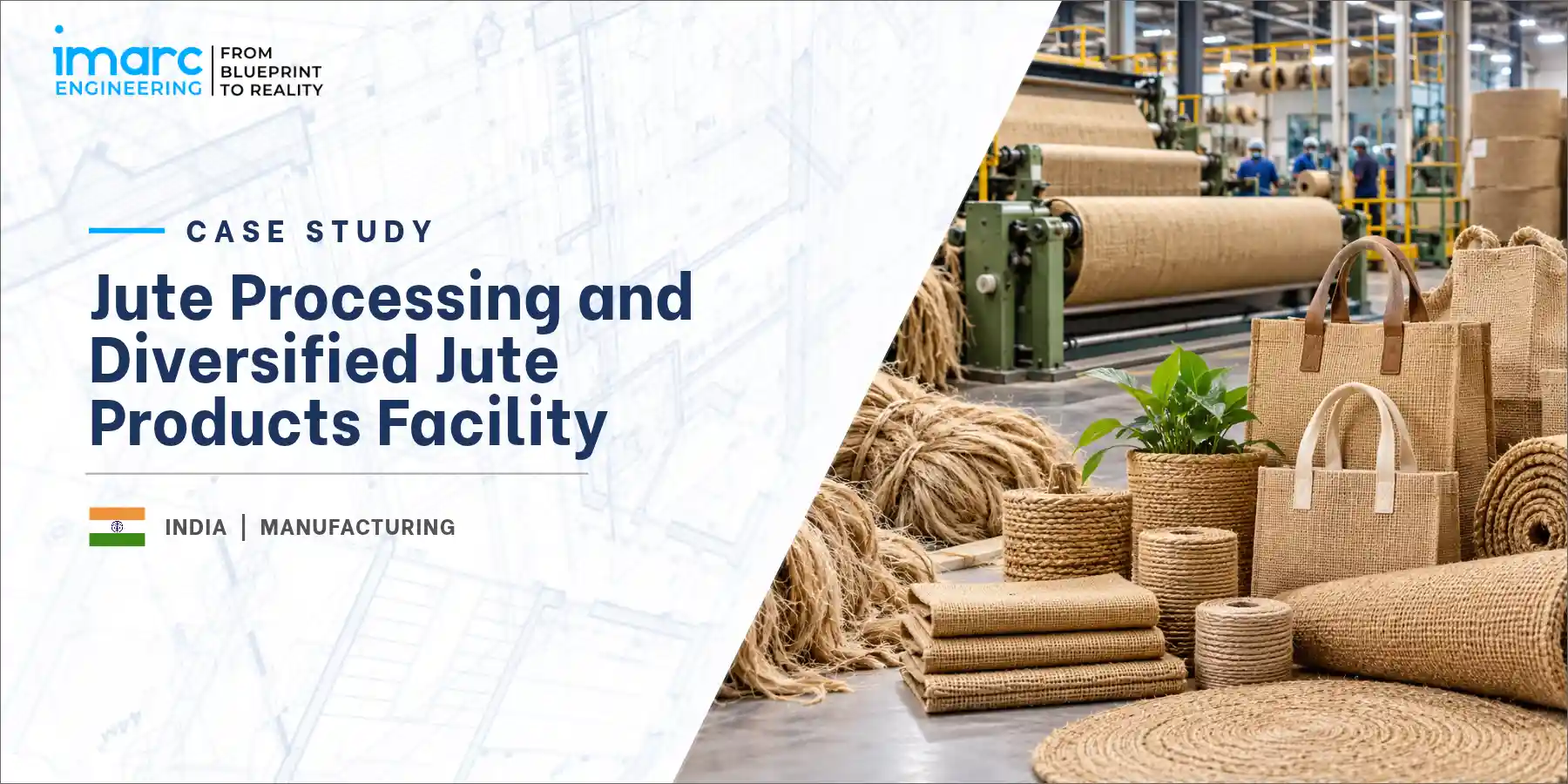
Jute Processing and Diversified Jute Products Facility
Case Study Details
Industry
Manufacturing- Jute Processing, Jute Geotextiles, and Diversified Jute Products
Location
Howrah, West Bengal, India (serving the Food Corporation of India and state civil-supplies corporations for mandatory jute foodgrain packaging, state sugar mills, infrastructure contractors for jute geotextile applications, and global export distributors across Europe, the Middle East, and the United States)
Project Type
Greenfield jute processing and diversified jute products manufacturing facility (Phase 1, expandable with specialty non-woven jute composite and bio-degradable jute-based agricultural mulch product lines)
Project Capacity
36,000 tonnes per annum of jute products across 24,000 tonnes of hessian and sacking (A-twill and B-twill foodgrain sacks and hessian cloth), 6,000 tonnes of jute geotextiles (JGT) for infrastructure applications, and 6,000 tonnes of diversified jute products (shopping bags, home furnishings, floor coverings, and fashion accessories)
Investment
INR 130 Crore (final CapEx)
Challenge
18 months to commissioning
Impact
National Jute Board aligned Hooghly jute belt processing anchor; Jute Packaging Materials (Compulsory Use in Packing Commodities) Act 1987 mandatory jute foodgrain sack supply qualification secured; BIS IS 2873 (packaging of jute products in bales), IS 2818 (hessian), and IS 14715 (jute geotextiles) compliance completed; Jute Mark certification secured through the National Jute Board quality assurance framework; supply commitments signed with the Food Corporation of India through the Jute Commissioner's indent system, two state civil-supplies corporations, three infrastructure contractors for jute geotextile applications, and two global export distributors
IMARC's Solution Highlights
End-to-end EPCM advisory across feasibility, jute spinning and weaving engineering, Jute ICARE-aligned farmer supply chain design across the Hooghly belt, multi-OEM equipment procurement, and integrated National Jute Board, Jute Commissioner, BIS, JPM Act, and West Bengal Pollution Control Board compliance readiness
Project Overview
An Indian natural fibre engineering major and a European jute processing technology partner engaged IMARC Engineering to establish a greenfield jute processing and diversified jute products manufacturing facility at Howrah, West Bengal. The project was structured against the Government of India's comprehensive jute sector protection and development framework comprising the Jute Packaging Materials (Compulsory Use in Packing Commodities) Act, 1987 (JPM Act), administered by the Ministry of Textiles and operationalised through the Office of the Jute Commissioner, mandating reservation of 100 percent of foodgrains and 20 percent of sugar for compulsory packaging in jute bags; the National Jute Board (NJB), the statutory body constituted under the National Jute Board Act 2008 subsuming the earlier Jute Manufactures Development Council and the National Centre for Jute Diversification; focused on raw jute productivity enhancement through improved seed, retting, and extraction practices; and the National Technology Mission on Jute coordinating R&D and diversified product development.
The scheme framework rests on India's structural dominance in the global jute value chain, India accounts for approximately 70 percent of global raw jute production and is the world's largest producer of jute goods, with the sector sustaining the livelihoods of approximately 40 lakh farmer families predominantly across West Bengal (which contributes approximately 80 percent of national jute production), Bihar, Assam, Odisha, Andhra Pradesh, Tripura, and Meghalaya, alongside direct employment of approximately 3.7 lakh workers in the organised jute mill sector concentrated along the Hooghly River in West Bengal.
The sector carries deep civilisational significance as the 'Golden Fibre' industry, representing one of India's oldest organised manufacturing traditions dating to the mid-nineteenth century, and holds enduring strategic relevance in the contemporary context as a 100 percent natural, biodegradable, and renewable packaging material directly aligned with the Government of India's circular economy and plastic reduction agenda alongside the global ESG-driven shift toward natural packaging substitutes.
The project involved establishing 36,000 tonnes per annum of jute processing capacity across three product families, 24,000 tonnes of hessian and sacking (comprising A-twill and B-twill foodgrain sacks of 1,000-gram and 665-gram specifications aligned with the Food Corporation of India indent requirements, alongside hessian cloth), 6,000 tonnes of jute geotextiles (JGT) for soil erosion control, road construction, landfill capping, and railway embankment stabilisation applications, and 6,000 tonnes of diversified jute products (shopping bags, home furnishings, floor coverings, promotional and gift bags, and fashion accessories). Site infrastructure was designed for Phase 2 expansion adding specialty non-woven jute composite and biodegradable jute-based agricultural mulch product lines targeting the premium global ESG-aligned demand pipeline.
Client's Challenges
The client faced several specific challenges in establishing greenfield jute processing in the Hooghly jute belt:
- Raw jute procurement across the Hooghly belt: Structuring a resilient raw jute procurement network across the surrounding West Bengal Hooghly belt and adjacent Assam and Bihar jute belts, with associated coordination across the Jute Corporation of India price support purchase operations, direct farmer sourcing arrangements, and Jute ICARE-aligned best practice input delivery across the small and marginal jute farmer base, alongside raw jute grading infrastructure covering the TD-1 through TD-8 grade classification for white jute and the equivalent tossa jute grading scheme.
- Spinning, weaving, and finishing engineering: Engineering the integrated jute processing capability spanning jute softening and emulsion treatment, carding, drawing, and spinning on apron-draft or ring-spinning infrastructure, weaving on broad-loom and narrow-loom infrastructure for sacking and hessian production, specialty needle-punched non-woven infrastructure for the jute geotextile product family, and multi-head embroidery and finishing infrastructure for the diversified jute products family, each with distinct process parameter and specification requirements.
- JPM Act and FCI indent qualification: Securing qualification as an approved supplier under the Office of the Jute Commissioner's indent system for the Food Corporation of India jute foodgrain sack procurement, with associated BIS IS 2873 (packaging of jute products in bales) and IS 2818 (hessian) product standards compliance, Jute Mark certification administered through the National Jute Board quality assurance framework, and the operational compliance infrastructure required for the mandatory indent-based procurement framework under the Jute Packaging Materials Act.
- Mill-level labour management: Managing the characteristically labour-intensive jute mill workforce (jute processing employs approximately 10 times the labour intensity per tonne of output compared to synthetic packaging manufacturing), through structured implementation of the Jute Workers Welfare Scheme obligations, Provident Fund and Employees' State Insurance compliance across the entire mill workforce, Industrial Safety and Health compliance under the Factories Act 1948, and progressive mechanisation and productivity improvement initiatives supported by the Jute SMART scheme.
- Diversified product market development: Engineering the diversified jute product line (shopping bags, home furnishings, floor coverings, fashion accessories) with associated design-development partnership, specialty finishing capability for export-grade product requirements, Jute Mark Diversified Jute Products certification, and the structured international market development support channelled through the National Jute Board's international market development initiatives.
- Workforce build-up: Recruiting 1,200 personnel including jute processing technicians, loom operators, spinning specialists, quality technicians, and skilled finishing operators in the Howrah regional labour market that hosts India's deepest historical jute workforce base dating to the mid-nineteenth century establishment of the Hooghly jute mill cluster.
What We Did
-
Pre-Investment and Strategic Advisory
Our feasibility study evaluated four candidate Indian locations, Howrah (West Bengal), Barrackpore in North 24 Parganas (West Bengal), Katihar (Bihar), and Dhubri (Assam), with Howrah selected on the strength of the Hooghly jute belt's unmatched historical infrastructure base, river-logistics access through the Hooghly River corridor for raw jute inbound and finished goods outbound movement, the deepest Indian jute processing labour pool and institutional memory, proximity to Haldia Port for direct container export logistics, the West Bengal Industrial Policy incentive framework alongside the state's dedicated jute sector support (reflecting the state's recognition of jute as a strategic sector sustaining millions of rural livelihoods), access to engineering talent from Indian Institute of Engineering Science and Technology Shibpur (IIEST, the surrounding engineering education base) and Jadavpur University, and the dense supplier ecosystem of jute machinery, replacement parts, and allied services across the Howrah industrial belt.
CapEx planning of INR 138 Crore covered the raw jute receiving and softening area, the carding and spinning area, the weaving hall with multiple product-specific loom banks, the finishing and packaging area, the jute geotextile needle-punching line, the diversified jute products workshop, the quality laboratory, the warehouse, and central utilities. Financial modelling demonstrated post-tax IRR of 16.4 percent at full ramp with a 6.6-year payback inclusive of West Bengal Industrial Policy incentive support.
-
Engineering and Design Services
IMARC designed a 32,000 sq.m built-up facility on an 18-acre plot comprising the raw jute receiving, grading, and softening area with jute batching emulsion treatment infrastructure, the carding and drawing area with multi-pass sliver preparation infrastructure, the spinning area housing apron-draft spinning frames and ring-spinning infrastructure sized for the hessian warp, hessian weft, and sacking yarn specifications, the weaving hall organised with dedicated loom banks covering broad-loom sacking cloth production (for A-twill and B-twill sacks), hessian cloth production, and specialty weaves for diversified products, the sack-cutting, hemming, printing, and finishing area for the FCI foodgrain sack final-product delivery, the jute geotextile line comprising needle-punching, calendaring, and roll-finishing infrastructure engineered to BIS IS 14715 specifications, the diversified jute products workshop covering shopping bag conversion, home furnishings assembly, floor covering production, and fashion accessory finishing, the quality laboratory covering tensile strength testing, fibre content analysis, moisture content testing, and full BIS specification verification infrastructure, the raw jute and finished goods warehouse with controlled-humidity environment for product integrity, and central utilities.
Process utility design covered 2.8 MW grid demand supplemented by a 0.8 MW captive rooftop solar array, dedicated boiler infrastructure for jute conditioning and finishing operations, dedicated dust extraction infrastructure across the carding, spinning, and weaving zones meeting West Bengal Pollution Control Board specifications, integrated MES for lot-level traceability aligned with Jute Commissioner indent system documentation requirements, and heavy-haul outbound logistics infrastructure engineered for both the characteristic high-volume sacking bale despatch and the specialty diversified products shipment.
-
Procurement and Supply Chain Support
We executed a multi-geography procurement programme across 42 critical vendors. Jute softening, emulsion treatment, carding, and drawing equipment was sourced from established Indian jute machinery specialists (reflecting the deep Indian engineering heritage in jute mill equipment dating to the historical Mackinnon Mackenzie and Lagan Engineering ecosystem) alongside select European jute machinery specialists. Spinning frames (apron-draft and ring-spinning) and weaving looms (broad-loom and narrow-loom) were sourced from Indian jute machinery specialists with proven multi-decade operational references across the Hooghly jute mill cluster.
Jute geotextile needle-punching line equipment was sourced from a combination of European non-woven specialists and Indian engineering partners. Quality laboratory equipment covering tensile strength testing, moisture content testing, and BIS specification verification was sourced from Indian and European textile testing equipment specialists. Dust extraction infrastructure was sourced from Indian environmental technology specialists with jute industry track record.
Raw jute feedstock sourcing was structured through the Jute Corporation of India price support purchase channel, direct farmer sourcing arrangements across the surrounding Hooghly belt, and structured long-term arrangements with jute mandis across the West Bengal and adjacent Assam-Bihar jute belts, building to committed feedstock supply covering the full 36,000 TPA nameplate across approximately 15,000 jute farmer linkages by Year-2 operations. Documented Domestic Content reached 94 percent in Year-1 operations and 97 percent in Year-2, reflecting the near-complete domestic sourcing of raw jute, jute machinery, and process consumables.
-
Project Execution and Site Management
Our turnkey project management delivered 18 months from groundbreaking to first commercial jute product despatch, coordinating civil construction, mechanical and electrical erection, loom installation and commissioning, equipment integration, and phased commissioning across the raw jute preparation, spinning, weaving, finishing, jute geotextile, and diversified products zones.
Phased commissioning ran the raw jute receiving, softening, and carding area first, followed by the spinning area, then the weaving hall with the first commercial hessian cloth batch completed in month 15 and the first A-twill foodgrain sack batch in month 16, then the jute geotextile needle-punching line with first commercial JGT despatch in month 17, and finally the diversified jute products workshop with first commercial shopping bag and home furnishings batches in month 18.
Multi-vendor coordination across Indian and European contractors required a 14-strong owner's engineering team supplemented by 4 European resident engineers from the jute processing technology partner during the specialty needle-punching line commissioning and initial product qualification phases.
-
Compliance, Quality and Sustainability
IMARC led certification readiness across BIS IS 2873 (packaging of jute products in bales), BIS IS 2818 (hessian cloth), and BIS IS 14715 (jute geotextiles) product standards, verified across the product portfolio in Year-1 of operations, Jute Mark certification administered through the National Jute Board quality assurance framework covering both the primary jute goods and the Jute Mark Diversified Jute Products certification for the shopping bag, home furnishings, and fashion accessory product families, Office of the Jute Commissioner's approved-supplier qualification for the Food Corporation of India jute foodgrain sack indent system, International Jute Study Group (IJSG) specification alignment for export-oriented supply, and ISO 9001:2015, ISO 14001:2015, ISO 45001:2018, and ISO 50001:2018 management system certifications alongside SA 8000 Social Accountability certification critical for premium export market qualification.
Workforce compliance covered Factories Act 1948 compliance, Provident Fund and Employees' State Insurance compliance across the entire mill workforce, Jute Workers Welfare Scheme obligations, and Minimum Wages Act compliance. Environmental compliance covered West Bengal Pollution Control Board Consent to Establish and Operate, dust emission monitoring across the carding and spinning operations, and Extended Producer Responsibility commitments (noting that jute is 100 percent biodegradable and compostable, structurally positioning the product portfolio favourably against synthetic packaging alternatives under the Plastic Waste Management Rules 2022 framework). The facility achieved IGBC Gold certification through heat recovery from finishing and conditioning operations, variable-frequency drives across HVAC and process pump systems, and 20 percent lower facility energy.
Final Results

Operational Performance
The facility achieved mechanical completion in 18 months with first commercial jute product despatch in month 19. Full 36,000 tonnes per annum nameplate capacity was reached at 76 percent utilisation (equivalent to 27,360 tonnes in Year-2, comprising approximately 18,240 tonnes of hessian and sacking, 4,560 tonnes of jute geotextiles, and 4,560 tonnes of diversified jute products) by month 16 of operations, with sustained BIS specification compliance across the product portfolio.
BIS IS 2873, IS 2818, and IS 14715 certifications were completed in Year-1, Jute Mark and Jute Mark Diversified Jute Products certifications were secured through the National Jute Board, Office of the Jute Commissioner approved-supplier qualification was secured for the Food Corporation of India indent system, International Jute Study Group specification alignment was verified for export-oriented supply, and successful supplier qualification audits were passed with the Food Corporation of India (through the Jute Commissioner's indent system), three infrastructure contractors for jute geotextile applications, and two global export distributors across the first operational year.
Financial Outcomes
Final CapEx of INR 130 Crore delivered 5.8 percent savings against the INR 138 Crore budget through optimised civil packaging, disciplined Indian-fabrication leverage across the structural and jute machinery infrastructure scope (reflecting the deep Indian engineering heritage in jute mill equipment), coordinated multi-vendor procurement, Jute SMART modernisation scheme capital subsidy benefit, and West Bengal Industrial Policy incentive framework support.
Year-2 revenue of INR 265 Crore was generated at an EBITDA margin of 8 percent, reflecting established Indian jute sector economics where the JPM Act-mandated procurement framework provides demand stability but the labour-intensive production structure and raw material price volatility structurally contain per-tonne margins, with returns supported by the diversified product portfolio contribution and the emerging export order book across the ESG-aligned natural packaging markets in Europe, the Middle East, and the United States.
Market Access
Long-term supply commitments were signed with the Food Corporation of India through the Office of the Jute Commissioner's mandatory indent system under the Jute Packaging Materials Act 1987 covering committed annual A-twill and B-twill foodgrain sack offtake, two state civil-supplies corporations covering state Public Distribution System foodgrain packaging offtake, three infrastructure contractors covering jute geotextile offtake for road construction, railway embankment stabilisation, and soil erosion control applications aligned with the growing Indian infrastructure development pipeline, and two global export distributors (covering one European distributor serving the United Kingdom and Germany specialty natural packaging retail channel, and one US distributor serving the organic grocery and specialty eco-retail channel).
Export share reached 18 percent of revenue by Year-2 through the diversified jute products channel targeting the growing global ESG-aligned natural packaging demand, a structural tailwind strengthened by the European Union Single-Use Plastics Directive, the US state-level plastic bag bans, and the growing global corporate commitment to replace plastic packaging with natural, biodegradable, and renewable alternatives.
Sustainability Impact
Our integrated design, combining 0.8 MW captive rooftop solar covering approximately 22 percent of facility daytime energy demand, heat recovery from finishing and conditioning operations, variable-frequency drives across HVAC and process pump systems, and LED lighting throughout, achieves 20 percent lower facility energy intensity versus the Southeast Asian jute processing industry benchmark.
The jute product portfolio itself delivers structurally superior sustainability characteristics: jute cultivation requires minimal fertiliser and pesticide input, matures in 4-6 months, enriches soil through nitrogen fixation and leaf-fall biomass contribution, and absorbs approximately 15 tonnes of carbon dioxide while releasing approximately 11 tonnes of oxygen per hectare over the growing cycle.
Finished jute products are 100 percent biodegradable and compostable at end-of-life, with a typical service life of 1-5 years followed by complete biological decomposition without microplastic residue. Jute geotextiles biodegrade over 1-3 years after fulfilling their soil-stabilisation function, releasing nutrients back to the soil. The jute workforce engagement model under the Jute Workers Welfare Scheme supports structured social welfare delivery across the historically marginalised Hooghly jute mill labour community.
Strategic Impact
The project established a meaningful greenfield jute processing and diversified products manufacturing capability within the Hooghly jute belt heritage framework, positioning the client across multiple reinforcing demand drivers, the structural domestic demand anchored on the Jute Packaging Materials Act 1987 mandatory jute foodgrain packaging reservation (100 percent for foodgrains, 20 percent for sugar) delivering demand stability, the growing Indian infrastructure demand for jute geotextiles in road construction and soil erosion control applications, the emerging global ESG-aligned natural packaging opportunity being structurally reinforced by the European Union Single-Use Plastics Directive and comparable regulatory initiatives in other advanced economies, the National Jute Board's international market development support, and the civilisational positioning of the Indian jute sector as both a critical rural livelihood anchor (approximately 40 lakh farmer families, 3.7 lakh organised sector workers) and a flagship natural-fibre sustainability narrative.
Year-2 revenue of INR 265 Crore, BIS and Jute Mark certifications across the product portfolio, the Food Corporation of India indent system qualification, and the two-market export entry led the client to approve Phase 2 expansion comprising specialty non-woven jute composite and biodegradable jute-based agricultural mulch product lines for the premium global ESG-aligned demand pipeline.
IMARC Engineering's end-to-end EPCM advisory, combining jute spinning and weaving engineering, Hooghly jute belt supply chain integration, JPM Act and Jute Commissioner indent system qualification pathway support, BIS and Jute Mark certification pathway support, and disciplined multi-vendor execution, enabled the client to anchor a strategically important Indian industrial asset in a civilisationally significant sector that sits at the intersection of India's rural livelihood agenda, infrastructure development pipeline, and the global natural-fibre sustainability transition.
Case Study Details
Industry
Manufacturing- Jute Processing, Jute Geotextiles, and Diversified Jute Products
Location
Howrah, West Bengal, India (serving the Food Corporation of India and state civil-supplies corporations for mandatory jute foodgrain packaging, state sugar mills, infrastructure contractors for jute geotextile applications, and global export distributors across Europe, the Middle East, and the United States)
Project Type
Greenfield jute processing and diversified jute products manufacturing facility (Phase 1, expandable with specialty non-woven jute composite and bio-degradable jute-based agricultural mulch product lines)
Project Capacity
36,000 tonnes per annum of jute products across 24,000 tonnes of hessian and sacking (A-twill and B-twill foodgrain sacks and hessian cloth), 6,000 tonnes of jute geotextiles (JGT) for infrastructure applications, and 6,000 tonnes of diversified jute products (shopping bags, home furnishings, floor coverings, and fashion accessories)
Investment
INR 130 Crore (final CapEx)
Challenge
18 months to commissioning
Impact
National Jute Board aligned Hooghly jute belt processing anchor; Jute Packaging Materials (Compulsory Use in Packing Commodities) Act 1987 mandatory jute foodgrain sack supply qualification secured; BIS IS 2873 (packaging of jute products in bales), IS 2818 (hessian), and IS 14715 (jute geotextiles) compliance completed; Jute Mark certification secured through the National Jute Board quality assurance framework; supply commitments signed with the Food Corporation of India through the Jute Commissioner's indent system, two state civil-supplies corporations, three infrastructure contractors for jute geotextile applications, and two global export distributors
IMARC's Solution Highlights
End-to-end EPCM advisory across feasibility, jute spinning and weaving engineering, Jute ICARE-aligned farmer supply chain design across the Hooghly belt, multi-OEM equipment procurement, and integrated National Jute Board, Jute Commissioner, BIS, JPM Act, and West Bengal Pollution Control Board compliance readiness
Have a similar project in mind?
Our engineering consultants can help you plan, design, and execute your next facility — from feasibility to commissioning.
Schedule a consultationTrusted by Industry Leaders
We partner with global enterprises and ambitious businesses across sectors to deliver operational excellence, strategic insights, and sustainable growth through integrated solutions.










Success in Their Words
Real feedback from clients across industries. Discover how our solutions delivered measurable impact and operational excellence.

I wanted to express my sincere appreciation for your efforts in handling this matter. Your dedication and commitment have been truly commendable, and it is evident that you have put in tremendous hard work and expertise into resolving the issues at hand. We are greatly interested in continuing our collaboration with you in the future, as your professionalism and reliability have made you a trusted partner. Thank you once again for your invaluable contribution. We look forward to strengthening our partnership ahead.

It has been a pleasure working with the IMARC team. The insights provided were structured, clear, and highly valuable, helping us strengthen both our technical and financial planning with confidence. We deeply appreciate the team’s professionalism, responsiveness, and attention to detail throughout the engagement. Every requirement was well understood and effectively incorporated, resulting in a comprehensive and actionable output. Overall, our experience has been excellent, and I would gladly recommend IMARC to organizations seeking a reliable research partner.

Your service is truly exceptional. Working with the IMARC team has been a seamless and professional experience. The clarity of communication, responsiveness to queries, and consistent support at every stage made the entire engagement highly efficient. The insights shared were well-structured, practical, and perfectly aligned with our requirements, helping us make informed decisions with confidence. Overall, the dedication and professionalism demonstrated by your team stand out, and I would be glad to recommend IMARC as a reliable and trustworthy research partner.

IMARC did an outstanding job in preparing our study. They were punctual, precise, and consistently responsive throughout the entire process. The team delivered all the data we required in a clear, well-organized, and highly professional format. Their strong attention to detail, combined with their ability to meet every deadline without compromising quality, truly set them apart. Overall, their reliability and commitment made them an exceptional partner for our project, and we would gladly work with them again in the future.

IMARC made the whole process incredibly easy from start to finish. Everyone I interacted with via email was polite, professional, and straightforward to deal with, always keeping their promises regarding delivery timelines and remaining consistently solutions-focused. From my very first contact, I appreciated the professionalism and support shown by the entire IMARC team. I highly recommend IMARC to anyone seeking timely, affordable, and reliable information or advice. My experience with IMARC was excellent, and I truly cannot fault any aspect of it.

I’d like to express my sincere gratitude for the excellent work you accomplished with the study. Your ability to quickly understand our requirements and deliver high-quality results under tight timelines truly reflects your expertise, exceptional work ethic, and unwavering commitment to your customer’s success. The professionalism and responsiveness you demonstrated throughout the process made a significant difference. Our entire team and company are incredibly thankful for your dedication, reliability, and support. Once again, thank you for your outstanding contribution.
Ready to Experience the IMARC Advantage?
Whether you're planning a new facility, expanding operations, optimizing performance, or facing complex challenges—IMARC Engineering brings the expertise, experience, and commitment needed for success.