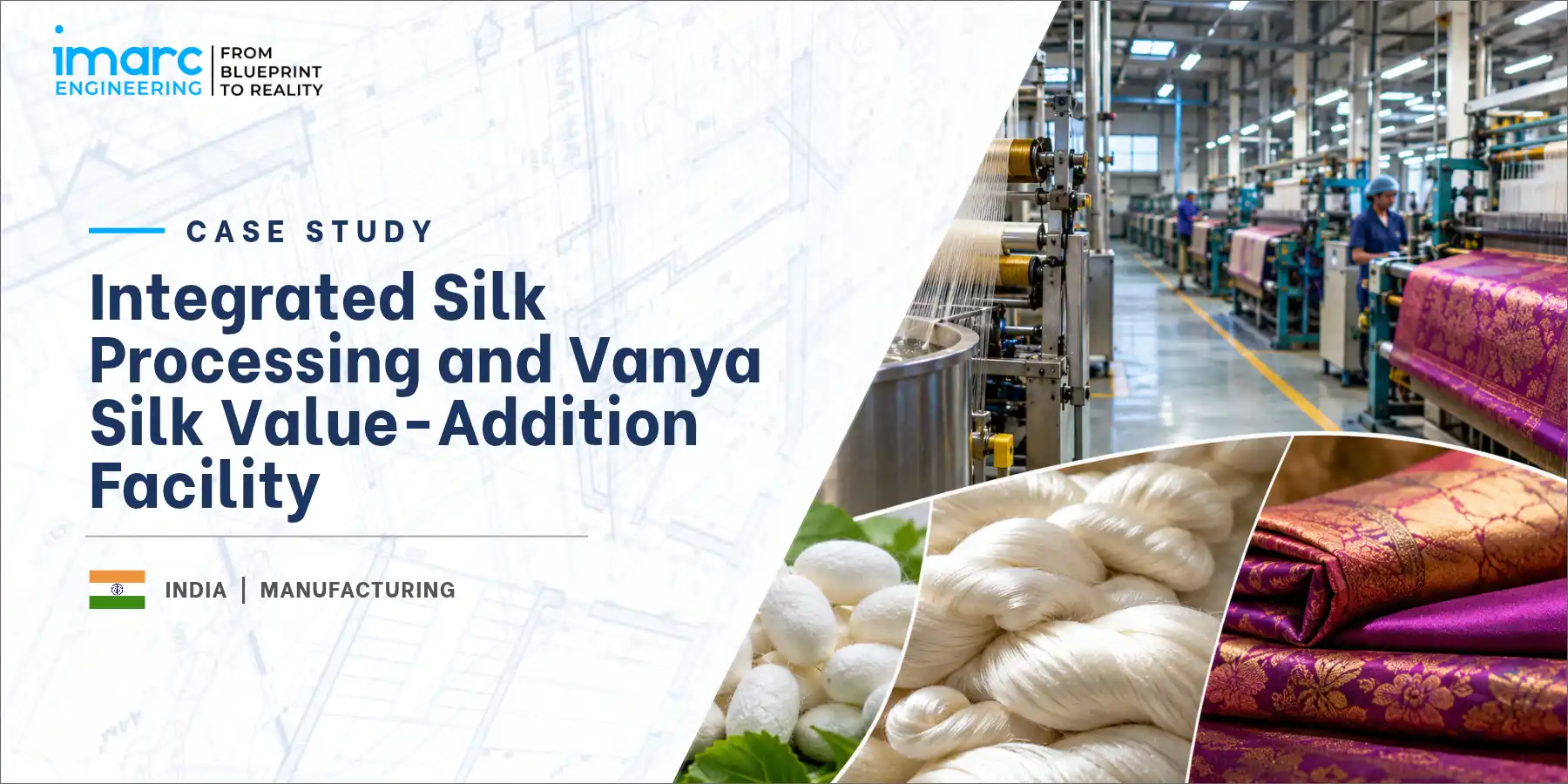
Integrated Silk Processing and Vanya Silk Value-Addition Facility
Case Study Details
Industry
Manufacturing – Integrated Silk Processing (Mulberry Raw Silk Reeling, Silk Yarn Throwing, Silk Fabric Weaving) and Vanya Silk Value-Addition
Location
Mysuru, Karnataka, India (serving Indian handloom and powerloom silk weaving clusters, premium Indian silk fashion brands, institutional buyers across the hospitality and wedding attire channels, and global silk importers across the United States, European Union, Japan, and Middle East markets)
Project Type
Greenfield integrated silk processing facility (Phase 1, expandable with silk degumming, dyeing and finishing line and specialty silk-based nonwoven medical textile product line)
Project Capacity
1,000 tonnes per annum of raw silk reeling throughput (covering mulberry raw silk alongside Vanya varieties including Tasar, Eri, and Muga), 400 tonnes per annum of thrown silk yarn, and 30 lakh metres per annum of specialty silk fabric weaving capacity
Investment
INR 190 Crore (final CapEx)
Challenge
18 months to commissioning
Impact
Silk Samagra-2 aligned Mysuru-Mandya-Ramanagara mulberry belt processing anchor; Silk Mark Organisation of India certification completed; Mysore Silk Geographical Indication framework alignment secured for the premium product family; supply commitments signed with four handloom and powerloom silk weaving clusters, three premium Indian silk fashion brands, two hospitality institutional accounts, and three global silk importers covering US, EU, and Japan markets
IMARC's Solution Highlights
End-to-end EPCM advisory across feasibility, silk reeling and throwing engineering, sericulturist supply chain design across the Mysuru-Mandya-Ramanagara mulberry belt, multi-OEM equipment procurement, and integrated Central Silk Board, Silk Samagra-2, Silk Mark, BIS, APEDA, and Karnataka State Pollution Control Board compliance readiness
Project Overview
An Indian sericulture and silk processing engineering major, in partnership with a European silk machinery and finishing technology specialist, engaged IMARC Engineering to establish a greenfield integrated silk processing facility at Mysuru, Karnataka. The project was structured under the Government of India's Silk Samagra-2 scheme, the comprehensive centrally sponsored scheme administered by the Central Silk Board (CSB) under the Ministry of Textiles.
The scheme carries a financial outlay of approximately INR 4,679.85 Crore for the FY 2021-22 to FY 2025-26 window, covering the full sericulture value chain from silkworm seed development through cocoon production, raw silk reeling, yarn throwing, fabric weaving, finishing, and marketing support. India is the world's second-largest silk producer (after China), with annual silk production of approximately 38,000 tonnes across mulberry and Vanya (non-mulberry) varieties. India is also the only country that produces all four commercial silk varieties: Mulberry, Tasar, Eri, and Muga.
The sector sustains the livelihoods of approximately 95 lakh persons across the full sericulture value chain, predominantly small and marginal landholders for whom sericulture is a critical rural income source. India's silk exports reach approximately USD 250 million annually. The sector carries deep civilisational significance, with Mysore Silk holding Geographical Indication (GI) status recognising the distinctive tradition developed over centuries in the Mysuru region. The Silk Samagra-2 framework is supported by several key institutions.
The Silk Mark Organisation of India (SMOI) provides the Silk Mark label for consumer authenticity verification. The Central Sericultural Research and Training Institute (CSR&TI) at Mysuru provides R&D and sericulturist extension support. The Central Silk Technological Research Institute (CSTRI) coordinates silk processing technology development. The National Silkworm Seed Project ensures quality silkworm seed availability, while the FTS-ASW framework supports cocoon marketing, the National Handloom Development Programme provides downstream linkage, and APEDA supports silk product exports.
The project was designed to establish 1,000 tonnes per annum of raw silk reeling throughput, 400 tonnes per annum of thrown silk yarn, and 30 lakh metres per annum of specialty silk fabric weaving capacity. Site infrastructure was planned for Phase 2 expansion with a silk degumming, dyeing, and finishing line and a specialty silk-based nonwoven medical textile product line aligned with the emerging biocompatible silk fibroin medical applications market.
Client's Challenges
The client faced several specific challenges in establishing greenfield integrated silk processing in the Mysuru mulberry belt:
- Sericulturist supply chain integration across the mulberry belt: The Mysuru-Mandya-Ramanagara belt is Karnataka's historical silk heartland, contributing approximately 45 percent of India's total mulberry silk production.
- Structuring a resilient cocoon supply chain required coordination with the Karnataka State Sericulture Department, direct sericulturist sourcing arrangements, participation in the Ramanagara Government Cocoon Market and Siddlaghatta Silk Exchange auctions, and structured SDO network engagement under the Central Silk Board framework.
- The target was approximately 22,000 sericulturist registrations by Year-2 operations.
- Multi-silk-variety processing engineering: The facility needed to process four distinct silk varieties, each with different equipment and process requirements.
- Mulberry raw silk, the predominant Indian variety, requires precision multi-end reeling on Automatic Reeling Machines (ARM) and Multi-End Reeling Machines (MERM). Tasar silk requires specialty equipment for coarser cocoon processing.
- Eri silk requires spun-silk processing for the non-mulberry variety. Muga silk, native to Assam, requires specialty handling protocols for the golden filament.
- Silk Mark and BIS certification pathway: The facility needed to secure Silk Mark Organisation of India certification for the full raw silk and silk fabric portfolio.
- Relevant BIS standard compliance was required across all product lines. Mysore Silk GI framework alignment was needed for the premium mulberry silk family, and APEDA registration-cum-membership certification was required for the export-oriented product supply.
- Cocoon quality grading infrastructure: The facility required a comprehensive cocoon receiving and grading setup covering shell ratio, cocoon weight, reelability index, raw silk recovery percentage, denier prediction, and cleanness classification.
- This infrastructure was essential for matching cocoon input quality to downstream reeling machine configuration and for fair-price, grading-based cocoon procurement from the sericulturist supply base.
- Raw silk price volatility management: Karnataka operates a bivoltine-polyvoltine hybrid regime with five mulberry silk crops per year, creating characteristic seasonal cocoon price volatility.
- This was compounded by imported raw silk price arbitrage pressure from the dominant Chinese export base.
- The approach combined structured forward-contracting with the downstream weaver customer base, buffer inventory management across the raw silk product family, and use of the Silk Samagra-2 price stabilisation framework.
- Recruiting 420 personnel including sericulture graduates from the surrounding sericulture educational ecosystem, silk reeling specialists (a specialised skill with deep institutional memory concentrated in the Mysuru-Mandya-Ramanagara belt), silk throwing and weaving specialists, quality technicians, and sericulturist extension officers in the Mysuru regional labour market.
What We Did
-
Pre-Investment and Strategic Advisory
Our feasibility study evaluated four candidate locations: Mysuru (Karnataka), Ramanagara (Karnataka), Bhagalpur (Bihar), and Malda (West Bengal).
Mysuru was selected on several grounds: the unmatched Mysuru-Mandya-Ramanagara mulberry belt infrastructure providing the deepest Indian sericulture labour pool and institutional memory; Mysore Silk GI heritage providing structural brand premium positioning; and proximity to the CSR&TI at Mysuru for R&D and extension access.
Additional factors included proximity to the Ramanagara Government Cocoon Market and Siddlaghatta Silk Exchange for structured cocoon sourcing, strong Karnataka Industrial Policy and State Sericulture Policy incentive support, and access to engineering and sericulture talent from the University of Mysore and University of Agricultural Sciences Bengaluru.
Established road and rail connectivity to Bengaluru and Chennai port logistics gateways supported the export shipment pattern. CapEx planning of INR 200 Crore covered the cocoon receiving and grading area, raw silk reeling hall, silk throwing shop, silk fabric weaving hall, quality laboratory, warehouse, effluent treatment plant, and central utilities.
Financial modelling demonstrated a post-tax IRR of 19.6 percent at full ramp with a 5.4-year payback, inclusive of Silk Samagra-2 capital subsidy support and Karnataka state incentive benefits.
-
Engineering and Design Services
IMARC designed a 24,000 sq.m built-up facility on a 14-acre plot. The cocoon receiving, grading, stifling, and storage area included dedicated quality evaluation infrastructure covering shell ratio determination, weight grading, reelability testing, raw silk recovery prediction, and cleanness classification.
The raw silk reeling hall housed ARM and MERM equipment alongside specialty Tasar reeling infrastructure, organised by silk variety and denier class. The silk throwing shop covered twisting, doubling, and specialty throwing operations for the multi-end silk yarn product family.
The silk fabric weaving hall used jacquard, dobby, and plain-weave loom banks for the specialty silk fabric portfolio.
The quality laboratory was equipped for applicable BIS standard testing, moisture regain testing, cohesion force testing, and cocoon testing. Temperature- and humidity-controlled warehousing was provided to preserve silk product integrity.
The effluent treatment plant was designed to Karnataka State Pollution Control Board specifications, covering the organic-rich cocoon stifling and silk processing effluent stream.
Process utilities included 2 MW grid supply supplemented by a 0.6 MW captive rooftop solar array, dedicated steam boiler infrastructure for stifling and thermal processing demand, and precision HVAC across reeling, throwing, and weaving zones.
An integrated MES provided lot-level and sericulturist-level traceability aligned with Silk Mark and GI documentation requirements, and dedicated outbound logistics infrastructure supported the high-value, low-weight silk despatch pattern.
-
Procurement and Supply Chain Support
We executed a multi-geography procurement programme across 42 critical vendors.
ARM and MERM equipment was sourced from established Indian silk reeling specialists, reflecting the deep domestic engineering heritage in silk machinery, alongside select Japanese and European specialty reeling equipment suppliers.
Silk throwing machines were sourced from Italian and Chinese specialty silk machinery specialists. Jacquard and dobby weaving looms were procured from Italian and Indian specialty silk loom specialists.
Specialty Tasar silk reeling equipment came from Indian specialists with proven references in the Jharkhand-Bihar Tasar belt. Cocoon stifling, quality grading, and effluent treatment plant equipment were sourced from Indian specialists.
Quality laboratory equipment for denier testing, cohesion force testing, and silk authenticity verification was sourced from Japanese, European, and Indian textile testing suppliers.
Cocoon feedstock sourcing was structured through the Ramanagara Government Cocoon Market and Siddlaghatta Silk Exchange auctions, direct sericulturist procurement arrangements, and the Karnataka State Sericulture Department SDO network, targeting approximately 22,000 sericulturist registrations by Year-2.
Documented Domestic Content reached 90 percent in Year-1 and 94 percent in Year-2, reflecting near-complete domestic sourcing of cocoons and silk machinery.
-
Project Execution and Site Management
Our turnkey project management delivered 18 months from groundbreaking to first commercial raw silk despatch, coordinating civil construction, mechanical and electrical erection, Automatic Reeling Machine installation, equipment integration, and phased commissioning.
Commissioning was sequenced: cocoon receiving, grading, and stifling came first, followed by the raw silk reeling hall with the first commercial Mulberry batch in month 15 and first Tasar batch in month 16.
The silk throwing shop achieved first commercial thrown silk yarn batches in month 17. The silk fabric weaving hall produced first commercial fabric batches in month 18.
Multi-vendor coordination across Indian, Italian, Japanese, and Chinese contractors required a 14-strong owner's engineering team, supplemented by five international resident engineers from the silk machinery and finishing technology partner during the critical ARM commissioning and initial Silk Mark qualification phases.
-
Compliance, Quality and Sustainability
IMARC led certification readiness across the full compliance portfolio.
BIS compliance was verified across the product portfolio in Year-1. Silk Mark Organisation of India certification was secured for the full raw silk and silk fabric family.
Mysore Silk GI framework alignment was completed for the premium mulberry product family. APEDA registration-cum-membership for export supply and Public Procurement (Preference to Make in India) local content certification were also secured.
ISO 9001:2015, ISO 14001:2015, ISO 45001:2018, and ISO 50001:2018 management system certifications were achieved.
Environmental compliance covered Karnataka State Pollution Control Board Consent to Establish and Operate, Hazardous Waste Authorisation for cocoon stifling residues and effluent treatment plant sludge, and the Plastic Waste Management Rules, 2016 (as amended) and the EPR Guidelines for Plastic Packaging, 2022.
IGBC Gold certification was achieved through 0.6 MW captive rooftop solar (covering approximately 23 percent of facility daytime energy demand), heat recovery from cocoon stifling and silk processing operations, variable-frequency drives across HVAC and process pump systems, and 18 percent lower facility energy intensity versus the Southeast Asian silk processing industry benchmark.
Final Results

Operational Performance
The facility achieved mechanical completion in 18 months, with first commercial raw silk despatch in month 19.
Full nameplate capacity was reached at 76 percent utilisation by month 15 of operations. This corresponded to approximately 304 tonnes of raw silk sold direct, 304 tonnes of thrown silk yarn produced and sold, and approximately 22.8 lakh metres of specialty silk fabric produced in Year-2.
In Year-1, Silk Mark Organisation of India certification was secured, Mysore Silk GI framework alignment was completed, and APEDA registration-cum-membership certification was obtained.
Successful supplier qualification audits were passed with four handloom and powerloom silk weaving clusters, three premium Indian silk fashion brands, two hospitality institutional accounts, and three global silk importers covering US, EU, and Japan markets.
Financial Outcomes
Final CapEx of INR 190 Crore delivered 5.0 percent savings against the INR 200 Crore budget. Savings were driven by optimised civil packaging, disciplined Indian-fabrication leverage across structural and silk reeling machinery scopes, coordinated multi-vendor procurement, Silk Samagra-2 capital subsidy support, and Karnataka Industrial Policy incentive benefits.
Year-2 revenue of INR 420 Crore was generated at an EBITDA margin of 11 percent. This reflects established Indian silk processing sector economics, where raw cocoon price volatility and Chinese raw silk arbitrage pressure structurally contain per-unit margins, offset by the premium Mysore Silk GI positioning, Vanya silk value-addition margins on the Tasar, Eri, and Muga product families, and the structural export premium on the specialty silk fabric portfolio.
Market Access
Long-term supply commitments were secured across multiple channels. Four handloom and powerloom silk weaving clusters were signed across Kanchipuram (Tamil Nadu), Varanasi (Uttar Pradesh), Bhagalpur (Bihar), and Dharmavaram (Andhra Pradesh), covering committed annual raw silk and thrown yarn offtake.
Three premium Indian silk fashion brands were signed for specialty silk fabric offtake in the premium bridal and designer attire channel. Two hospitality institutional accounts were secured for silk fabric offtake in the Indian premium hotel and specialty gifting segment. Three global silk importers were onboarded: one US importer serving the premium textile retail channel, one EU importer serving the Italian and French specialty silk fabric channel, and one Japan importer serving the premium Japanese silk apparel channel.
Export share reached 24 percent of revenue by Year-2 through the premium specialty silk fabric channel targeting global ESG-aligned natural luxury textile demand. The sericulturist supply base reached approximately 22,000 registered households by Year-2 across the Mysuru-Mandya-Ramanagara mulberry belt, delivering measurable farm-gate income uplift aligned with the Silk Samagra-2 rural livelihood objectives.
Sustainability Impact
The facility's integrated design achieves 18 percent lower energy intensity versus the Southeast Asian silk processing industry benchmark. It combines 0.6 MW captive rooftop solar covering approximately 23 percent of facility daytime energy demand, heat recovery from cocoon stifling and silk processing operations, variable-frequency drives across HVAC and process pump systems, and LED lighting throughout.
Process water reclamation is delivered through closed-loop cooling cycles and an effluent treatment plant with biological treatment of the organic-rich cocoon stifling and silk processing effluent stream. Silk is a renewable, biodegradable, and compostable natural fibre produced through the sericulturist-mulberry-silkworm biological cycle, offering superior sustainability characteristics versus synthetic textile alternatives. This positions the Indian silk industry favourably against growing global ESG-aligned natural luxury textile demand.
The sericulturist supply base is engaged on sustainable practices including integrated pest management, scientific silkworm rearing protocols that reduce crop losses and chemical input requirements, and structured extension support under the Central Silk Board framework. End-of-life packaging recovery partnerships are established under the Plastic Waste Management Rules 2022 framework.
Strategic Impact
The project established a meaningful greenfield integrated silk processing capability within the historical Mysuru mulberry belt. It positions the client across several structural growth vectors: India's standing as the world's second-largest silk producer at approximately 38,000 tonnes annual production, its unique status as the only country producing all four commercial silk varieties, and approximately 95 lakh sericulture livelihoods across the value chain.
Additional vectors include the Silk Samagra-2 INR 4,679.85 Crore scheme framework, the growing global ESG-aligned natural luxury textile demand, and the premium positioning provided by the Mysore Silk GI heritage. Year-2 revenue of INR 420 Crore, Silk Mark and BIS compliance across the portfolio, four weaving cluster supply commitments, and three-market global export entry led the client to approve Phase 2 expansion. Phase 2 will add a silk degumming, dyeing, and finishing line and a specialty silk-based nonwoven medical textile product line targeting the emerging global biocompatible silk fibroin medical applications market.
IMARC Engineering's end-to-end EPCM advisory combined silk reeling and throwing engineering, sericulturist supply chain design across the Mysuru-Mandya-Ramanagara belt, Silk Samagra-2 and Central Silk Board framework navigation, Silk Mark and Mysore Silk GI compliance pathway support, and disciplined multi-vendor execution. This enabled the client to anchor a strategically important industrial asset in a sector that sits at the intersection of India's rural livelihood agenda, premium natural luxury textile heritage, and the global ESG-aligned sustainable textile transition.
Case Study Details
Industry
Manufacturing – Integrated Silk Processing (Mulberry Raw Silk Reeling, Silk Yarn Throwing, Silk Fabric Weaving) and Vanya Silk Value-Addition
Location
Mysuru, Karnataka, India (serving Indian handloom and powerloom silk weaving clusters, premium Indian silk fashion brands, institutional buyers across the hospitality and wedding attire channels, and global silk importers across the United States, European Union, Japan, and Middle East markets)
Project Type
Greenfield integrated silk processing facility (Phase 1, expandable with silk degumming, dyeing and finishing line and specialty silk-based nonwoven medical textile product line)
Project Capacity
1,000 tonnes per annum of raw silk reeling throughput (covering mulberry raw silk alongside Vanya varieties including Tasar, Eri, and Muga), 400 tonnes per annum of thrown silk yarn, and 30 lakh metres per annum of specialty silk fabric weaving capacity
Investment
INR 190 Crore (final CapEx)
Challenge
18 months to commissioning
Impact
Silk Samagra-2 aligned Mysuru-Mandya-Ramanagara mulberry belt processing anchor; Silk Mark Organisation of India certification completed; Mysore Silk Geographical Indication framework alignment secured for the premium product family; supply commitments signed with four handloom and powerloom silk weaving clusters, three premium Indian silk fashion brands, two hospitality institutional accounts, and three global silk importers covering US, EU, and Japan markets
IMARC's Solution Highlights
End-to-end EPCM advisory across feasibility, silk reeling and throwing engineering, sericulturist supply chain design across the Mysuru-Mandya-Ramanagara mulberry belt, multi-OEM equipment procurement, and integrated Central Silk Board, Silk Samagra-2, Silk Mark, BIS, APEDA, and Karnataka State Pollution Control Board compliance readiness
Have a similar project in mind?
Our engineering consultants can help you plan, design, and execute your next facility — from feasibility to commissioning.
Schedule a consultationTrusted by Industry Leaders
We partner with global enterprises and ambitious businesses across sectors to deliver operational excellence, strategic insights, and sustainable growth through integrated solutions.









Success in Their Words
Real feedback from clients across industries. Discover how our solutions delivered measurable impact and operational excellence.

I wanted to express my sincere appreciation for your efforts in handling this matter. Your dedication and commitment have been truly commendable, and it is evident that you have put in tremendous hard work and expertise into resolving the issues at hand. We are greatly interested in continuing our collaboration with you in the future, as your professionalism and reliability have made you a trusted partner. Thank you once again for your invaluable contribution. We look forward to strengthening our partnership ahead.

It has been a pleasure working with the IMARC team. The insights provided were structured, clear, and highly valuable, helping us strengthen both our technical and financial planning with confidence. We deeply appreciate the team’s professionalism, responsiveness, and attention to detail throughout the engagement. Every requirement was well understood and effectively incorporated, resulting in a comprehensive and actionable output. Overall, our experience has been excellent, and I would gladly recommend IMARC to organizations seeking a reliable research partner.

Your service is truly exceptional. Working with the IMARC team has been a seamless and professional experience. The clarity of communication, responsiveness to queries, and consistent support at every stage made the entire engagement highly efficient. The insights shared were well-structured, practical, and perfectly aligned with our requirements, helping us make informed decisions with confidence. Overall, the dedication and professionalism demonstrated by your team stand out, and I would be glad to recommend IMARC as a reliable and trustworthy research partner.

IMARC did an outstanding job in preparing our study. They were punctual, precise, and consistently responsive throughout the entire process. The team delivered all the data we required in a clear, well-organized, and highly professional format. Their strong attention to detail, combined with their ability to meet every deadline without compromising quality, truly set them apart. Overall, their reliability and commitment made them an exceptional partner for our project, and we would gladly work with them again in the future.

IMARC made the whole process incredibly easy from start to finish. Everyone I interacted with via email was polite, professional, and straightforward to deal with, always keeping their promises regarding delivery timelines and remaining consistently solutions-focused. From my very first contact, I appreciated the professionalism and support shown by the entire IMARC team. I highly recommend IMARC to anyone seeking timely, affordable, and reliable information or advice. My experience with IMARC was excellent, and I truly cannot fault any aspect of it.

I’d like to express my sincere gratitude for the excellent work you accomplished with the study. Your ability to quickly understand our requirements and deliver high-quality results under tight timelines truly reflects your expertise, exceptional work ethic, and unwavering commitment to your customer’s success. The professionalism and responsiveness you demonstrated throughout the process made a significant difference. Our entire team and company are incredibly thankful for your dedication, reliability, and support. Once again, thank you for your outstanding contribution.
Ready to Experience the IMARC Advantage?
Whether you're planning a new facility, expanding operations, optimizing performance, or facing complex challenges—IMARC Engineering brings the expertise, experience, and commitment needed for success.