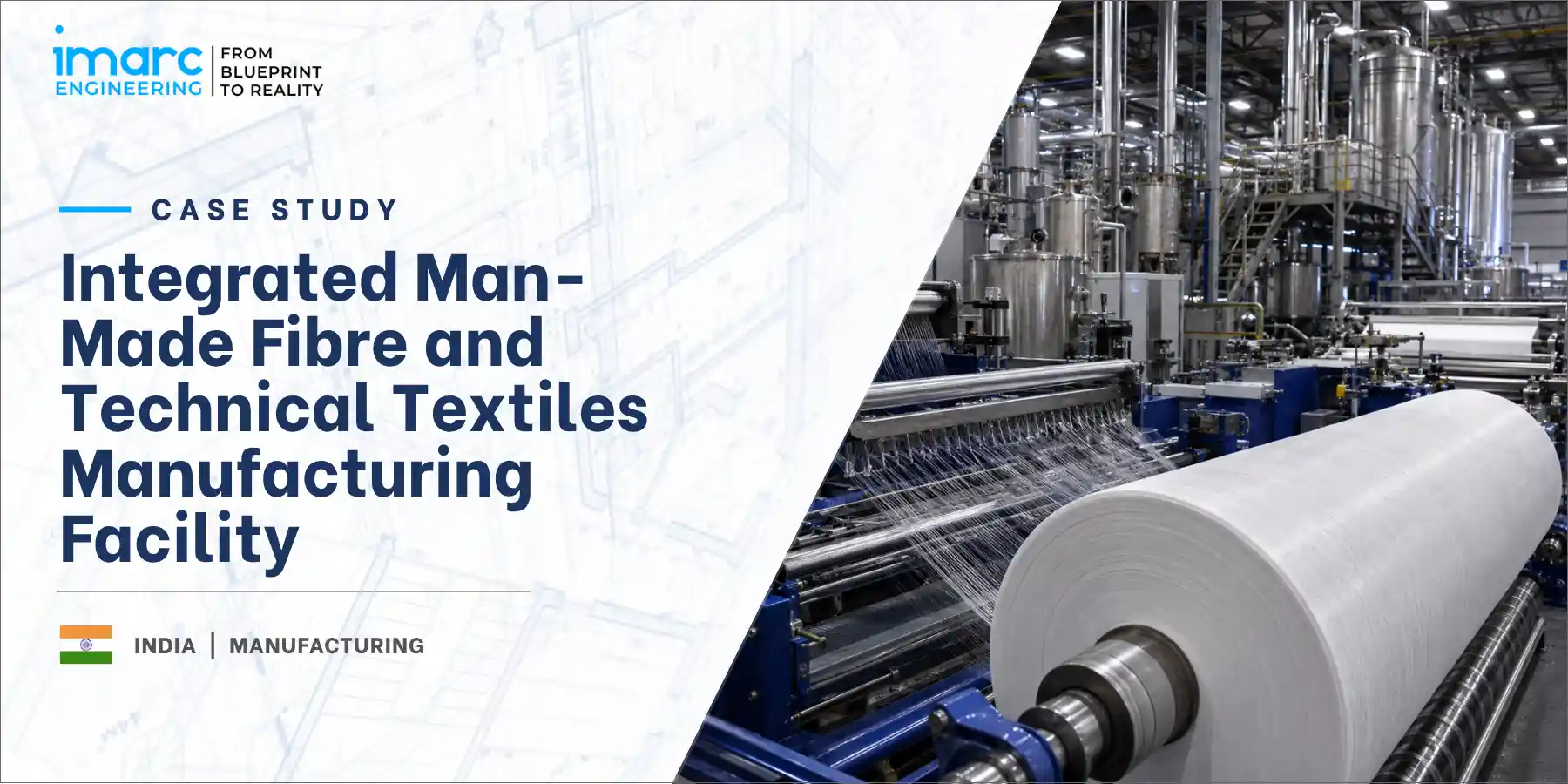
Integrated Man-Made Fibre and Technical Textiles Manufacturing Facility
Case Study Details
Industry
Manufacturing – Man-Made Fibre and Technical Textiles
Location
PM MITRA Park, Virudhunagar District, Tamil Nadu, India (serving Indian apparel, home textiles, automotive, and infrastructure end-markets, plus regulated export geographies)
Project Type
Greenfield integrated downstream MMF (PSF + PFY) and technical textiles facility (Phase 1, expandable with upstream PET polymerisation and additional technical-textile lines)
Project Capacity
180,000 MT per annum Polyester Staple Fibre + 90,000 MT per annum Polyester Filament Yarn + 22 million sq.m per annum technical textiles
Investment
INR 2,180 Crore (final CapEx)
Challenge
28 months to commissioning (as an anchor tenant within the PM MITRA park's common-infrastructure development window)
Impact
PLI Textiles Part 1 scheme allocation executed against milestone schedule; OEKO-TEX Standard 100, GRS (Global Recycled Standard), and BIS certifications secured; supply commitments signed with eight Indian textile-converter customers; export entries into European Union, United States, and ASEAN technical-textile markets
IMARC's Solution Highlights
End-to-end EPCM advisory across feasibility, melt-spinning and technical-textile engineering, multi-OEM specialty equipment procurement, PM MITRA park common-utilities integration, and integrated PLI/BIS/OEKO-TEX/GRS compliance readiness
Project Overview
A consortium led by an Indian textile conglomerate and a European synthetic-fibre spinning technology licensor engaged IMARC Engineering to establish a greenfield integrated Man-Made Fibre (MMF) and technical textiles manufacturing facility within the PM MITRA Park in Virudhunagar District, Tamil Nadu — one of seven Mega Integrated Textile Region and Apparel parks approved by the Government of India in 2023 under the PM MITRA scheme. The project was structured against the convergence of three policy frameworks: the PLI scheme for Textiles (Man-Made Fibre and Technical Textiles), with an INR 10,683 Crore corpus across two parts under which 64 manufacturers were approved across 2022–2023; the PM MITRA scheme itself, with central financial assistance of up to INR 500 Crore per park for common infrastructure across the seven approved parks; and the National Technical Textiles Mission (NTTM), an INR 1,480 Crore mission corpus advancing domestic technical-textile manufacturing capability.
Driven by India's strategic transition from cotton-dominant textile manufacturing toward higher-value MMF (where global growth is concentrated), India's documented import dependence on specialty MMF and technical textiles, and the growing domestic and export demand profile (Indian MMF consumption growing at high single digits with technical-textile market expansion at 11 to 13 percent CAGR), the client identified a strategic opportunity to anchor an integrated PSF + PFY + technical-textile facility within a structured park environment with shared utilities and effluent infrastructure.
The project involved establishing 180,000 MT per annum of Polyester Staple Fibre (PSF) by melt-spinning purchased PET chips into 1.0 to 2.5 denier-per-filament fibre across cotton-blend, viscose-blend, and wool-blend types; 90,000 MT per annum of Polyester Filament Yarn (PFY) across Partially Oriented Yarn (POY), Fully Drawn Yarn (FDY), and Draw Textured Yarn (DTY) variants; and 22 million sq.m per annum of technical textiles spanning geotextiles (for highway and infrastructure applications), automotive interior textiles (seating, headliner, and parcel-shelf substrates), and agro textiles, with site infrastructure designed for Phase 2 expansion adding upstream PET polymerisation and additional technical-textile lines.
Client's Challenges
The client faced several specific challenges in establishing greenfield integrated MMF and technical textiles manufacturing in India:
- Melt-spinning process precision: Engineering precision melt-spinning of PET chips at 285 to 295°C with tight control on melt temperature, throughput per spinneret hole, take-up speed, and quenching air profile — critical to maintaining target denier, tenacity, elongation at break, and shrinkage properties across the product range.
- PSF and PFY product-mix flexibility: Designing parallel PSF and PFY trains capable of campaign-based product changeover with minimal lost production, given variable customer demand mixes across denier ranges and product variants — particularly between commodity PSF for apparel converters and value-added PFY variants for home textiles and technical applications.
- Technical-textile manufacturing diversity: Engineering disparate technical-textile manufacturing across woven routes (geotextiles), nonwoven routes (spunbond and needlepunch for geotextiles and automotive interiors), and laminated and coated routes (agro textiles) — each requiring distinct process equipment, quality control protocols, and customer-specific certifications.
- PM MITRA park anchor tenant sequencing: Sequencing project execution against the PM MITRA park's parallel common-infrastructure development (water supply, dedicated power feeder, common effluent treatment plant connectivity, internal road network) with appropriate contractual provisions covering common-infrastructure delivery milestones and the project's own commissioning trajectory.
- Multi-certification readiness: Simultaneous compliance with BIS IS 2316 (Polyester Staple Fibre), BIS IS 7016 (Polyester Filament Yarn), OEKO-TEX Standard 100 (textile harmful substances), the GRS Global Recycled Standard (for recycled-content claims), automotive OEM-specific specifications (including VW Group's PV 3905 and PV 3927 protocols), and ISO 9001/14001/45001/50001 management systems.
- Effluent and water management: Operating under Tamil Nadu's strict textile-sector zero-liquid-discharge enforcement (TNPCB has aggressively enforced ZLD across the state's textile clusters since the 2011 Tirupur dyeing-sector ZLD enforcement order), requiring engineered ZLD process with reverse-osmosis recovery, mechanical vapour recompression evaporators, and salt crystallisation.
What We Did
-
Pre-Investment and Strategic Advisory
Our feasibility study evaluated five of the seven approved PM MITRA parks — Virudhunagar (Tamil Nadu), Warangal (Telangana), Kalaburagi (Karnataka), Navsari (Gujarat), and Dhar (Madhya Pradesh) — alongside greenfield options in established Tamil Nadu textile clusters around Karur and Madurai. Selection criteria covered park common-infrastructure readiness, surrounding textile-ecosystem maturity, port and logistics connectivity, water availability, grid reliability, state-level textile-sector incentives, and engineering and operator talent pipelines.
Virudhunagar PM MITRA Park was selected on the strength of Tamil Nadu's mature textile ecosystem (Tirupur knitwear, Coimbatore spinning mills, Karur home textiles, Erode dyeing cluster, and the broader textile-engineering supplier base across the state), Tuticorin Port proximity (approximately 110 kilometres) for PET chip imports and finished-goods exports, the Tamil Nadu Industrial Policy 2021 textile-sector capital subsidy structure, and the PM MITRA park's common-infrastructure framework.
CapEx planning of INR 2,280 Crore covered the PSF spinning lines, PFY spinning lines, technical-textile manufacturing block, PET chip handling and blending, central utilities, the dedicated zero-liquid-discharge effluent treatment plant, and the connection to the PM MITRA park common infrastructure for power, water, road network, and common effluent treatment. Our team led the PLI Textiles Part 1 bid preparation for MMF priority categories (PSF and PFY) and selected technical-textile categories, alongside Tamil Nadu Industries Department investment approval, the PM MITRA park anchor-tenant agreement, and Tamil Nadu Pollution Control Board pre-engagement on ZLD compliance.
Financial modelling demonstrated post-tax IRR of 18.6 percent at full ramp with a 6.4-year payback inclusive of PLI accruals against incremental turnover milestones and the Tamil Nadu state capital subsidy. Cumulative PLI Textiles eligibility was modelled at approximately INR 140 Crore across the five-year scheme window.
-
Engineering and Design Services
IMARC designed a 65,000 sq.m built-up facility on a 38-acre plot within the PM MITRA park boundaries comprising the PSF spinning hall (housing six parallel PSF lines each rated at 30,000 MT per annum nameplate, complete with melt-extruder, spinneret pack, quench tower, finish application, drawing, crimping, and cutting equipment), the PFY spinning hall (housing four parallel PFY lines each rated at 22,500 MT per annum across POY, FDY, and DTY product variants with corresponding take-up winders), the technical-textile manufacturing block (housing spunbond and needlepunch nonwoven lines for geotextiles and automotive substrates, projectile and rapier weaving looms for geotextile and agro-textile substrates, and coating and laminating lines), the PET chip handling and blending facility, and the central utility block.
Process utility design covered 18 MW grid demand from the PM MITRA park dedicated feeder supplemented by 4 MW captive rooftop solar, process steam at 12 bar from gas-fired boilers, chilled water at 12,400 TR for melt-spinning chiller load and HVAC, compressed dry air, captive nitrogen at 99.9 percent purity for inert atmosphere requirements in PFY drawing and POY operations, and demineralised water for boiler feed and high-purity rinsing applications.
The dedicated zero-liquid-discharge effluent treatment package was engineered through multi-stage primary and secondary biological treatment, reverse-osmosis recovery, mechanical vapour recompression evaporation, and final salt crystallisation, delivering target reclamation exceeding 84 percent of process intake. HVAC for the spinning halls was specified with controlled temperature (22 to 24°C) and relative humidity (50 to 60%) — critical to consistent fibre processing and quality.
-
Procurement and Supply Chain Support
We executed a multi-geography procurement programme across 62 critical vendors. PSF and PFY melt-spinning lines including extruders, spinneret packs, quench towers, drawing godets, crimpers, cutters, and take-up winders were sourced from European synthetic-fibre machinery specialists with documented Indian and global PSF/PFY reference installations.
Nonwoven spunbond and needlepunch equipment was sourced from established European specialists; weaving looms for technical-textile applications from a combination of European and Asian OEMs; coating and laminating equipment from European specialists. The zero-liquid-discharge package was awarded to a qualified Indian-European water-technology partnership with documented Tamil Nadu textile-sector ZLD references.
Raw material sourcing was structured to maximise PLI Domestic Value Addition and supply security. PET chip feedstock was secured through long-term supply agreements with established Indian PET resin producers covering the bulk of base-grade requirements, supplemented by selective imports for specialty grades and recycled-PET (rPET) feedstock for the GRS-certified product segment. Specialty additives including titanium dioxide for delustering, light stabilisers, and antimicrobial agents for selected technical-textile applications were sourced from established Indian specialty chemical suppliers.
Civil, structural, and clean-utility scope was awarded to qualified Indian contractors with documented textile-sector project track records, achieving approximately 65 percent Indian content across the structural and utility scope. Vendor qualification protocols included on-site supplier audits, factory acceptance testing of spinning lines under simulated operating conditions, site acceptance validation, and full incoming material certification under BIS IS 2316 and IS 7016 standards.
-
Project Execution and Site Management
Our turnkey project management delivered 28 months from groundbreaking to first commercial product release, coordinating civil construction, mechanical and electrical erection, equipment integration, and integrated commissioning of the PSF, PFY, and technical-textile lines in sequenced phases — all sequenced against the PM MITRA park's parallel common-infrastructure development with milestone-linked contractual provisions covering power feeder energisation, water supply availability, common effluent treatment connectivity, and internal road network completion.
We managed construction of the PSF spinning hall, the PFY spinning hall, the technical-textile manufacturing block, the PET chip handling facility, the dedicated zero-liquid-discharge effluent treatment plant, the central utility block, and the warehouse and outbound logistics block.
Phased commissioning ran PSF Line 1 first to enable early product qualification and customer sampling, followed by PFY Line 1 commissioning, the ZLD effluent treatment plant commissioning (critical to operate the full plant under Tamil Nadu's strict ZLD enforcement framework), and then parallel ramp-up of the remaining PSF and PFY lines, with technical-textile lines commissioned in the final phase.
Installation supervision ensured textile-grade specifications: melt-spinning extruder discharge temperature uniformity within ±1°C across the spinneret pack, denier consistency within ±2 percent across product lots, tenacity and elongation control within tight customer-specification windows, and continuous in-line process monitoring with statistical process control reporting at each critical operation. Multi-vendor coordination across European, Asian, and Indian contractors required a 22-strong owner's engineering team supplemented by 14 European resident engineers from the technology licensor during the first PSF and PFY line commissioning.
-
Compliance, Quality and Sustainability
IMARC led certification readiness across BIS IS 2316 (Polyester Staple Fibre) and BIS IS 7016 (Polyester Filament Yarn) — both certified in Year-1 of operations — OEKO-TEX Standard 100 (textile harmful substances) certified in Year-1 across product lines, GRS Global Recycled Standard certified in Year-2 with the recycled-PET feedstock segment, automotive OEM-specific requirements including VW Group's PV 3905 (interior textile fogging) and PV 3927 (interior textile odour) protocols for the automotive technical-textile applications, and ISO 9001:2015, ISO 14001:2015, ISO 45001:2018, and ISO 50001:2018 management systems.
Environmental compliance covered Tamil Nadu Pollution Control Board Consent to Establish and Operate under the State's strict zero-liquid-discharge enforcement framework, Central Ground Water Authority clearance for water abstraction, Hazardous Waste Authorisation for spinning-oil residues and ZLD reject crystallised salts (managed through dedicated treatment and licensed offsite disposal), and Extended Producer Responsibility commitments.
The facility achieved IGBC Gold certification through 4 MW captive solar (covering approximately 12 percent of facility energy demand), 84 percent water reclamation through the dedicated ZLD package, heat recovery from melt-spinning chillers and coating/laminating presses, 22 percent lower process energy intensity versus the Chinese MMF industry benchmark per third-party comparative assessment, and the GRS-certified recycled-PET feedstock segment offering a quantified circular-economy product proposition to converter customers.
Final Results

Operational Performance
The facility achieved mechanical completion in 28 months with first commercial PSF dispatch in month 29. Full 270,000 MT per annum combined PSF + PFY nameplate capacity and 22 million sq.m per annum technical-textile capacity was reached at 79 percent utilisation by month 18 of operations, with sustained denier consistency within ±2 percent across both fibre product lines and tenacity and elongation performance within customer-specification windows across all major product variants.
First-pass yield reached 98.4 percent at PSF, 97.8 percent at PFY, and 96.6 percent at the technical-textile lines. BIS IS 2316 and IS 7016 certifications were secured in Year-1, OEKO-TEX Standard 100 in Year-1, GRS in Year-2, and automotive OEM certifications across two Indian and two global OEM specifications for automotive interior textile applications.
Financial Outcomes
Final CapEx of INR 2,180 Crore delivered 4.4 percent savings against the INR 2,280 Crore budget through optimised civil packaging, deliberate Indian-fabrication leverage for the structural and clean-utility scope, the PM MITRA park common-infrastructure cost-sharing benefit, and disciplined multi-vendor procurement under the PLI Textiles framework. PLI Textiles Part 1 disbursements commenced from Year-1 commercial production against the scheme's incremental-turnover milestone structure, with cumulative scheme benefit of approximately INR 140 Crore across the five-year window.
Year-2 revenue of INR 2,720 Crore was generated at an EBITDA margin of 11 percent — consistent with non-integrated MMF and technical-textile manufacturing economics in the Indian market — supported by the value-added technical-textile mix and the GRS recycled-PET segment's pricing premium relative to commodity PSF.
Market Access
Long-term supply commitments were signed with eight Indian textile-converter customers covering aggregate annual offtake across PSF (covering apparel and home-textile converter applications), PFY (covering home-textile and selected technical applications), and technical textiles (geotextiles, automotive interior substrates, and agro textiles), supplemented by automotive OEM qualifications across two Indian OEMs and two global OEMs operating Indian assembly plants.
Technical-textile export channels were established into the European Union, United States, and ASEAN markets, with export share reaching 38 percent of revenue by Year-2 — concentrated in the higher-margin technical-textile segment (geotextiles for infrastructure projects and automotive interior substrates) rather than commodity PSF/PFY where Indian-domestic pricing remains the primary demand vector.
Sustainability Impact
Our integrated design — combining 4 MW captive rooftop solar covering approximately 12 percent of facility energy demand, heat recovery from melt-spinning chillers and coating/laminating press systems delivering 6.8 GJ per hour of useful thermal energy, variable-frequency drives across HVAC and process pump and fan systems, and LED lighting throughout — achieves 22 percent lower process energy intensity versus the Chinese MMF industry benchmark, saving approximately INR 18 Crore annually in energy operating costs.
The dedicated zero-liquid-discharge effluent treatment package reclaims 84 percent of process intake, with the residual 16 percent processed through MVR evaporation and salt crystallisation for licensed offsite disposal under Tamil Nadu's ZLD enforcement framework. The GRS-certified recycled-PET feedstock segment uses approximately 28,000 MT annually of post-consumer rPET, contributing to the client's circular-economy positioning with converter customers requiring documented recycled-content claims.
Strategic Impact
The project established a major anchor-tenant facility within the PM MITRA Virudhunagar Park and demonstrated the operational viability of the combined PM MITRA + PLI Textiles policy framework at integrated MMF + technical-textile scale. Year-2 revenue of INR 2,720 Crore, sustained 79 percent utilisation, the 38 percent export share concentrated in higher-value technical textiles, the GRS-certified recycled-PET feedstock segment, and the automotive OEM qualifications led the client to approve Phase 2 expansion comprising upstream PET polymerisation capacity (backward integration to capture PET resin margins) and additional technical-textile lines targeting medical textiles and protective-fabric applications.
IMARC Engineering's end-to-end EPCM advisory — combining melt-spinning and technical-textile engineering, PM MITRA park common-utilities integration, PLI Textiles scheme navigation, multi-OEM equipment procurement, and integrated BIS, OEKO-TEX, GRS, and automotive customer certification readiness — enabled the client to anchor a strategically important Indian industrial asset in a sector where India's transition from cotton-dominant to value-added MMF and technical-textile capability remains a national strategic priority.
Case Study Details
Industry
Manufacturing – Man-Made Fibre and Technical Textiles
Location
PM MITRA Park, Virudhunagar District, Tamil Nadu, India (serving Indian apparel, home textiles, automotive, and infrastructure end-markets, plus regulated export geographies)
Project Type
Greenfield integrated downstream MMF (PSF + PFY) and technical textiles facility (Phase 1, expandable with upstream PET polymerisation and additional technical-textile lines)
Project Capacity
180,000 MT per annum Polyester Staple Fibre + 90,000 MT per annum Polyester Filament Yarn + 22 million sq.m per annum technical textiles
Investment
INR 2,180 Crore (final CapEx)
Challenge
28 months to commissioning (as an anchor tenant within the PM MITRA park's common-infrastructure development window)
Impact
PLI Textiles Part 1 scheme allocation executed against milestone schedule; OEKO-TEX Standard 100, GRS (Global Recycled Standard), and BIS certifications secured; supply commitments signed with eight Indian textile-converter customers; export entries into European Union, United States, and ASEAN technical-textile markets
IMARC's Solution Highlights
End-to-end EPCM advisory across feasibility, melt-spinning and technical-textile engineering, multi-OEM specialty equipment procurement, PM MITRA park common-utilities integration, and integrated PLI/BIS/OEKO-TEX/GRS compliance readiness
Have a similar project in mind?
Our engineering consultants can help you plan, design, and execute your next facility — from feasibility to commissioning.
Schedule a consultationTrusted by Industry Leaders
We partner with global enterprises and ambitious businesses across sectors to deliver operational excellence, strategic insights, and sustainable growth through integrated solutions.








Success in Their Words
Real feedback from clients across industries. Discover how our solutions delivered measurable impact and operational excellence.

I wanted to express my sincere appreciation for your efforts in handling this matter. Your dedication and commitment have been truly commendable, and it is evident that you have put in tremendous hard work and expertise into resolving the issues at hand. We are greatly interested in continuing our collaboration with you in the future, as your professionalism and reliability have made you a trusted partner. Thank you once again for your invaluable contribution. We look forward to strengthening our partnership ahead.

It has been a pleasure working with the IMARC team. The insights provided were structured, clear, and highly valuable, helping us strengthen both our technical and financial planning with confidence. We deeply appreciate the team’s professionalism, responsiveness, and attention to detail throughout the engagement. Every requirement was well understood and effectively incorporated, resulting in a comprehensive and actionable output. Overall, our experience has been excellent, and I would gladly recommend IMARC to organizations seeking a reliable research partner.

Your service is truly exceptional. Working with the IMARC team has been a seamless and professional experience. The clarity of communication, responsiveness to queries, and consistent support at every stage made the entire engagement highly efficient. The insights shared were well-structured, practical, and perfectly aligned with our requirements, helping us make informed decisions with confidence. Overall, the dedication and professionalism demonstrated by your team stand out, and I would be glad to recommend IMARC as a reliable and trustworthy research partner.

IMARC did an outstanding job in preparing our study. They were punctual, precise, and consistently responsive throughout the entire process. The team delivered all the data we required in a clear, well-organized, and highly professional format. Their strong attention to detail, combined with their ability to meet every deadline without compromising quality, truly set them apart. Overall, their reliability and commitment made them an exceptional partner for our project, and we would gladly work with them again in the future.

IMARC made the whole process incredibly easy from start to finish. Everyone I interacted with via email was polite, professional, and straightforward to deal with, always keeping their promises regarding delivery timelines and remaining consistently solutions-focused. From my very first contact, I appreciated the professionalism and support shown by the entire IMARC team. I highly recommend IMARC to anyone seeking timely, affordable, and reliable information or advice. My experience with IMARC was excellent, and I truly cannot fault any aspect of it.

I’d like to express my sincere gratitude for the excellent work you accomplished with the study. Your ability to quickly understand our requirements and deliver high-quality results under tight timelines truly reflects your expertise, exceptional work ethic, and unwavering commitment to your customer’s success. The professionalism and responsiveness you demonstrated throughout the process made a significant difference. Our entire team and company are incredibly thankful for your dedication, reliability, and support. Once again, thank you for your outstanding contribution.
Ready to Experience the IMARC Advantage?
Whether you're planning a new facility, expanding operations, optimizing performance, or facing complex challenges—IMARC Engineering brings the expertise, experience, and commitment needed for success.