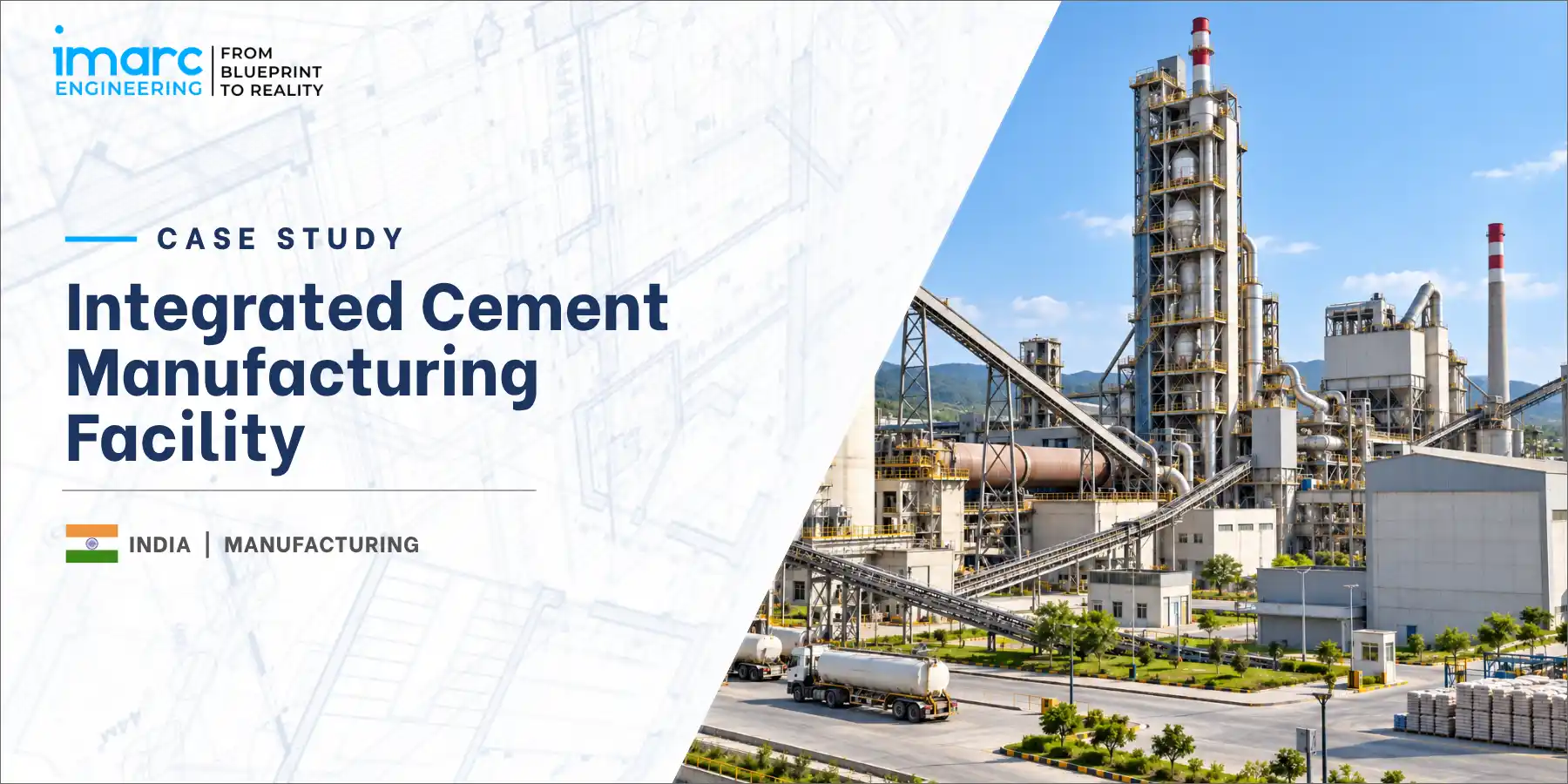
Integrated Cement Manufacturing Facility
Case Study Details
Industry
Manufacturing – Cement (Integrated Cement Plant)
Location
Jowai, Meghalaya, India (serving Northeast India construction and infrastructure markets and select adjacent East Indian markets)
Project Type
Greenfield integrated cement manufacturing facility with captive limestone mining, clinker production, and cement grinding (Phase 1, expandable with a second grinding line)
Project Capacity
2.4 MMTPA (million tonnes per annum) integrated cement production across OPC 43, OPC 53, Portland Pozzolana Cement, and Portland Slag Cement grades
Investment
INR 1,200 Crore (final CapEx)
Challenge
26 months to commissioning
Impact
PM Awas Yojana, Bharatmala Pariyojana, and National Infrastructure Pipeline aligned Northeast supply anchor; BIS cement grade certifications completed; supply commitments signed with three central infrastructure programme aggregators, two Northeast state PWD anchors, and two private construction chain customers
IMARC's Solution Highlights
End-to-end EPCM advisory across feasibility, limestone quarry planning, kiln and grinding engineering, multi-OEM equipment procurement, alternative fuel co-processing design, and integrated BIS, MoEFCC, and Meghalaya State Pollution Control Board compliance readiness
Project Overview
An Indian building materials major and a European cement technology partner engaged IMARC Engineering to develop a greenfield integrated cement manufacturing facility in Jowai, Meghalaya. The project was aligned with four key policy frameworks. The National Infrastructure Pipeline, with its reported INR 111 lakh crore investment programme, supports long-term cement demand across highways, railways, urban infrastructure, and industrial development.
The project also aligned with PM Awas Yojana (Urban and Gramin), the Bharatmala Pariyojana highway programme, and PM-DevINE. PM-DevINE is an INR 6,600 crore Ministry of Development of North Eastern Region scheme covering 2022–2026, supporting infrastructure and development in the Northeast. The project was further supported by Meghalaya’s substantial limestone reserves in the Jaintia Hills belt and the incentive framework under the Meghalaya Industrial Investment Promotion Policy 2024.
The project involved establishing 2.4 MMTPA (million tonnes per annum) of integrated cement manufacturing capacity, with captive limestone mining, clinker production, and cement grinding, across the Ordinary Portland Cement (OPC) 43 grade, OPC 53 grade, Portland Pozzolana Cement (PPC), and Portland Slag Cement (PSC) product families. Site infrastructure was designed for Phase 2 expansion adding a second cement grinding line targeting the growing Northeast infrastructure and adjacent East Indian market demand.
Client's Challenges
The client faced several specific challenges in establishing greenfield integrated cement manufacturing in Northeast India:
- Limestone reserve quality and mining planning: Engineering resource assessment and mining planning for the Jaintia Hills belt limestone reserves, with the associated variable-grade reserves requiring blending and processing to achieve consistent clinker feedstock chemistry, alongside the environmental clearance pathway required for limestone mining operations under Meghalaya's strict regulatory scrutiny.
- Northeast logistics complexity: Managing the logistics constraints of Northeast cement dispatch to Assam, other Northeast states, and East Indian markets given the region's road connectivity limitations, rail bottlenecks through the Siliguri corridor, and monsoon-season operational disruptions, with associated distribution network design and buffer storage infrastructure.
- Alternative fuel co-processing engineering: Engineering alternative fuel (AF) co-processing capability across the pyroprocessing line covering biomass, refuse-derived fuel, and select industrial waste streams, critical to reducing thermal energy costs and lowering the plant's Scope 1 emissions profile, aligned with the broader Indian cement industry's decarbonisation trajectory.
- Environmental compliance rigour: Meeting Ministry of Environment, Forest and Climate Change (MoEFCC) environmental clearance requirements alongside Meghalaya State Pollution Control Board air, water, and mining compliance, with associated bag house filtration, continuous emission monitoring, waste heat recovery, and mining rehabilitation infrastructure.
- BIS grade certifications and quality consistency: Achieving BIS certifications across the four cement grade product families including IS 269, IS 8112, IS 12269, IS 1489, and IS 455, with associated raw material and finished product quality laboratory infrastructure.
- Workforce build-up: Recruiting 480 personnel including cement process engineers, mining specialists, quality technicians, and skilled operators in the Meghalaya regional labour market — supported by structured technology-transfer partnerships with the European cement licensor and by talent inflow from adjacent Northeast cement operations.
What We Did
-
Pre-Investment and Strategic Advisory
Our feasibility study evaluated four candidate Northeast locations, Jowai (Meghalaya), Umrangso (Assam-Meghalaya border), Digboi (Assam), and Tuli (Nagaland), with Jowai selected on the strength of the surrounding Jaintia Hills limestone reserve base, the established Northeast cement industry ecosystem providing supplier and technical talent, Meghalaya Industrial Investment Promotion Policy 2024incentive framework, and PM-DevINE Northeast infrastructure development support.
CapEx planning of INR 1,264 Crore covered the limestone mining infrastructure and crushing plant, the raw material preparation and blending area, the vertical roller mills for raw meal preparation, the pyroprocessing line including preheater tower and rotary kiln, the clinker storage and cement grinding line, the packaging and dispatch area, and central utilities. Financial modelling demonstrated post-tax IRR of 18.6 percent at full ramp with a 6.4-year payback.
-
Engineering and Design Services
IMARC designed a 46,000 sq.m built-up facility on a 32-acre plot (excluding the adjacent limestone mining lease area) comprising the limestone crushing plant and stockpile, the vertical roller mill for raw meal preparation, the six-stage preheater tower with in-line calciner, the rotary kiln for clinker production (with alternative fuel co-processing capability across the kiln and calciner), the clinker cooler and storage silos, the ball mill and vertical roller mill grinding lines for cement finishing across the OPC and blended cement product families, the cement storage silos and packaging plant, the automated bulk dispatch infrastructure, the raw material and finished product quality laboratory, and central utilities.
Process utility design covered 24 MW grid demand alongside captive waste heat recovery power generation from the pyroprocessing line (delivering approximately 12 MW at full load) and a 2 MW captive rooftop solar array, comprehensive bag house filtration meeting MoEFCC emission norms, continuous emission monitoring across all major stacks, water reclamation infrastructure meeting Meghalaya SPCB zero-liquid-discharge orientation, and integrated MES for lot-level product traceability.
-
Procurement and Supply Chain Support
We executed a multi-geography procurement programme across 52 critical vendors. Vertical roller mills for raw meal preparation and cement grinding were sourced from established European cement equipment specialists with documented references.
The preheater tower, calciner, and rotary kiln were sourced from European cement technology specialists with proven references in Indian cement industry deployments. Clinker cooler infrastructure was sourced from established European specialists. Bag house filtration and continuous emission monitoring infrastructure was sourced from a combination of European and Indian environmental technology specialists. Waste heat recovery power generation infrastructure was sourced from Chinese and Indian WHR specialists with cement industry track record.
Alternative fuel co-processing infrastructure was engineered by the client's team in collaboration with the European licensor. Raw material sourcing was structured through the captive limestone mining alongside contracted coal and gypsum supply through established Indian mineral distribution channels. Documented local content reached 78 percent in Year-1 operations and 84 percent in Year-2 as the local supplier ecosystem developed.
-
Project Execution and Site Management
Our turnkey project management delivered 26 months from groundbreaking to first commercial cement dispatch, coordinating civil construction, heavy mechanical and electrical erection, mining infrastructure development, equipment integration, and phased commissioning across the mining, raw meal preparation, pyroprocessing, cement grinding, and packaging zones.
Phased commissioning ran the limestone mining and crushing infrastructure first (as the critical-path bottleneck for first raw material availability), followed by the raw meal preparation and preheater tower, then the rotary kiln and clinker cooler with first clinker production, then the cement grinding and packaging lines, and finally the waste heat recovery power generation infrastructure.
Multi-vendor coordination across European, Chinese, and Indian contractors required a 22-strong owner's engineering team supplemented by 12 European resident engineers from the cement technology partner during the pyroprocessing line and initial cement product qualification phases.
-
Compliance, Quality and Sustainability
IMARC led certification readiness across key BIS cement standards, including IS 8112, IS 12269, IS 1489, and IS 455. Each product family was verified during the first year of operations. The project also covered MoEFCC environmental clearance for the integrated plant and limestone mining operations. Meghalaya State Pollution Control Board Consent to Establish and Consent to Operate were secured.
DGMS statutory approvals were completed for mining operations. Central Ground Water Authority clearance was obtained for water abstraction. Management system certification covered ISO 9001:2015, ISO 14001:2015, ISO 45001:2018, and ISO 50001:2018. Environmental compliance also included Extended Producer Responsibility commitments and structured mining rehabilitation planning.
The facility achieved IGBC Gold certification through 12 MW captive waste heat recovery power alongside 2 MW captive rooftop solar covering approximately 36.8 percent of facility power demand, 24 percent alternative fuel share in thermal energy mix (through co-processing of biomass and refuse-derived fuel), heat recovery from the pyroprocessing line, and 20 percent lower facility energy intensity versus the Southeast Asian integrated cement industry benchmark.
Final Results
.webp)
Operational Performance
The facility achieved mechanical completion in 26 months. First commercial cement dispatch followed in month 27. Full 2.4 MMTPA nameplate capacity was reached by month 22 of operations, at 78% utilisation. BIS grade compliance was sustained across OPC 43, OPC 53, PPC, and PSC products.
MoEFCC environmental clearance was maintained through operational-phase compliance monitoring. Meghalaya SPCB Consent to Operate was secured. DGMS statutory mining approvals were also completed. During the first operational year, the facility passed supplier qualification audits with three central infrastructure programme aggregators, two Northeast state PWD anchors, and two private construction chain customers.
Financial Outcomes
Final CapEx of INR 1,200 Crore delivered 5.1 percent savings against the INR 1,264 Crore budget through optimised civil packaging, disciplined Indian-fabrication leverage across the structural and mining infrastructure scope, coordinated multi-vendor procurement, PM-DevINE Northeast development scheme benefits, and Meghalaya Industrial Investment Promotion Policy 2024 capital subsidy support.
Year-2 revenue of INR 940 Crore was generated at an EBITDA margin of 16 percent, consistent with established Indian cement manufacturer reporting adjusted for Northeast logistics cost structure, supported by the Northeast supply anchor positioning against the growing National Infrastructure Pipeline, PM Awas Yojana, and Bharatmala Pariyojana demand pipeline.
Market Access
Long-term supply commitments were signed with three central infrastructure programme aggregators covering allocations against PM Awas Yojana, Bharatmala Pariyojana, and adjacent National Infrastructure Pipeline highway and railway projects in Northeast and adjacent East Indian markets, two Northeast state Public Works Department anchor accounts covering state infrastructure procurement, and two private construction chain customers covering commercial and industrial construction demand across the Northeast belt.
The facility positioned itself as a Northeast supply anchor providing regional supply security aligned with the Government of India's structural push to improve Northeast infrastructure connectivity under PM-DevINE and the broader Northeast Development framework.
Sustainability Impact
Our integrated design, combining 12 MW captive waste heat recovery power generation from the pyroprocessing line alongside 2 MW captive rooftop solar covering approximately 36.8 percent of facility power demand, 24 percent alternative fuel share in thermal energy mix through co-processing of biomass and refuse-derived fuel across the kiln and calciner, variable-frequency drives across HVAC and process fan systems, and LED lighting throughout, achieves 20 percent lower facility energy intensity versus the Southeast Asian integrated cement industry benchmark.
Process water reclamation reaches high recovery levels through closed-loop cooling and structured Meghalaya SPCB compliance. Structured mining rehabilitation planning covers progressive back-filling and community-integrated post-mining land use restoration. The facility holds IGBC Gold certification and operates end-of-life bagged cement material recovery arrangements with the supplied customer base.
Strategic Impact
The project established a meaningful greenfield integrated cement manufacturing capability in the Northeast limestone belt, positioning the client as a Northeast supply anchor at the intersection of two structural drivers, the National Infrastructure Pipeline demand growth flowing through PM Awas Yojana mass housing and Bharatmala Pariyojana highway construction across Northeast and adjacent East Indian markets, and the PM-DevINE Northeast development trajectory driving structural infrastructure investment in the region.
Year-2 revenue of INR 940 Crore, BIS grade compliance across the product portfolio, secured central infrastructure programme aggregator and state PWD anchor commitments, and the 36.8 percent captive power share supporting operating cost resilience led the client to approve Phase 2 expansion comprising a second cement grinding line targeting the emerging adjacent East Indian market opportunity.
IMARC Engineering's end-to-end EPCM advisory, combining limestone quarry planning, integrated cement plant engineering, alternative fuel co-processing design, waste heat recovery integration, and disciplined multi-vendor execution, enabled the client to anchor a strategically important Indian industrial asset in a region where mining, environmental, and logistics complexity has historically restricted greenfield cement investment to modest-scale operators.
Case Study Details
Industry
Manufacturing – Cement (Integrated Cement Plant)
Location
Jowai, Meghalaya, India (serving Northeast India construction and infrastructure markets and select adjacent East Indian markets)
Project Type
Greenfield integrated cement manufacturing facility with captive limestone mining, clinker production, and cement grinding (Phase 1, expandable with a second grinding line)
Project Capacity
2.4 MMTPA (million tonnes per annum) integrated cement production across OPC 43, OPC 53, Portland Pozzolana Cement, and Portland Slag Cement grades
Investment
INR 1,200 Crore (final CapEx)
Challenge
26 months to commissioning
Impact
PM Awas Yojana, Bharatmala Pariyojana, and National Infrastructure Pipeline aligned Northeast supply anchor; BIS cement grade certifications completed; supply commitments signed with three central infrastructure programme aggregators, two Northeast state PWD anchors, and two private construction chain customers
IMARC's Solution Highlights
End-to-end EPCM advisory across feasibility, limestone quarry planning, kiln and grinding engineering, multi-OEM equipment procurement, alternative fuel co-processing design, and integrated BIS, MoEFCC, and Meghalaya State Pollution Control Board compliance readiness
Have a similar project in mind?
Our engineering consultants can help you plan, design, and execute your next facility — from feasibility to commissioning.
Schedule a consultationTrusted by Industry Leaders
We partner with global enterprises and ambitious businesses across sectors to deliver operational excellence, strategic insights, and sustainable growth through integrated solutions.








Success in Their Words
Real feedback from clients across industries. Discover how our solutions delivered measurable impact and operational excellence.
I wanted to express my sincere appreciation for your efforts in handling this matter. Your dedication and commitment have been truly commendable, and it is evident that you have put in tremendous hard work and expertise into resolving the issues at hand. We are greatly interested in continuing our collaboration with you in the future, as your professionalism and reliability have made you a trusted partner. Thank you once again for your invaluable contribution. We look forward to strengthening our partnership ahead.

It has been a pleasure working with the IMARC team. The insights provided were structured, clear, and highly valuable, helping us strengthen both our technical and financial planning with confidence. We deeply appreciate the team’s professionalism, responsiveness, and attention to detail throughout the engagement. Every requirement was well understood and effectively incorporated, resulting in a comprehensive and actionable output. Overall, our experience has been excellent, and I would gladly recommend IMARC to organizations seeking a reliable research partner.

Your service is truly exceptional. Working with the IMARC team has been a seamless and professional experience. The clarity of communication, responsiveness to queries, and consistent support at every stage made the entire engagement highly efficient. The insights shared were well-structured, practical, and perfectly aligned with our requirements, helping us make informed decisions with confidence. Overall, the dedication and professionalism demonstrated by your team stand out, and I would be glad to recommend IMARC as a reliable and trustworthy research partner.

IMARC did an outstanding job in preparing our study. They were punctual, precise, and consistently responsive throughout the entire process. The team delivered all the data we required in a clear, well-organized, and highly professional format. Their strong attention to detail, combined with their ability to meet every deadline without compromising quality, truly set them apart. Overall, their reliability and commitment made them an exceptional partner for our project, and we would gladly work with them again in the future.

IMARC made the whole process incredibly easy from start to finish. Everyone I interacted with via email was polite, professional, and straightforward to deal with, always keeping their promises regarding delivery timelines and remaining consistently solutions-focused. From my very first contact, I appreciated the professionalism and support shown by the entire IMARC team. I highly recommend IMARC to anyone seeking timely, affordable, and reliable information or advice. My experience with IMARC was excellent, and I truly cannot fault any aspect of it.

I’d like to express my sincere gratitude for the excellent work you accomplished with the study. Your ability to quickly understand our requirements and deliver high-quality results under tight timelines truly reflects your expertise, exceptional work ethic, and unwavering commitment to your customer’s success. The professionalism and responsiveness you demonstrated throughout the process made a significant difference. Our entire team and company are incredibly thankful for your dedication, reliability, and support. Once again, thank you for your outstanding contribution.
Ready to Experience the IMARC Advantage?
Whether you're planning a new facility, expanding operations, optimizing performance, or facing complex challenges—IMARC Engineering brings the expertise, experience, and commitment needed for success.