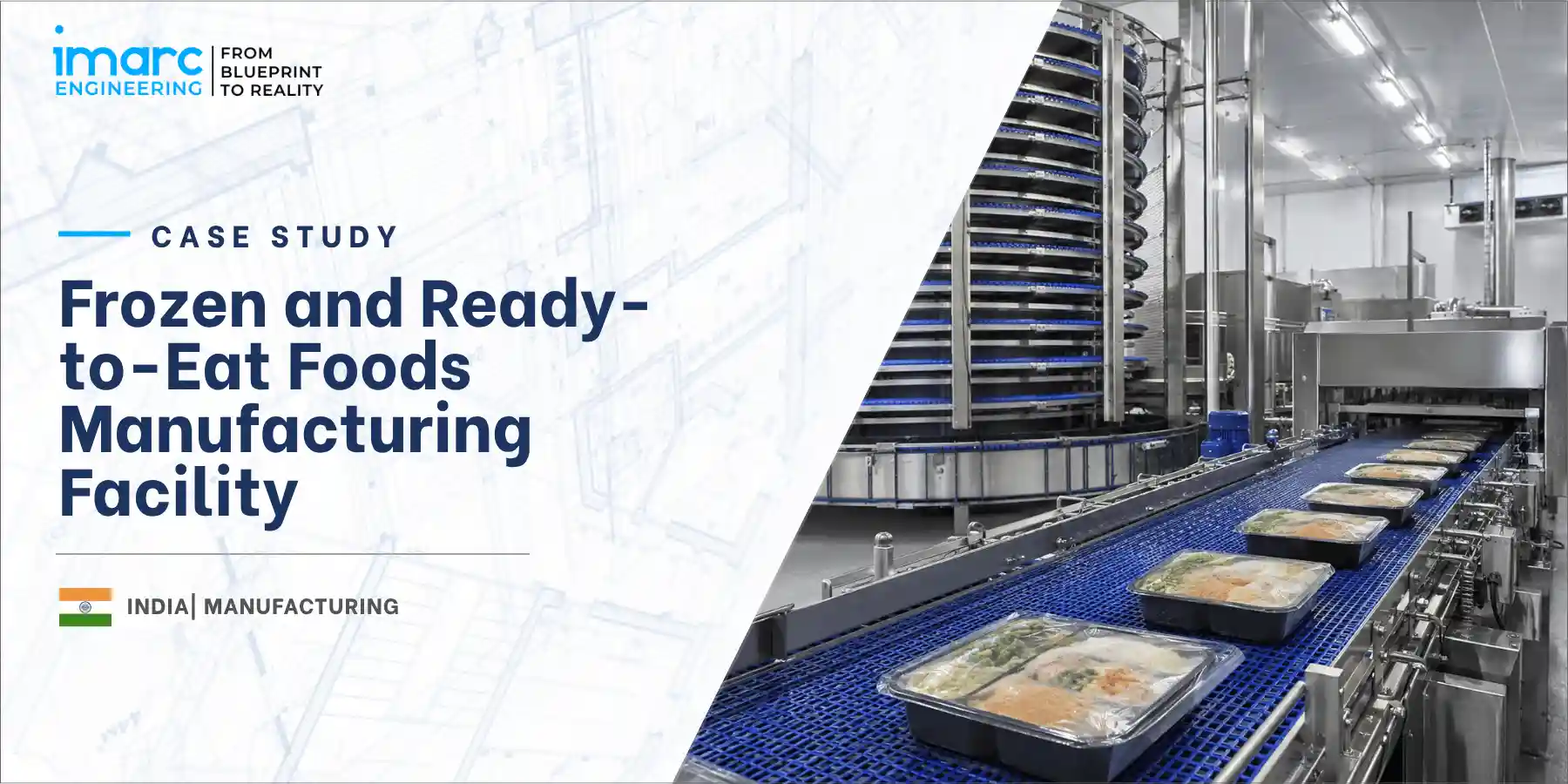
Frozen and Ready-to-Eat Foods Manufacturing Facility
Case Study Details
Industry
Manufacturing – Food Processing (Frozen and Ready-to-Eat Foods)
Location
Avantee Mega Food Park, Dewas District, Madhya Pradesh, India (serving Indian modern trade, quick-commerce, and select regional export markets)
Project Type
Greenfield frozen and ready-to-eat foods manufacturing facility (Phase 1, expandable with a dairy-based dessert line)
Project Capacity
48,000 MT per annum across frozen vegetables, frozen snacks, ready-to-eat curries, and ready-to-cook meal solutions
Investment
INR 380 Crore (final CapEx)
Challenge
20 months to commissioning
Impact
PLI Food Processing scheme allocation executed; FSSAI, BRCGS, and Halal certifications completed; supply contracts signed with five Indian modern trade retailers and three quick-commerce platforms; smallholder farmer sourcing network established across the surrounding agricultural districts
IMARC's Solution Highlights
End-to-end EPCM advisory across feasibility, IQF freezing and RTE processing engineering, multi-OEM equipment procurement, cold-chain integration, and integrated PLI, FSSAI, and BRCGS compliance readiness
Project Overview
An Indian packaged foods major and a European food processing technology partner engaged IMARC Engineering to establish a greenfield frozen and ready-to-eat foods manufacturing facility within the Avantee Mega Food Park at Dewas District, Madhya Pradesh — an operational Mega Food Park approved under the Pradhan Mantri Kisan Sampada Yojana (PMKSY) framework of the Ministry of Food Processing Industries. The project was structured against the Government of India’s PLI scheme for Food Processing (an INR 10,900 Crore corpus covering Ready-to-Cook and Ready-to-Eat, marine products, processed fruits and vegetables, and mozzarella cheese categories and others) under which 128 manufacturers were approved.
The project involved establishing 48,000 MT per annum of frozen vegetables, frozen snacks, ready-to-eat Indian regional curries, and ready-to-cook meal solutions, targeting Indian modern trade retail, the rapidly growing quick-commerce channel, and select regulated export markets across the Middle East, Southeast Asia, and Indian diaspora consumer geographies. Site infrastructure was designed for Phase 2 expansion adding a dairy-based frozen dessert line.
Client's Challenges
The client faced several specific challenges in establishing greenfield value-added food processing in India:
- Cold-chain integrity from farm to shelf: Building a reliable end-to-end cold chain covering agricultural sourcing, primary processing, individual quick freezing (IQF), frozen storage, cold-chain outbound logistics, and modern trade cold-chain distribution — critical to product quality, food safety, and shelf life across India's variable ambient conditions.
- Smallholder farmer sourcing network: Building a reliable seasonal supply of vegetables, pulses, and grains through a smallholder farmer sourcing network across the surrounding agricultural districts, with associated procurement logistics, quality grading, and payment infrastructure.
- Multi-product manufacturing complexity: Engineering parallel manufacturing lines for the distinct product families — IQF-frozen vegetables, coated frozen snacks, ready-to-eat retort curries, and ready-to-cook meal kits — each with distinct process flow, hygiene classification, and packaging requirements.
- Multi-certification readiness: Simultaneous compliance with FSSAI (Food Safety and Standards Authority of India) licensing under the FSS Act 2006, BRCGS (British Retail Consortium Global Standards) certification for regulated export access, Halal certification, and modern trade retailer-specific supplier audit frameworks.
- PLI scheme milestone tracking: Meeting the PLI Food Processing scheme's investment, production volume, and sales milestone requirements over the six-year scheme tenure across the Ready-to-Cook and Ready-to-Eat category.
- Workforce build-up: Recruiting 320 personnel including food technologists, quality and food safety specialists, and skilled processing operators in the regional labour market surrounding Dewas and Indore.
What We Did
-
Pre-Investment and Strategic Advisory
Our feasibility study evaluated four candidate locations across the operational Mega Food Park network — Avantee (MP), Satara (Maharashtra), Krishnagiri (Tamil Nadu), and Fazilka (Punjab) — with Avantee Dewas selected on the strength of Madhya Pradesh's strong agricultural sourcing base (major producer of pulses, wheat, oilseeds, and vegetables), the operational Mega Food Park common infrastructure covering cold storage, effluent treatment, and utilities, proximity to Indore for logistics and talent access, and the Madhya Pradesh Industrial Development Policy 2019 incentive structure. CapEx planning of INR 400 Crore covered the processing halls, IQF freezing infrastructure, frozen storage, retort processing area, packaging, warehouse, and central utilities, with cumulative PLI eligibility of approximately INR 42 Crore modelled across the six-year scheme window. Financial modelling demonstrated post-tax IRR of 20.6 percent at full ramp with a 5.4-year payback.
-
Engineering and Design Services
IMARC designed a 22,000 sq.m built-up facility on an 18-acre plot comprising the vegetable receiving, washing, and grading area, the blanching and IQF freezing lines for frozen vegetables, the coating and frying lines for frozen snacks, the processing lines for ready-to-eat curries, the ready-to-cook meal kit assembly area, the frozen storage warehouse operating at −25°C, the ambient warehouse and outbound logistics block, and the central utility area. Process utility design covered 4 MW grid demand supplemented by a 1.2 MW captive rooftop solar array, ammonia (R717) refrigeration for frozen storage and IQF operations with zero global-warming-potential exposure, dedicated boiler steam for retort processing and CIP, and connection to the Mega Food Park’s shared effluent treatment infrastructure.
-
Procurement and Supply Chain Support
We executed a multi-geography procurement programme across 42 critical vendors. IQF freezing tunnels, blanching and cooling infrastructure, and frozen product handling equipment were sourced from European specialists with documented references in the Indian frozen foods industry. Retort processing equipment for ready-to-eat curries was sourced from Japanese and European specialists. Coating and frying equipment for frozen snacks was sourced from European and Indian specialists. Packaging equipment was sourced from a combination of European and Indian OEMs. Cold storage racking and material handling systems were sourced from Indian and European specialists. Agricultural raw material sourcing was structured through the smallholder farmer network with dedicated collection centres and quality grading infrastructure, supplemented by contracted-farming arrangements for select high-quality crop varieties.
-
Project Execution and Site Management
Our turnkey project management delivered 20 months from groundbreaking to first commercial dispatch, coordinating civil construction, mechanical and electrical erection, cold-chain infrastructure installation, and phased commissioning across the multiple product lines. Phased commissioning ran the IQF frozen vegetables line first (as the highest-volume product category), followed by the frozen snacks coating and frying line, then the processing line for ready-to-eat curries, and finally the ready-to-cook meal kit assembly line. Multi-vendor coordination across European, Japanese, and Indian contractors required a 14-strong owner’s engineering team supplemented by 6 European resident engineers from the technology partner during the IQF and retort commissioning phases.
-
Compliance, Quality and Sustainability
IMARC led certification readiness across FSSAI (Food Safety and Standards Authority of India) manufacturing licensing under the FSS Act 2006 — secured before first commercial dispatch — BRCGS certification for regulated export market access, Halal certification across the product portfolio, ISO 22000:2018 food safety management system certification, and modern trade retailer-specific supplier audits. Environmental compliance covered Madhya Pradesh Pollution Control Board Consent to Establish and Operate, Hazardous Waste Authorisation for spent processing residues, and Extended Producer Responsibility commitments for plastic packaging under the Plastic Waste Management Rules. The facility achieved IGBC Gold certification through 1.2 MW captive rooftop solar covering approximately 18 percent of facility daytime energy demand, ammonia refrigeration with zero global-warming-potential exposure, 68 percent process water reclamation through closed-loop cooling and CIP recovery, and 22 percent lower facility energy intensity versus the Southeast Asian frozen foods industry benchmark.
Final Results

Operational Performance
The facility achieved mechanical completion in 20 months with first commercial dispatch in month 21. Full 48,000 MT per annum nameplate capacity was reached at 78 percent utilisation by month 15 of operations, with sustained first-pass quality acceptance across the product portfolio and zero major FSSAI or BRCGS inspection observations across the first operational year. Smallholder farmer sourcing reached 8,400 farmers across the surrounding agricultural districts by Year-2, forming the anchor of the facility's seasonal vegetable and grain supply base.
Financial Outcomes
Final CapEx of INR 380 Crore delivered 5.0 percent savings against the INR 400 Crore budget through optimised civil packaging, disciplined Indian-fabrication leverage across the structural scope, the Mega Food Park common-utilities cost-sharing benefit, and multi-vendor procurement. PLI Food Processing disbursements commenced from Year-1 commercial production against the scheme's sales-milestone structure, with cumulative scheme benefit of approximately INR 42 Crore modelled across the six-year window. Year-2 revenue of INR 450 Crore was generated at an EBITDA margin of 14 percent, consistent with value-added Indian food processing manufacturer reporting.
Market Access
Long-term supply commitments were signed with five Indian modern trade retailers and three quick-commerce platforms covering aggregate annual offtake across the frozen and ready-to-eat product categories. Export share reached 24 percent of revenue by Year-2, covering shipments to Middle East and Southeast Asian markets with Indian diaspora consumer bases, alongside select regulated-market entries under the BRCGS certification framework. The facility became a preferred supplier for the modern trade private-label frozen and RTE segments across the anchor customer network.
Sustainability Impact
Our integrated design — combining 1.2 MW captive rooftop solar covering approximately 18 percent of facility daytime energy demand, ammonia (R717) refrigeration with zero global-warming-potential exposure, heat recovery from retort operations and refrigeration systems, and variable-frequency drives across cooling and process pump systems — achieves 22 percent lower facility energy intensity versus the Southeast Asian frozen foods industry benchmark. Process water reclamation reaches 68 percent through closed-loop cooling and CIP rinse recovery. The smallholder farmer sourcing network delivers meaningful rural income uplift across the surrounding agricultural districts, and the facility holds IGBC Gold certification with formal commitments toward extended solar capacity and lower packaging plastic intensity.
Strategic Impact
The project established a meaningful greenfield value-added food processing capability under the combined PLI Food Processing and PMKSY Mega Food Park framework, demonstrating the operational viability of the co-siting model at scale. Year-2 revenue of INR 450 Crore, 24 percent export share, and the 8,400-farmer sourcing network led the client to approve Phase 2 expansion comprising a dairy-based frozen dessert line and an organic ready-to-eat product family targeting the premium retail segment.
IMARC Engineering's end-to-end EPCM advisory, combining IQF freezing and RTE processing engineering, smallholder sourcing network design, PLI scheme navigation, and Mega Food Park common-utilities integration, enabled the client to anchor a strategically important Indian agri-processing asset in a sector where cold-chain complexity and multi-product manufacturing had historically confined greenfield investment to established incumbent operators.
Case Study Details
Industry
Manufacturing – Food Processing (Frozen and Ready-to-Eat Foods)
Location
Avantee Mega Food Park, Dewas District, Madhya Pradesh, India (serving Indian modern trade, quick-commerce, and select regional export markets)
Project Type
Greenfield frozen and ready-to-eat foods manufacturing facility (Phase 1, expandable with a dairy-based dessert line)
Project Capacity
48,000 MT per annum across frozen vegetables, frozen snacks, ready-to-eat curries, and ready-to-cook meal solutions
Investment
INR 380 Crore (final CapEx)
Challenge
20 months to commissioning
Impact
PLI Food Processing scheme allocation executed; FSSAI, BRCGS, and Halal certifications completed; supply contracts signed with five Indian modern trade retailers and three quick-commerce platforms; smallholder farmer sourcing network established across the surrounding agricultural districts
IMARC's Solution Highlights
End-to-end EPCM advisory across feasibility, IQF freezing and RTE processing engineering, multi-OEM equipment procurement, cold-chain integration, and integrated PLI, FSSAI, and BRCGS compliance readiness
Have a similar project in mind?
Our engineering consultants can help you plan, design, and execute your next facility — from feasibility to commissioning.
Schedule a consultationTrusted by Industry Leaders
We partner with global enterprises and ambitious businesses across sectors to deliver operational excellence, strategic insights, and sustainable growth through integrated solutions.








Success in Their Words
Real feedback from clients across industries. Discover how our solutions delivered measurable impact and operational excellence.

I wanted to express my sincere appreciation for your efforts in handling this matter. Your dedication and commitment have been truly commendable, and it is evident that you have put in tremendous hard work and expertise into resolving the issues at hand. We are greatly interested in continuing our collaboration with you in the future, as your professionalism and reliability have made you a trusted partner. Thank you once again for your invaluable contribution. We look forward to strengthening our partnership ahead.

It has been a pleasure working with the IMARC team. The insights provided were structured, clear, and highly valuable, helping us strengthen both our technical and financial planning with confidence. We deeply appreciate the team’s professionalism, responsiveness, and attention to detail throughout the engagement. Every requirement was well understood and effectively incorporated, resulting in a comprehensive and actionable output. Overall, our experience has been excellent, and I would gladly recommend IMARC to organizations seeking a reliable research partner.

Your service is truly exceptional. Working with the IMARC team has been a seamless and professional experience. The clarity of communication, responsiveness to queries, and consistent support at every stage made the entire engagement highly efficient. The insights shared were well-structured, practical, and perfectly aligned with our requirements, helping us make informed decisions with confidence. Overall, the dedication and professionalism demonstrated by your team stand out, and I would be glad to recommend IMARC as a reliable and trustworthy research partner.

IMARC did an outstanding job in preparing our study. They were punctual, precise, and consistently responsive throughout the entire process. The team delivered all the data we required in a clear, well-organized, and highly professional format. Their strong attention to detail, combined with their ability to meet every deadline without compromising quality, truly set them apart. Overall, their reliability and commitment made them an exceptional partner for our project, and we would gladly work with them again in the future.

IMARC made the whole process incredibly easy from start to finish. Everyone I interacted with via email was polite, professional, and straightforward to deal with, always keeping their promises regarding delivery timelines and remaining consistently solutions-focused. From my very first contact, I appreciated the professionalism and support shown by the entire IMARC team. I highly recommend IMARC to anyone seeking timely, affordable, and reliable information or advice. My experience with IMARC was excellent, and I truly cannot fault any aspect of it.

I’d like to express my sincere gratitude for the excellent work you accomplished with the study. Your ability to quickly understand our requirements and deliver high-quality results under tight timelines truly reflects your expertise, exceptional work ethic, and unwavering commitment to your customer’s success. The professionalism and responsiveness you demonstrated throughout the process made a significant difference. Our entire team and company are incredibly thankful for your dedication, reliability, and support. Once again, thank you for your outstanding contribution.
Ready to Experience the IMARC Advantage?
Whether you're planning a new facility, expanding operations, optimizing performance, or facing complex challenges—IMARC Engineering brings the expertise, experience, and commitment needed for success.