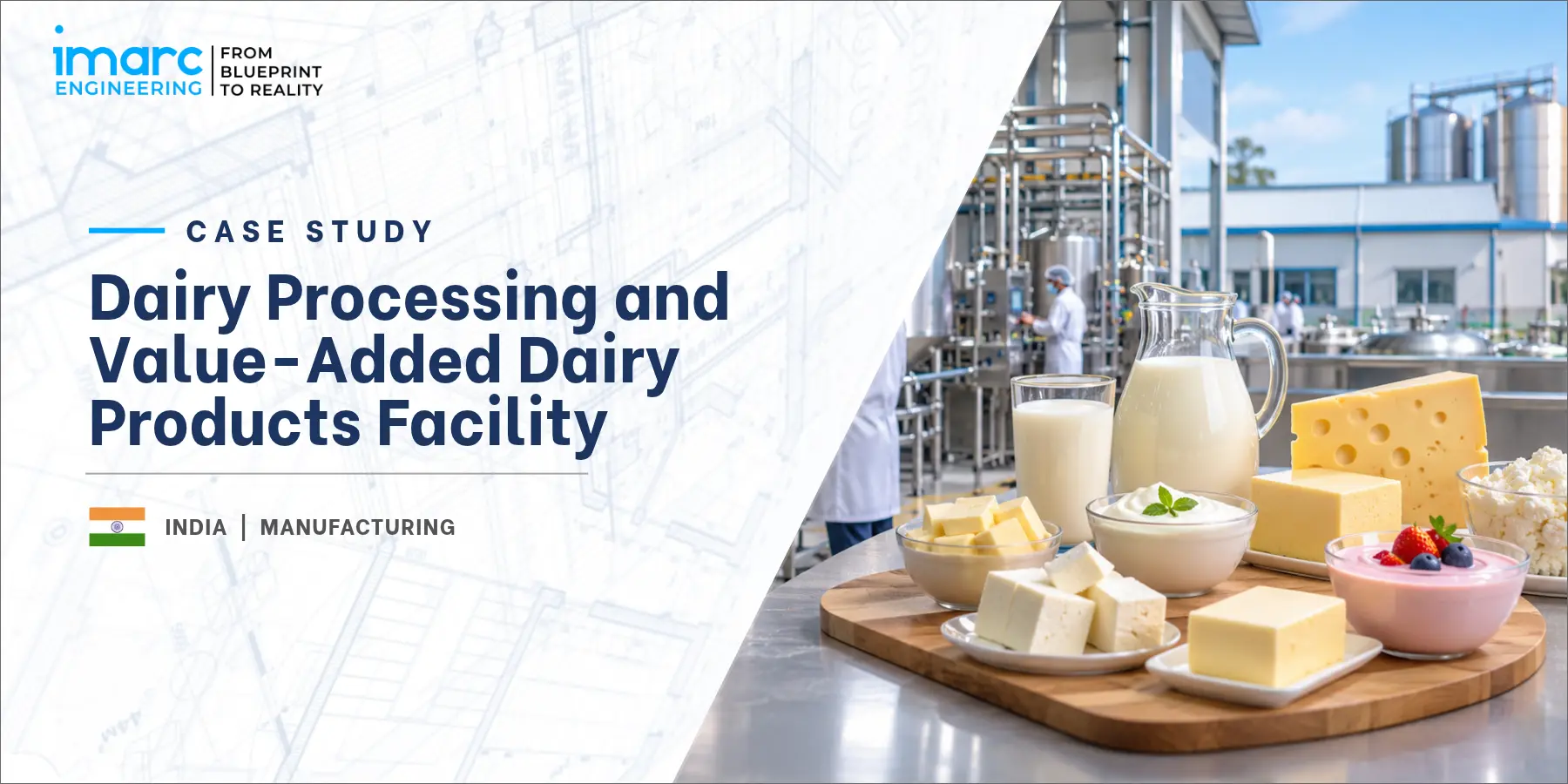
Dairy Processing and Value-Added Dairy Products Facility
Case Study Details
Industry
Manufacturing Fluid Milk, Fermented Dairy, and Value-Added Dairy Products
Location
Barabanki, Uttar Pradesh, India (serving Indian dairy cooperative federation retail networks, modern trade and quick-commerce distribution, institutional buyers across the hospitality and food-service channels, and the growing Indian middle-class premium dairy consumer base)
Project Type
Greenfield fluid milk processing, fermented dairy, and value-added dairy products manufacturing facility (Phase 1, expandable with cheese and functional nutrition dairy product lines for the emerging Indian premium dairy and sports nutrition segment)
Project Capacity
3 lakh litres per day (LLPD) milk processing capacity, equivalent to approximately 10.95 crore litres per annum of raw milk input, delivering pouch milk, dahi (set and stirred curd), paneer, flavoured milk, ghee, butter and skim and whole milk powder across the product portfolio
Investment
INR 160 Crore (final CapEx)
Challenge
18 months to commissioning
Impact
National Programme for Dairy Development aligned Uttar Pradesh dairy belt processing anchor; FSSAI Milk and Milk Products Regulations 2011 compliance completed; BIS IS 13688 (packaged milk), IS 10484 (paneer), IS 3507 (butter sampling and test), and IS 1479 (methods of test for dairy) compliance verified; Agmark grading secured for ghee and butter product families; supply commitments signed with the state dairy cooperative federation, three modern trade distributors, one quick-commerce aggregator, and two institutional buyers
IMARC's Solution Highlights
End-to-end EPCM advisory across feasibility, dairy processing and value-addition engineering, farmer supply chain design across the Uttar Pradesh dairy belt, Bulk Milk Cooler (BMC) and Milk Chilling Centre (MCC) network integration, multi-OEM equipment procurement, and integrated NPDD, DIDF, AHIDF, FSSAI, BIS, and Uttar Pradesh State Pollution Control Board compliance readiness
Project Overview
An Indian dairy engineering major and a European dairy processing technology partner engaged IMARC Engineering to establish a greenfield fluid milk processing, fermented dairy, and value-added dairy products manufacturing facility at Barabanki, Uttar Pradesh. The project was structured against the Government of India's comprehensive dairy sector development framework administered by the Department of Animal Husbandry and Dairying (DAHD) under the Ministry of Fisheries, Animal Husbandry and Dairying.
The framework comprises the National Programme for Dairy Development (NPDD), the centrally sponsored scheme focused on strengthening milk procurement infrastructure, Bulk Milk Coolers, Milk Chilling Centres, and dairy cooperative capacity building, providing interest subvention and credit guarantee support for private-sector and cooperative dairy, meat, and animal feed infrastructure investment; and the Rashtriya Gokul Mission (RGM) focused on indigenous bovine breed development and productivity enhancement.
The scheme framework is anchored on India's position as the world's largest milk producer with annual milk production of approximately 239 million tonnes in 2023-24, reflecting the cumulative legacy of Operation Flood launched in 1970 by Dr Verghese Kurien and continuing through the National Dairy Development Board (NDDB) coordination of the cooperative dairy ecosystem, alongside the structural importance of Uttar Pradesh as India's largest milk-producing state (contributing approximately 16 percent of national milk production). The dairy sector sustains the livelihoods of approximately 8 crore farmers across the country, predominantly small and marginal landholders for whom dairy represents a critical rural income source alongside crop cultivation. India's per-capita milk availability has grown structurally from approximately 110 grams per day in 1970 to over 450 grams per day currently, with continuing growth expected as household incomes rise and premium dairy consumption (fermented dairy, cheese, flavoured milk, and functional nutrition) expands across the Indian middle-class consumer base.
The project involved establishing 3 lakh litres per day (LLPD) of milk processing capacity, equivalent to approximately 10.95 crore litres per annum of raw milk input, delivering a diversified value-addition portfolio across pouch milk (toned, double-toned, full-cream, and standardised variants), fermented dairy products (set dahi, stirred dahi, flavoured yoghurt, lassi, and paneer), flavoured milk and dairy drinks, ghee (clarified butter), butter, and skim and whole milk powder product families. Site infrastructure was designed for Phase 2 expansion adding cheese production (processed cheese, mozzarella, and cheddar variants) alongside functional nutrition dairy product lines targeting the emerging Indian premium dairy and sports nutrition segment.
Client's Challenges
The client faced several specific challenges in establishing greenfield dairy processing and value-addition in India:
- Farmer supply chain integration across the UP dairy belt: Structuring a resilient raw milk procurement network across the surrounding Uttar Pradesh dairy belt, targeting approximately 24,000 dairy farmer registrations across small and marginal landholders by Year-2 operations, through coordination with Village Dairy Cooperative Societies, direct Milk Producer Company arrangements, and structured deployment of Bulk Milk Coolers (BMCs) and Milk Chilling Centres (MCCs) across the procurement catchment to maintain the cold chain integrity from farm-gate collection through plant reception.
- Multi-product dairy processing engineering: Engineering the integrated multi-product dairy processing capability spanning pasteurisation and standardisation for pouch milk, culture inoculation and fermentation temperature control for the dahi and yoghurt product family, acid coagulation and pressing for paneer, batch homogenisation and flavouring for the flavoured milk product family, continuous churning and separation for ghee and butter production, and spray-drying for the skim and whole milk powder product family, each with distinct process parameters, equipment configuration, and quality specification requirements.
- FSSAI and BIS compliance across diverse product portfolio: Achieving FSSAI Milk and Milk Products Regulations 2011 compliance across the full product portfolio alongside BIS IS 13688 (packaged milk), BIS IS 10484 (paneer), BIS IS 3507 (butter sampling and test), BIS IS 1166 (condensed milk), BIS IS 1479 (methods of test for dairy), and BIS IS 11766 (titratable acidity in milk powder) product standards, the required credentials for cooperative federation retail network supply, modern trade distribution, and institutional procurement participation.
- Cold chain integrity across the farm-to-shelf window: Engineering the uninterrupted dairy cold chain from the farm-gate collection point through the Bulk Milk Cooler network, insulated tanker transport, plant reception and chilled storage, through-processing refrigeration, chilled finished goods storage, chilled distribution logistics, and modern trade and quick-commerce last-mile delivery, a particularly demanding requirement in the Uttar Pradesh summer temperature profile where ambient highs regularly exceed 42 degrees Celsius.
- Milk procurement price volatility and seasonal flush management: Managing the structural dairy procurement price volatility across the lean summer and flush winter cycle alongside the seasonal milk supply flush that creates periodic processing capacity utilisation challenges, through structured conversion of flush-period surplus into skim milk powder and butter inventory for lean-period reconstitution, aligned with the NDDB-pioneered seasonal flush management framework that has stabilised Indian dairy supply over five decades.
- Workforce build-up: Recruiting 220 personnel including dairy processing engineers, microbiology and quality specialists (certified under the FSSAI framework), cold chain logistics coordinators, farmer liaison officers for the procurement network, and skilled process operators in the Barabanki regional labour market that hosts the broader Awadh dairy belt labour ecosystem alongside Lucknow regional technical talent access.
What We Did
-
Pre-Investment and Strategic Advisory
Our feasibility study evaluated four candidate Indian locations, Barabanki (Uttar Pradesh), Meerut (Uttar Pradesh), Alwar (Rajasthan), and Hassan (Karnataka), with Barabanki selected on the strength of Uttar Pradesh's dominant position as India's largest milk-producing state, the surrounding Awadh dairy belt providing structural raw milk feedstock supply (with the Awadh and adjacent Rohilkhand belts hosting high dairy farmer density and traditional dairy cultural anchoring), established road connectivity to the Lucknow metropolitan consumer market and the Delhi-NCR distribution network, the Uttar Pradesh Industrial and Service Sector Investment Policy incentive framework alongside the state's dedicated dairy sector promotion support, access to engineering talent from the surrounding IET Lucknow and NDRI Karnal (National Dairy Research Institute) ecosystem, and the historic dairy cooperative movement foundation across the state providing supplier and institutional partnership base.
CapEx planning of INR 170 Crore covered the raw milk reception and chilling area, the processing hall with multiple dedicated product lines, the ghee and butter manufacturing area, the spray-drying tower for milk powder, the quality laboratory, the effluent treatment plant, and central utilities. Financial modelling demonstrated post-tax IRR of 18.6 percent at full ramp with a 5.8-year payback.
-
Engineering and Design Services
IMARC designed a 14,000 sq.m built-up facility on an 8-acre plot comprising the raw milk reception bay with dedicated tanker unloading, weighing, platform testing, and chilling infrastructure, the milk silo and raw milk chilled storage area sized to accommodate the twice-daily collection cycle, the pasteurisation and homogenisation processing hall with multiple parallel product lines covering toned, double-toned, full-cream, and standardised pouch milk variants, the dahi and yoghurt fermentation area with controlled-temperature incubation infrastructure and culture inoculation stations, the paneer manufacturing area, the flavoured milk and dairy drinks compounding and bottling area, the ghee and butter manufacturing area with continuous churn and separator infrastructure, the spray-drying tower for the skim and whole milk powder product family, the pouch milk filling, dahi pot filling, and specialty dairy packaging infrastructure, the quality laboratory covering antibiotic residue testing, aflatoxin testing, somatic cell count, microbiological testing, and full FSSAI Milk and Milk Products Regulations specification verification infrastructure, the finished goods chilled warehouse engineered for the characteristic high-turnover dairy inventory, the effluent treatment plant with anaerobic and aerobic biological treatment supported by chemical oxygen demand removal, and central utilities.
Process utility design covered 3.2 MW grid demand supplemented by a 1 MW captive rooftop solar array, ammonia-based industrial refrigeration infrastructure sized for the chilled dairy processing and finished goods storage duty, a dedicated steam boiler for pasteurisation and spray-drying thermal demand, Water for Processing Use infrastructure meeting FSSAI potable water specifications, integrated MES for lot-level and farmer-level traceability aligned with FSSAI documentation requirements, and chilled distribution logistics bay engineered for the twice-daily chilled distribution cycle.
-
Procurement and Supply Chain Support
We executed a multi-geography procurement programme across 42 critical vendors. Pasteurisation, homogenisation, and standardisation equipment was sourced from established European dairy processing equipment specialists with documented Indian dairy industry references. Dahi and yoghurt fermentation infrastructure was sourced from a combination of European and Indian specialists. Spray-drying tower for the milk powder product family was sourced from established European specialists with proven large-scale dairy spray-drying deployment references.
Ammonia-based industrial refrigeration infrastructure was sourced from European industrial refrigeration specialists. Quality laboratory equipment covering antibiotic residue testing, aflatoxin testing, somatic cell count, and microbiological testing was sourced from European and US analytical equipment specialists. Pouch milk filling, dahi pot filling, and specialty dairy packaging equipment was sourced from European and Indian packaging equipment specialists.
Effluent treatment plant infrastructure was sourced from Indian water technology specialists with dairy industry track record. Raw milk feedstock sourcing was structured through the Village Dairy Cooperative Society framework, direct Milk Producer Company arrangements, and structured Bulk Milk Cooler and Milk Chilling Centre deployment across the surrounding Awadh dairy belt, building to approximately 24,000 dairy farmer registrations by Year-2 operations.
Specialty dairy cultures and enzymes (for the dahi, yoghurt, and future cheese product families) were sourced from a combination of Indian specialty culture producers and select international suppliers. Documented Domestic Content reached 94 percent in Year-1 operations and 98 percent in Year-2, reflecting the near-complete domestic sourcing of raw milk, packaging, and process consumables alongside select imports of specialty dairy cultures and analytical reference standards.
-
Project Execution and Site Management
Our turnkey project management delivered 18 months from groundbreaking to first commercial dairy product despatch, coordinating civil construction, mechanical and electrical erection, FSSAI-compliant hygienic process area fit-out, industrial refrigeration installation, equipment integration, and phased commissioning across the raw milk reception, processing, fermentation, ghee and butter, spray-drying, and packaging zones. Phased commissioning ran the raw milk reception and chilled storage area first, followed by the pasteurisation and homogenisation processing hall (as the critical-path bottleneck for first pouch milk product qualification), then the dahi and yoghurt fermentation area with first commercial pouch milk and dahi batches completed in month 15 and 16 respectively, then the ghee, butter, and flavoured milk lines with first batches in month 17, and finally the spray-drying tower for milk powder with first commercial despatch in month 19. Multi-vendor coordination across European, Indian, and US contractors required a 12-strong owner's engineering team supplemented by 5 European resident engineers from the dairy processing technology partner during the pasteurisation, spray-drying commissioning, and initial FSSAI qualification phases.
-
Compliance, Quality and Sustainability
IMARC led certification readiness across FSSAI Milk and Milk Products Regulations 2011 compliance verification across the full product portfolio, secured through documented facility inspection and compliance verification completed in Year-1 of operations, BIS IS 13688 (packaged milk), BIS IS 10484 (paneer), BIS IS 3507 (butter sampling and test), BIS IS 1166 (condensed and dried milks), BIS IS 1479 (methods of test for dairy), BIS IS 11766 (titratable acidity in milk powder), and BIS IS 2802 (ice-cream, for future product line extensibility) product standards compliance verification, Agmark grading certification for the ghee and butter product families, National Dairy Research Institute (NDRI)-aligned best practice compliance verification, Codex Alimentarius international dairy specification compliance for export-oriented supply (future-state), Hazard Analysis and Critical Control Points (HACCP) compliance across the processing operations, and ISO 9001:2015, ISO 14001:2015, ISO 22000:2018 (Food Safety Management), ISO 45001:2018, and ISO 50001:2018 management system certifications. Environmental compliance covered Uttar Pradesh State Pollution Control Board Consent to Establish and Operate, Hazardous Waste Authorisation for effluent treatment plant sludge, and Extended Producer Responsibility commitments for end-of-life packaging material recovery under the Plastic Waste Management Rules 2022 framework.
The facility achieved IGBC Gold certification through 1 MW captive rooftop solar covering approximately 22 percent of facility daytime energy demand, heat recovery from spray-drying and industrial refrigeration operations, variable-frequency drives across HVAC and process pump systems, biogas generation from dairy effluent delivering supplementary thermal energy, and 20 percent lower facility energy intensity versus the Southeast Asian dairy processing industry benchmark.
Final Results

Operational Performance
The facility achieved mechanical completion in 18 months with first commercial dairy product despatch in month 19. Full 3 LLPD nameplate processing capacity was reached at 76 percent utilisation (equivalent to 8.32 crore litres of raw milk processed in Year-2 across the diversified product portfolio) by month 15 of operations, with sustained first-pass FSSAI compliance and quality acceptance across the pouch milk, dahi, flavoured milk, ghee, butter, and milk powder product families.
FSSAI Milk and Milk Products Regulations compliance was secured in Year-1, BIS product standards compliance was verified across the portfolio, Agmark grading was secured for the ghee and butter product families, HACCP compliance was verified, and successful supplier qualification audits were passed with the state dairy cooperative federation, three modern trade distributors, one quick-commerce aggregator, and two institutional buyers across the first operational year.
Financial Outcomes
Final CapEx of INR 160 Crore delivered 5.9 percent savings against the INR 170 Crore budget through optimised civil packaging, disciplined Indian-fabrication leverage across the structural and process infrastructure scope, Dairy Processing and Infrastructure Development Fund concessional financing framework support alongside Animal Husbandry Infrastructure Development Fund interest subvention benefit, coordinated multi-vendor procurement, and Uttar Pradesh Industrial and Service Sector Investment Policy incentive framework benefits.
Year-2 revenue of INR 460 Crore was generated at an EBITDA margin of 7 percent, consistent with established Indian dairy processing sector economics where commodity-nature pouch milk pricing combined with high raw material cost structure delivers a characteristic high-turnover low-margin financial profile, offset by stronger value-addition margins on the fermented dairy, flavoured milk, ghee, and milk powder product families, with returns driven by capital turnover rather than per-unit margin.
Market Access
Long-term supply commitments were signed with the state dairy cooperative federation covering committed annual pouch milk and value-added dairy offtake across the cooperative's Uttar Pradesh retail distribution network, three modern trade distributors covering committed offtake for the premium dairy retail distribution across the Lucknow metropolitan market, Delhi-NCR, and adjacent urban centres, one quick-commerce aggregator covering committed offtake for the rapidly growing 10-to-30-minute dairy delivery segment across the top Indian urban markets, and two institutional buyers (covering one hospitality chain and one food-service company) covering value-added dairy offtake.
The farmer supply base reached approximately 24,000 registered dairy farmer households by Year-2 across the surrounding Awadh dairy belt, delivering measurable farm-gate income uplift aligned with the structural rural livelihood objectives of the National Programme for Dairy Development framework.
Sustainability Impact
Our integrated design, combining 1 MW captive rooftop solar covering approximately 22 percent of facility daytime energy demand, biogas generation from dairy effluent delivering supplementary thermal energy, heat recovery from spray-drying and industrial refrigeration operations, variable-frequency drives across HVAC and process pump systems, and LED lighting throughout, achieves 20 percent lower facility energy intensity versus the Southeast Asian dairy processing industry benchmark.
Process water reclamation reaches 72 percent through the dedicated anaerobic-aerobic biological treatment plant with polishing, with reclaimed water used for non-contact cooling, floor washing, and landscape irrigation. Industrial refrigeration operations use ammonia-based natural refrigerant systems with substantially lower global warming potential versus HFC-based alternatives.
The dairy farmer supply base is engaged on sustainable dairy production principles including balanced ration advisory services, veterinary health camp support, fodder cultivation extension, and manure management guidance, directly supporting the Rashtriya Gokul Mission indigenous breed productivity enhancement framework. End-of-life packaging material recovery partnerships are established under the Plastic Waste Management Rules 2022 framework.
Strategic Impact
The project established a meaningful greenfield dairy processing and value-added dairy products manufacturing capability within the National Programme for Dairy Development framework, positioning the client across the structural Indian dairy sector trajectory, with India's position as the world's largest milk producer at approximately 239 million tonnes in 2023-24, Uttar Pradesh's dominant position contributing approximately 16 percent of national milk production, the growing premium Indian dairy consumer base driving fermented dairy, flavoured milk, cheese, and functional nutrition dairy demand, the structural policy support from NPDD, DIDF, AHIDF, and the Rashtriya Gokul Mission, and the continuing legacy of Operation Flood and the NDDB cooperative dairy coordination that has made India the global dairy production leader.
Year-2 revenue of INR 460 Crore, FSSAI and BIS compliance across the product portfolio, 24,000-farmer supply network, and the state cooperative federation plus modern trade plus quick-commerce supply commitments led the client to approve Phase 2 expansion comprising cheese production and functional nutrition dairy product lines for the emerging Indian premium dairy and sports nutrition segment.
IMARC Engineering's end-to-end EPCM advisory, combining dairy processing and value-addition engineering, farmer supply chain design across the Uttar Pradesh dairy belt, Bulk Milk Cooler and Milk Chilling Centre network integration, FSSAI and BIS compliance pathway support, and disciplined multi-vendor execution, enabled the client to anchor a strategically important Indian industrial asset in the sector that has historically underpinned the Indian rural economy and that remains central to India's protein security and rural livelihood agenda.
Case Study Details
Industry
Manufacturing Fluid Milk, Fermented Dairy, and Value-Added Dairy Products
Location
Barabanki, Uttar Pradesh, India (serving Indian dairy cooperative federation retail networks, modern trade and quick-commerce distribution, institutional buyers across the hospitality and food-service channels, and the growing Indian middle-class premium dairy consumer base)
Project Type
Greenfield fluid milk processing, fermented dairy, and value-added dairy products manufacturing facility (Phase 1, expandable with cheese and functional nutrition dairy product lines for the emerging Indian premium dairy and sports nutrition segment)
Project Capacity
3 lakh litres per day (LLPD) milk processing capacity, equivalent to approximately 10.95 crore litres per annum of raw milk input, delivering pouch milk, dahi (set and stirred curd), paneer, flavoured milk, ghee, butter and skim and whole milk powder across the product portfolio
Investment
INR 160 Crore (final CapEx)
Challenge
18 months to commissioning
Impact
National Programme for Dairy Development aligned Uttar Pradesh dairy belt processing anchor; FSSAI Milk and Milk Products Regulations 2011 compliance completed; BIS IS 13688 (packaged milk), IS 10484 (paneer), IS 3507 (butter sampling and test), and IS 1479 (methods of test for dairy) compliance verified; Agmark grading secured for ghee and butter product families; supply commitments signed with the state dairy cooperative federation, three modern trade distributors, one quick-commerce aggregator, and two institutional buyers
IMARC's Solution Highlights
End-to-end EPCM advisory across feasibility, dairy processing and value-addition engineering, farmer supply chain design across the Uttar Pradesh dairy belt, Bulk Milk Cooler (BMC) and Milk Chilling Centre (MCC) network integration, multi-OEM equipment procurement, and integrated NPDD, DIDF, AHIDF, FSSAI, BIS, and Uttar Pradesh State Pollution Control Board compliance readiness
Have a similar project in mind?
Our engineering consultants can help you plan, design, and execute your next facility — from feasibility to commissioning.
Schedule a consultationTrusted by Industry Leaders
We partner with global enterprises and ambitious businesses across sectors to deliver operational excellence, strategic insights, and sustainable growth through integrated solutions.





Success in Their Words
Real feedback from clients across industries. Discover how our solutions delivered measurable impact and operational excellence.

I wanted to express my sincere appreciation for your efforts in handling this matter. Your dedication and commitment have been truly commendable, and it is evident that you have put in tremendous hard work and expertise into resolving the issues at hand. We are greatly interested in continuing our collaboration with you in the future, as your professionalism and reliability have made you a trusted partner. Thank you once again for your invaluable contribution. We look forward to strengthening our partnership ahead.
It has been a pleasure working with the IMARC team. The insights provided were structured, clear, and highly valuable, helping us strengthen both our technical and financial planning with confidence. We deeply appreciate the team’s professionalism, responsiveness, and attention to detail throughout the engagement. Every requirement was well understood and effectively incorporated, resulting in a comprehensive and actionable output. Overall, our experience has been excellent, and I would gladly recommend IMARC to organizations seeking a reliable research partner.
Your service is truly exceptional. Working with the IMARC team has been a seamless and professional experience. The clarity of communication, responsiveness to queries, and consistent support at every stage made the entire engagement highly efficient. The insights shared were well-structured, practical, and perfectly aligned with our requirements, helping us make informed decisions with confidence. Overall, the dedication and professionalism demonstrated by your team stand out, and I would be glad to recommend IMARC as a reliable and trustworthy research partner.

IMARC did an outstanding job in preparing our study. They were punctual, precise, and consistently responsive throughout the entire process. The team delivered all the data we required in a clear, well-organized, and highly professional format. Their strong attention to detail, combined with their ability to meet every deadline without compromising quality, truly set them apart. Overall, their reliability and commitment made them an exceptional partner for our project, and we would gladly work with them again in the future.

IMARC made the whole process incredibly easy from start to finish. Everyone I interacted with via email was polite, professional, and straightforward to deal with, always keeping their promises regarding delivery timelines and remaining consistently solutions-focused. From my very first contact, I appreciated the professionalism and support shown by the entire IMARC team. I highly recommend IMARC to anyone seeking timely, affordable, and reliable information or advice. My experience with IMARC was excellent, and I truly cannot fault any aspect of it.

I’d like to express my sincere gratitude for the excellent work you accomplished with the study. Your ability to quickly understand our requirements and deliver high-quality results under tight timelines truly reflects your expertise, exceptional work ethic, and unwavering commitment to your customer’s success. The professionalism and responsiveness you demonstrated throughout the process made a significant difference. Our entire team and company are incredibly thankful for your dedication, reliability, and support. Once again, thank you for your outstanding contribution.
Ready to Experience the IMARC Advantage?
Whether you're planning a new facility, expanding operations, optimizing performance, or facing complex challenges—IMARC Engineering brings the expertise, experience, and commitment needed for success.