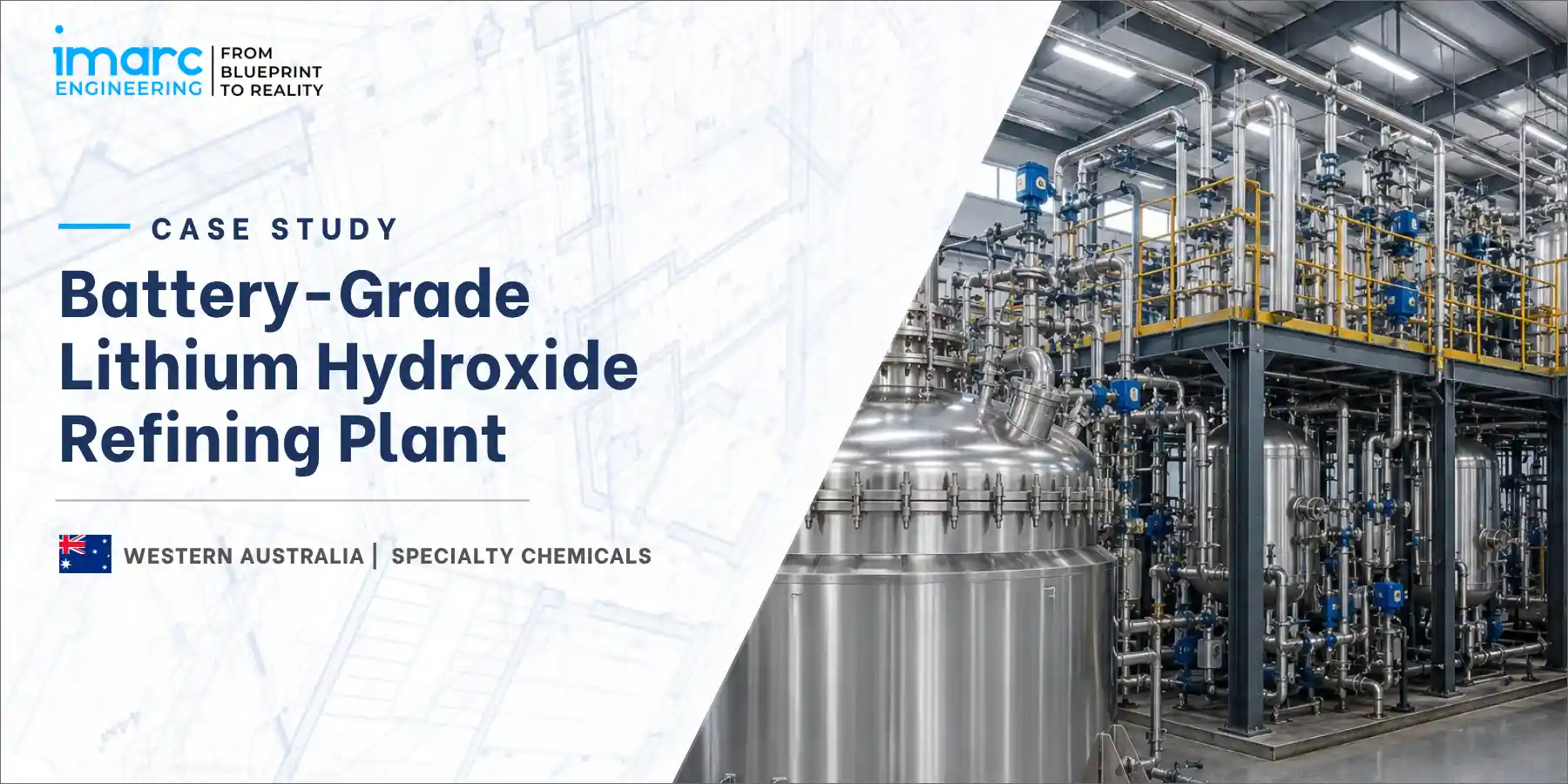
Battery-Grade Lithium Hydroxide Refining Plant
Case Study Details
Industry
Specialty Chemicals – Critical Minerals Processing
Location
Kwinana Strategic Industrial Area, Western Australia (serving Korean, Japanese and European cathode manufacturers)
Project Type
Greenfield refining plant (Train 1, expandable with second train to 48,000 MT)
Project Capacity
24,000 MT per annum of battery-grade lithium hydroxide monohydrate
Investment
AUD 945 Million (final CapEx after Execution)
Challenge
32 months to commissioning
Impact
Australia's third operational battery-grade LiOH refinery; IRA Section 30D non-FEOC qualifying supply; offtake agreements signed with three Korean cathode majors; AUD 220 Million Critical Minerals Facility and Modern Manufacturing Initiative grant secured
IMARC's Solution Highlights
End-to-end EPCM advisory across feasibility, hazardous-process engineering, multi-OEM specialty equipment procurement, purity ramp-up, and integrated environmental and IRA Section 30D compliance readiness
Project Overview
An Australian critical minerals consortium, in partnership with a Korean cathode material technology licensor, engaged IMARC Engineering to establish a greenfield battery-grade lithium hydroxide monohydrate refining plant in the Kwinana Strategic Industrial Area, Western Australia. Driven by the United States Inflation Reduction Act Section 30D supply-chain "non-Foreign Entity of Concern" requirements, the Australia–US Critical Minerals Compact, and the long-term offtake commitments of Korean, Japanese, and European cathode makers seeking trusted non-China refined lithium, the client identified a strategic opportunity to convert Australian spodumene concentrate domestically — capturing the substantial conversion margin that has historically been exported with concentrate to Chinese refineries.
The project involved establishing a 24,000 MT per annum facility producing high-purity battery-grade lithium hydroxide monohydrate (LiOH·H2O), with site infrastructure designed for a Train 2 expansion to 48,000 MT total capacity.
Client's Challenges
The client faced several specific challenges in establishing greenfield battery-grade lithium refining in Australia:
- Battery-grade purity at scale: Achieving and sustaining LiOH·H2O purity above 99.5%, with strict impurity controls on sodium, potassium, calcium, magnesium, sulphate, and iron at single-digit parts-per-million levels, a step-change beyond technical-grade chemistry.
- Hazardous process chemistry: Engineering a two-stage thermal process comprising calcination at 1,050°C (alpha-to-beta conversion) followed by sulphation roasting at 250°C, multi-stage acidic leaching, ion exchange, and evaporation-crystallisation circuits handling concentrated sulphuric acid, caustic soda, and lithium-bearing streams under Australian Major Hazard Facility (MHF) regulations.
- IRA Section 30D qualifying readiness: Establishing full upstream traceability of spodumene concentrate from non-FEOC Australian mine sources and end-to-end chain-of-custody documentation under United States Treasury and Department of Energy verification requirements.
- Water-scarce siting: Operating in Perth's water-stressed metropolitan environment requiring zero-liquid-discharge engineering, brine valorisation, and tightly controlled freshwater intake under WA Department of Water and Environmental Regulation licence conditions.
- Spodumene feedstock variability: Managing lithium oxide (Li2O) feedstock variability between 5.5% and 6.2% from multiple Western Australian mine sources, with associated variation in alumina, iron, and mica impurity content.
- Workforce in a tight labour market: Recruiting 480 skilled operators and 110 specialist process engineers in Western Australia's mining-driven full-employment labour market with associated wage premia and high turnover risk.
What We Did
-
Pre-Investment and Strategic Advisory
Our feasibility study evaluated four candidate sites across Western Australia — Kwinana, Bunbury, Geraldton, and an inland greenfield site near Kalgoorlie — against 16 weighted criteria including spodumene logistics costs, port export connectivity, gas pipeline access, water entitlements, brownfield infrastructure availability, and skilled labour pools. Kwinana Strategic Industrial Area was selected on the strength of established heavy industrial co-utilities (existing Tianqi-IGO refinery, Alcoa alumina, and the broader BP refinery infrastructure corridor), 132 kV grid availability, direct rail siding to Kwinana Bulk Terminal, AUD 220 Million Australian Government Critical Minerals Facility grant eligibility, and proximity to the University of Western Australia's metallurgy research capacity.
CapEx planning of AUD 1.0 Billion covered roasting and acid-leaching circuits, ion-exchange and crystallisation trains, packaging and bulk-handling infrastructure, effluent treatment and water-recycling systems, and dedicated 132 kV substation works. Our team led the joint application that secured AUD 220 Million from the Australian Government's Critical Minerals Facility and Modern Manufacturing Initiative, alongside Major Hazard Facility licensing advisory, IRA Section 30D non-FEOC traceability framework design, and WA Department of Jobs, Tourism, Science and Innovation engagement. Financial modelling demonstrated post-tax IRR of 18.6% at full ramp with a 6.4-year payback inclusive of grants and downstream offtake premiums.
-
Engineering and Design Services
IMARC designed a 36,000 sq.m built-up facility on a 28-hectare site comprising sulphation-roasting kilns (two parallel rotary kilns at 1,050°C, 28 MW thermal each), water-leaching and impurity-removal circuits, ion-exchange polishing trains, multi-effect evaporators and reactive crystallisers, dryer-classifier-packaging trains, and a fully integrated effluent treatment plant. Process design incorporated double-confinement of all acid and caustic streams under Major Hazard Facility regulations, with HAZOP and LOPA analyses driving 86 design modifications across 12 formal review cycles.
Crystallisation engineering specified controlled-cooling reactive crystallisers with seed recycle to deliver target particle size distribution (D50 of 8 to 12 µm) critical to downstream cathode performance, with anti-caking centrifugal drying and inert-atmosphere classification to suppress carbonate impurity formation. Utility design covered 42 MW of contracted demand including 6 MW dedicated solar with battery firming, 6,200 TR of process cooling, 12 MLD gross water intake with target reuse exceeding 80%, and a 28 km natural gas pipeline tap for kiln firing. Process safety design embedded SIL-3 instrumented protection layers across 24 high-consequence loops, with full Safety Integrity Level verification under IEC 61511.
-
Procurement and Supply Chain Support
We executed a globally-sourced procurement programme across 74 critical vendors. Rotary calcination kilns were sourced from a German specialist with documented lithium-industry references; ion-exchange resins and contactors from Japanese specialty chemical suppliers; multi-effect evaporators and reactive crystallisers from Italian process equipment specialists; and packaging, bulk handling, and pneumatic conveying systems from European and Australian suppliers. Specialty stainless steel reactors (904L and Alloy 20 for sulphuric acid service), Hastelloy components, and FRP equipment were sourced under tightly specified material certification protocols with positive material identification on all incoming items.
Spodumene feedstock sourcing was structured under long-term offtake agreements with three Western Australian mine sources covering 220,000 MT of spodumene concentrate per annum at average 5.8% Li2O grade, with formal allowance for grade variability and a feedstock blending protocol developed jointly with the mine-blending stages. Sulphuric acid supply was secured under regional swap agreements; caustic soda and ion-exchange polymers under direct supplier contracts. Vendor qualification protocols included on-site supplier audits, FAT and SAT validation packages, full material traceability under non-FEOC certification, and incoming material specifications validated through pilot-scale runs at the partner Korean facility.
-
Project Execution and Site Management
Our turnkey project management delivered 32 months from groundbreaking to first qualified product, coordinating civil construction, mechanical erection, electrical and instrumentation installation, and integrated commissioning of nine process trains. We managed construction of the main process building (18,400 sq.m), the tank farm (2,800 sq.m footprint with 28 process tanks ranging 50 to 800 m³), the effluent treatment plant (4,400 sq.m), the warehouse and packaging hall (6,200 sq.m), and the central utility block including substation and cooling tower complex.
Installation supervision ensured specialty-chemical-grade specifications: 100% radiography on critical acid-service welds, hydrostatic testing of all reactor vessels to 1.5 times design pressure, alloy material verification at incoming and during installation via portable XRF, and orbital-welded high-purity product piping in 316L electropolished stainless steel. Multi-vendor coordination across German, Italian, Japanese, Chinese, Australian, and South African contractors required a 32-strong owner's engineering team, daily site safety stand-downs during heavy-lift and tie-in campaigns, and dedicated commissioning sub-teams running pre-commissioning, mechanical completion, and operational acceptance in parallel-track sequence across the process areas.
-
Operations Readiness and Ramp-Up
We developed a structured operational readiness programme comprising 268 SOPs, integrated control narratives covering 18 unit operations, 14 emergency response protocols under Major Hazard Facility regulations, and a tiered training matrix covering all 590 plant personnel. Operator training included 12-week classroom and full-scope dynamic simulator programmes, with hands-on rotations through the Korean partner facility for 86 supervisory and senior operating personnel. Six-month embedded technology-transfer assignments were structured for 22 process engineers at the licensor's Korean refinery.
Production ramp-up tracked purity evolution from 99.1% (first qualified batches in month 33) to 99.6% by month 38, with weekly steering reviews driving root-cause closure on 168 process anomalies and 42 design-stage process modifications. Post-commissioning performance validation confirmed achievement of design throughput within 14 months and customer-side acceptance through 24 sequential qualification batches across three Korean cathode customer specifications, with first commercial offtake shipments commencing in month 40 of the project clock.
-
Compliance, Quality and Sustainability
IMARC led certification readiness across the WA Major Hazard Facility licence (Department of Mines, Industry Regulation and Safety), Department of Water and Environmental Regulation Part V works approval and operating licence, dangerous goods storage and handling licences, and Operational Safety Case documentation. We implemented an integrated quality system including inline ICP-MS and ICP-OES analysis on every batch, automated wet chemistry verification, particle size and morphology analysis, and full lot traceability compliant with cathode customer pre-qualification protocols and ISO 9001/14001/45001 management systems.
Environmental and social compliance covered Native Title and Cultural Heritage protocols under the Aboriginal Heritage Act, ESG assurance compliant with the Towards Sustainable Mining framework, and an integrated water management plan delivering zero liquid discharge through brine evaporation, gypsum solidification, and 84% process water reclamation. The facility achieved Green Star Industrial certification through a 22% renewable energy share, heat recovery from kiln offgas (28 GJ/hr useful steam recovery), 24% lower process energy intensity versus the Chinese refinery industry benchmark, and embedded IRA Section 30D non-FEOC traceability across the full upstream value chain through blockchain-anchored chain-of-custody documentation reviewed by an independent third-party auditor.
Final Results

Operational Performance
The facility achieved mechanical completion in 32 months with first qualified product delivered in month 33. Full 24,000 MT per annum nameplate capacity was reached by month 14 of operations at 92% utilisation, with sustained battery-grade purity of 99.6% across all product streams and particle size D50 maintained within the 8 to 12 µm target band on every batch. Customer-side qualification batches across three Korean cathode majors passed 24 of 24 sequential acceptance tests, with sodium impurity averaging 8 ppm against a customer-specified ceiling of 20 ppm.
Financial Outcomes
Final CapEx of AUD 945 Million delivered 5.5% savings against the AUD 1.0 Billion budget through optimised civil packaging, multi-source equipment procurement leverage, and disciplined fabrication outsourcing to qualified Asian and South African shops. The Australian Critical Minerals Facility and Modern Manufacturing Initiative grant of AUD 220 Million was disbursed across construction and ramp-up milestones. Year-2 revenue of AUD 720 Million was generated at an EBITDA margin of 34%, substantially above the Chinese refinery benchmark of 18 to 22%, driven by IRA Section 30D-qualifying premium pricing and direct cathode-maker offtake structure.
Market Access
IRA Section 30D non-FEOC qualifying supply status was secured through US Treasury Department guidance verification, unlocking US-bound supply premium contracts. Long-term offtake agreements were signed with three Korean cathode majors covering 22,000 MT per annum cumulatively through 2032, alongside a pilot supply agreement with a Japanese Tier-1 cathode buyer and an active RFQ pipeline with four European cathode and cell manufacturers. Export share reached 92%, with the residual 8% supplying Australia's nascent domestic battery materials sector.
Sustainability Impact
Our integrated design — combining 6 MW captive solar with battery firming, kiln-offgas heat recovery delivering 28 GJ/hr of useful process steam, variable-frequency drives across rotating equipment, and zero-liquid-discharge water management — achieves 24% lower process energy intensity versus the Chinese refinery benchmark, saving AUD 18 Million annually in operating costs. Process water reclamation reaches 84%, with all residual brine processed through evaporation crystallisation and gypsum solidification for licensed offsite disposal. The facility holds Green Star Industrial certification and is committed to net-zero Scope 1+2 emissions by 2035 through a planned electrification roadmap.
Strategic Impact
The project established Australia's third operational battery-grade lithium hydroxide refinery and demonstrated viability of Australian domestic conversion economics against the historical default of Chinese refining. The client has approved Train 2 expansion to 48,000 MT total capacity by 2028, alongside scoping studies for a co-located lithium iron phosphate (LFP) precursor facility leveraging Train 1's residual lithium streams. IMARC Engineering's end-to-end EPCM advisory enabled the client to capture the structural shift in Western critical minerals localisation in a sector where execution complexity, regulatory burden, and process chemistry risk had previously confined Australia to upstream concentrate exports.
Case Study Details
Industry
Specialty Chemicals – Critical Minerals Processing
Location
Kwinana Strategic Industrial Area, Western Australia (serving Korean, Japanese and European cathode manufacturers)
Project Type
Greenfield refining plant (Train 1, expandable with second train to 48,000 MT)
Project Capacity
24,000 MT per annum of battery-grade lithium hydroxide monohydrate
Investment
AUD 945 Million (final CapEx after Execution)
Challenge
32 months to commissioning
Impact
Australia's third operational battery-grade LiOH refinery; IRA Section 30D non-FEOC qualifying supply; offtake agreements signed with three Korean cathode majors; AUD 220 Million Critical Minerals Facility and Modern Manufacturing Initiative grant secured
IMARC's Solution Highlights
End-to-end EPCM advisory across feasibility, hazardous-process engineering, multi-OEM specialty equipment procurement, purity ramp-up, and integrated environmental and IRA Section 30D compliance readiness
Have a similar project in mind?
Our engineering consultants can help you plan, design, and execute your next facility — from feasibility to commissioning.
Schedule a consultationTrusted by Industry Leaders
We partner with global enterprises and ambitious businesses across sectors to deliver operational excellence, strategic insights, and sustainable growth through integrated solutions.








Success in Their Words
Real feedback from clients across industries. Discover how our solutions delivered measurable impact and operational excellence.

I wanted to express my sincere appreciation for your efforts in handling this matter. Your dedication and commitment have been truly commendable, and it is evident that you have put in tremendous hard work and expertise into resolving the issues at hand. We are greatly interested in continuing our collaboration with you in the future, as your professionalism and reliability have made you a trusted partner. Thank you once again for your invaluable contribution. We look forward to strengthening our partnership ahead.

It has been a pleasure working with the IMARC team. The insights provided were structured, clear, and highly valuable, helping us strengthen both our technical and financial planning with confidence. We deeply appreciate the team’s professionalism, responsiveness, and attention to detail throughout the engagement. Every requirement was well understood and effectively incorporated, resulting in a comprehensive and actionable output. Overall, our experience has been excellent, and I would gladly recommend IMARC to organizations seeking a reliable research partner.

Your service is truly exceptional. Working with the IMARC team has been a seamless and professional experience. The clarity of communication, responsiveness to queries, and consistent support at every stage made the entire engagement highly efficient. The insights shared were well-structured, practical, and perfectly aligned with our requirements, helping us make informed decisions with confidence. Overall, the dedication and professionalism demonstrated by your team stand out, and I would be glad to recommend IMARC as a reliable and trustworthy research partner.

IMARC did an outstanding job in preparing our study. They were punctual, precise, and consistently responsive throughout the entire process. The team delivered all the data we required in a clear, well-organized, and highly professional format. Their strong attention to detail, combined with their ability to meet every deadline without compromising quality, truly set them apart. Overall, their reliability and commitment made them an exceptional partner for our project, and we would gladly work with them again in the future.

IMARC made the whole process incredibly easy from start to finish. Everyone I interacted with via email was polite, professional, and straightforward to deal with, always keeping their promises regarding delivery timelines and remaining consistently solutions-focused. From my very first contact, I appreciated the professionalism and support shown by the entire IMARC team. I highly recommend IMARC to anyone seeking timely, affordable, and reliable information or advice. My experience with IMARC was excellent, and I truly cannot fault any aspect of it.

I’d like to express my sincere gratitude for the excellent work you accomplished with the study. Your ability to quickly understand our requirements and deliver high-quality results under tight timelines truly reflects your expertise, exceptional work ethic, and unwavering commitment to your customer’s success. The professionalism and responsiveness you demonstrated throughout the process made a significant difference. Our entire team and company are incredibly thankful for your dedication, reliability, and support. Once again, thank you for your outstanding contribution.
Ready to Experience the IMARC Advantage?
Whether you're planning a new facility, expanding operations, optimizing performance, or facing complex challenges—IMARC Engineering brings the expertise, experience, and commitment needed for success.