Manufacturing
April 23 2026
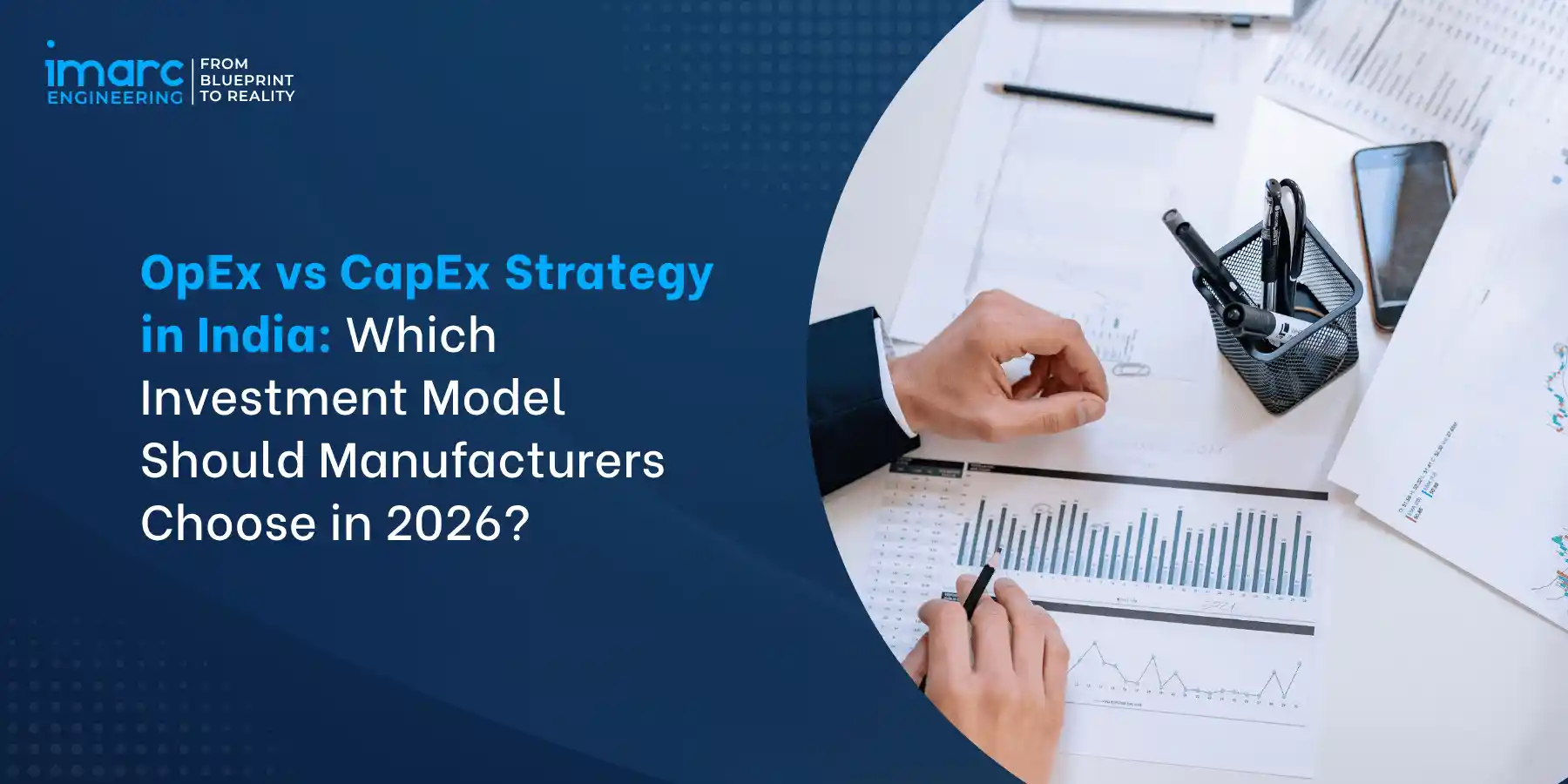
OpEx vs CapEx Strategy in India: Which Investment Model Should Manufacturers Choose in 2026?
Introduction:
For Indian manufacturers entering 2026, few decisions will shape long-term competitiveness more than the CapEx vs OpEx choice. The OpEx vs CapEx strategy in India debate, once a quiet finance-team conversation, is now a board-level strategic priority, reshaped by the make in India manufacturing strategy 2026, accelerating PLI scheme disbursements, semiconductor and EV mega-investments, and a generational shift in how equipment, technology, and capacity are financed.
Indian manufacturers that get the CapEx vs OpEx manufacturing in India call right will compound cost advantage, balance-sheet agility, and speed-to-market for the entire decade; those that default to legacy thinking risk locking capital into rapidly-ageing assets.
The financial scale involved is substantial. India’s manufacturing sector is set to reach USD 1 trillion by 2025-26, and significant number of investments are planned in coming years across electronics, semiconductors, EVs, batteries, green hydrogen, specialty chemicals, pharma, and textiles, with PLI allocations alone exceeding USD 26 billion. The PLI scheme impact on manufacturing investment has further complicated the choice between owning assets and adopting operating models, forcing companies to rethink their capital investment strategy in India.
Drawing on IMARC Engineering’s experience in CapEx planning, OpEx optimization in manufacturing, financial modelling, and investment-strategy decisions across sectors, this guide lays out a structured, end-to-end view of the CapEx vs OpEx strategy in India. You will find definitions and examples, a detailed differences matrix, advantages-and-disadvantages analysis, a decision framework, real-world case studies, 2026 trends, and the most frequently asked questions from Indian manufacturers evaluating the right manufacturing cost strategy in India for the next growth cycle.
Key Insight: Having supported CapEx planning, OpEx modelling, and investment-strategy decisions for manufacturing projects across pharmaceuticals, automotive, electronics, chemicals, EVs, semiconductors, and food processing, IMARC Engineering’s teams have developed a structured multi-factor methodology that goes far beyond accounting classification. This guide distils that methodology into a framework Indian manufacturer can apply to their own 2026 investment decisions.
Table of Contents:
- Introduction
- What Is CapEx vs OpEx in Manufacturing?
- Key Differences Between CapEx and OpEx
- Why the OpEx vs CapEx Strategy Debate Matters More in 2026?
- CapEx vs OpEx: Advantages and Disadvantages
- CapEx vs OpEx Examples in Industrial Projects
- OpEx vs CapEx: Which Is Better for Indian Manufacturers?
- How to Choose the Right Investment Strategy in 2026?
- Latest Trends Shaping Industrial Investment Strategy India 2026
- Conclusion
1. What is CapEx vs OpEx in Manufacturing?
At the most basic level, capital expenditure (CapEx) is the money a manufacturer spends to acquire, upgrade, or extend long-lived productive assets, factory land and buildings, plant and machinery, utility infrastructure, and technology platforms, that are expected to generate returns over multiple years. Operating expenditure (OpEx) is the money spent to keep those assets running and to produce output day-to-day, raw materials, labour, utilities, maintenance, software subscriptions, leased equipment, third-party services, and logistics. In the context of CapEx vs OpEx in manufacturing, the distinction is not just an accounting one, it is a strategic choice about what the manufacturer owns, what it rents, and how it structures its cost-base for flexibility, scale, and resilience.
The difference between CapEx and OpEx in manufacturing therefore directly shapes the entire OpEx vs CapEx strategy in India, from project financing and tax treatment through to balance-sheet optics, PLI eligibility, and 10-year total-cost-of-ownership economics.
1.1 Defining CapEx in an Indian Manufacturing Context
In India, CapEx typically includes the purchase of land and buildings, factory construction, plant and machinery, utility infrastructure (power, water, steam, compressed air), material-handling and automation systems, ERP and MES platforms, laboratories and R&D infrastructure, and the pre-operative expenses capitalised into the project. Under the Indian Accounting Standards (Ind AS 16), these costs are capitalised on the balance sheet and depreciated over the asset’s useful life. The GST paid on most CapEx is eligible for input-tax credit, and depreciation is allowable as a tax deduction.
OpEx, by contrast, is the recurring cost of running the business, raw materials and packaging, direct and indirect labour, utility consumption, maintenance and spares, insurance, logistics, leased equipment rentals, software-as-a-service subscriptions, utility-as-a-service contracts, contract-manufacturing fees, and quality-testing services are part of this. OpEx is expensed in the profit-and-loss statement in the period it is incurred, directly reducing the current year’s taxable income.
For Indian manufacturers, OpEx has traditionally been viewed as the flexible, variable cost base that scales with production, but modern OpEx-led models increasingly absorb what used to be CapEx items (equipment, automation, utilities) under long-term service or lease arrangements.
1.3 The Rise of Hybrid and Asset-Light Models
The cleanest CapEx / OpEx boundary of a decade ago has blurred meaningfully. Equipment leasing, equipment leasing vs buying India decisions, robotics-as-a-service, utility-as-a-service (solar PPAs, compressed air, steam), managed maintenance contracts, and contract manufacturing all convert what would previously have been CapEx into recurring OpEx. The choice between asset ownership vs leasing model now extends across almost every category of factory investment, which is why Indian manufacturers must think in terms of a portfolio of ownership / leasing / service arrangements rather than a binary CapEx-or-OpEx decision.
2. Key Differences Between CapEx and OpEx:
Understanding the difference between CapEx and OpEx in manufacturing is the foundation for every downstream decision, how the project is financed, how it is accounted for, how it is taxed, how it affects the balance sheet, and how the returns are measured. The matrix below summarises the eleven dimensions across which CapEx and OpEx behave differently, with the practical implications for Indian manufacturers.
| Dimension | CapEx (Capital Expenditure) | OpEx (Operating Expenditure) |
|---|---|---|
| Nature of spend | One-time purchase of long-lived assets | Recurring cost of running the business |
| Accounting treatment (Ind AS) | Capitalised on balance sheet, depreciated over useful life | Expensed fully in the P&L in the period incurred |
| Typical horizon | 5 – 25 years (asset life) | Weeks to 12 months |
| Tax treatment in India | Depreciation allowance + ITC on GST where eligible | Full expense deduction; GST ITC where eligible |
| Balance-sheet impact | Increases assets and (often) debt; lifts gross block | No asset addition; reflected only in P&L |
| Cash-flow profile | Large lumpy upfront outflow | Smooth, predictable periodic outflow |
| Funding sources | Equity, term loans, debentures, PLI grants, lease-finance | Working-capital facilities, cash-flow from operations |
| Flexibility | Low- committed capital, high exit cost | High- scalable up or down with demand |
| Return measurement | IRR, NPV, payback period, ROCE | Cost per unit, EBITDA margin, OpEx intensity |
| Risk profile | Concentrated up-front; long payback | Distributed over time; faster to adjust |
| Strategic message | Signals long-term commitment and scale ambition | Signals operational agility and cost discipline |
2.1 Why the Accounting Treatment Matters Strategically
The balance sheet vs expense model distinction is not a back-office detail, it materially affects reported profitability, debt-service capacity, and the financial ratios that banks, rating agencies, and investors use to judge the business. CapEx-heavy manufacturers report higher depreciation and often higher interest, which compress EBIT in the early years of the asset’s life; OpEx-led manufacturers expense everything immediately, with a leaner balance sheet but a higher recurring cost baked into the P&L. Neither is universally better, but each produces very different financial optics, ratios, and funding conversations.
2.2 Cash-Flow Profile and Financing Implications
From a treasury standpoint, the CapEx vs OpEx decision manufacturing comes down to whether the company wants a large, concentrated outflow now (followed by lower running costs) or a smoother, distributed cost base over time. The former requires access to capital like equity, project finance, PLI grants, ECB, and disciplined capital investment planning to ensure utilisation and returns justify the outlay.
The latter frees up capital for other uses (market expansion, working capital, R&D) but typically pays a premium to the asset owner over the asset’s life. Robust financial modeling for factories covering CapEx, OpEx, depreciation, working capital, and sensitivity testing is the foundation for either path, and is where most CapEx vs OpEx decision manufacturing exercises succeed or fail.
2.3 Tax and Regulatory Considerations in India
- Depreciation on plant and machinery is allowable at 15% (written-down-value method) under the Income-tax Act, with higher rates for specified classes; SEZ units and Section 115BAB companies have distinct rate structures
- Input Tax Credit (ITC) on GST paid for plant, machinery, and most production-linked services is eligible against GST on output supply, but specific exclusions (motor vehicles, works contract for buildings, etc.) must be verified
- OpEx expenses are fully deductible in the year incurred under normal business-expense rules, subject to specific disallowances (Section 40A cash payments, TDS compliance, related-party limits)
- Lease payments on operating leases are generally deductible as business expenses; finance leases are treated differently under Ind AS 116 and may partially be capitalised
- PLI and state-level capital subsidies typically offset CapEx; some state packages also reimburse SGST, stamp duty, and power tariffs, partially offsetting OpEx in the early operating years
3. Why the OpEx vs CapEx Strategy Debate Matters More in 2026?
The OpEx vs CapEx strategy in India has moved from accounting convention to genuine strategic battleground because of five converging forces, each of which is sharpening the 2026 decision for Indian manufacturers. Together they explain why the answer that worked in 2015 is almost certainly the wrong answer for the next five years.
3.1 Policy Tailwinds Are Restructuring the CapEx Case
The PLI scheme impact on manufacturing investment has been substantial. Across 14 sectors, PLI has committed approximately USD 26 billion in incentives and has catalysed over USD 30 billion in fresh manufacturing commitments. For eligible sectors like electronics, semiconductors, specialty steel, pharmaceuticals, auto components, advanced chemistry cell batteries, white goods, textiles, drones, telecom, PLI structurally improves CapEx economics by underwriting a share of the investment in exchange for committed incremental output. The Make in India manufacturing strategy 2026, combined with state-level capital-subsidy stacking, has arguably made this the single most attractive window for disciplined CapEx deployment India has seen in a generation.
3.2 Technology Obsolescence Is Accelerating
Manufacturing technology is obsoleting faster than depreciation schedules assume. Industry 4.0 platforms, AI-based quality inspection, collaborative robotics, 3D-printed tooling, and digital-twin systems evolve on 3–5-year cycles, while plant and machinery are typically depreciated over 10–20 years. Manufacturers that lock heavily into owned, bespoke automation risk carrying an asset base that is technologically obsolete long before it is accounting obsolete. This is the single strongest argument in favour of OpEx-led, service-model adoption for technology-intensive categories, and explains why many leading manufacturers are explicitly converting historical CapEx into recurring service contracts.
3.3 Sector-Specific Investment Dynamics
The CapEx-vs-OpEx calculus differs materially by sector. The table below summarises how four of India’s most active 2026 investment themes are actually structured, including where CapEx vs OpEx intensity matters most.
| Theme | Typical CapEx Intensity | Typical OpEx Levers | Dominant 2026 Investment Logic |
|---|---|---|---|
| Semiconductor manufacturing India investment strategy | Extremely high (fabs: USD 2–20 B) | Yield, materials, utilities, talent | CapEx-led, PLI/SPECS subsidised, anchor investor model |
| EV manufacturing cost strategy India | High (cell, drivetrain, battery pack plants) | Battery materials, labour, logistics, after-sales | Hybrid- own core cells, lease ancillary capacity |
| Green hydrogen projects India investment model | Very high (electrolysers, renewable PPA, storage) | Power PPA, water, O&M, transport | OpEx-heavy through long-term PPAs + take-or-pay offtake |
| Pharma APIs & contract manufacturing | Moderate to high (multipurpose blocks) | Raw materials, energy, QA/QC, compliance | Hybrid- own GMP plants, lease utilities |
| Electronics (ESDM) assembly | Low to moderate (lines and fixtures) | Components, labour, SMT tooling, logistics | OpEx-biased, capital-light, PLI-linked output |
3.4 Cost of Capital, Interest Rates, and Financing Markets
India’s cost of capital in 2026 remains structurally higher than in developed markets, even as banking-sector liquidity has eased and the corporate-bond market has deepened. For CapEx-heavy projects, this means capital investment planning must be tight, internal rate of return targets of 18–22% are common, and deviations from those targets compound quickly over a 10-year asset life. For OpEx-led models, the corresponding discipline is on vendor cost control and contract structuring, long-term service pricing has to be benchmarked against the buy-alternative, with clear escalation caps and exit clauses.
3.5 Global Supply-Chain Reconfiguration
The China+1 and nearshoring wave is pushing Indian manufacturers in two opposing directions simultaneously. On one hand, the opportunity to capture new export and anchor-customer volumes is pulling investment toward CapEx-heavy capacity creation, especially in electronics, auto-components, pharma, and specialty chemicals. On the other, the volatility and demand-reshaping that accompanies a global supply-chain reset is making flexibility and capital-light scaling more valuable than ever, arguing for measured OpEx use as a hedge against misread volumes and mistimed capacity.
4. CapEx vs OpEx: Advantages and Disadvantages
Any serious evaluation of CapEx vs OpEx advantages and disadvantages must move beyond the generic pros-and-cons checklists that dominate the internet. For Indian manufacturers in 2026, the relevant question is how each model performs against the specific constraints of the Indian market, cost of capital, incentive regimes, demand volatility, technology evolution, and workforce dynamics. The stakes are particularly high when considering CapEx vs OpEx for plant setup in India, where the initial structural choice locks in cost positions, compliance exposures, and financing obligations for a decade or more. Leading manufacturing cost optimization strategies India explicitly addresses this trade-off rather than defaulting to legacy CapEx thinking or unconditional OpEx preference.
A structured review of CapEx vs OpEx advantages and disadvantages should also explicitly weight the opportunity cost of capital, every rupee committed to CapEx is a rupee unavailable for market expansion, working capital, R&D, or strategic acquisitions. That opportunity cost is often the single largest, and most overlooked, item on the CapEx side of the ledger.
4.1 CapEx Advantages (in the Indian Context)
- Full operational control over quality, throughput, customisation, and IP protection, critical for regulated or strategically sensitive categories
- Lower long-run per-unit cost once the asset is fully utilised, particularly in commodity and high-volume production
- Eligibility for PLI schemes, state-level capital subsidies, and tax benefits that directly offset a portion of the capital outlay
- Stronger balance sheet, owned assets build gross block, which supports borrowing capacity and enterprise valuation
- Strategic signalling- CapEx commitment demonstrates long-term intent to customers, financiers, and policymakers
4.2 CapEx Disadvantages
- Large, concentrated cash outflow with long payback- typically 4–7 years in Indian manufacturing, longer in capital-intensive sectors
- Technology obsolescence risk- assets may become outdated before they are fully depreciated
- Low flexibility- unused capacity is a sunk cost, and right-sizing requires expensive restructuring
- Exit friction- divesting underutilised or obsolete assets often yields pennies on the rupee
- Debt-service exposure- in sectors with volatile demand, fixed interest and depreciation can squeeze margins in down cycles
4.3 OpEx Advantages
- High flexibility- costs scale up and down with demand, preserving margin resilience in volatile markets
- Faster speed-to-market- leased equipment, contract-manufacturing, and utility-as-a-service can be operational in weeks rather than the 12–18 months typical of greenfield CapEx
- Technology currency- service contracts typically include periodic upgrades, keeping the manufacturer on current-generation technology
- Capital preservation- freed-up capital can be deployed into working capital, market expansion, R&D, or acquisitions
- Simpler administration- no depreciation schedules, no asset-impairment risk, no divestment burden at end-of-life
4.4 OpEx Disadvantages
- Higher total cost over long horizons- the service provider’s margin, financing cost, and risk premium are embedded in the recurring fee
- Lower control over quality, scheduling, and customisation- particularly in leased equipment or contract-manufacturing arrangements
- Dependency on third-party reliability- supplier failure or contract disputes can disrupt production
- Weaker balance-sheet optics for lenders and investors who still value owned gross block
- Limited subsidy eligibility- PLI and capital-subsidy benefits are largely tied to qualifying owned CapEx
4.5 Side-by-Side Advantages & Disadvantages Matrix
The matrix below consolidates the pros and cons across both models, a useful quick-reference view for teams actively shaping their OpEx vs CapEx strategy in India. It also highlights why the asset ownership vs leasing model choice is rarely black-and-white and why a well-designed CapEx heavy vs asset light strategy India usually blends the two to match project economics and strategic priorities.
| Dimension | CapEx Advantage | OpEx Advantage |
|---|---|---|
| Control & IP | Full control over process, quality, and IP | - |
| Flexibility | - | Costs scale with demand |
| Speed-to-market | - | Weeks instead of 12–18 months |
| Long-run unit cost | Lowest once asset is fully utilised | - |
| Technology currency | - | Periodic upgrades bundled in service |
| Incentive capture | PLI + state subsidy eligibility | - |
| Balance-sheet optics | Builds gross block, supports borrowing | - |
| Risk absorption | - | Distributes risk across periods |
| Exit / rightsizing | High friction, divestment discounts | Easy- non-renewal ends obligation |
| Administration overhead | - | No depreciation, impairment, or end-of-life burden |
5. CapEx vs OpEx Examples in Industrial Projects:
Concrete examples are the fastest way to internalise how the OpEx vs CapEx strategy in India plays out on the ground. Every credible CapEx vs OpEx lifecycle cost analysis starts by mapping the actual line items a project will incur and then classifying them against ownership, leasing, and service alternatives. The tables below summarise the most common investment line items in Indian manufacturing projects, particularly relevant for any CapEx vs OpEx for plant setup in India, and how they typically split between CapEx and OpEx under traditional and asset-light models.
5.1 CapEx Examples in Industrial Projects
| Category | Typical CapEx Line Items | Indicative Range (USD, mid-size plant) |
|---|---|---|
| Land & buildings | Industrial plot, factory building, site development | 2 – 10 M |
| Plant & machinery | Core production equipment, utilities, piping, instrumentation | 5 – 25 M |
| Automation & controls | PLCs, SCADA, MES platform, robotics, conveyors | 1 – 5 M |
| Utility infrastructure | Transformers, DG sets, boilers, chillers, compressed-air, ETP | 1 – 4 M |
| IT & ERP | ERP licences, servers, networking, cybersecurity baseline | 0.3 – 1.5 M |
| R&D & QC lab | Lab equipment, QA instruments, validation infrastructure | 0.2 – 2 M |
| Pre-operative | Project management, design, approvals, interest during construction | 5 – 10% of total |
5.2 OpEx Examples in Industrial Projects
| Category | Typical OpEx Line Items | Cost Driver / Frequency |
|---|---|---|
| Raw materials & packaging | Direct inputs, consumables, bulk packaging | Variable with output |
| Direct & indirect labour | Operators, supervisors, maintenance, QA, indirect staff | Monthly payroll |
| Energy & utilities | Power, water, fuel, steam, compressed air | Monthly consumption |
| Maintenance & spares | Preventive, predictive, breakdown, rotable spares | Monthly + event-driven |
| Leased equipment / RaaS | Leased machines, robotics-as-a-service, tooling | Monthly lease rentals |
| Utility-as-a-Service | Solar PPAs, steam-on-demand, compressed-air contracts | Pay-per-use |
| IT subscriptions (SaaS) | ERP cloud, MES cloud, design software, analytics | Annual / monthly subscriptions |
| Third-party services | Contract manufacturing, laboratory testing, calibration, housekeeping | Per-engagement or per-unit |
| Logistics | Inbound freight, outbound distribution, warehousing | Variable with volume |
5.3 Hybrid Example- A Mid-Size Specialty Chemicals Plant
Consider a USD 35 million specialty-chemicals plant being planned in Gujarat. Under a traditional CapEx-heavy model, essentially all line items like land, building, reactors, utilities, ETP, IT, and lab are owned. Under a modern hybrid model, the same capability can be delivered at meaningfully lower balance-sheet intensity: the core reaction block (IP-sensitive) remains CapEx, while solar captive power shifts to a 25-year PPA (OpEx), compressed air is outsourced to a utility-as-a-service provider (OpEx), part of the MES is SaaS (OpEx), and non-core analytical testing is contracted out (OpEx).
The hybrid structure illustrates how operational expenditure optimization can preserve strategic control while freeing up 20–30% of upfront CapEx for working capital, R&D, or faster capacity expansion, a textbook example of cost efficiency in manufacturing achieved through deliberate structural design rather than incremental cost-cutting. The net effect is typically a 2–4 percentage-point uplift in return on investment manufacturing economics compared with a pure-CapEx structure.
5.4 Industrial Automation- A Canonical CapEx vs OpEx Trade-Off
Few decisions illustrate the industrial automation cost strategy trade-off as cleanly as robotics deployment. A six-axis industrial robot with end-of-arm tooling and safety fencing typically costs USD 50,000–150,000 in CapEx for a mid-range Indian installation, depreciated over 8–10 years. The same capability procured as robotics-as-a-service runs roughly USD 5,000–7,500 per month, no upfront investment, upgrades included, and a cancellation-at-notice option. Over a 10-year horizon, owned CapEx wins on TCO by 25–35%, but only if the robot is used at 75%+ utilisation and the application is stable. For variable-demand or rapidly evolving applications, the service model almost always wins on risk-adjusted value.
6. OpEx vs CapEx: Which is Better for Indian Manufacturers?
The short answer is: it depends, and the right answer varies by sector, scale, growth stage, product IP-sensitivity, demand volatility, and policy eligibility. There is no universally superior model in the capital expenditure vs operating expenditure in India debate. What we can do is provide a structured view of OpEx vs CapEx benefits India manufacturing so that each manufacturer can triangulate the right fit for its specific context and align the final answer with the broader manufacturing cost strategy in India that suits its sector, scale, and growth stage.
6.1 When CapEx Is the Better Choice
A CapEx-heavy model is typically the better choice when one or more of the following conditions apply:
- Product is IP-sensitive, regulated, or mission-critical- pharma APIs, speciality chemicals, semiconductors, defence, medical devices
- Demand is large, stable, and multi-year-visible- anchor-customer contracts, government offtake, export-backed volumes
- Asset utilisation can be confidently maintained above 70–75%
- The manufacturer qualifies for PLI, state-level capital subsidies, or SEZ / 115BAB tax regimes that offset capital cost
- Cost of capital is accessible, and the balance sheet can absorb the outlay without stressing coverage ratios
- Long-term cost leadership is a strategic pillar- i.e., the business case explicitly rests on lowest-unit-cost positioning
6.2 When OpEx Is the Better Choice
An OpEx-led model is typically the better choice when:
- Demand is volatile, seasonal, or poorly visible- startups, new-product launches, fast-fashion, contract-manufacturing swings
- Technology is evolving quickly- AI inspection, robotics, digital platforms, advanced analytics
- Utilisation is expected to be below 60–65% for a meaningful period
- Capital is scarce or better deployed elsewhere- growth markets, acquisitions, working capital, R&D
- The asset is non-core- utilities, IT infrastructure, warehousing, material handling, non-production services
- Speed-to-market is decisive- OpEx contracting can compress commissioning timelines by 60–80%
6.3 The Hybrid Middle- Where Most Indian Manufacturers Land
In practice, the OpEx model vs CapEx model in factories debate rarely ends in a pure answer. Most Indian manufacturers in 2026 are converging on a hybrid structure, owning the strategic core (IP-sensitive production, regulated processes, anchor utilities) while shifting non-core capacity, technology, and support services into OpEx. This hybrid approach sits squarely within the CapEx heavy vs asset light strategy India spectrum, not at either extreme. The key is deliberate construction: explicit decisions, component by component, based on IP, utilisation, and flexibility needs.
A useful way to stress-test the hybrid is to overlay it against leading manufacturing cost optimization strategies India, comparing, for example, a pure-ownership plant, an asset-light plant, and the hybrid plant on 10-year unit cost, capital intensity, and flexibility. In almost every sector we advise, the hybrid produces the strongest OpEx model vs CapEx model in factories outcome across the three metrics together, even where one of the pure structures wins on a single metric.
6.4 A Structural Decision Matrix
The matrix below summarises how the CapEx / OpEx / hybrid choice typically maps against common manufacturing profiles in India. It is a starting framework; the final decision should always be informed by project-specific financial modelling.
| Manufacturer Profile | Recommended Model | Key Rationale |
|---|---|---|
| Large, regulated, export-oriented (pharma, chemicals, semiconductors) | CapEx-dominant hybrid | IP protection, regulatory control, PLI-eligible scale |
| Mid-size, high-mix / high-variability (EMS, specialty engineering) | OpEx-biased hybrid | Flexibility, fast retooling, demand volatility |
| Startup / new-product ramp (batteries, EVs, green hydrogen pilots) | OpEx-led | Capital preservation, technology currency |
| Anchor manufacturer with stable base-load (steel, cement, integrated chemicals) | CapEx-led | Scale, cost leadership, long asset life |
| Contract manufacturer / OEM supplier | Hybrid (CapEx core, OpEx ancillary) | Own IP-sensitive; lease utilities / automation |
| Technology-intensive production (AI inspection, robotics-driven lines) | OpEx-led or leased CapEx | Avoid obsolescence risk |
Get a structured CapEx vs OpEx strategy model for your specific project from IMARC Engineering. Our multi-disciplinary team combines financial modelling, sector expertise, and policy-incentive mapping to help you structure the right investment model, balancing capital, flexibility, and strategic control.
→ Book your free consultation with an IMARC investment-strategy specialist
7. How to Choose the Right Investment Strategy in 2026?
Choosing the right industrial investment strategy India 2026 is not a single decision, it is a sequence of progressively deeper filters that narrows the universe of possible structures down to a defensible, board-ready recommendation. IMARC’s methodology on how to choose CapEx or OpEx strategy unfolds across six steps, built around the core question: what maximises risk-adjusted return while preserving strategic flexibility?
The framework is equally applicable whether the decision sits at the greenfield plant investment decision India manufacturing stage, at a brownfield expansion, or at a cost-base restructuring, and mirrors the industrial financial planning strategies in India that sophisticated manufacturers now apply to every major capital commitment.
The resulting OpEx vs CapEx strategy in India is always project-specific, but the underlying methodology, and the disciplines it enforces on the leadership team, are universally applicable.
7.1 The Six-Step Decision Framework
Step 1- Define Strategic Intent and Success Metrics
Align the investment with the underlying business strategy like product positioning, customer geography, growth trajectory, IP sensitivity, and 10-year scale ambition. Document what success looks like: target IRR, payback period, ROCE, EBITDA margin, capacity ramp curve. Without clear targets, any CapEx-vs-OpEx analysis collapses into aesthetic preference.
Step 2- Decompose the Project into Functional Blocks
Break the project down into discrete functional blocks: production machinery, utilities, automation, IT, laboratories, logistics, warehousing, facilities. Each block has a distinct IP-sensitivity, utilisation profile, technology evolution rate, and subsidy eligibility, and will often end up with a different CapEx / OpEx answer.
Step 3- Model Scenarios for Each Block
For each block, build a 10-year TCO model comparing pure-CapEx, pure-OpEx, and leading hybrid structures. Apply disciplined CapEx vs OpEx lifecycle cost analysis, including depreciation, interest, service fees, escalation, utilisation sensitivity, and exit assumptions. Run the numbers against multiple scenarios: base case, downside demand, upside demand, technology obsolescence, and policy regime change.
Step 4- Apply Strategic and Risk Filters
Quantitative analysis alone is insufficient. Layer in strategic filters: IP protection requirement, regulatory exposure, control sensitivity, speed-to-market, competitor dynamics, policy eligibility, and risk appetite. CapEx planning vs OpEx model in India is a judgement call informed by analysis, not replaced by it.
Step 5- Construct the Hybrid Portfolio
Assemble the project as a portfolio of ownership / leasing / service arrangements, with each block placed where its individual analysis pointed. Test the combined portfolio for overall CapEx footprint, 10-year TCO, subsidy capture, and flexibility. Adjust boundary decisions where the combined picture is sub-optimal.
Step 6- Structure Financing and Governance
Structure the financing using equity, term loan, project finance, ECB, lease finance, PLI disbursement schedule, against the final CapEx-OpEx split. Put in place the commercial-contracting discipline for the OpEx elements: long-term service pricing, escalation caps, SLA / KPI definitions, exit clauses, and audit rights. Lock in governance for periodic review with industrial financial planning strategies that demand annual revisit as technology, policy, and demand change.
7.2 A Weighted Scoring Example
The illustrative matrix below applies a weighted scoring framework to three CapEx / OpEx / hybrid alternatives for a notional mid-size Indian manufacturing project. The structure is indicative; weights should be tuned to the specific project.
| Decision Dimension | Weight | Pure CapEx (score / weighted) | Pure OpEx (score / weighted) | Hybrid (score / weighted) |
|---|---|---|---|---|
| 10-year TCO | 20% | 8 / 1.60 | 6 / 1.20 | 9 / 1.80 |
| Balance-sheet impact | 12% | 5 / 0.60 | 9 / 1.08 | 8 / 0.96 |
| Flexibility & scale-down | 15% | 4 / 0.60 | 9 / 1.35 | 8 / 1.20 |
| Speed-to-market | 10% | 4 / 0.40 | 9 / 0.90 | 8 / 0.80 |
| Control & IP protection | 15% | 9 / 1.35 | 5 / 0.75 | 8 / 1.20 |
| Subsidy / PLI capture | 10% | 9 / 0.90 | 4 / 0.40 | 8 / 0.80 |
| Technology obsolescence risk | 10% | 5 / 0.50 | 9 / 0.90 | 8 / 0.80 |
| Exit & restructuring ease | 8% | 4 / 0.32 | 9 / 0.72 | 7 / 0.56 |
| TOTAL (weighted) | 100% | 6.27 | 7.30 | 8.12 |
In this illustrative case, the hybrid structure outperforms both pure models because it captures most of the CapEx upside (control, subsidies, long-run TCO) while absorbing most of the OpEx resilience (flexibility, speed, technology currency). This outcome is the norm rather than the exception, which is why structured plant investment decision India manufacturing programmes increasingly default to hybrid designs.
Key Insight- Methodology: In our experience, the manufacturers who get the CapEx-OpEx decision right share one discipline: they decompose the project into functional blocks, model each block against clear success metrics, and construct the final investment as a deliberate hybrid. Those who default to a single model, whether 'we always own' or 'we always lease', consistently leave significant part of project NPV on the table. Rigorous decomposition is the single most valuable discipline in 2026 manufacturing investment strategy.
7.3 Common Mistakes in the Decision Process
- Applying a blanket CapEx or OpEx preference to the whole project- instead of decomposing into functional blocks
- Ignoring the total cost of ownership (TCO) view- optimising for near-term cash at the expense of long-term unit economics
- Under-weighting technology obsolescence- assuming 10–20-year useful life for assets that are functionally obsolete in 5–7
- Over-weighting accounting optics- choosing a structure because it looks better in the P&L rather than because it is economically superior
- Ignoring PLI and state-subsidy eligibility in the early design- and then retrofitting, typically at a 10–20% efficiency cost
- Treating OpEx contracts as commodity procurement- without the contract-governance discipline they require
8. Latest Trends Shaping Industrial Investment Strategy India 2026:
The 2026 landscape is moving fast across policy, technology, financing, and sector-specific investment models. The eight developments below capture the most important shifts that are actively reshaping industrial investment strategy India 2026.
PLI scheme expansion and second-phase disbursement momentum
The PLI scheme impact on manufacturing investment continues to deepen, with new allocations for semiconductors, electronics components, advanced chemistry cell batteries, speciality steel, and pharmaceutical components driving a second wave of CapEx commitments. Schemes approaching their production-trigger milestones are now disbursing at scale, validating the CapEx-led business case for qualifying manufacturers.
The semiconductor investment cycle is reshaping the CapEx landscape
The semiconductor manufacturing India investment strategy has moved from aspiration to execution, with multiple fabs, ATMP facilities, and design-linked projects now under active construction in Gujarat, Karnataka, Tamil Nadu, and Uttar Pradesh. These are structurally CapEx-intensive, fabs run to USD 2–20 billion each but are backed by deep PLI and SPECS subsidy support that restructures effective investment economics.
EV and battery manufacturing- hybrid models winning
The EV manufacturing cost strategy India has converged on hybrid structures: own battery cell and core-drivetrain CapEx, lease ancillary capacity, and structure long-term material PPAs for critical inputs (lithium, nickel, cobalt). PLI-ACC and FAME-II trajectories are pulling qualifying CapEx forward; supply-chain and demand volatility are pulling non-core capacity toward OpEx.
Green hydrogen projects- OpEx-heavy through long-term offtake and PPAs
The emerging green hydrogen projects India investment model relies heavily on OpEx structures: 20–25-year renewable PPAs, take-or-pay offtake contracts, electrolyser service agreements, and storage-as-a-service arrangements. Electrolyser capital cost remains a significant CapEx item, but the operating and input-power economics are predominantly OpEx-led. SIGHT Mission allocations and state hydrogen policies are sharpening this structure further.
Utility-as-a-Service adoption accelerates across Indian industry
Solar captive PPAs, wheeled-renewable arrangements, managed compressed-air contracts, steam-on-demand utilities, and outsourced ETP operations are converting traditionally-CapEx utility lines into predictable OpEx contracts. Indian industrial utility-as-a-service providers now serve thousands of factories, delivering both capital relief and (typically) sustainability gains.
Robotics-as-a-Service and asset-light automation
Collaborative robots, autonomous mobile robots, and vision-inspection systems are increasingly being deployed on subscription models, reshaping the industrial automation cost strategy for Indian mid-market manufacturers who could not previously justify the CapEx. Upgrades, spare parts, and calibration are typically bundled into the service, keeping the manufacturer on current-generation technology.
ESG-linked financing and sustainability-linked loans
Indian banks and DFIs are increasingly offering sustainability-linked loans, ESG-linked bonds, and green project finance with margin incentives tied to measurable sustainability outcomes. These structures reshape the effective cost of CapEx for qualifying projects and are particularly relevant for green hydrogen, EV, renewable power, and energy-efficient manufacturing investments.
Digital and cyber-physical systems entering the investment base
ERP, MES, digital-twin, and analytics platforms are increasingly structured as SaaS subscriptions rather than perpetual licences, aligning Indian manufacturers’ operating expenditure optimization efforts with global industry norms. The modern factory’s IT stack is substantially more OpEx-intensive than the equivalent stack of five years ago, even as production CapEx remains largely owned.
Conclusion:
For Indian manufacturers charting their next growth cycle, the OpEx vs CapEx strategy in India is no longer a back-office accounting decision, it is a board-level strategic choice that directly determines competitiveness, capital productivity, flexibility, and long-term resilience. The Make in India manufacturing strategy 2026, the accelerating PLI scheme impact on manufacturing investment, the rapid scaling of semiconductor manufacturing, the EV transition, and the emerging green hydrogen economy have together created the most incentive-rich CapEx window India has seen in a generation, while technology velocity and demand volatility have simultaneously sharpened the value of OpEx flexibility.
Getting the right answer requires integrated analysis across ten-year TCO, strategic control, technology evolution, balance-sheet impact, subsidy eligibility, and risk absorption; a disciplined scoring methodology applied block-by-block rather than at the project level; and the willingness to construct the investment as a deliberate hybrid portfolio rather than a single-model bet. For most Indian manufacturers in 2026, the winning structure is neither CapEx-heavy nor pure OpEx, it is a hybrid that owns the strategic core, leases the variable, and contracts the non-core.
Ultimately, the real OpEx vs CapEx benefits India manufacturing equation is captured only when CapEx planning vs OpEx model in India is treated as an integrated exercise, where the board considers subsidy eligibility, cost of capital, technology velocity, and competitive dynamics together rather than in silos. That integrated lens is exactly what distinguishes manufacturers who capture the 2026 opportunity from those who merely participate in it.
Whether you are planning a greenfield factory, expanding an existing facility, or restructuring a manufacturing cost base to release capital, IMARC Engineering provides end-to-end CapEx and OpEx strategy, financial modelling, policy-incentive mapping, and project execution support. Contact our team to discuss your 2026 investment requirements and turn your CapEx-OpEx strategy into a structural competitive advantage.
IMARC Engineering is a leading EPC and advisory company delivering end-to-end project solutions for industrial and infrastructure development. With a presence across five continents and deep expertise in industrial investment strategy, CapEx and OpEx planning, feasibility analysis, facility design, and turnkey execution, we combine international best practices with local market knowledge to help clients structure and deliver world-class manufacturing operations. Our multi-disciplinary teams bring technical and financial excellence to investment structuring, policy-incentive optimisation, risk-adjusted modelling, and operational readiness.
→ Reach out to our experts at sales@imarcengineering.com
Frequently Asked Questions
CapEx is the one-time spend on long-lived productive assets like land, buildings, plant, machinery, utility infrastructure, which is capitalised on the balance sheet and depreciated over the asset’s useful life. OpEx is the recurring cost of running the business-like raw materials, labour, utilities, maintenance, leases, subscriptions, third-party services, which is expensed in the P&L in the period incurred. Beyond the accounting definition, the real difference between CapEx and OpEx in manufacturing in 2026 is strategic: CapEx signals long-term commitment and captures subsidy eligibility, while OpEx preserves flexibility and technology currency. Framing the question as a structured OpEx vs CapEx strategy in India, rather than an accounting classification, is the starting point for every serious investment decision.
No. For most well-utilised, long-lived assets, owned CapEx produces lower 10-year TCO than equivalent OpEx arrangements, the service provider’s margin, financing cost, and risk premium are embedded in the recurring fee. However, OpEx wins decisively on flexibility, technology currency, and rapid scale-down, which can be more valuable than headline TCO in volatile or rapidly-evolving categories.
Prefer CapEx when the product is IP-sensitive or regulated, demand is stable and visible, asset utilisation will comfortably exceed 70–75%, PLI or state capital-subsidy eligibility is attractive, and long-term cost leadership is a strategic pillar. Prefer OpEx when demand is volatile, technology is evolving quickly, capital has better alternative uses, utilisation is uncertain, or speed-to-market is decisive.
Yes, and in 2026, most successful manufacturers deliberately do so. The strategic core (IP-sensitive production, regulated processes, PLI-qualifying capacity) is typically owned, while non-core functions (utilities, IT, warehousing, automation, ancillary capacity) shift to OpEx contracts. The hybrid portfolio approach consistently outperforms either pure model on risk-adjusted IRR and strategic flexibility, and is the practical answer to the question of how to choose CapEx or OpEx strategy in most real-world projects.
Under Ind AS 16 (Property, Plant and Equipment), CapEx is capitalised on the balance sheet at cost (including directly attributable acquisition, commissioning, and interest-during-construction) and depreciated systematically over the asset’s useful life using the written-down-value or straight-line method as appropriate. Impairment testing is required if indicators of impairment exist.
Under Ind AS 116, lessees are generally required to recognise right-of-use assets and lease liabilities for most leases, bringing what was previously pure OpEx partially onto the balance sheet. Short-term leases (≤12 months) and low-value asset leases remain off-balance-sheet. Lease-accounting implications should be tested before finalising any OpEx-heavy structure, as they can meaningfully affect reported ratios.
PLI schemes are structured around committed incremental production tied to minimum investment thresholds, typically requiring qualifying CapEx in specified categories. Most state capital-subsidy packages are similarly tied to owned investment in plant, machinery, and infrastructure. OpEx contracts (leases, service arrangements) are usually not directly subsidy-eligible, though their indirect effects on cost structure can improve project returns.
Build a side-by-side 10-year cash-flow model. For the CapEx case, include upfront investment, annual depreciation, residual value, maintenance, and operating costs. For the OpEx case, include annual lease or service fees with contractual escalation. Discount both to NPV at the company’s weighted average cost of capital. Layer in tax effects (depreciation allowance vs OpEx deduction) and policy incentives. The structure with the lower risk-adjusted NPV is the better economic choice, but the decision should also reflect strategic, control, and flexibility considerations.
PLI incentives are awarded against committed incremental production and minimum qualifying investment in specified sectors. Because PLI rewards committed owned CapEx (not service contracts), the availability of PLI typically tilts the decision toward CapEx in qualifying categories, sometimes enough to change the optimal structure entirely. Non-qualifying categories or sub-assemblies, however, remain freely choosable between CapEx and OpEx.
Most industrial states like Gujarat, Maharashtra, Tamil Nadu, Karnataka, Telangana, Uttar Pradesh, Andhra Pradesh, and others offer capital subsidies (typically 10–25% of qualifying investment), stamp-duty waivers, power-tariff rebates, SGST reimbursement, and industrial-plot allocations for qualifying manufacturing projects. Most of these are tied to owned CapEx rather than OpEx arrangements, strengthening the case for CapEx in eligible categories.
Yes. CapEx gets tax relief through depreciation over the asset’s useful life (typically 10-15% WDV on plant and machinery, plus input-tax credit on GST where eligible). OpEx gets full deduction in the year incurred, subject to standard disallowances. The time-value-of-money impact can favour OpEx for shorter-horizon expenses and CapEx for long-lived assets paired with accelerated-depreciation categories, the right answer depends on the specific asset class and the manufacturer’s tax position.
IMARC Engineering provides end-to-end CapEx and OpEx strategy advisory, covering strategic intent definition, project decomposition, 10-year TCO modelling, scenario and sensitivity analysis, PLI and state-subsidy mapping, financing structuring, and governance design. Our multi-disciplinary teams combine engineering, financial, policy, and sector expertise to help Indian manufacturers structure the right investment model for 2026 and beyond.
Yes. IMARC is an EPC-capable partner delivering not only investment-strategy advisory but also feasibility studies, location analysis, facility design, regulatory approvals, procurement support, installation supervision, commissioning, and turnkey project management. The strategy advisory integrates seamlessly into downstream execution, avoiding the common gap between planning and delivery.
IMARC supports CapEx and OpEx strategy across pharmaceuticals, specialty chemicals, automotive, EVs, electronics (ESDM), semiconductors, packaging, metals and engineering, food processing, and consumer goods, with experience ranging from MSME-scale brownfield expansions to multi-billion-dollar greenfield industrial projects across India and selected international geographies.
Recent Post


Trusted by Industry Leaders
We partner with global enterprises and ambitious businesses across sectors to deliver operational excellence, strategic insights, and sustainable growth through integrated solutions.











Success in Their Words
Real feedback from clients across industries. Discover how our solutions delivered measurable impact and operational excellence.

I wanted to express my sincere appreciation for your efforts in handling this matter. Your dedication and commitment have been truly commendable, and it is evident that you have put in tremendous hard work and expertise into resolving the issues at hand. We are greatly interested in continuing our collaboration with you in the future, as your professionalism and reliability have made you a trusted partner. Thank you once again for your invaluable contribution. We look forward to strengthening our partnership ahead.

It has been a pleasure working with the IMARC team. The insights provided were structured, clear, and highly valuable, helping us strengthen both our technical and financial planning with confidence. We deeply appreciate the team’s professionalism, responsiveness, and attention to detail throughout the engagement. Every requirement was well understood and effectively incorporated, resulting in a comprehensive and actionable output. Overall, our experience has been excellent, and I would gladly recommend IMARC to organizations seeking a reliable research partner.

Your service is truly exceptional. Working with the IMARC team has been a seamless and professional experience. The clarity of communication, responsiveness to queries, and consistent support at every stage made the entire engagement highly efficient. The insights shared were well-structured, practical, and perfectly aligned with our requirements, helping us make informed decisions with confidence. Overall, the dedication and professionalism demonstrated by your team stand out, and I would be glad to recommend IMARC as a reliable and trustworthy research partner.

IMARC did an outstanding job in preparing our study. They were punctual, precise, and consistently responsive throughout the entire process. The team delivered all the data we required in a clear, well-organized, and highly professional format. Their strong attention to detail, combined with their ability to meet every deadline without compromising quality, truly set them apart. Overall, their reliability and commitment made them an exceptional partner for our project, and we would gladly work with them again in the future.

IMARC made the whole process incredibly easy from start to finish. Everyone I interacted with via email was polite, professional, and straightforward to deal with, always keeping their promises regarding delivery timelines and remaining consistently solutions-focused. From my very first contact, I appreciated the professionalism and support shown by the entire IMARC team. I highly recommend IMARC to anyone seeking timely, affordable, and reliable information or advice. My experience with IMARC was excellent, and I truly cannot fault any aspect of it.

I’d like to express my sincere gratitude for the excellent work you accomplished with the study. Your ability to quickly understand our requirements and deliver high-quality results under tight timelines truly reflects your expertise, exceptional work ethic, and unwavering commitment to your customer’s success. The professionalism and responsiveness you demonstrated throughout the process made a significant difference. Our entire team and company are incredibly thankful for your dedication, reliability, and support. Once again, thank you for your outstanding contribution.